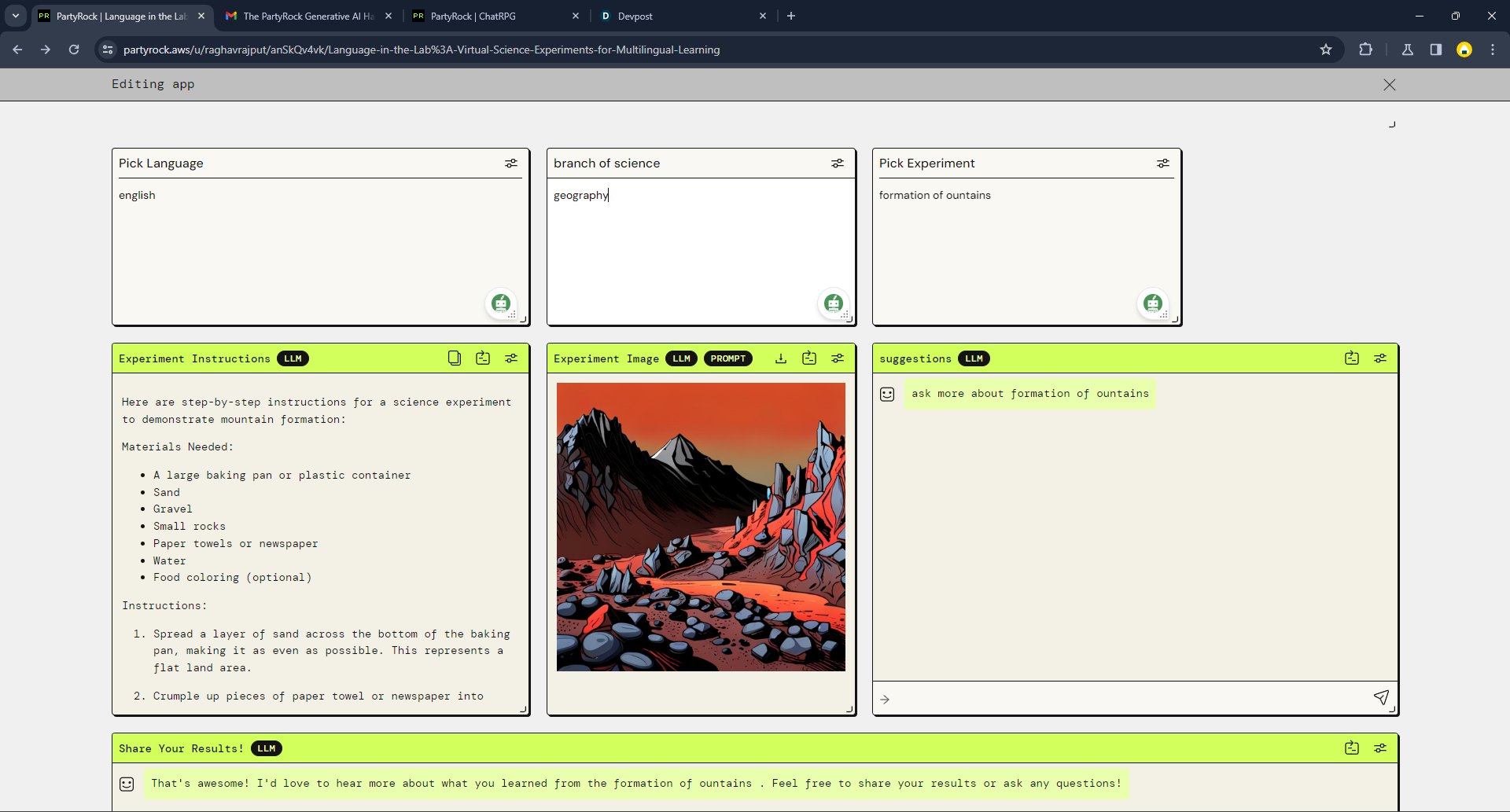
What inspired us to create this project was that, for someone who's not well versed in scientific terms and explanations, it would always be a tough job to understand the know-how of conducting a particular experiment and the process that goes behind it. Science experiments aren't only for those learning that particular field; they're also for those who'd like to figure out the nuances of what goes into conducting an experiment and why it's conducted. Curiosity is human nature and should not be curbed as such. What "Language in the Lab" does is, based on the language the user is comfortable with and the experiment they want to learn about, give out the procedure for the particular experiment, an image regarding the experiment, and a comprehensive quiz on the given experiment procedures. It also gives suggestions on how to improve the experiment and a chatbot that will answer any and all questions regarding the experiment and its background. What we decided to do with this project was figure out how to make this application as user-friendly as possible and ensure that people of all age groups would find it useful and insightful. It was a challenge to figure out the requirements for a virtual science lab, as it is not the most conventional method of learning. But we did end up fulfilling what we think are the most needed components of a lab experiment. We learned through the making of this project that virtual environments need to be able to give the most insights within the constraints of the particular environment. In the case of Partyrock, it proved to be tough when making it an interactive experience, so we stuck to trying to give as much information as possible and ensuring that the user benefits the most from this application.
Built With
- amazon-web-services
- partyrock

Log in or sign up for Devpost to join the conversation.