-
-
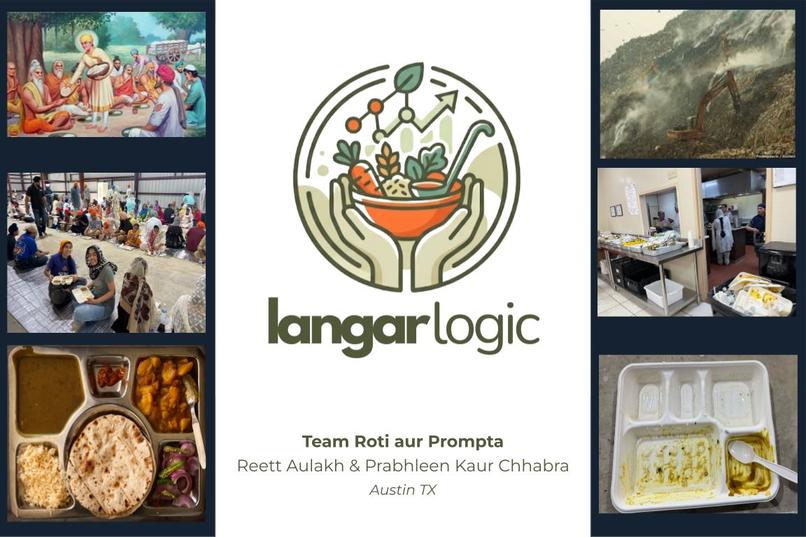
LangarLogic
-
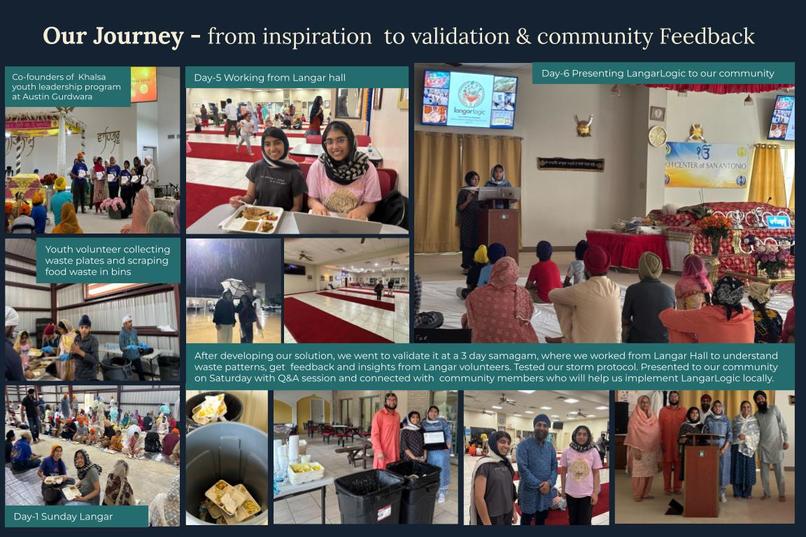
Our Journey
-
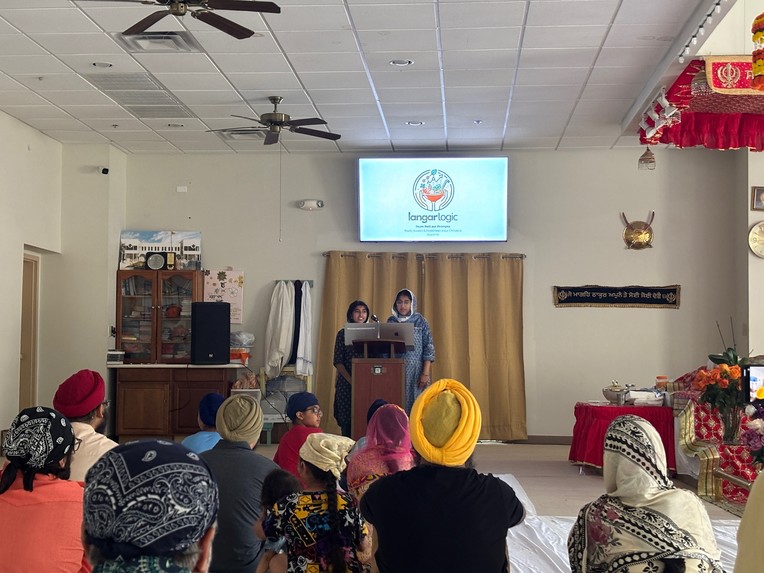
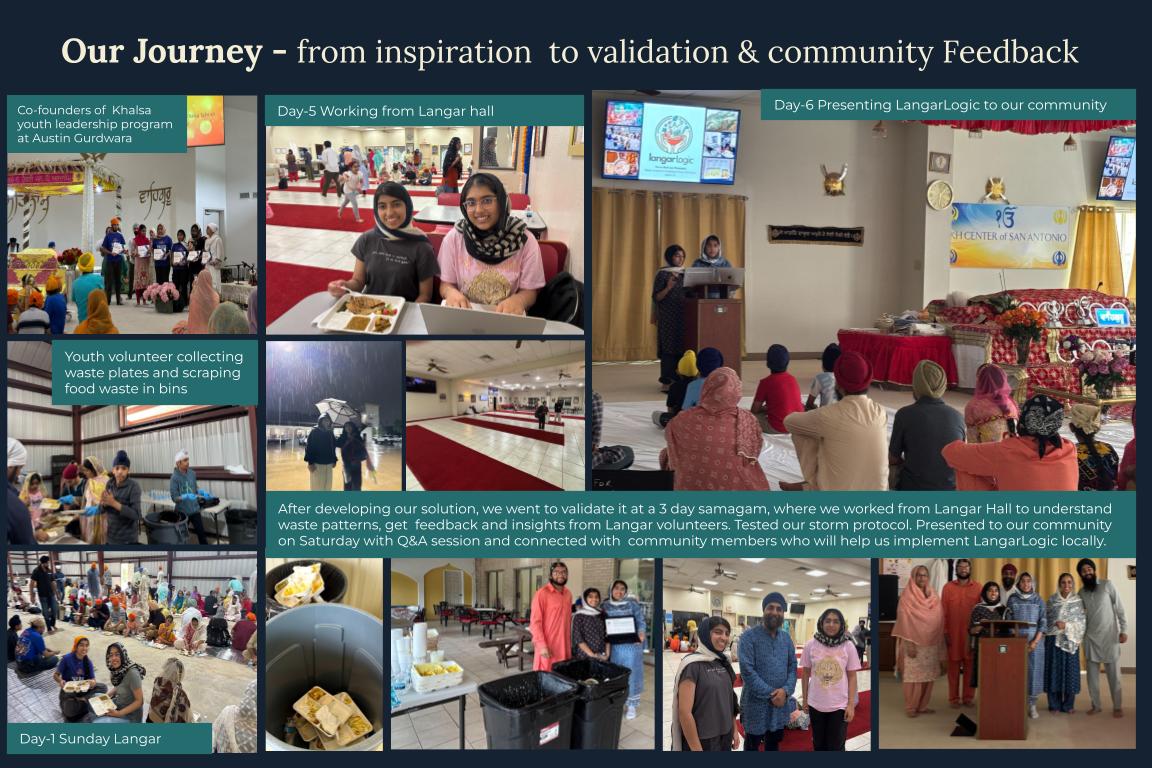
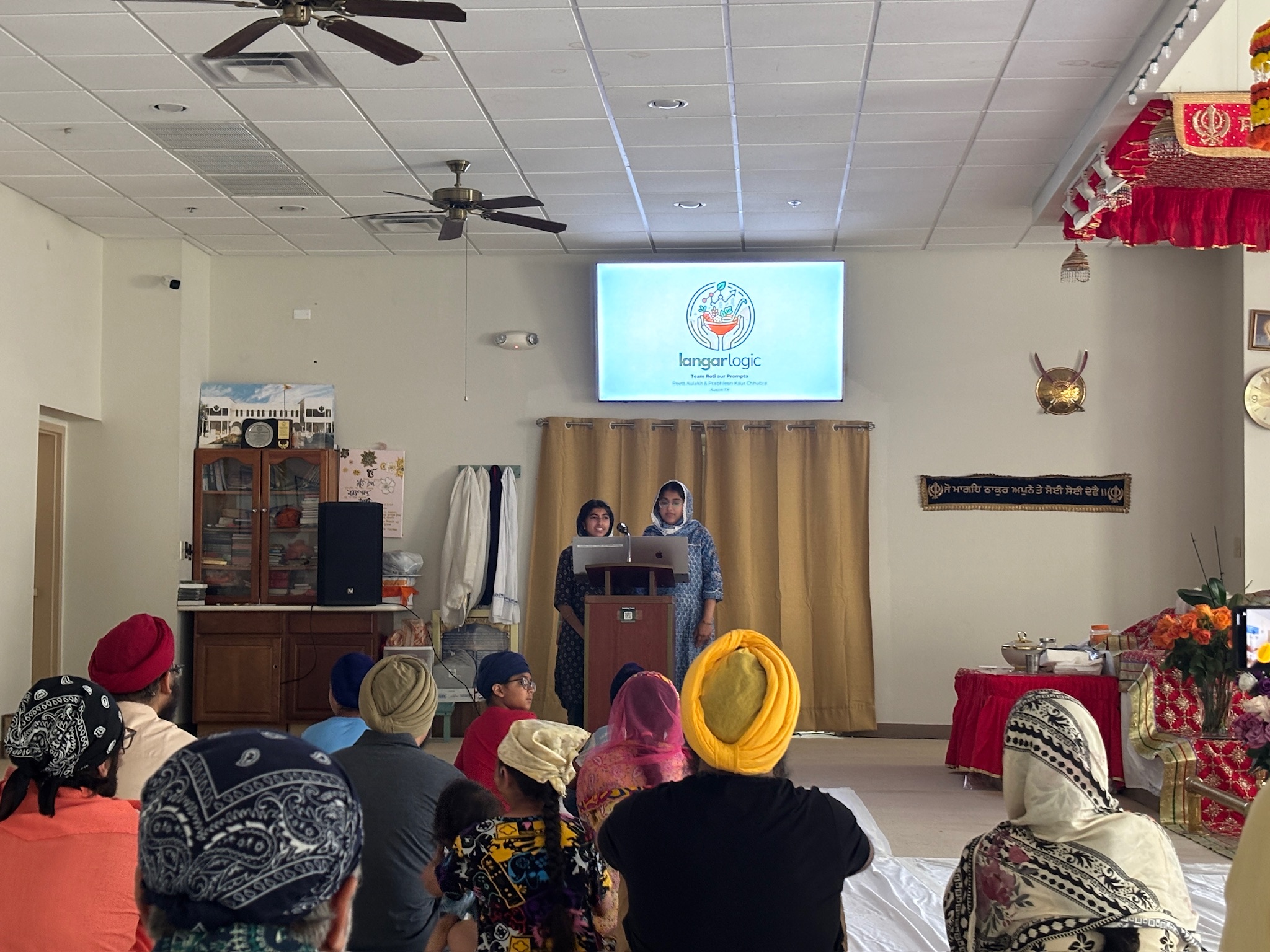
Validation and Feedback (Presenting in Gurdwara)
-
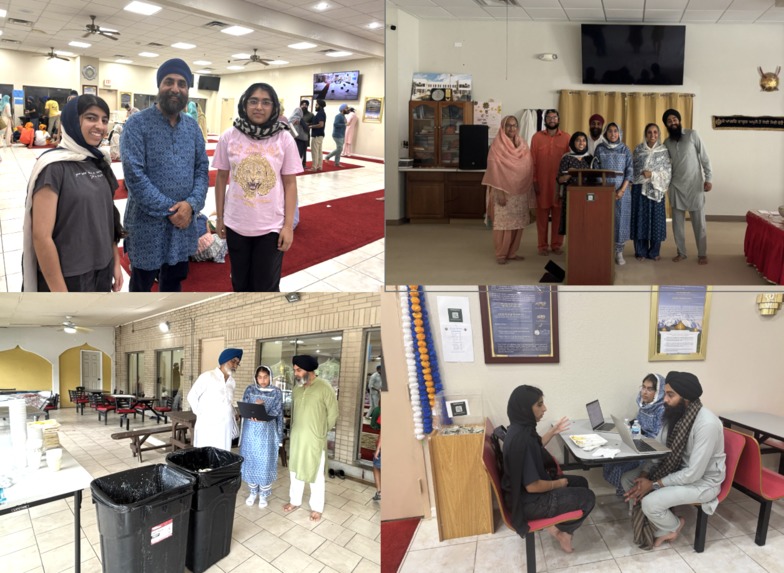
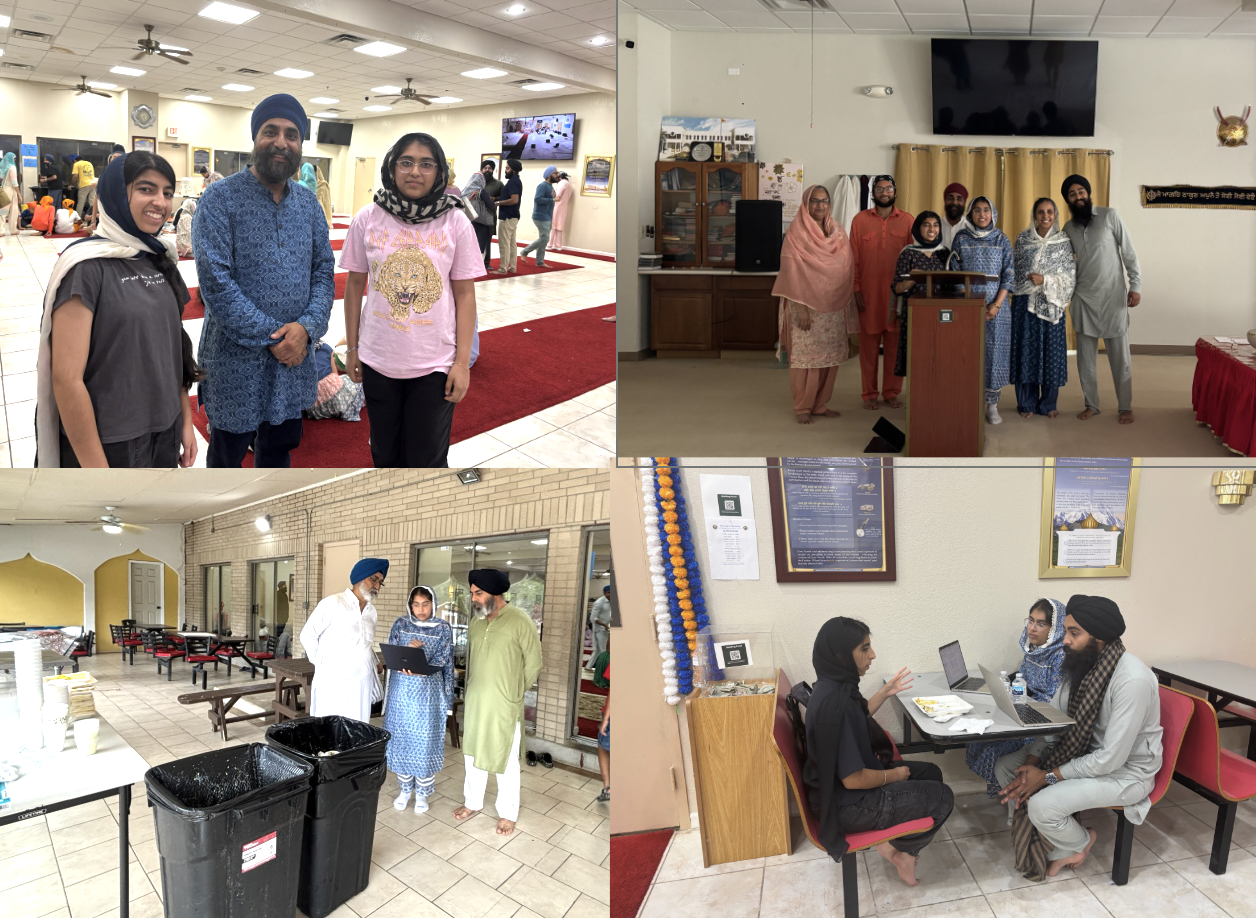
Community feedback sessions with Langar Volunteers
-
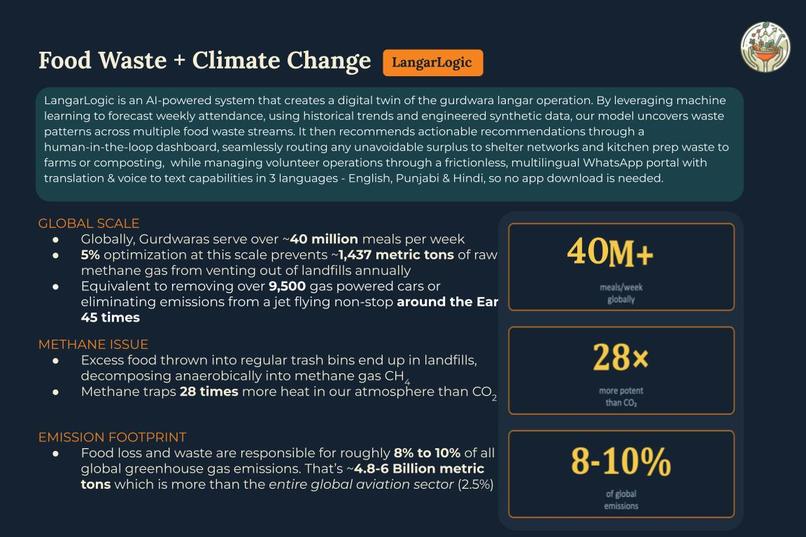
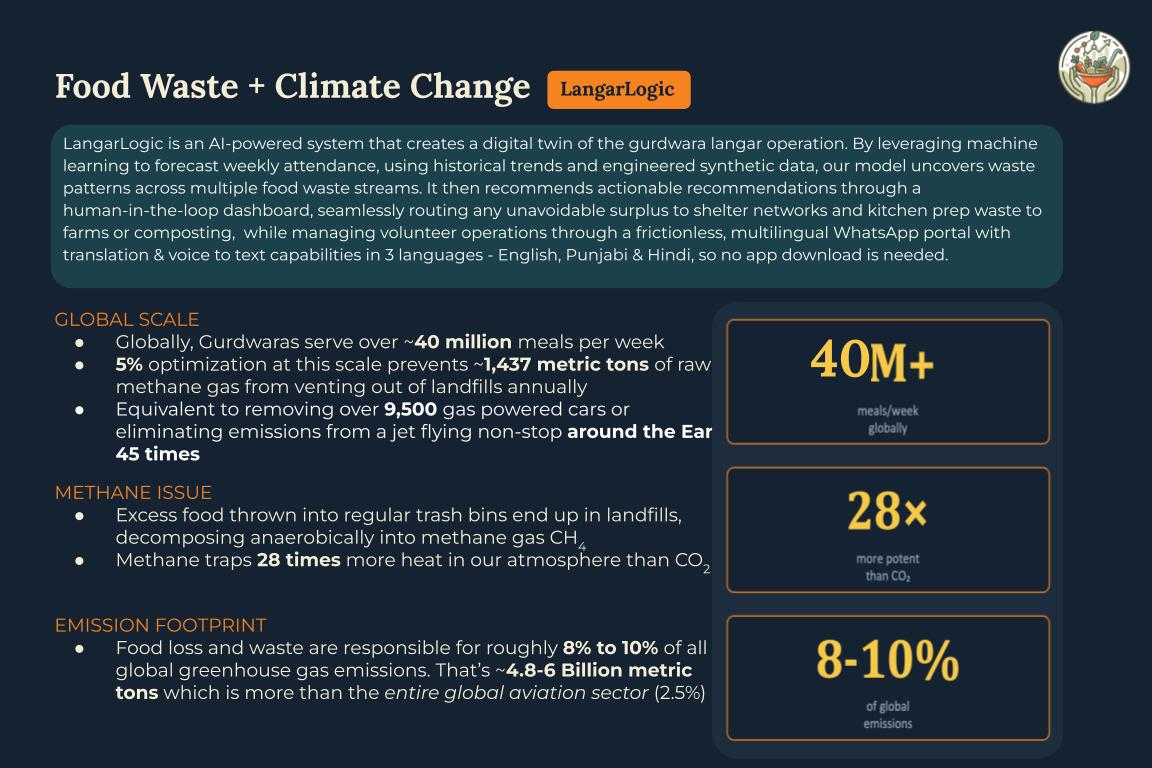
Food Waste + Climate Change
-
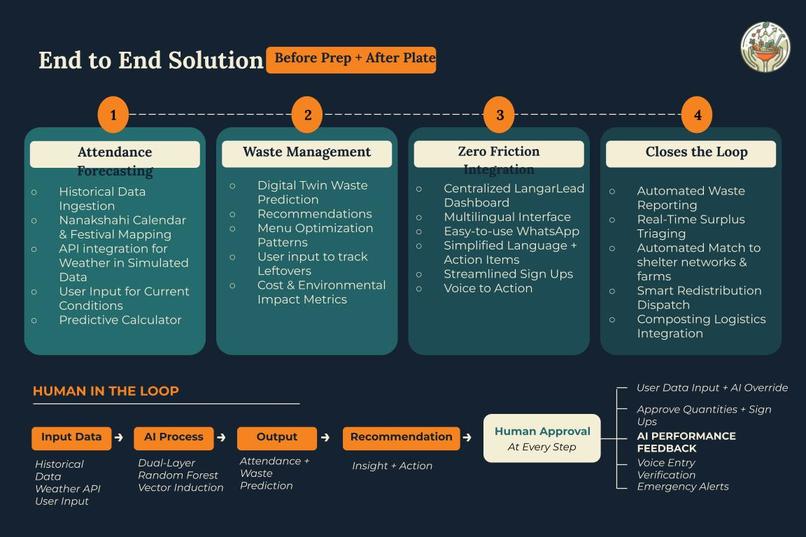
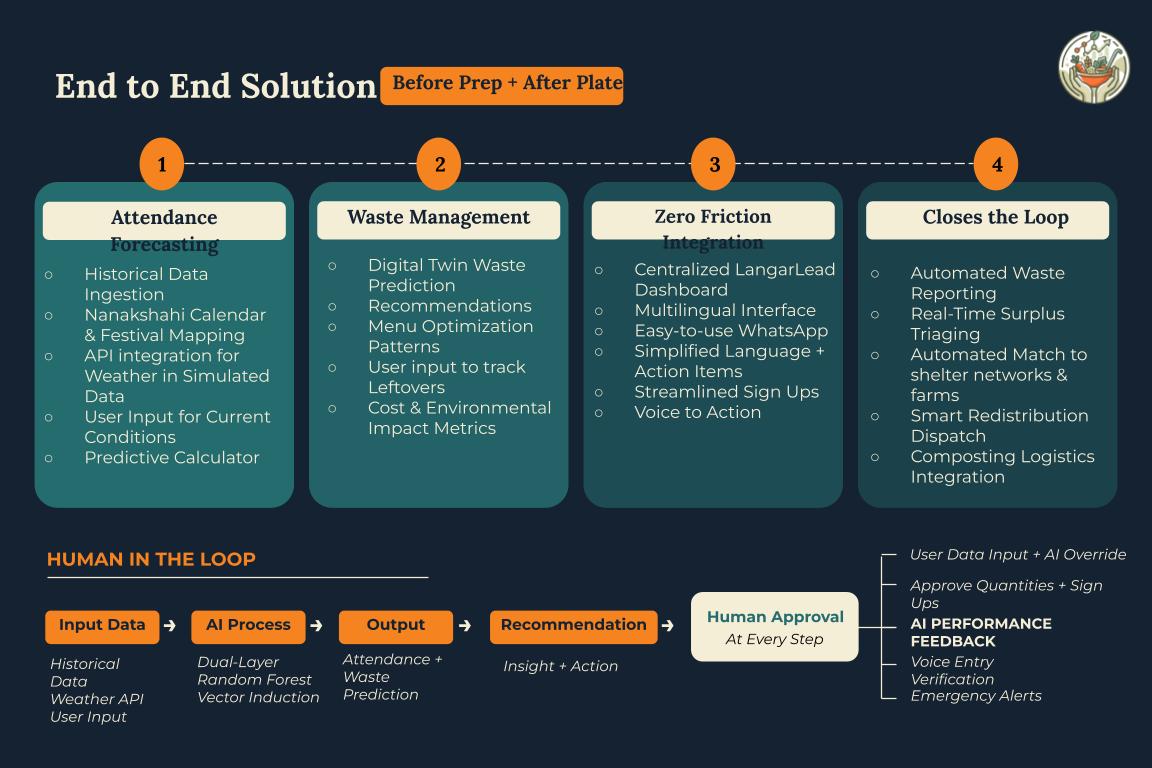
End to End Solution
-
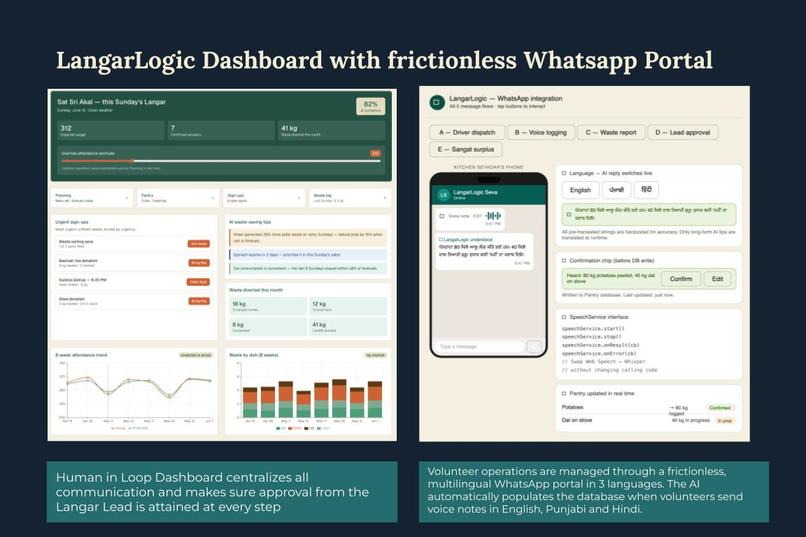
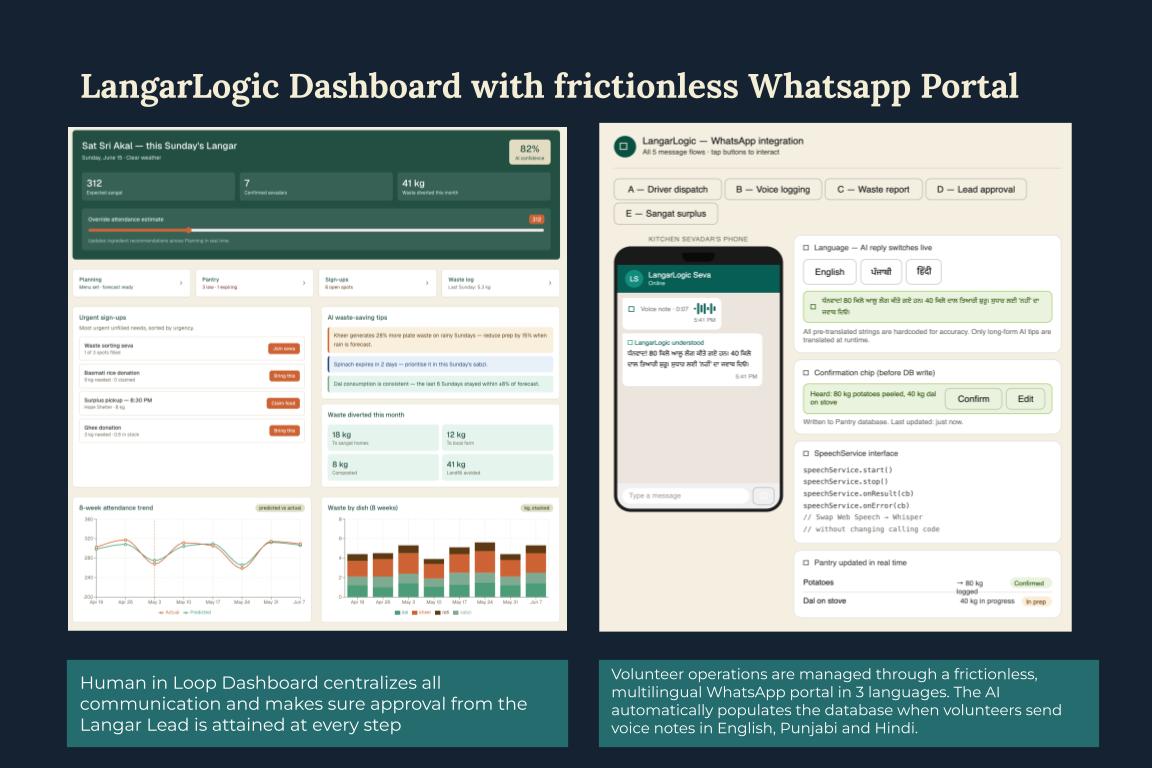
LangarLogic Dashboard with frictionless Whatsapp Portal
-
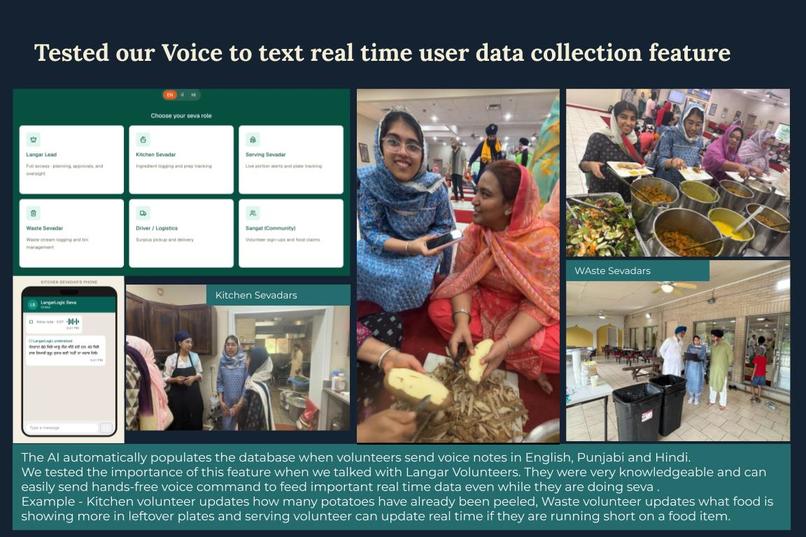
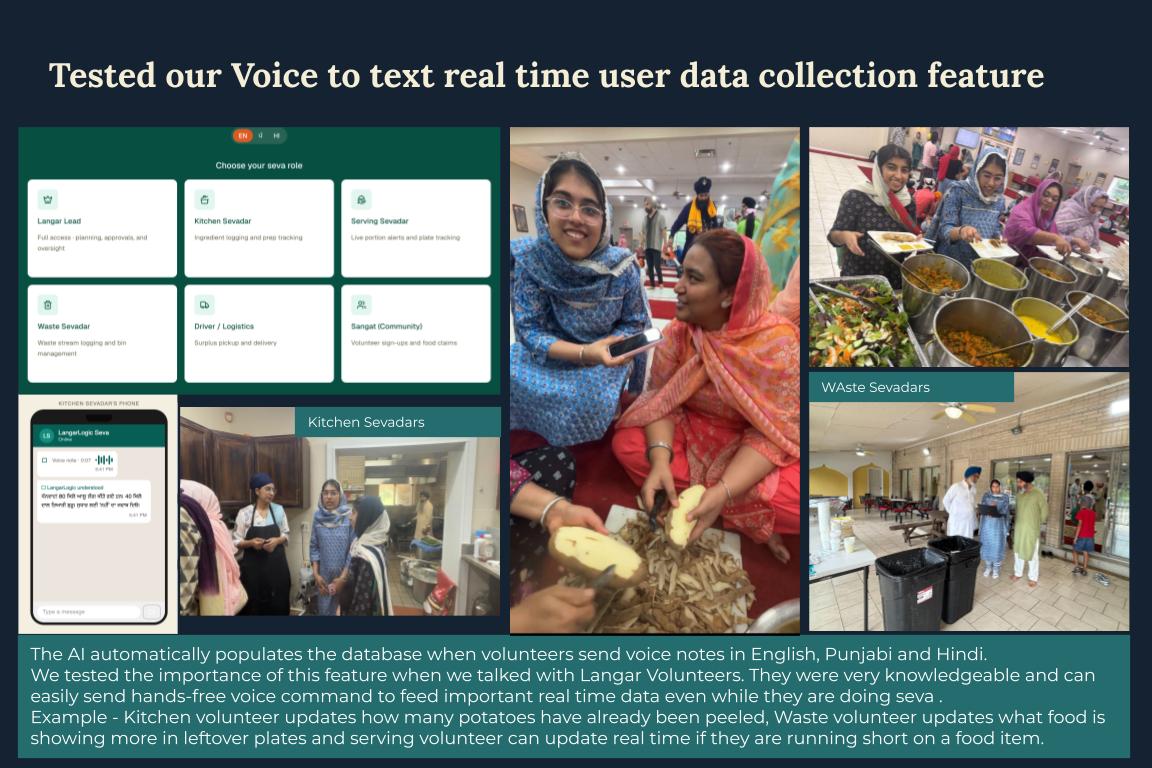
Tested our voice to text real time user data collection feature
-
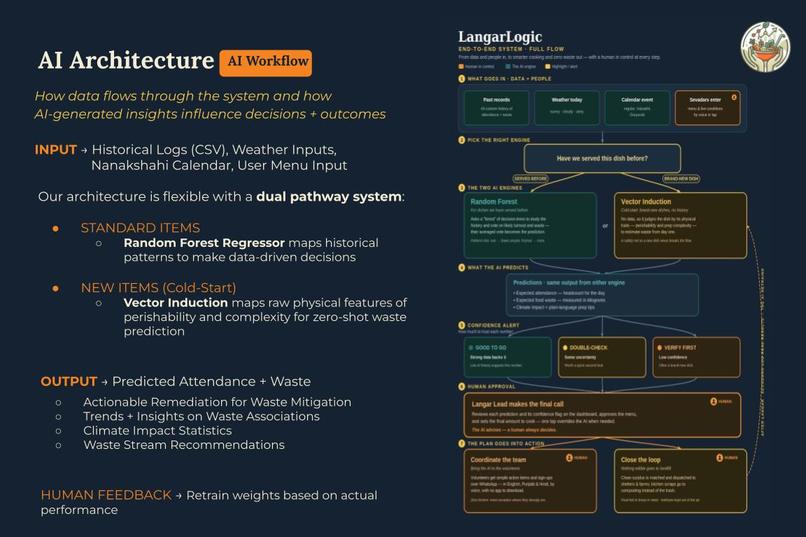
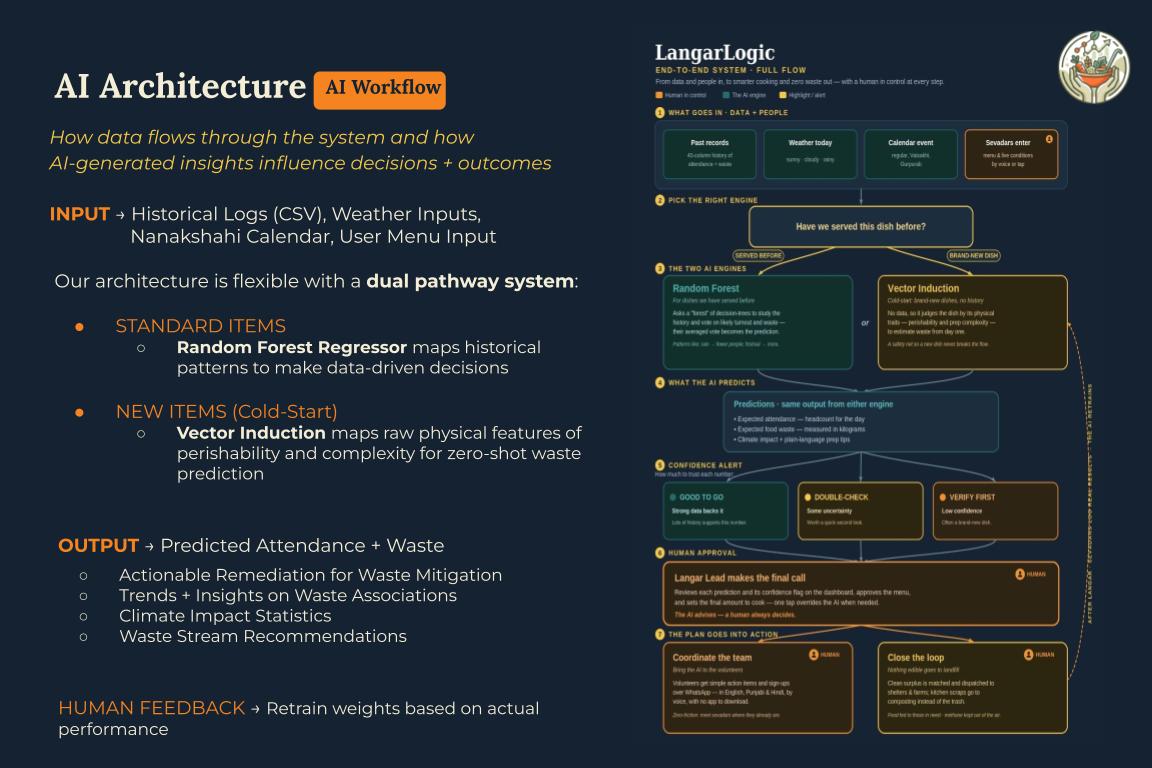
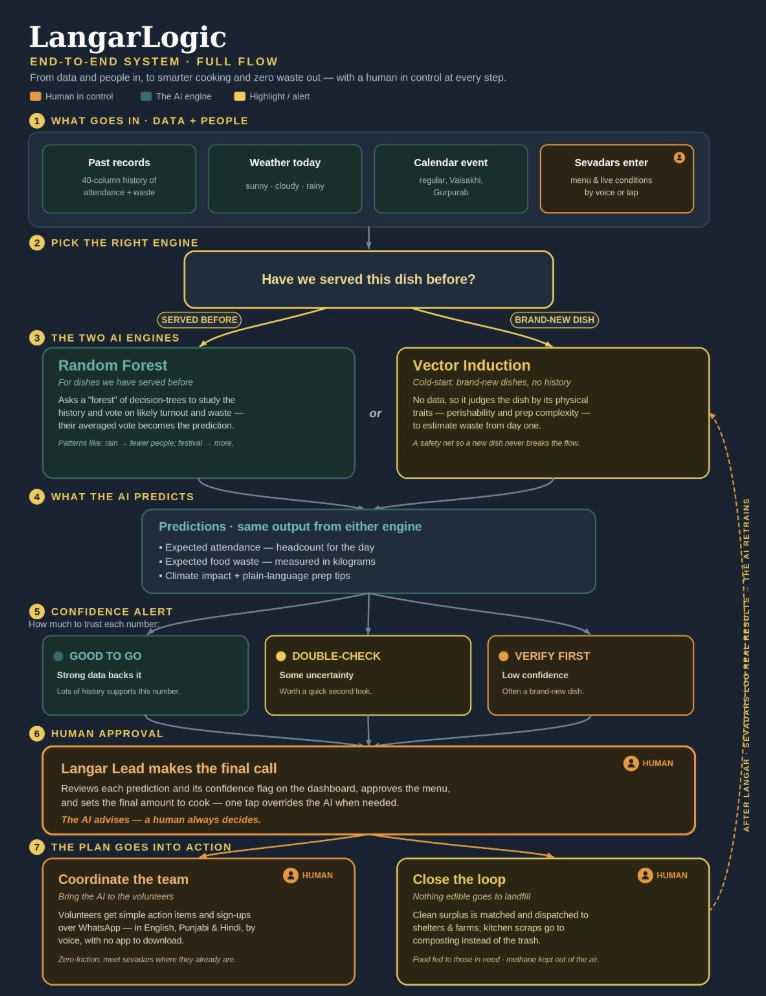
AI Architecture
-
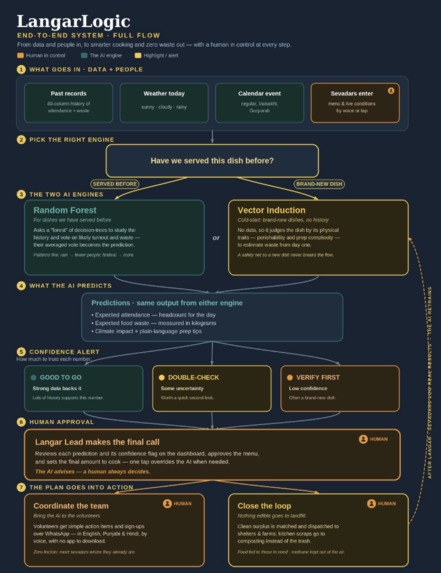
Architecture AI demonstration
-
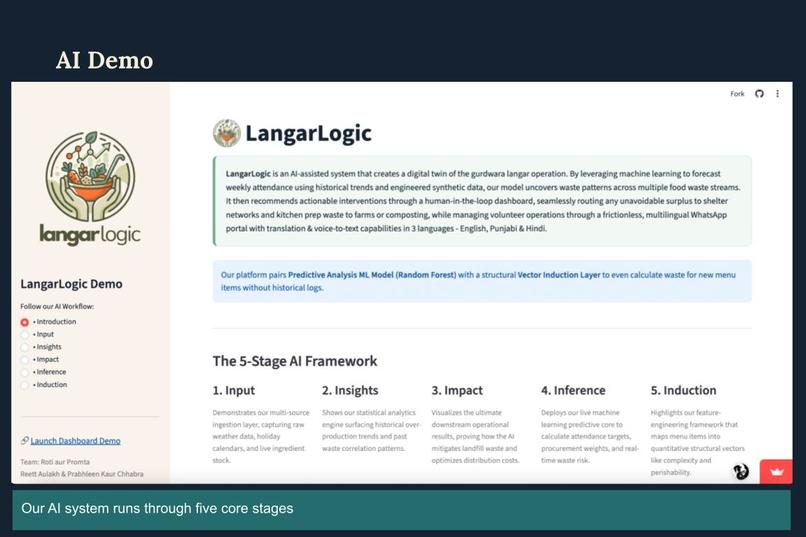
AI Demo
-
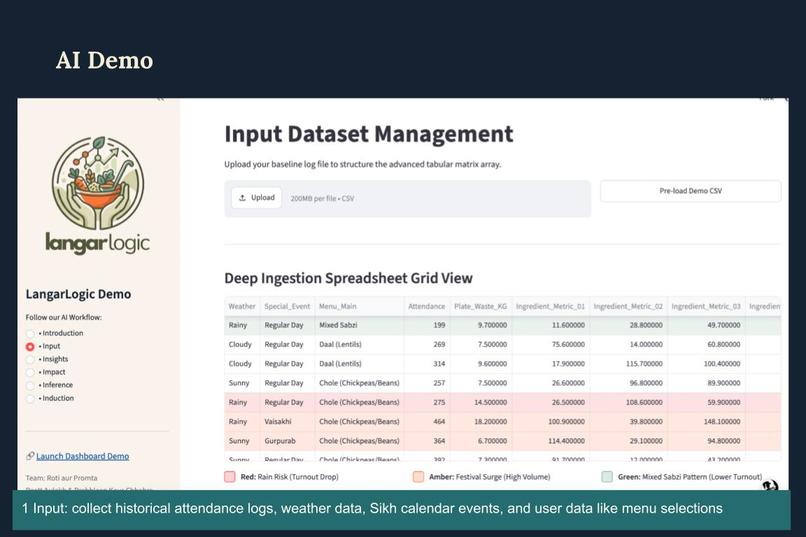
Input
-
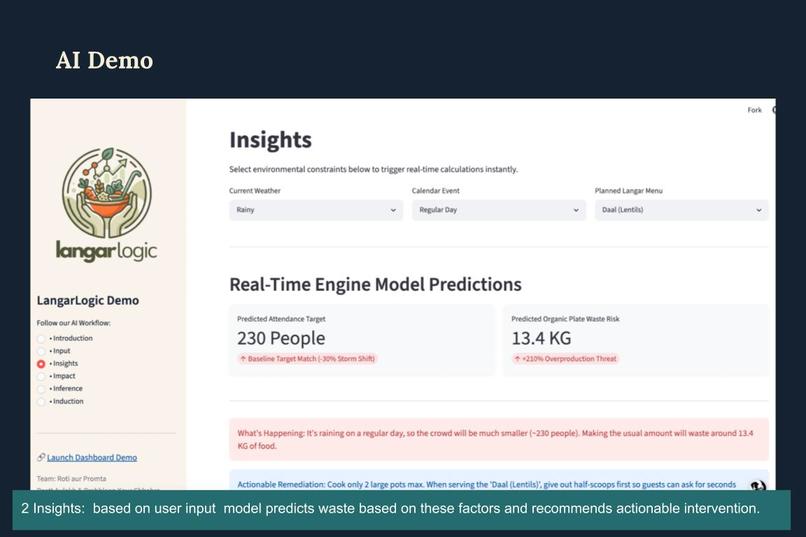
Insights
-
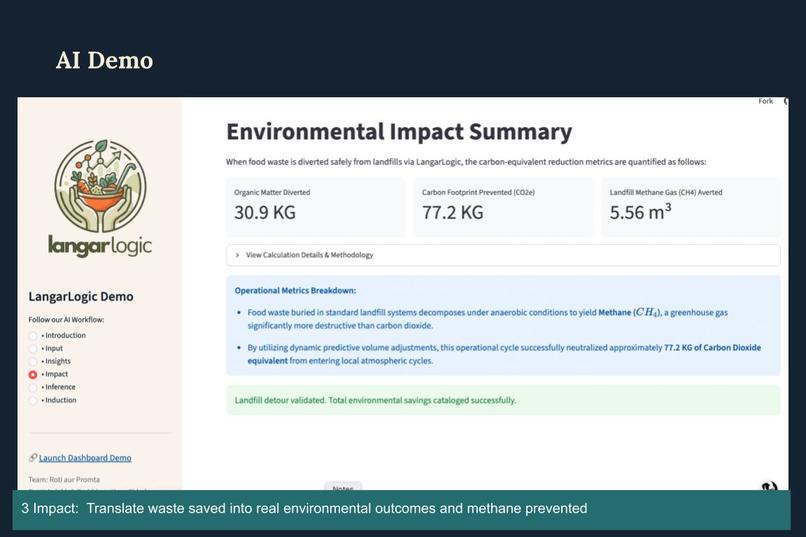
Impact
-
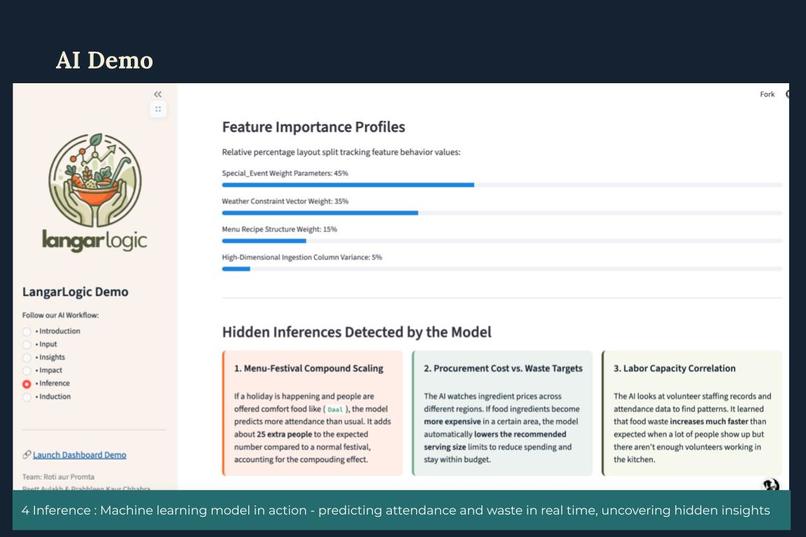
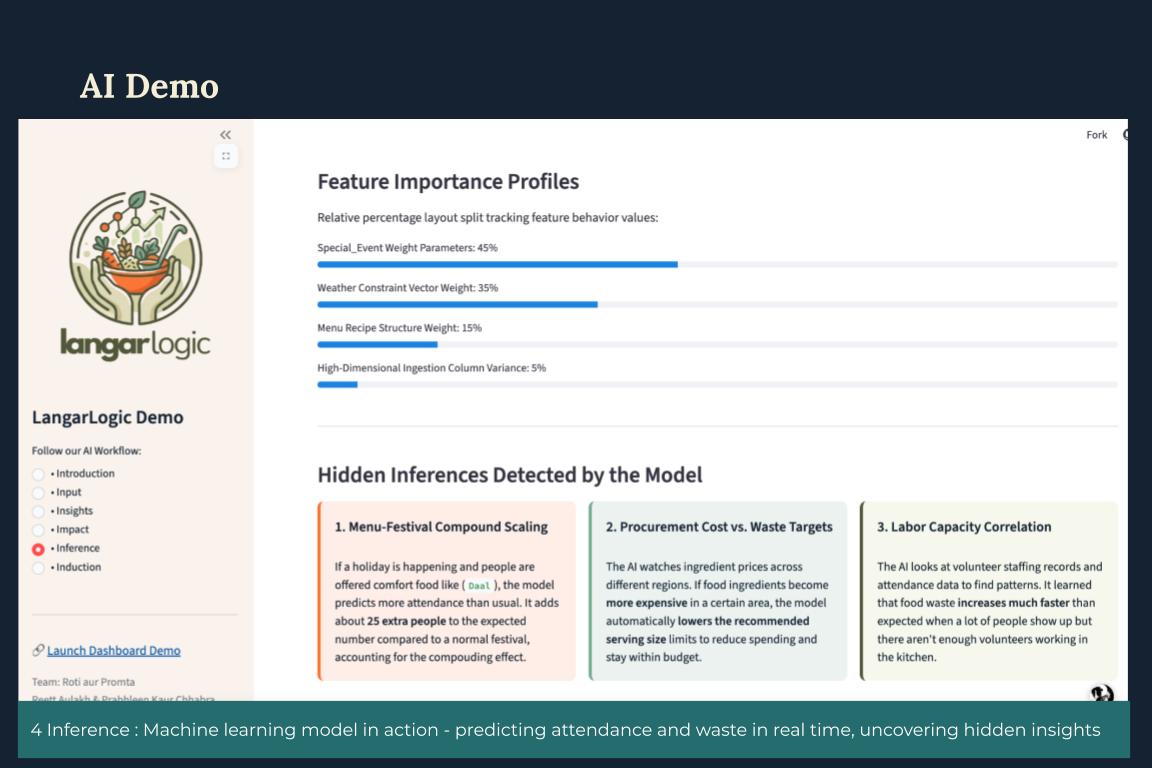
Inference
-
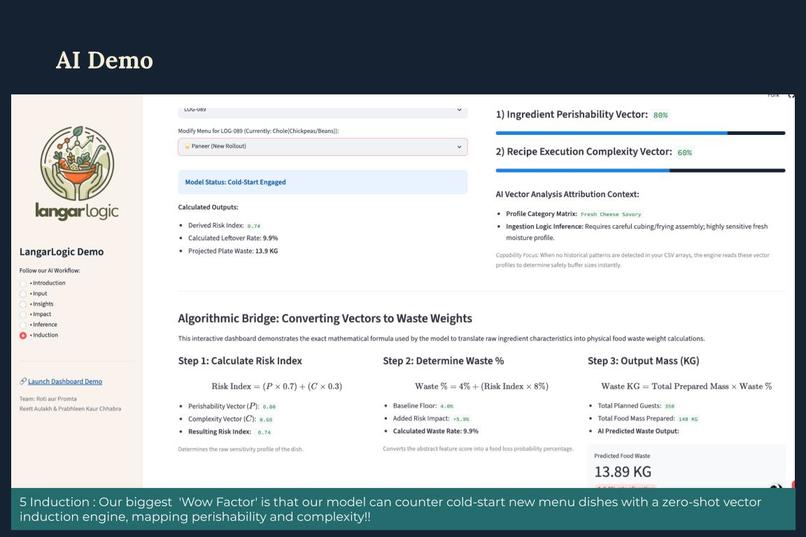
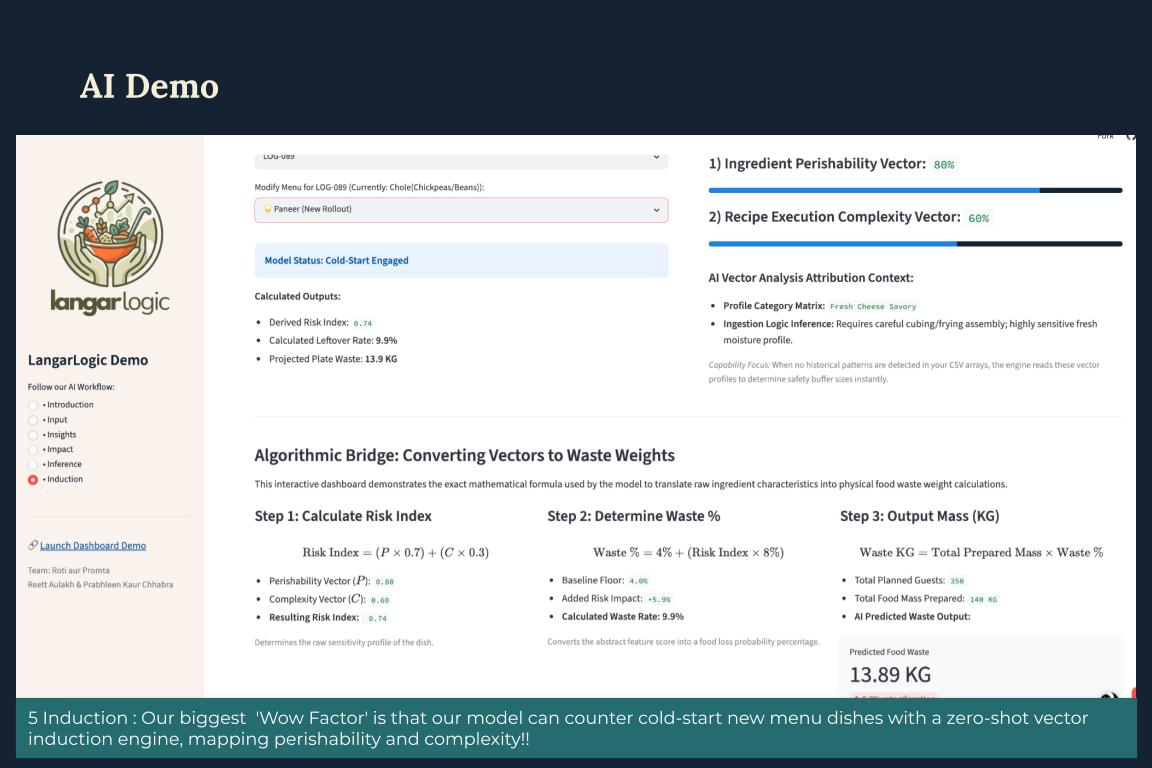
Induction
-
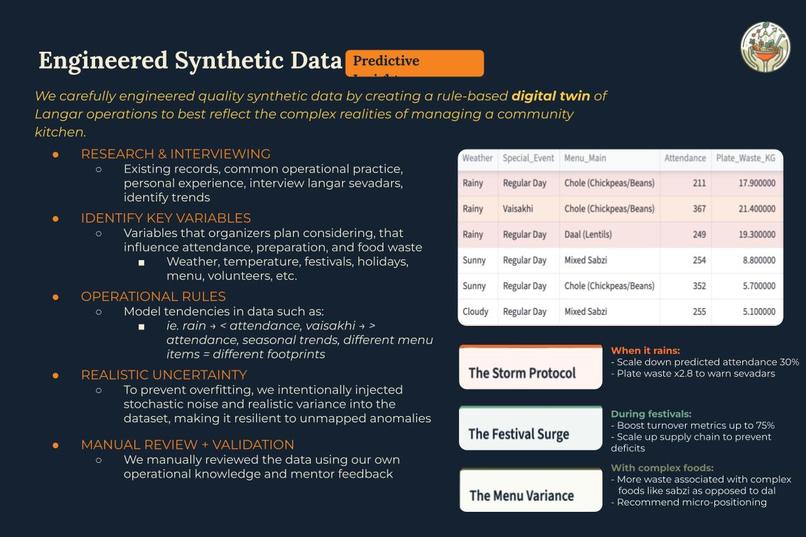
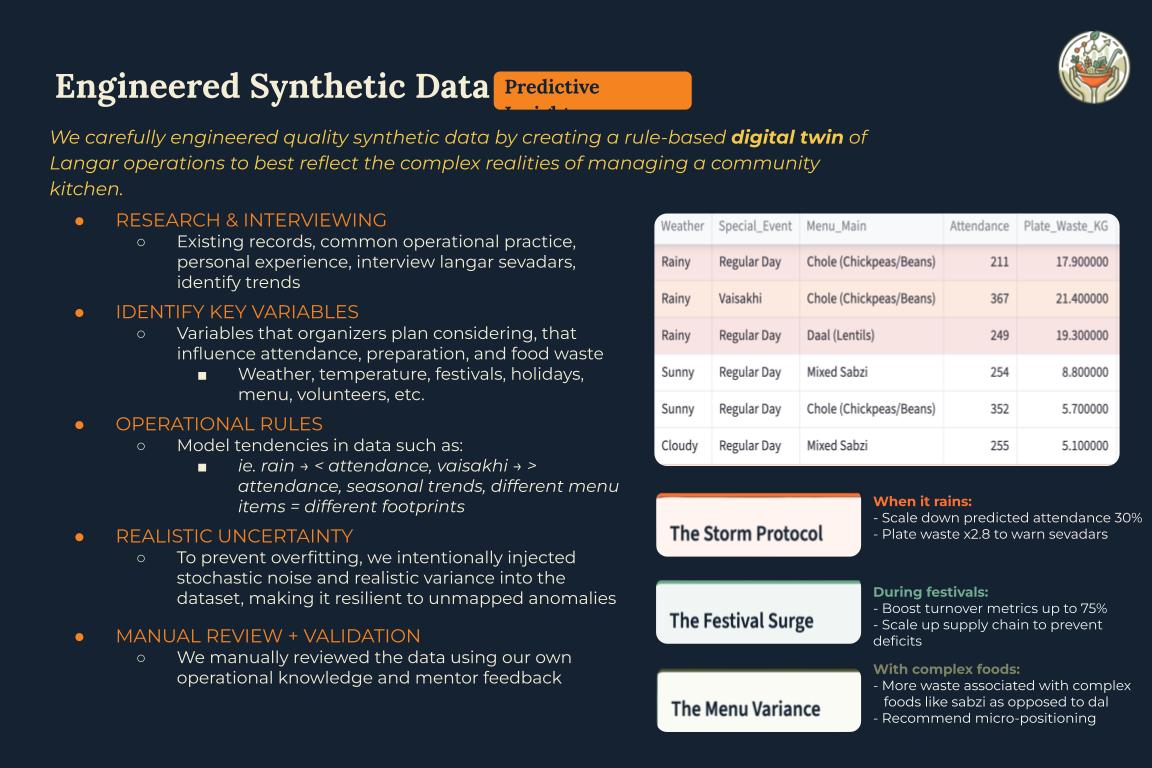
Engineered Synthetic Data
-
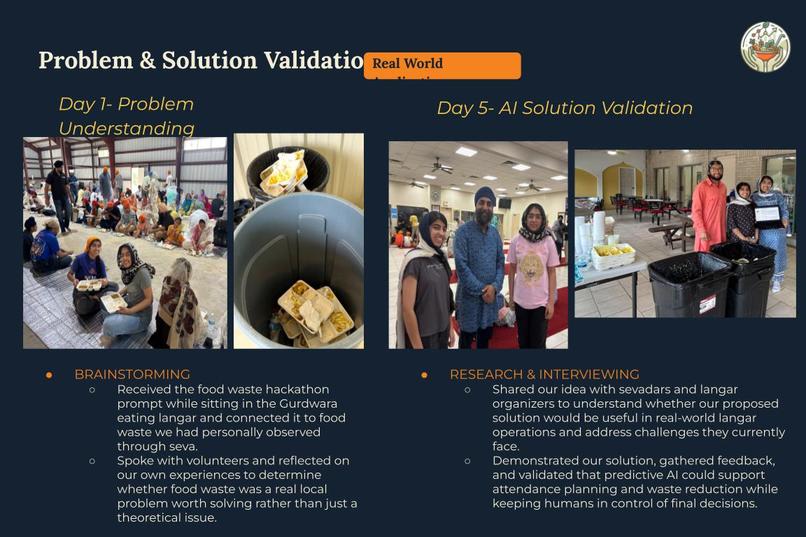
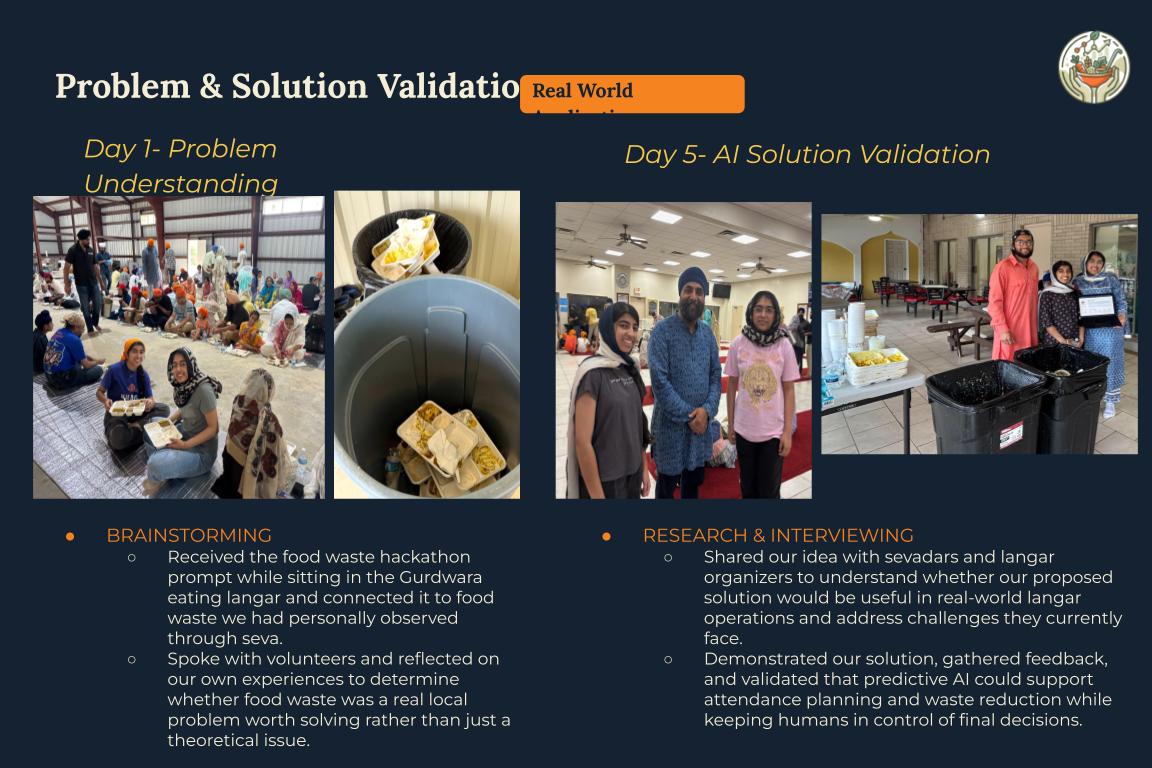
Problem & Solution Validation
-
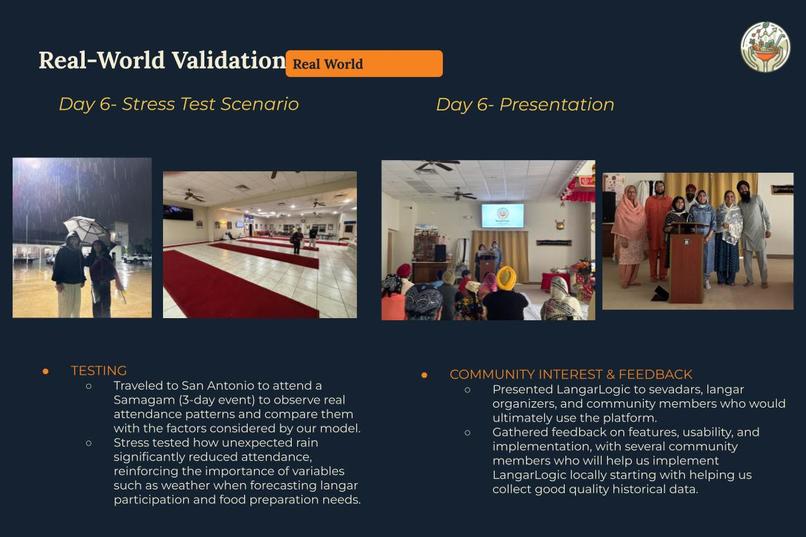
Real-World Validation
-
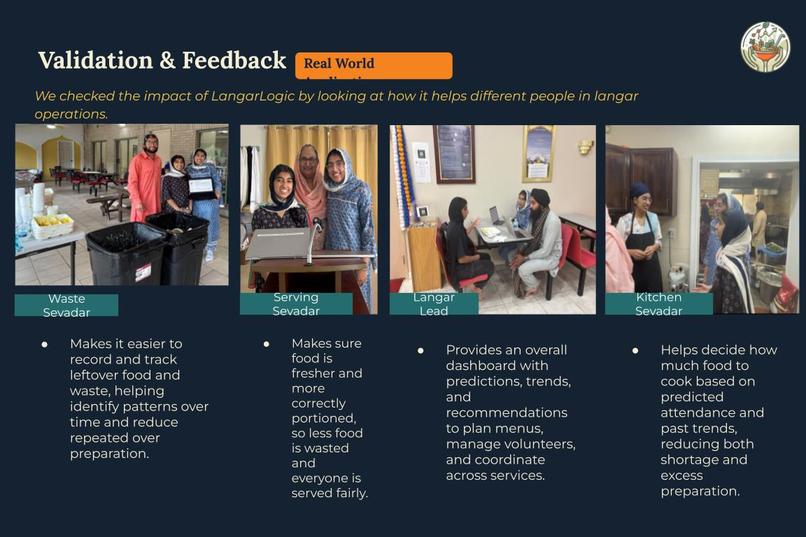
Real-World Validation
-
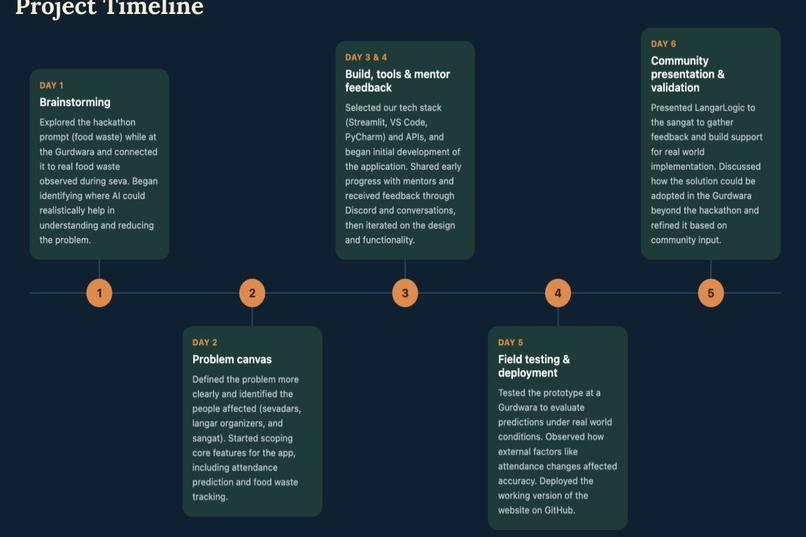
Project Timeline
-
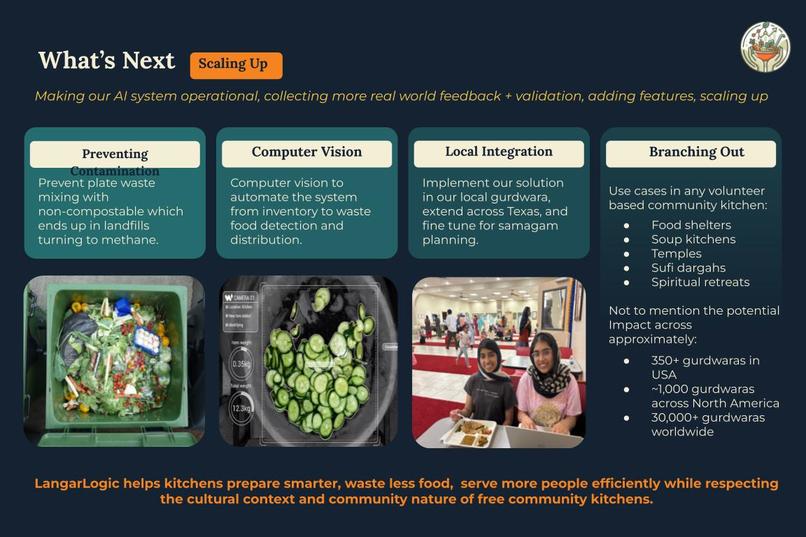
What's next: Making our AI system operational, collecting more real world feedback + validation, adding features, scaling up
Inspiration
Every Sunday, we both go to our local Austin Gurdwara where langar (free community meal) is prepared and served to anyone who comes through the door. As co-founders of the Khalsa Leadership Youth Program, we volunteer there for langar and recycling seva (community service) and witness first hand how much food gets wasted during langar, packed in thrashbags, thrown in big dumpsters and heading straight to landfills. Since 2023, we have been part of the recycling and composting initiative at our annual Austin Samagam (3 day event) since 2023 where every year our coordinated volunteer efforts help to collect and sort waste helps in diverting 500 pounds of organic waste for composting and 400 lbs of plastic waste for recycling. Our youth volunteers have been trying to implement these practices at our Sunday Langar services to help reduce our environmental impact. Interestingly, when we received the hackathon prompt, we both were sitting in the Gurdwara eating langar. That sparked a simple question: how could we use technology to reduce food waste in the place where we volunteer every week? We realized our food waste might be high because our Gurdwara is still relatively new. The langar systems and processes are not yet as established as those in older Gurdwaras with experienced langar organizers who can accurately plan attendance and food preparation. As part of our research we interviewed our multilingual rotating langar sevadars (volunteers) to understand the root problem. They all talked about the unpredictable attendance and the guesswork that goes into langar planning and preparation, so we decided to build our AI solution to tackle this age old problem faced by all langar kitchens since langar was started by Guru Nanak 550 years ago!
What it does
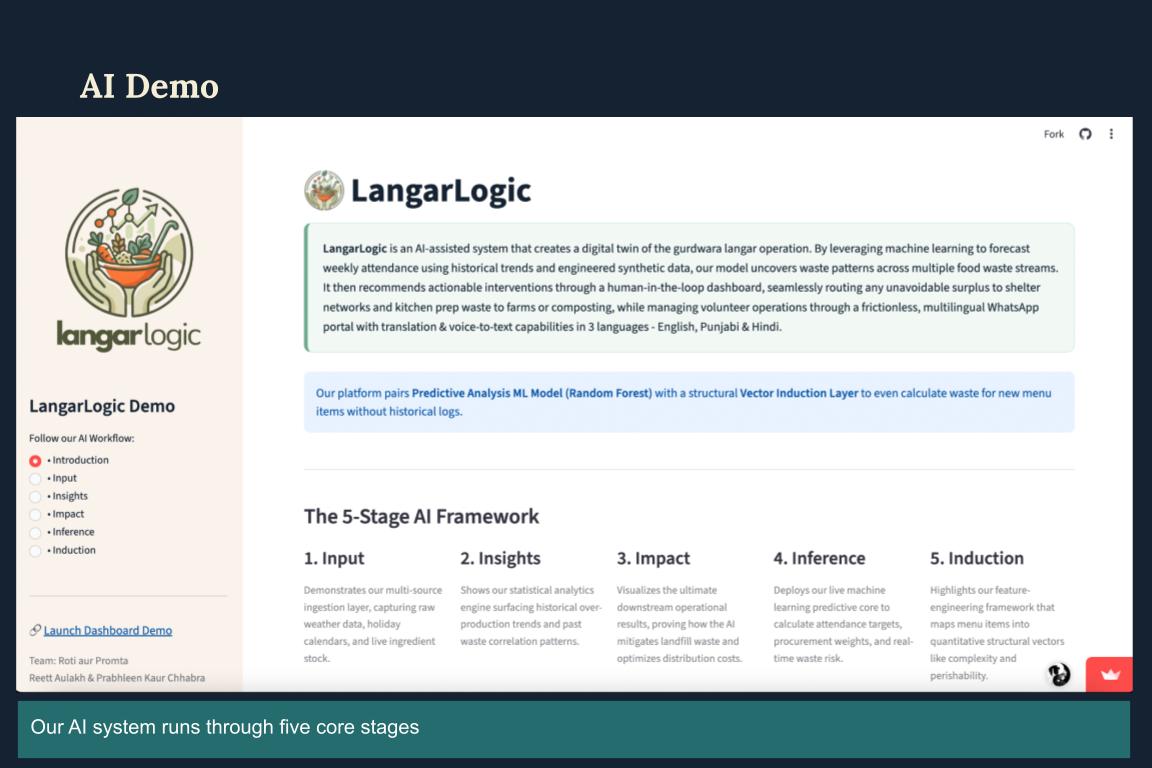
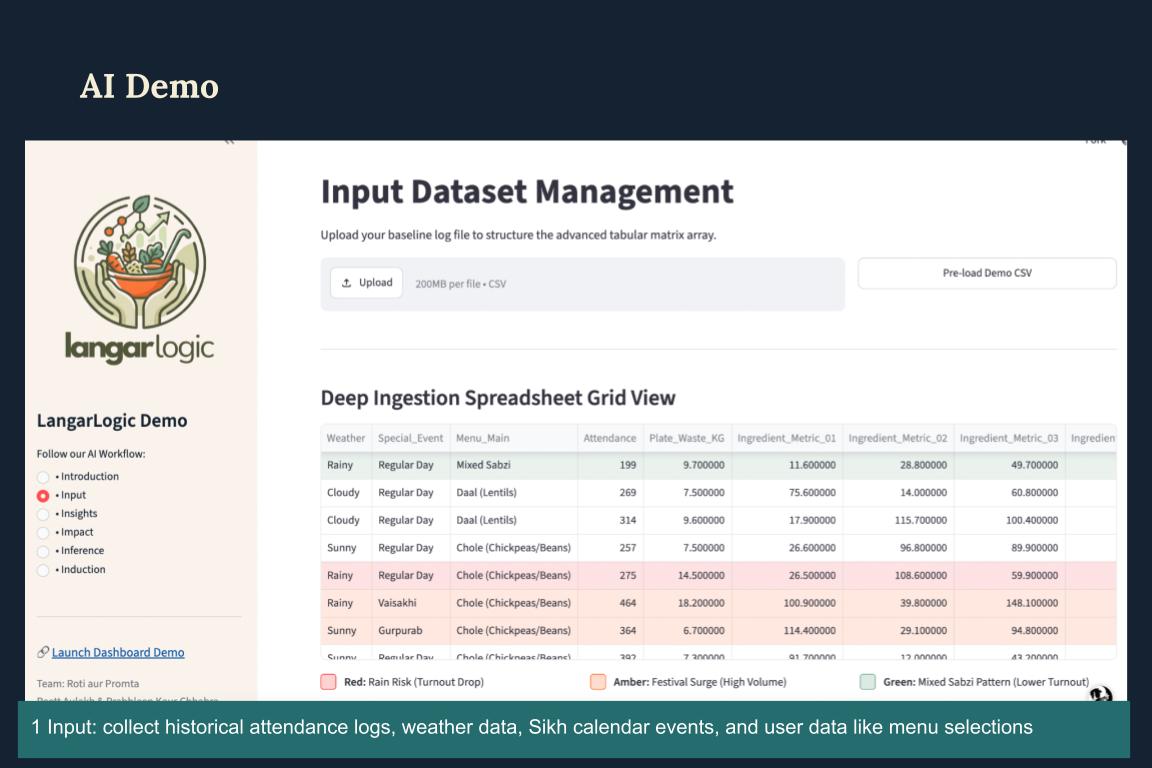
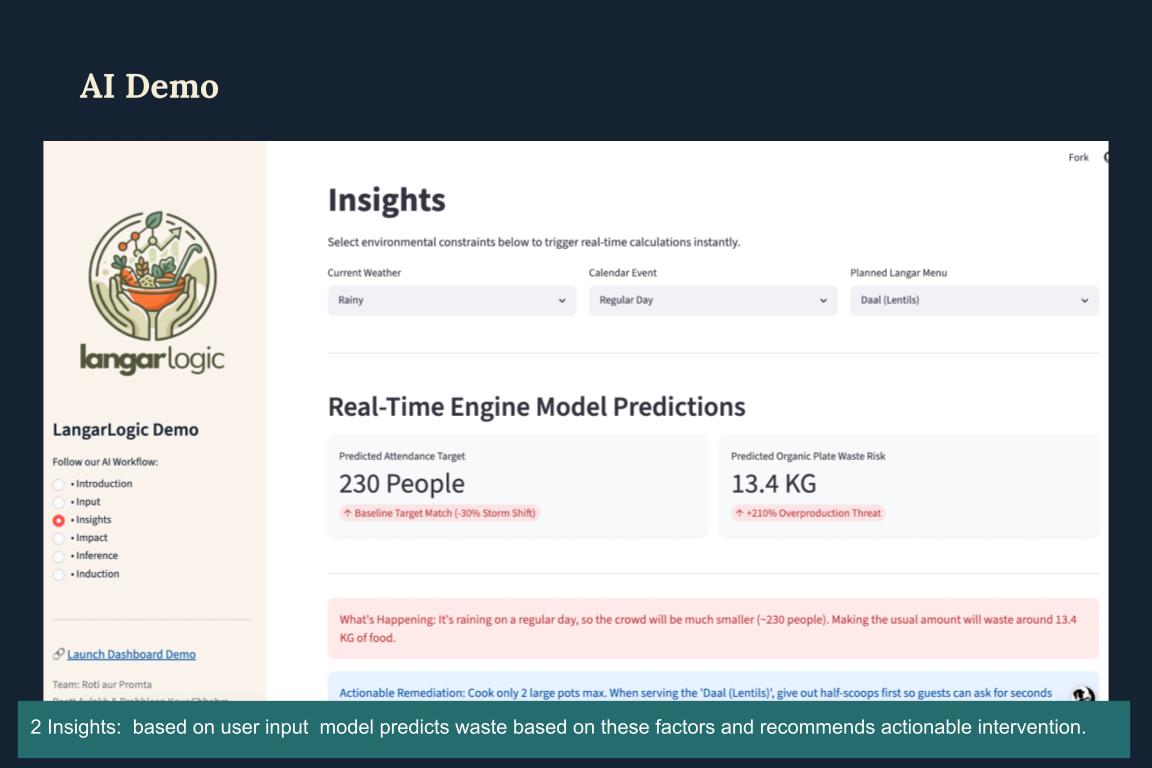
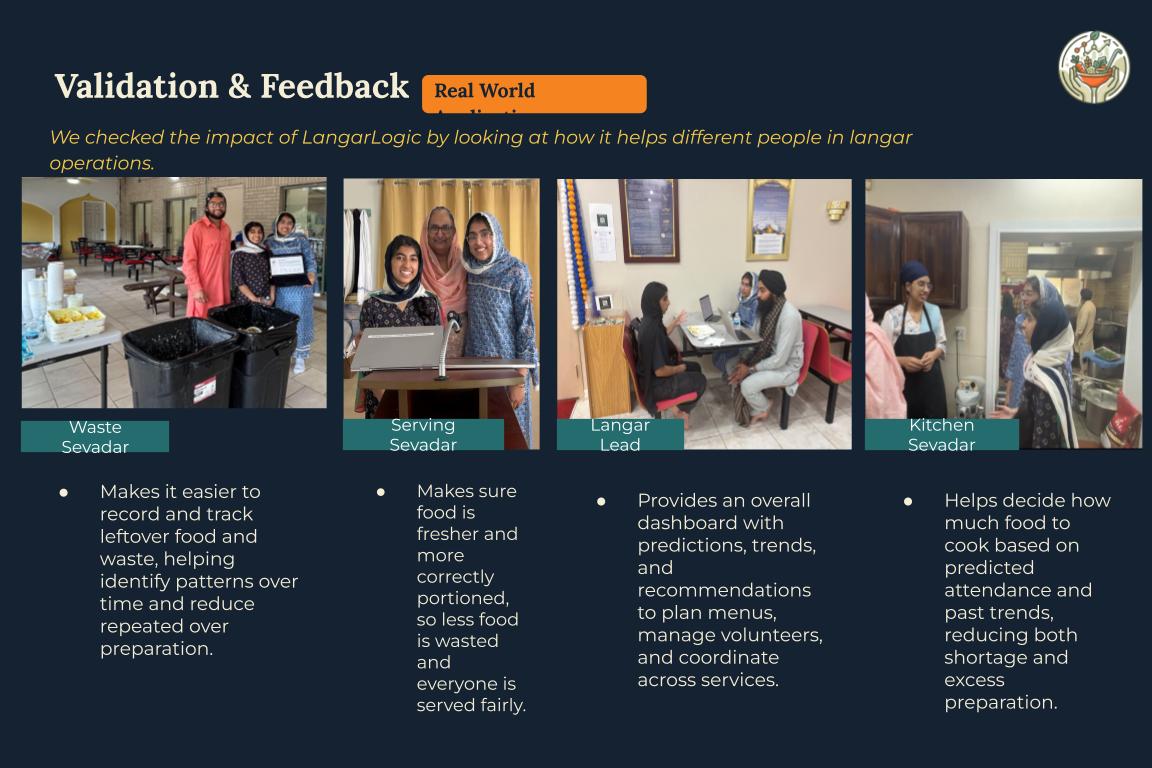
For our AI hackathon challenge Food Waste Rescue Radar, we built LangarLogic - an AI-assisted system that creates a digital twin of the gurdwara langar operation. Using inputs like historical attendance logs, menu choices, weather conditions, festival calendar, holidays, volunteer availability, and user feedback, it predicts the attendance headcount for langar. By leveraging machine learning our model can also predict the food waste generated based on attendance and engineered synthetic data. It also uncovers waste patterns across multiple food waste streams, showing insights like food waste can increase when attendance rises faster than volunteer staffing levels, while excessive staffing may also lead to increased food waste as they prepare more food than necessary. It then converts these insights into actionable recommendations for Langar Leads and volunteers, such as preparing smaller quantities of certain foods when lower attendance is expected due to stormy weather or reducing the serving portion sizes for specific food items.
In addition, our system has a human-in-the-loop dashboard for the langar leads to make sure they have the ability to make all final decisions, overriding any wrong predictions made by AI with one click. We centralize communication by linking our dashboard to a frictionless, multilingual WhatsApp portal with translation & voice to text capabilities in 3 languages - English, Punjabi & Hindi, that requires no app download for volunteers.
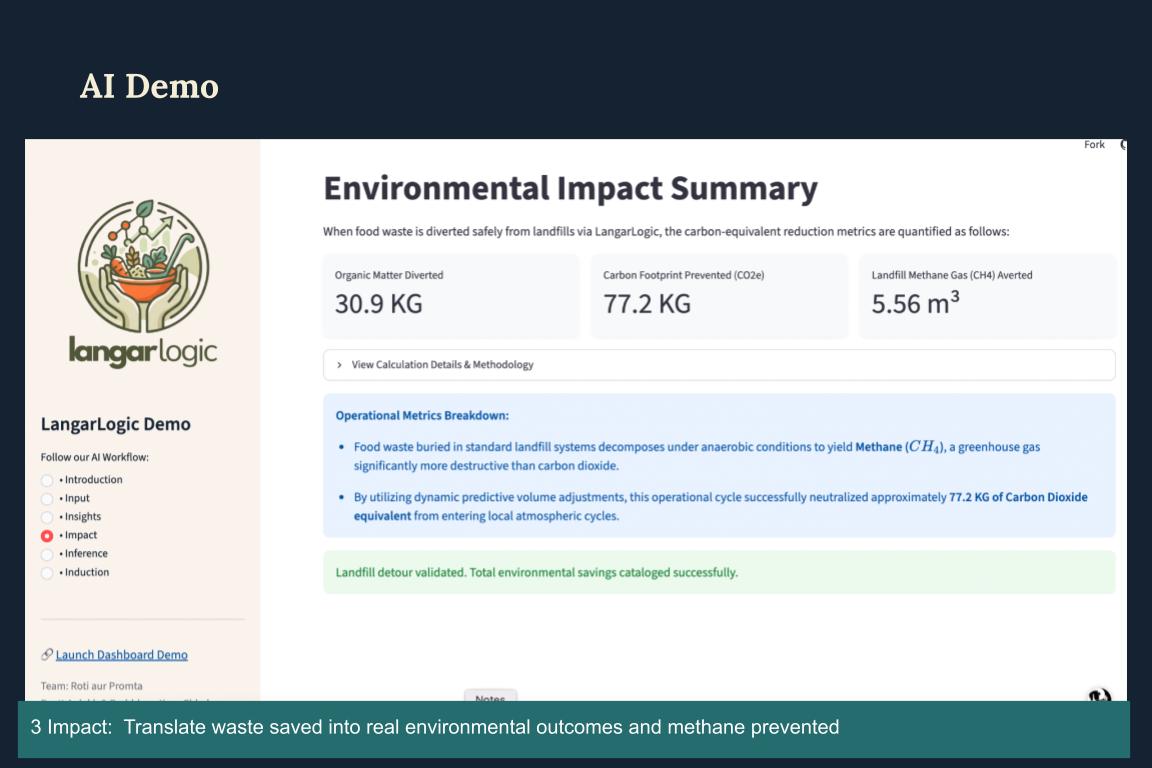
The langar lead opens LangarLogic platform to see a comprehensive dashboard with AI’s forecast for the coming Sunday. (first page, slide slider). They can then adjust the attendance and menu, confirming the prediction and prep measurements. (pantry page). The app generates an ingredient shopping list, accounting for community donation sign-ups while flagging items for expiration. (sign up page) Finally- we close the loop for our end-to-end solution with food waste tracking and logs for future insight (waste page). At the end of the day waste food is sorted in three streams - Green bin for kitchen prep waste like vegetable peels that can go for composting or nearby farms. Blue bin for food that is left on the plates after langar is finished and scrapped off the plates in bins. Tracking in this waste shows what food items were left over more and give better insights for future prediction. The third will be a clean surplus bin for leftover food redirected to sangat (community) pickup or sevadar (volunteer driver) delivery to food redistribution centers, shelters and other non profits in our network.
All the information recorded in the dashboard is automatically added to our historical dataset and makes our model’s prediction better and better every Sunday.
How we built it
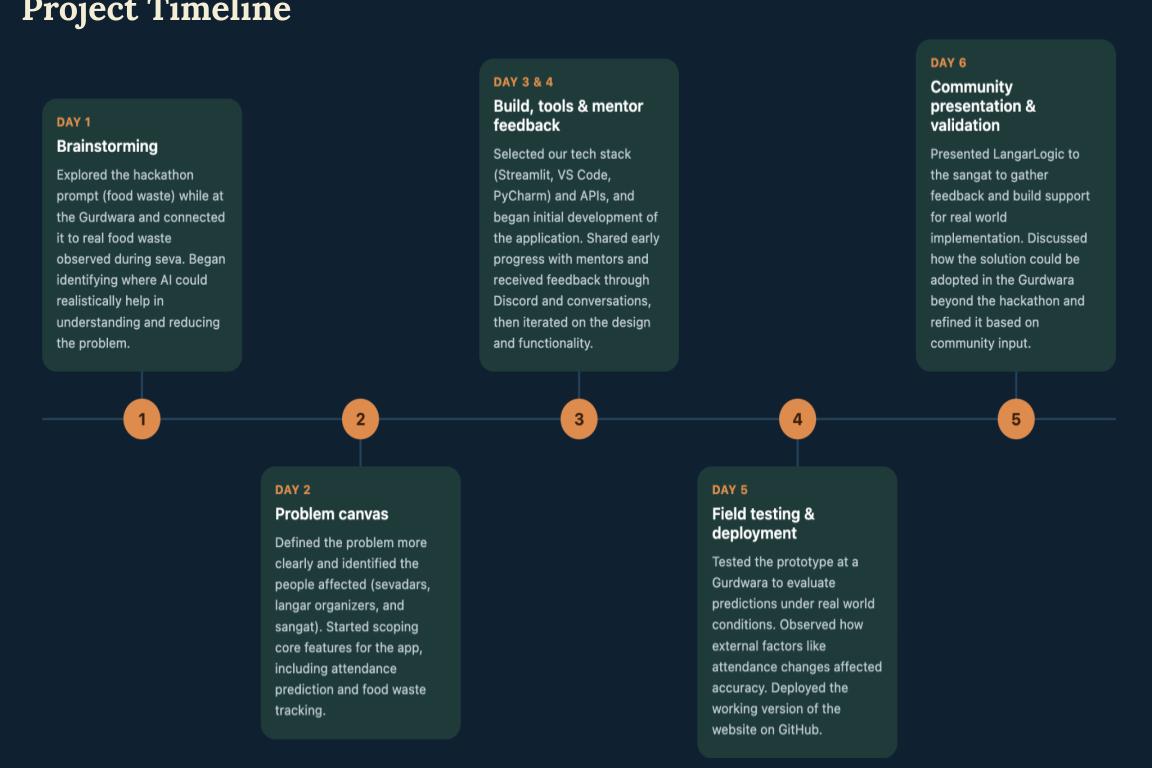
We started brainstorming our project while sitting in the Gurdwara, eating langar, looking at the unavoidable leftovers in our plates and watching the entire langar operation in action to figure out the patterns that lead to food waste. We took photos and after speaking directly with langar volunteers to understand the causes of food waste and the factors influencing it , we decided to focus on the core problem - unpredictable attendance and the guesswork that goes into langar planning and preparation.
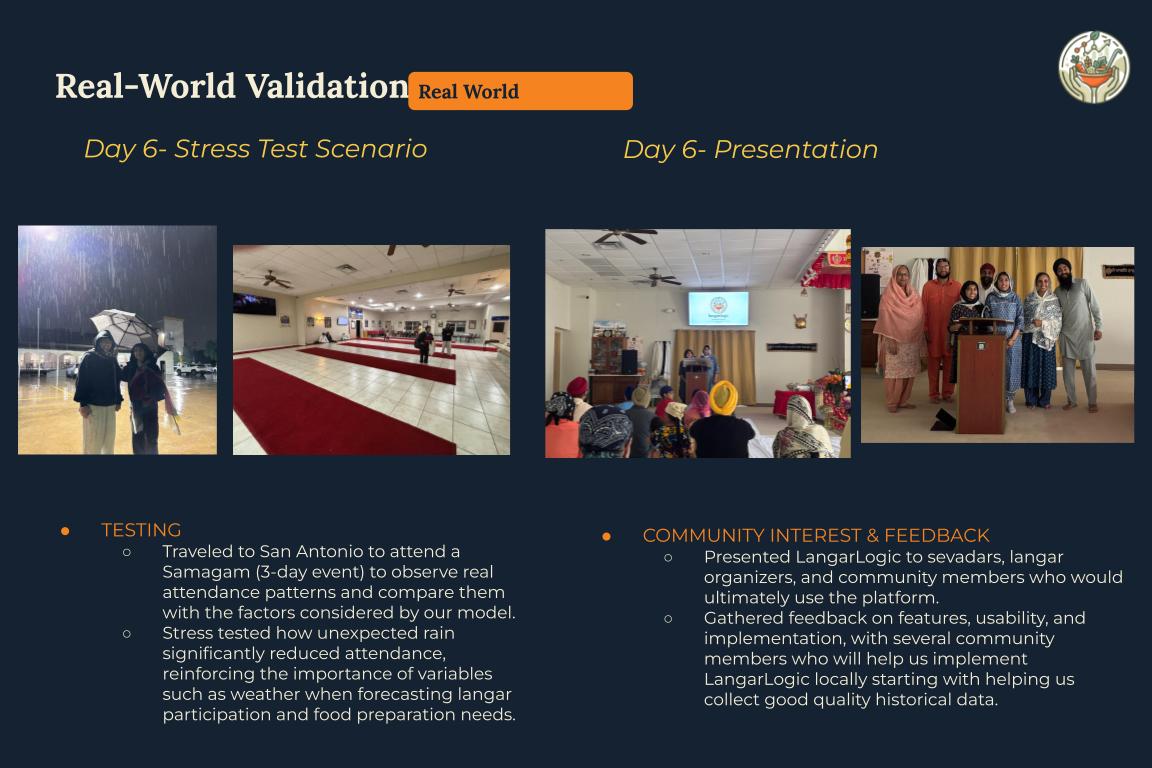
We soon realized that solving this problem with AI and technology had far more dimensions than we could address in one week. We narrowed our focus to examining how food could be prepared more accurately and how unavoidable leftovers could be managed responsibly. We created a problem canvas to refine our scope and identify the platform's key features, designed the front end using v0.dev, and developed the AI architecture and demonstrations in Streamlit. Using VS Code, PyCharm, and assistance from Gemini, Claude, and ChatGPT, we curated synthetic datasets based on observed and researched trends involving weather, Sangat attendance, volunteer capacity, menu preferences, and food waste patterns. We also intentionally introduced uncertainty and variability into the data to better simulate real-world conditions. We then developed Random Forest Regressor models that predicted attendance and waste, compared predictions against static estimates, and incorporated human feedback whenever predictions appeared significantly off. We coded a Streamlit Wizard demo to guide users through the workflow, allowing them to test predictions and explore insights interactively. At the end of the week, we travelled to San Antonio for Samagam (3 day weekend event) so we could test our idea in real time, see real work flows, continue interviewing volunteers to improve our solution and worked mostly from gurdwara langar hall eating all our meals there. When a storm came in we even went to gurdwara at 5 am to test out our stress scenario - what happens to attendance when it rains (predicting lower attendance) on an important early morning Simran event (predicting higher attendance).
Seeing our passion, the San Antonio gurdwara organizers gave us an opportunity to present our project to the congregation (community) at San Antonio Gurdwara on saturday, We showed slides and demo of our project, hosted a large Q&A session with sevadars and langar organizers, some of them travelling to this event from all over USA and Canada. We collected feedback, and discussed ideas for future implementation. We also request follow up meetings with experienced langar organizers to ensure we were creating something that would genuinely support their work rather than simply building a concept for a hackathon. We found a team of passionate adults in our community who would help us implement LangarLogic locally starting with helping us collect good quality historical data.
Challenges we ran into
One of our biggest challenges was creating high-quality synthetic data because our own Austin Gurdwara and local volunteers and community Sangat did not have well-recorded historical data. To overcome this, we relied heavily on interviews, personal experiences, observations, and online research to establish realistic patterns and trends while continuously validating our assumptions with community members. Another challenge was navigating unfamiliar technologies and the hackathon format itself. We had limited experience building a project of this scale, so each day we shared our progress with mentors, gathered feedback from different perspectives, and gradually assembled the many components required to make the project work. Their guidance helped us refine our direction throughout the week and ultimately produce our first published and shareable GitHub repository.
Accomplishments that we're proud of
As we finalize our project from the langar hall today, we are proud of building a functioning digital twin of langar operations that can predict attendance and food waste while transforming historical trends into actionable recommendations for organizers. We successfully developed machine learning models, created a multilingual dashboard that supports sevadar in English, Punjabi, and Hindi, and built an end-to-end AI application despite having limited prior experience with this type of hackathon. We also presented our prototype at San Antonio Gurdwara, received meaningful feedback from volunteers and experienced langar organizers, and created a project that extends beyond a hackathon concept. Most importantly, we developed a solution with real potential to reduce food waste, improve langar planning, and support communities through better stewardship of resources.
What we learned
Through this program, we learned the complete process of building an AI-powered solution from idea to implementation. Our Learning started the moment when we signed up for USAII hackathon, learning from the bootcamp resources and professional presentations. Next from the qualifier round we learnt how to clearly define the issue we wanted to solve and understand the people affected by it. So for deriving our hackathon solution, we used the problem canvas to brainstorm our solution. We then conducted large-scale research by speaking directly with langar sevadars and volunteers to gather community knowledge, understand operational challenges, and incorporate real-world insights into our solution. We learned how to create high-quality synthetic datasets by combining AI-generated data with domain knowledge to ensure our training data remained realistic and representative. We also learned how to design AI systems, create Product Review Documents (PRDs), build implementation plans, and develop Mermaid diagrams to visualize our AI architecture. On the technical side, we learned Python, GitHub, APIs, Streamlit, VS Code, and PyCharm. We learned how to build and connect repositories, deploy applications, create interactive dashboards, and integrate different technologies into a working product. We also explored machine learning techniques such as Random Forest Regression and decision-tree-based models to generate predictions and compare results using evaluation metrics. Beyond the technical skills, we learned industry practices by working with mentors who actively work in AI and technology. They taught us how products move from an idea to a deployable solution, how to evaluate tradeoffs, and how to connect tools with real-world services to make solutions more practical and scalable. We also developed important professional skills, including presenting to community members, answering questions during Q&A sessions, receiving constructive criticism, and using feedback to continuously improve our project through active iteration. Most importantly, we learned how to build solutions that address local community needs while leaving room for future growth and expansion.
What's next for LangarLogic
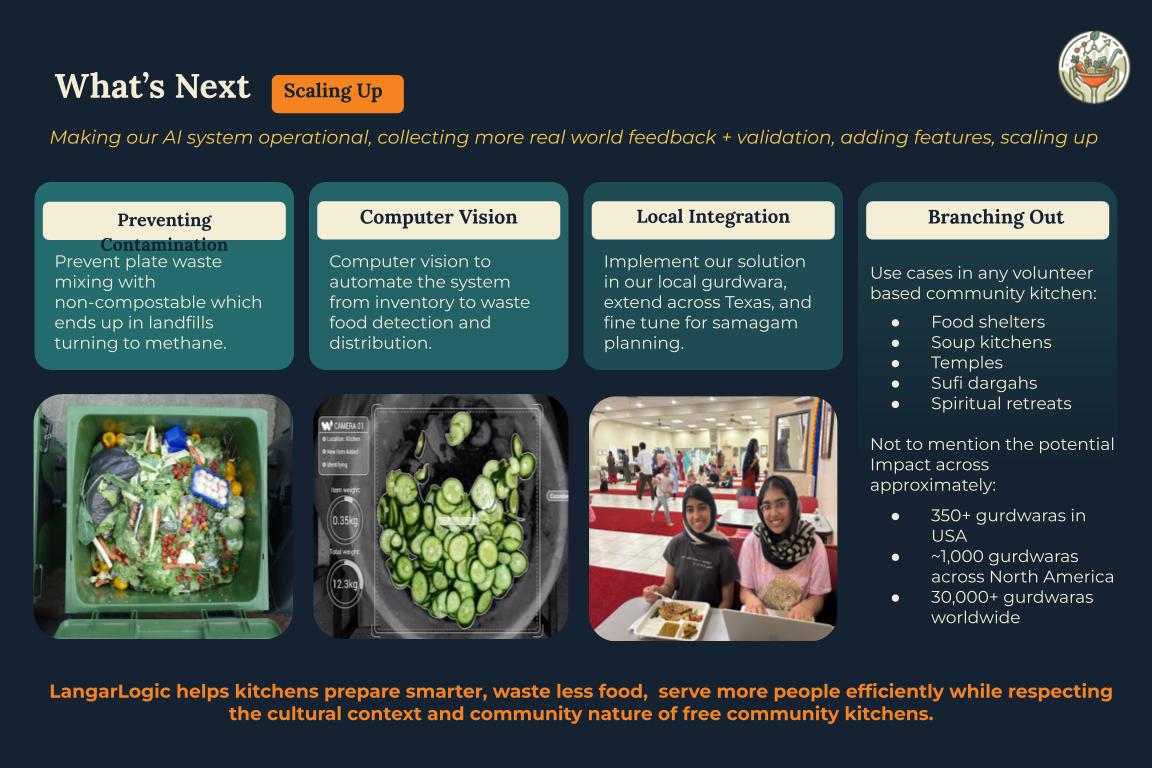
What’s next? We want to make our AI system operational, collect more real world feedback and validation. Add more helpful features like contamination risk prediction in our AI model so it can suggest better waste-sorting practices. We hope to integrate Computer vision in our AI ecosystem using cameras and sensors to detect the patterns of food leftovers on the plates and find insights for optimizing the menu. We want to start locally by testing LangarLogic at our Austin gurdwara first and scale it up from there. Lastly, we would also like to explore other Use cases for our app like volunteer-based community kitchens in homeless shelters, Soup kitchens, Temples, Sufi dargahs & Spiritual retreats and see how it can be customized to fit their unique cultural context.
Built With
- chatgpt
- claude
- gemini
- nanakshahi-sikh-calendar-api
- openweathermap-api
- streamlit
- translation/language-model-apis
- whatsapp-api


Log in or sign up for Devpost to join the conversation.