-
-
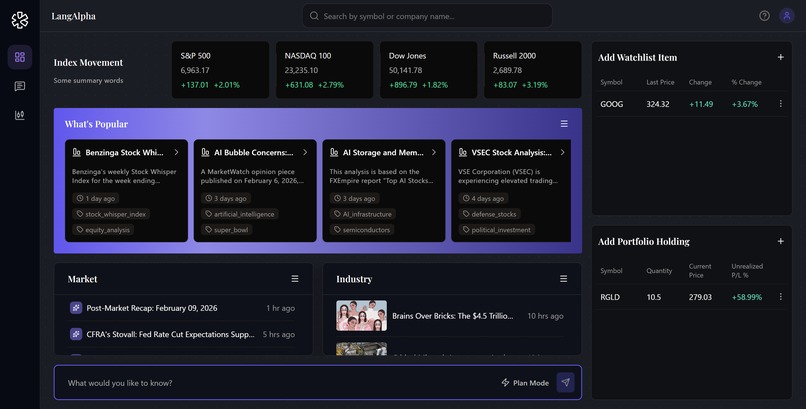
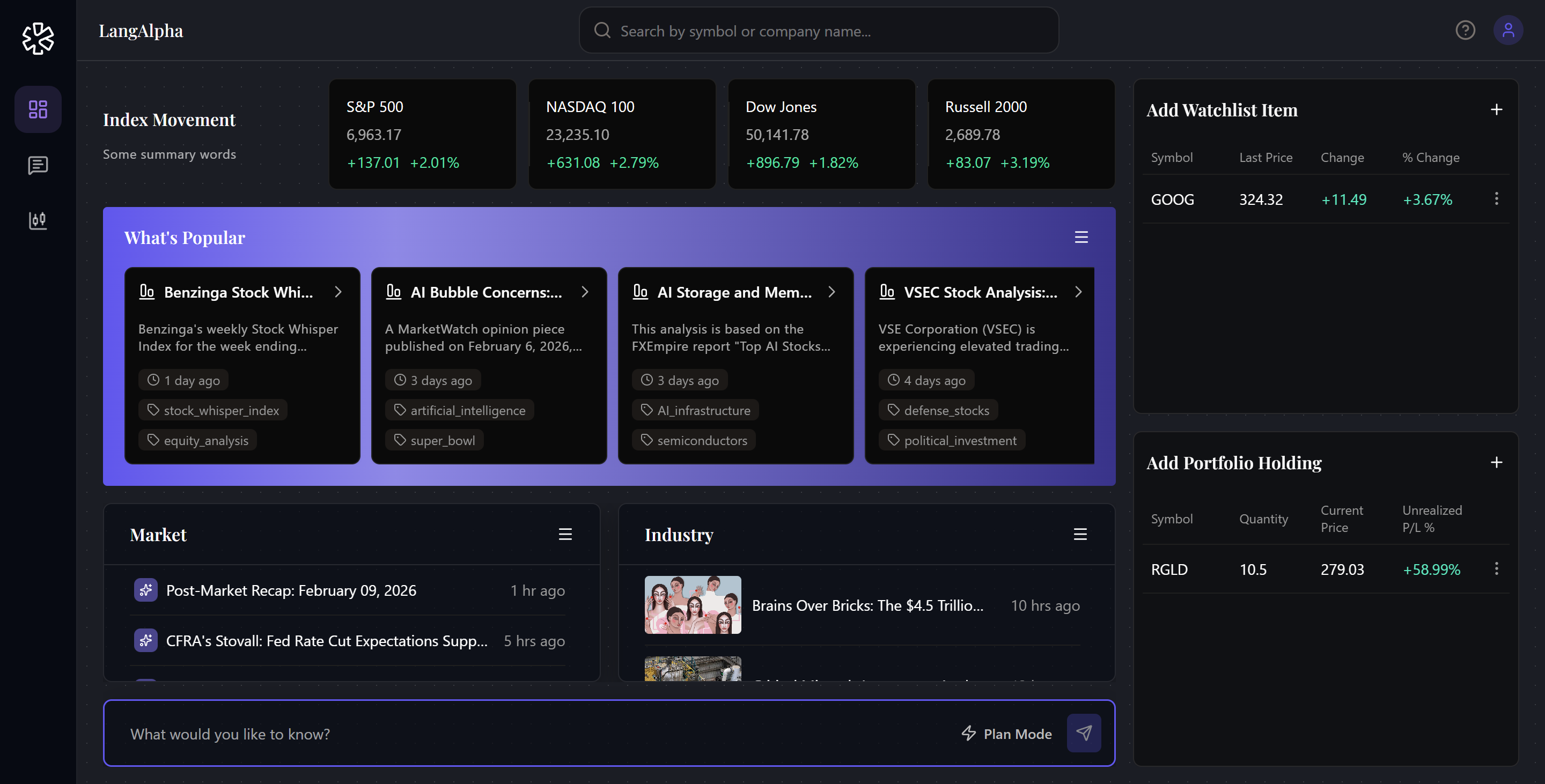
Dashboard
-
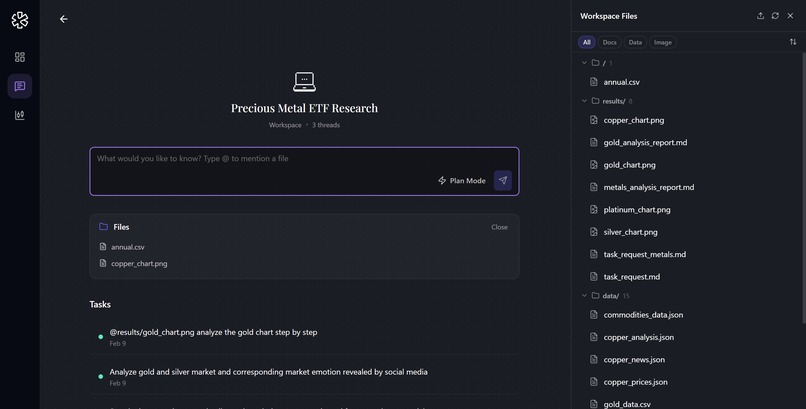
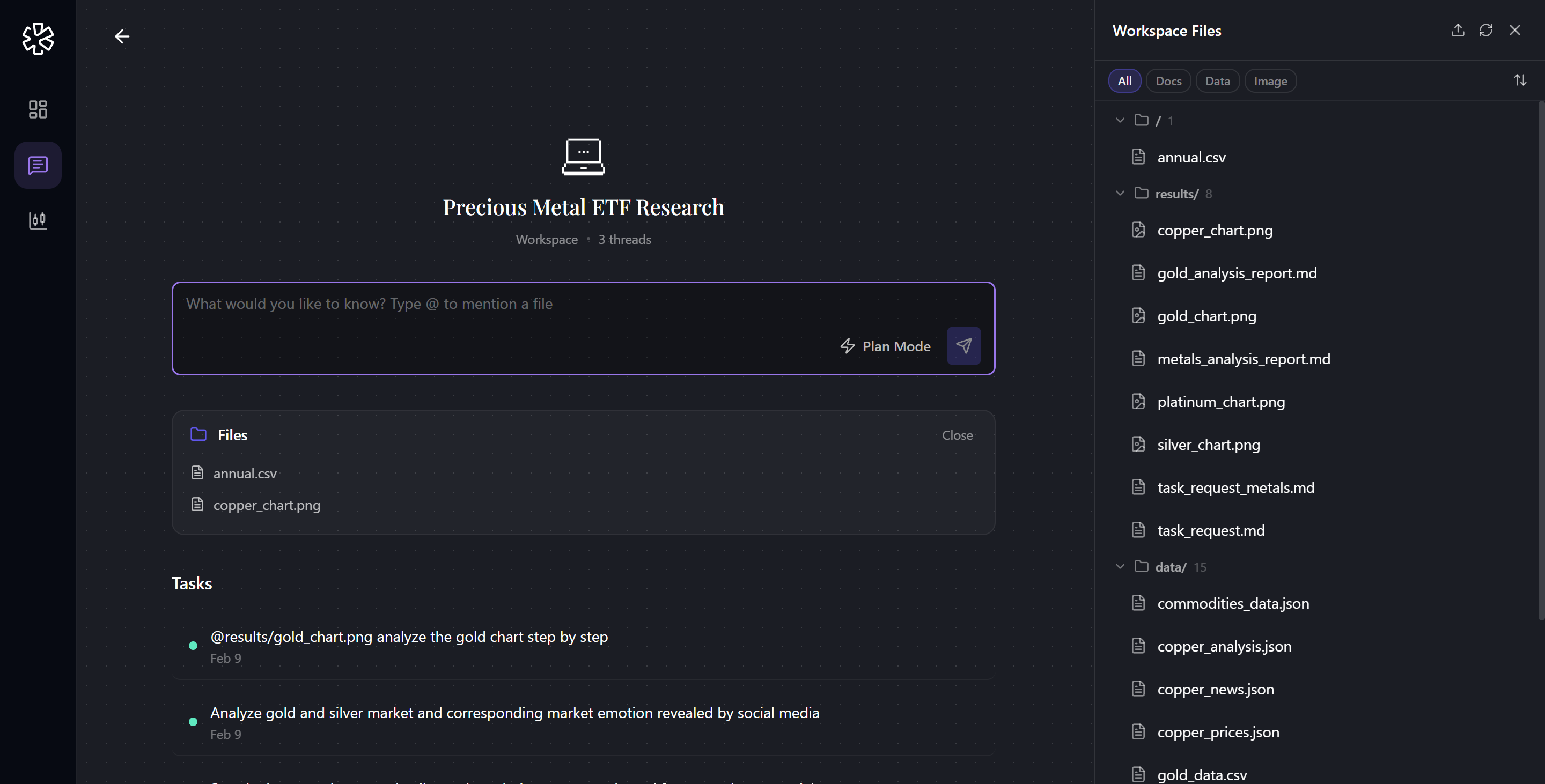
Workspace of Agent
-
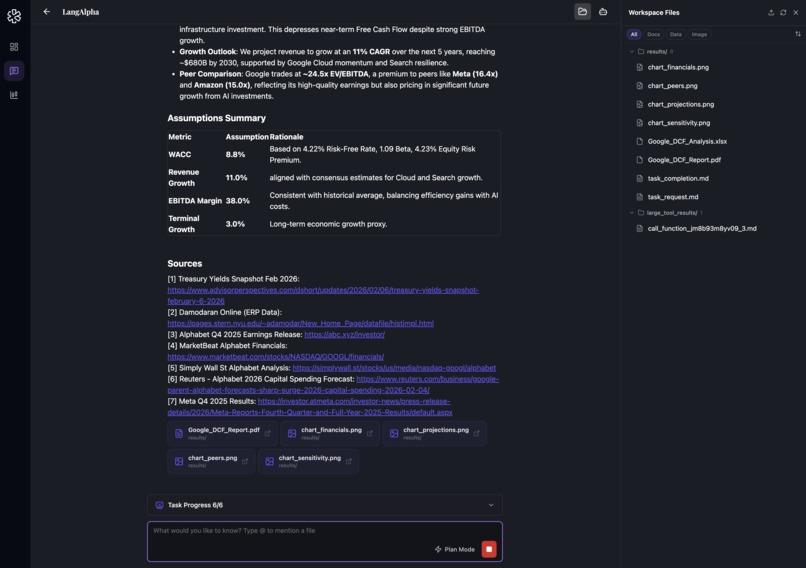
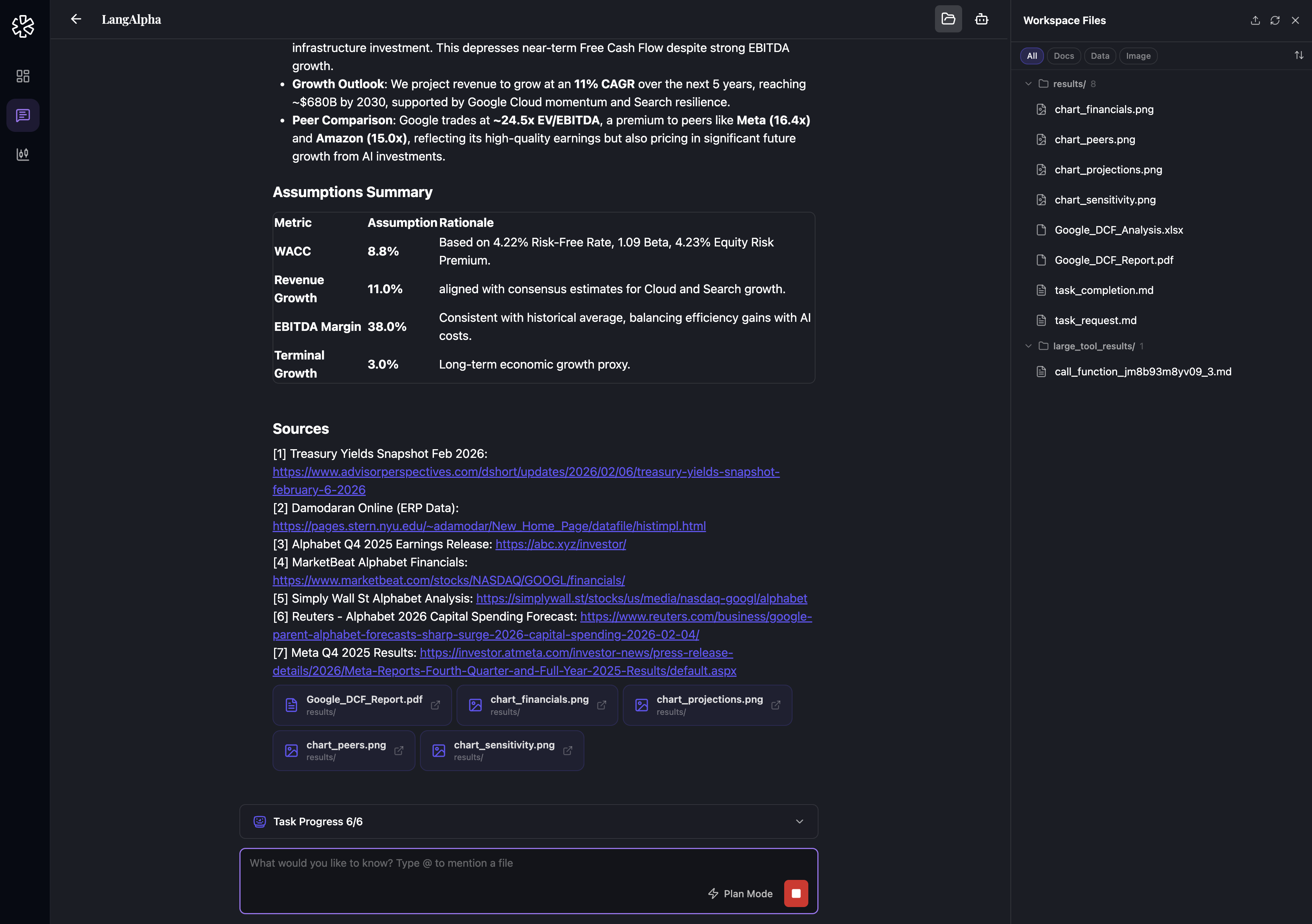
Deliverable with charts, pdf, excel, etc
-
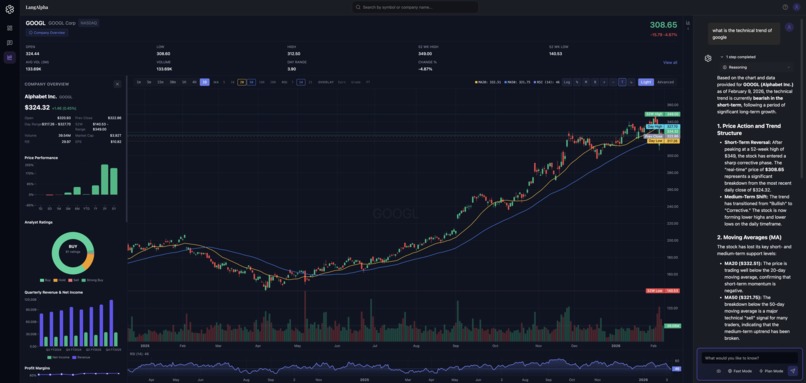
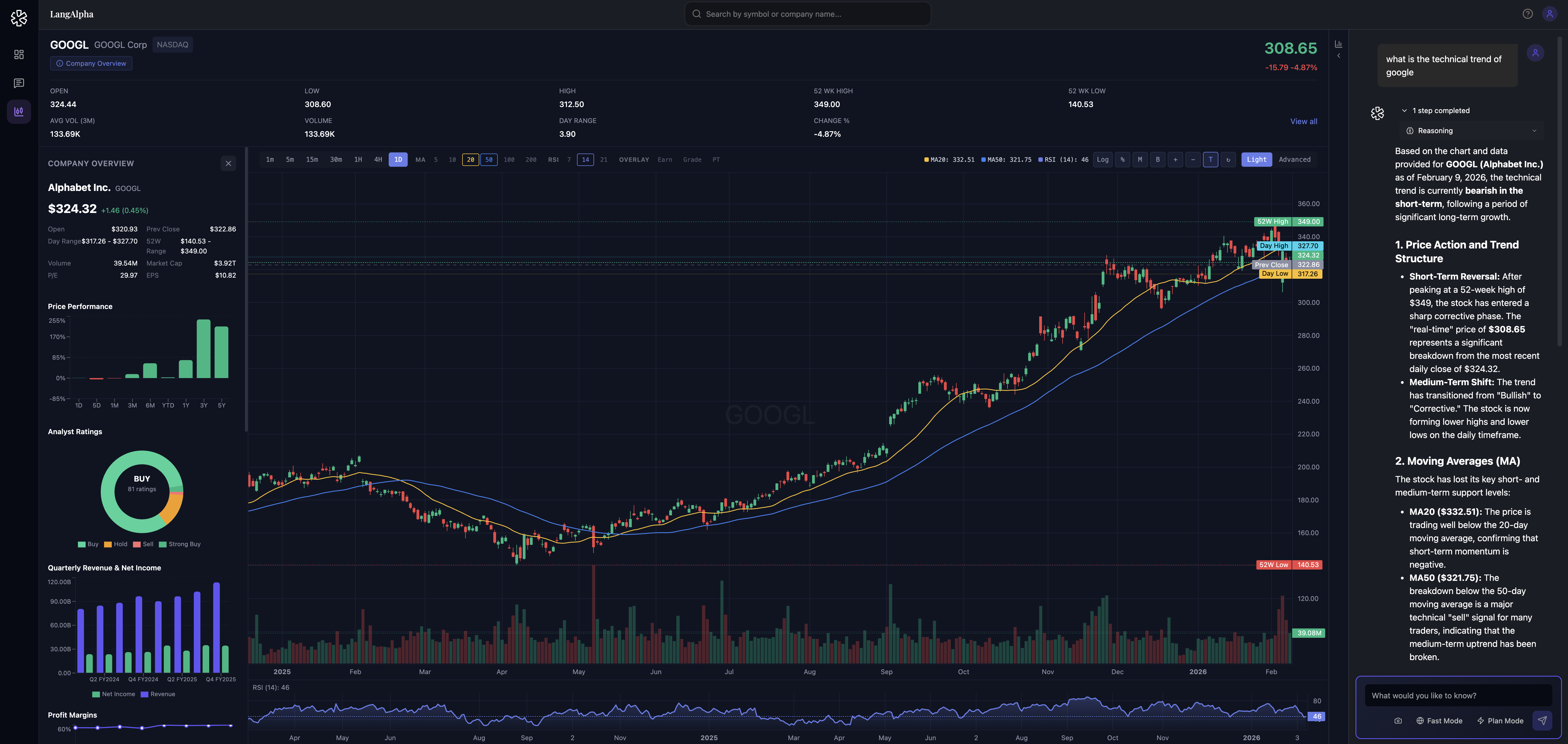
Leverage the native multimodal input of Gemini 3 for K line interpretation
LangAlpha: From Vibe Coding to Vibe Investing
Inspiration
Every AI finance product today treats investment decisions as one-shot. Ask a question, get an answer, move on. But real investing doesn't work that way. You refine theses, revisit positions, and layer new data on existing analysis over weeks and months. No single prompt can capture that.
Vibe coding (Cursor, Windsurf, Claude Code) solved this problem for software by giving AI agents workspaces: persistent environments where work compounds across sessions. We applied the same pattern to investing. LangAlpha is vibe investing.
What it does
LangAlpha provides an agent-native workspace for investment research. Each workspace is a persistent sandboxed environment where deliverables (reports, data, charts, code) are saved across sessions. Users create a workspace per research goal: "Data center demand deep dive", "Q2 rebalance", "energy sector rotation".
End-to-end journey:
- Conversational onboarding. The agent interviews you about your goals, experience, risk tolerance, and investing style.
- First stock coverage. The agent produces your first deliverable in the workspace.
- Ongoing collaboration. Come back tomorrow; your workspace has your files, threads, and accumulated research.
- Compounding intelligence. Each session builds on the last. The agent reads previous files and reaches more sophisticated conclusions.
Key capabilities:
- Project-based workspaces with persistent filesystem, multiple threads, and file management
- Agent swarm where parallel async subagents handle heavy lifting while the main agent stays on track
- Gemini 3 multimodal intelligence for native chart/K-line interpretation, PDF digesting, and visual analysis of financial documents
- Broad data coverage. Real-time market quotes, fundamental data, macro/economic indicators, web and news data, sentiment analysis, and original SEC filings all accessible to the agent out of the box
- Full traceability so you can inspect the agent's thinking process, tool calls, and data sources in real time
- TradingCenter for fast-mode chart-and-chat market lookups, with multimodal input so the agent can interpret what's on your screen
How we built it
Workspace Architecture
- Each workspace is a Daytona cloud sandbox with persistent filesystem
- Users create workspaces per research or analysis goal
- Multiple conversation threads per workspace
- Agent reads and writes files to the workspace filesystem (results/, data/)
- Snapshot-based initialization for fast creation (~8s vs ~60s cold start)
Intelligence & Multimodal (Gemini 3)
- Built natively on Gemini 3, leveraging:
- Native multimodal intelligence for K-line/candlestick chart interpretation, PDF financial document digesting, and image-based analysis
- Strong reasoning for multi-step investment analysis
- Long-context window for deep cross-verification across SEC filings and research reports
- Multiple reasoning modes: Fast Search, Plan Search, Deep Search
Agent Swarm & Context Management
- Main agent orchestrates via LangGraph and spawns async subagents via the
Task()tool - Subagents run in parallel with isolated context windows to prevent drift in long reasoning chains
- Each subagent returns synthesized results, not raw data, keeping the main agent lean
- Workspace filesystem serves as external memory: intermediate results written to files, read on demand
- Auto-summarization middleware kicks in when conversations approach token limits
Frontend & Traceability
- Workspace-first navigation: WorkspaceGallery → ThreadGallery → ChatView
- Real-time agent thinking exposed via SSE streaming
- Live subagent status cards showing parallel task execution progress
- File panel for browsing workspace deliverables alongside the conversation
- Every agent decision mapped to inspectable tool calls and artifacts
Challenges we ran into
- Context management and subagent coordination. Deciding what scope of information to expose at each level of the agent hierarchy was a core design challenge. Too much context causes drift; too little and the agent misses important connections. We solved this through isolated subagent context windows, synthesized result handoff, and filesystem-based external memory.
- Financial time series data is hard. Long-term market data doesn't fit neatly into LLM context windows, and raw feeds are noisy. We custom-built a data pipeline that the agent understands how to query and process, so it can work with financial data reliably instead of hallucinating numbers.
- Balancing transparency with usability. The agent makes dozens of decisions, tool calls, and intermediate reasoning steps per task. Showing all of it overwhelms users; hiding it breaks trust. Finding the right level of visibility, where users feel informed without being buried, took significant iteration.
Accomplishments that we're proud of
- Built a workspace-native investment agent that goes beyond chat into a persistent research environment.
- Implemented an async agent swarm with parallel execution and live progress streaming.
- Leveraged Gemini 3's multimodal intelligence for native chart interpretation and financial document analysis.
- Covered the end-to-end investment workflow, from onboarding interview through first stock coverage to ongoing collaboration.
- Custom-built a financial data pipeline that makes time series data reliably accessible to the agent.
- Showed that the vibe coding paradigm (workspace + tools + persistence) translates powerfully to investing.
What we learned
- The workspace pattern is the missing primitive for AI-powered knowledge work. What it did for code agents, it can do for investing.
- Personalization starts with listening. A short conversation beats a long settings page.
- Persistence changes behavior. When the agent's work is saved, users treat it as a real tool, not a novelty.
- Financial data needs its own engineering. You can't just feed raw market data to an LLM and expect good results.
- Traceability builds confidence. Users don't just want answers; they want to see how the agent got there.
What's next for LangAlpha
- 24/7 market watch. The agent monitors market conditions proactively and alerts you based on your portfolio and watchlist, not just when you ask.
- Long-term memory. A dedicated memory layer so the agent truly learns your preferences, past decisions, and evolving thesis across months of use.
- Mock trading and backtesting. Test strategies against historical data before committing real capital.
- Complete instrument coverage. Expand beyond equities to options, futures, and other financial instruments.
- Workspace templates for common workflows like earnings analysis, sector rotation, and IPO evaluation.
- Collaborative workspaces where multiple users share research and build on each other's work.
Your investment intelligence should compound, not expire after one conversation. That's vibe investing.
Built With
- aws-(boto3)
- crawl4ai
- css
- daytona
- docker
- fastapi
- fmp-(financial-modeling-prep)
- google-genai
- httpx
- javascript
- langchain
- langgraph
- matplotlib
- mcp-(model-context-protocol)
- node.js
- postgresql
- pydantic
- python
- react
- redis
- serper
- sql
- tailwind-css
- tavily
- uvicorn
- vite


Log in or sign up for Devpost to join the conversation.