Inspiration
I grew up in a local town where kampung businesses and street burger stalls are part of everyday life. Street burgers are something families buy for dinner, friends eat while lepak, and people enjoy as a midnight snack or even a little “healing food.”
These stalls are more than places to buy food. For many people in my town, they are a source of income built through long hours, regular customers, and the effort of running everything, often without a full team.
But the customer experience can become frustrating when orders are delayed or forgotten, customers do not know their order status, or their favourite burger suddenly runs out of stock. At the same time, vendors are trying to manage orders, kitchen work, ingredient stock, and promotion all at once, especially during unpredictable peak hours.
I built Laku Sitok because this problem feels close to home. I wanted to create something that could help the local food stalls and kampung businesses I grew up around operate more smoothly, without needing separate tools or a large team.
By bringing ordering, kitchen workflows, ingredient aware stock, and promotion into one place, I hope Laku Sitok can help small stalls serve customers better, manage their business with more confidence, and continue being part of the local community. As a customer, that also means a faster, clearer, and more reliable experience for the food we love.
What it does
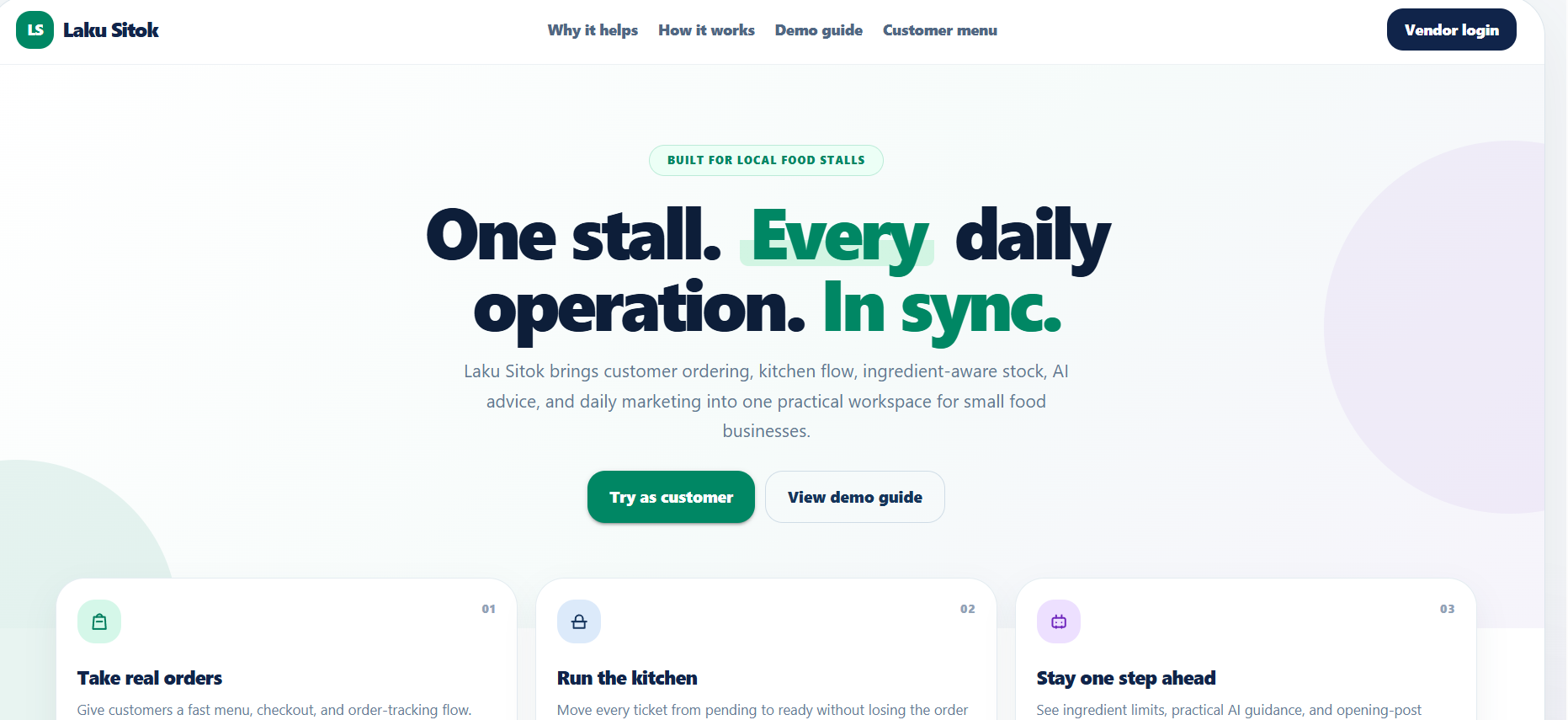
Laku Sitok is an AI-assisted daily operations hub for small food stalls.
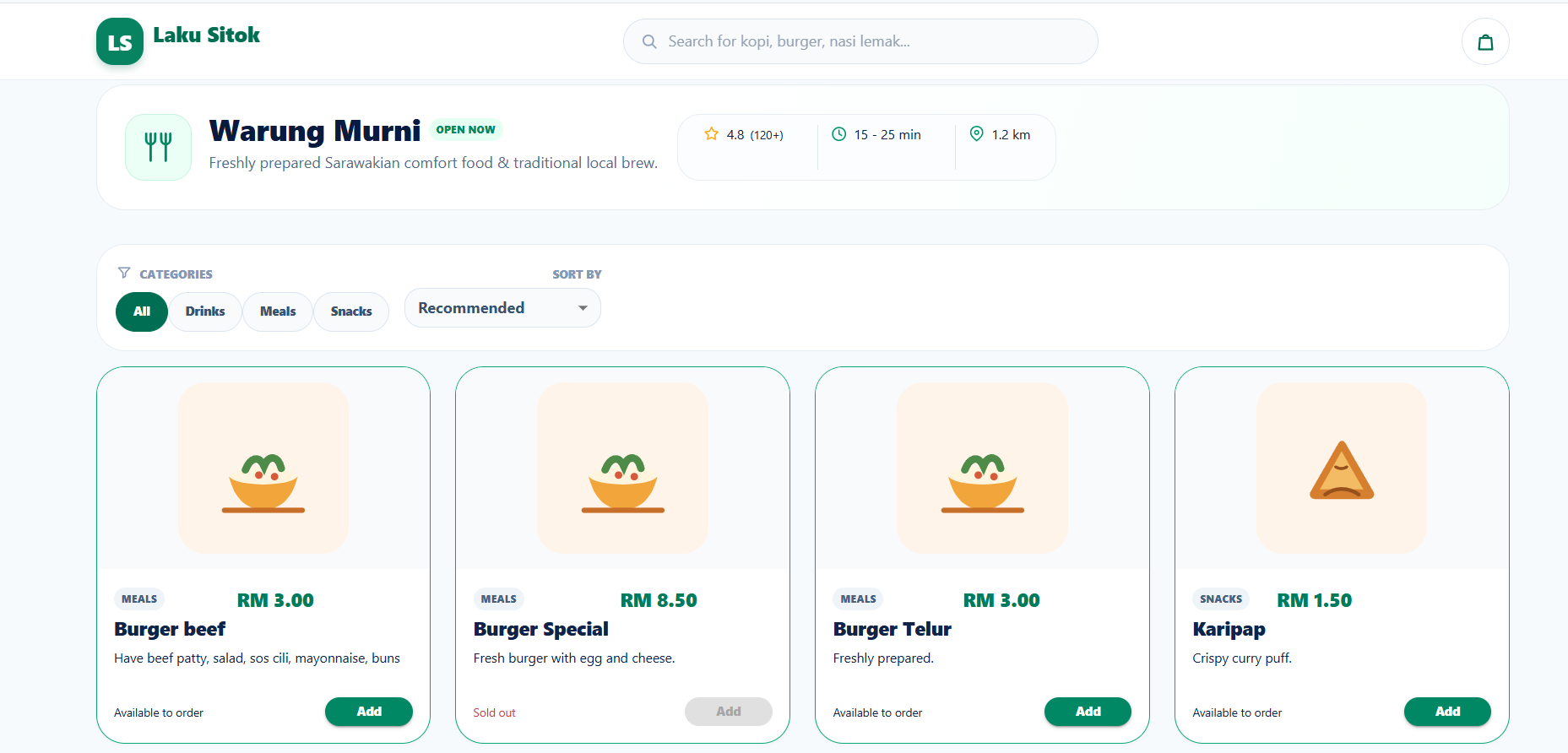
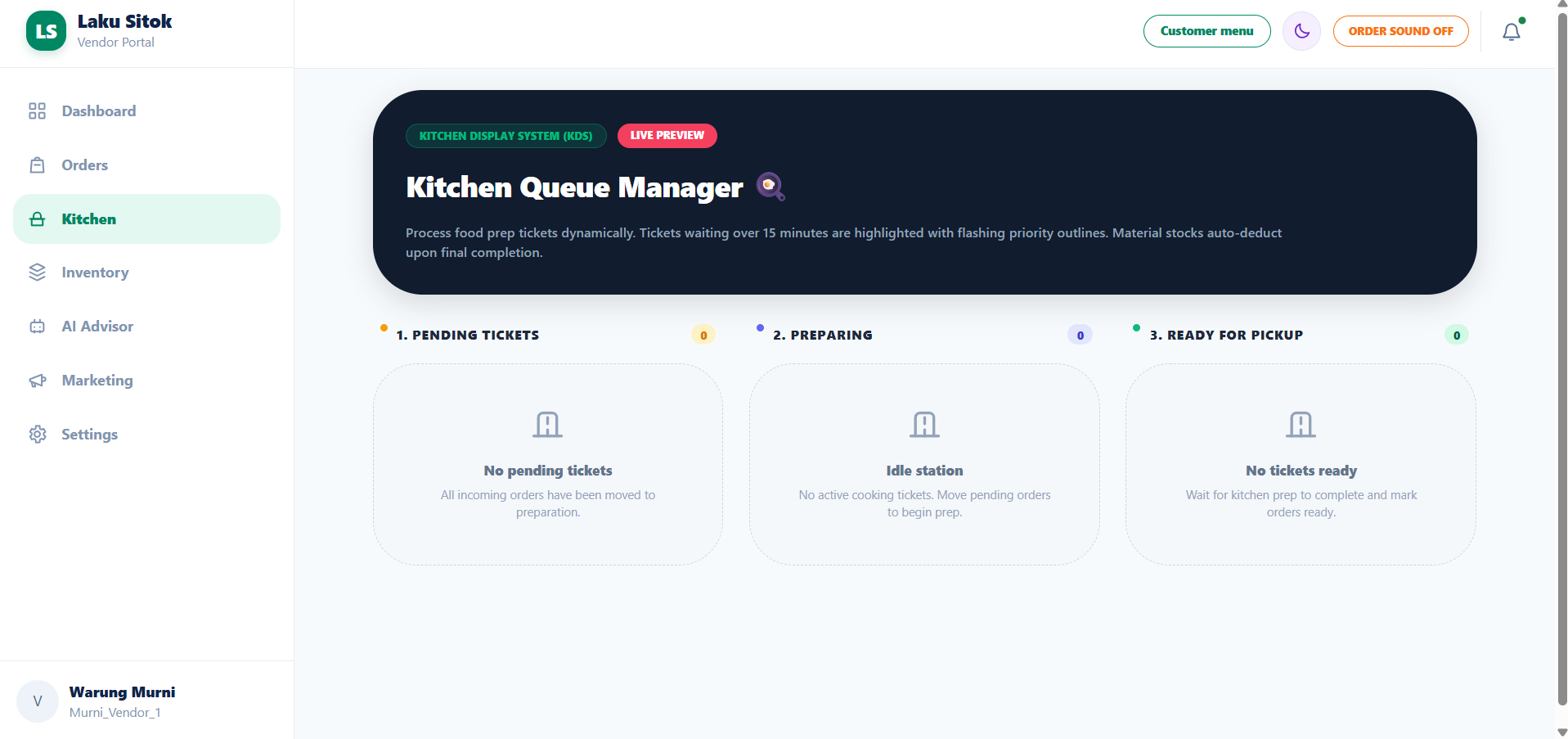
It lets customers open a digital menu, place an order, and track its progress. Vendors receive orders in a kitchen workflow and move them through Pending, Preparing, Ready, and Completed.
The vendor portal also includes ingredient-aware inventory. It can show how many servings of a recipe-based menu item can still be made, identify the limiting ingredient, and update stock only when an order is completed.
Laku Sitok also provides a grounded AI Manager and Business Advisor that use the vendor’s actual completed-order and inventory data to provide practical guidance. Vendors can create an opening-status promotional post and share it directly to WhatsApp.
How we built it
We built Laku Sitok with a React and Vite frontend, an Express.js backend, and Supabase for authentication, PostgreSQL data, and transactional order processing.
The backend manages customer orders, kitchen status transitions, inventory checks, recipe ingredients, stock movements, analytics, and approval based manager actions. Supabase database functions help keep order completion and inventory deduction consistent.
For AI, Laku Sitok uses a Qwen model through a configured API provider. The AI is grounded with real sales and stock context, while operational actions such as restocking still require vendor approval.
Before building, I used ChatGPT with the Devpost plugin to understand the OpenAI Build Week requirements and make sure the project idea aligned with the Work and Productivity track. I created the initial PROJECT.md and ARCHITECTURE.md documents, then added them to the project’s markdown folder so Codex could refer to them throughout development.
Whenever I wanted to add a feature, I first asked Codex to review it against the project scope, architecture, and hackathon track. I then used a separate Codex chat to create a focused implementation plan covering the goal, user flow, technical approach, and testing steps.
After that, I brought the plan into the main Codex chat to refine it further before implementation. Codex could refer back to the Markdown documentation, including the project, architecture, database, features, and implementation plans, so each feature stayed connected to the same product vision.
This planning and review workflow accelerated development by turning broad ideas into clear, reviewable steps before coding. It reduced rework, helped prevent avoidable bugs, caught scope and architecture issues earlier, and helped me build features that stayed aligned with both what I wanted Laku Sitok to be and the OpenAI Build Week track.
Challenges we ran into
The biggest challenge was making inventory reflect real stall operations. Ready-made items and recipe-based meals need different stock logic, and stock should not be permanently deducted until an order is actually completed.
We also had to make the AI useful without letting it make unchecked operational changes. We solved this by grounding advice in vendor data and introducing approval steps for actions such as ingredient restocking.
Other challenges included connecting Supabase authentication to the vendor record, configuring deployment environment variables safely, making the experience work well on mobile, and designing a workflow that feels simple enough for a busy food-stall owner.
Accomplishments that we're proud of
- Built a complete customer-to-vendor journey: menu, checkout, order tracking, kitchen workflow, and completion.
- Created ingredient-aware recipe stock that shows the vendor how many more servings they can make.
- Kept inventory updates safe by applying them through transactional completion logic.
- Built a grounded AI Manager that provides useful context while keeping the vendor in control of approvals.
- Added opening-status marketing posts with WhatsApp sharing for real small-stall promotion.
- Designed the product around a local street-food experience rather than a generic restaurant dashboard.
- Deployed a working public frontend and backend for end-to-end testing.
What we learned
We learned that AI is most useful when it is connected to reliable, current business data and has clear boundaries. The best experience was not asking AI to replace the vendor—it was using AI to summarize, suggest, and help the vendor act faster.
We also learned that small operational details matter: an order status customers can see, a kitchen notification vendors notice, and a clear warning before an ingredient runs out can make a major difference in daily stall operations.
What's next for Laku Sitok
Next, we want Laku Sitok to support more real world stall workflows, including multiple staff roles, customer notifications, richer recipe management, supplier and restock tracking, and more flexible operating hour rules.
We also want to expand beyond a single demo vendor so more local food stalls can register their own business, set up their menu, ingredients, recipes, opening hours, and marketing profile, then manage their daily operations through their own Laku Sitok workspace.
For marketing, we want to add better campaign templates and optional social platform integrations. Long term, Laku Sitok could become a practical operating companion for local food businesses, helping more kampung and street food vendors stay organised, serve customers better, and become more “laku.”
Built With
- codex
- gpt
- react
- vite

Log in or sign up for Devpost to join the conversation.