-
-
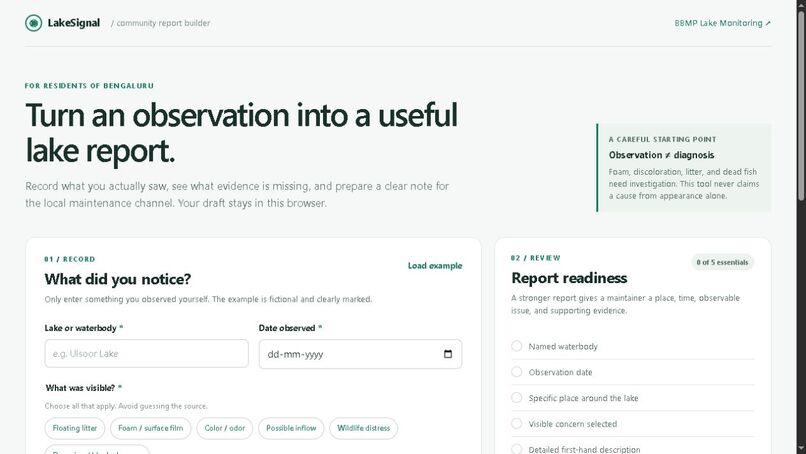
LakeSignal’s live report builder: observation fields and an evidence checklist, with explicit limits on diagnosis.
Inspiration
A useful lake-maintenance report starts with what someone actually observed, where and when. Visible litter, foam or an apparent inflow should be recorded clearly without being presented as a water-quality diagnosis. LakeSignal is a working browser prototype that helps a resident prepare that evidence-aware record.
Primary track: Community Impact. Historical IISc research documents broader pressures on Bengaluru lakes, and BBMP provides an official lake-maintenance grievance channel. Those references establish context; they do not prove a current incident at a particular lake. The demo does not claim a personal sighting or a real complaint.
References: Historical IISc assessment and official BBMP lake channel.
What it does
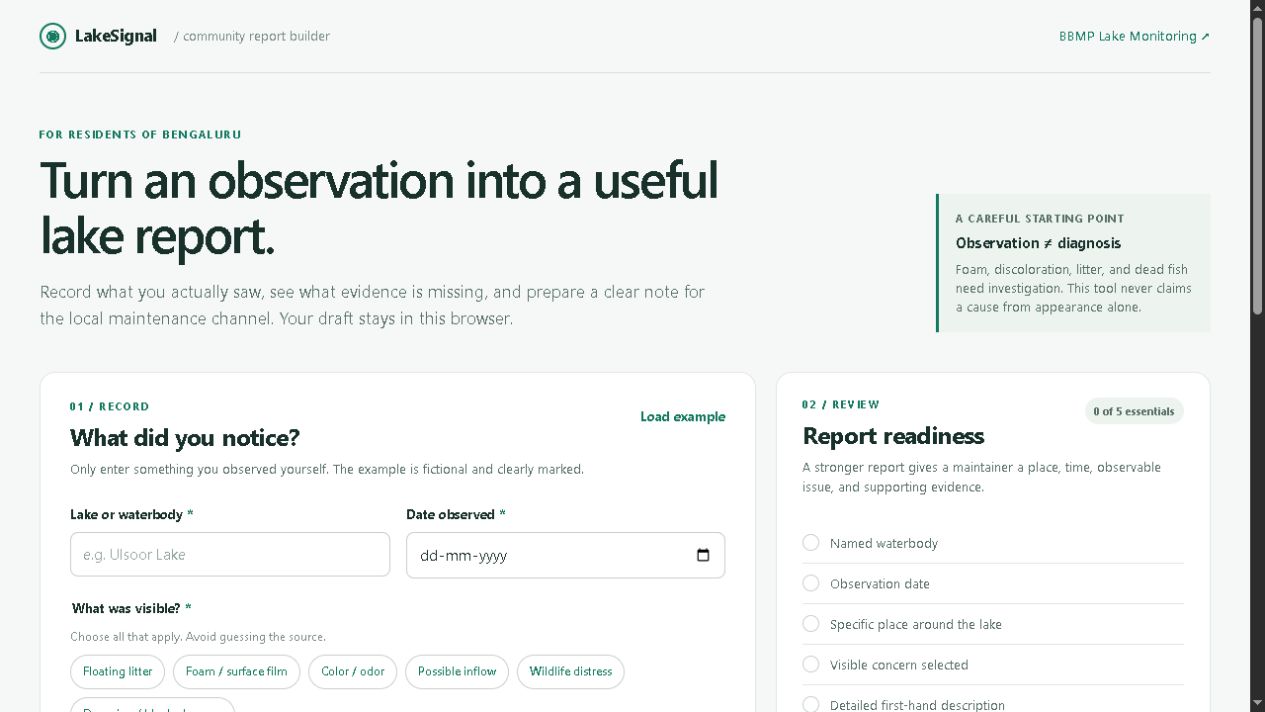
Enter the waterbody, observation date, shoreline landmark, visible concern and first-hand description, plus an optional evidence link. A live checklist and field-level validation identify missing essentials. LakeSignal formats a copyable and downloadable maintenance report asking for inspection, with explicit limits on what the observations can establish.
Drafts stay in browser localStorage. The app has no account system, backend collection or automatic complaint filing. It links to BBMP's official lake channel so the resident can review and submit an appropriate report there. The built-in example is explicitly fictional in both the interface and generated report.
How we built it
The project uses HTML, CSS and vanilla JavaScript, with deterministic validation and report formatting. Open index.html locally or use the live prototype; no build step or account is required.
An OpenAI assistant in the ChatGPT/Codex workflow generated the initial code and design, created the synthetic demo narration and helped test the prototype in a browser. The project does not perform runtime AI inference. API credits are unavailable for this entry, so it uses the event's disclosed development-assistance exception rather than claiming an integrated AI feature.
LakeSignal was created on October 16, 2026, within STEM2Connect's October 11–November 21 build window. It was also submitted to Neighborhood Hacks. Earlier lake-awareness projects informed the subject, but no LakeAlive or Kere code, design or content was copied. This is a separate event-specific project page, not a claim that the underlying project is exclusive to STEM2Connect.
Challenges we ran into
The central design challenge is keeping a report actionable without implying an environmental diagnosis. A description of visible foam or litter can justify a request for inspection, but it cannot establish a pollutant, cause or current water-quality measurement.
Explicit uncertainty language, required location/date details and repeated fictional-example labels make that boundary visible. Another important boundary is the handoff: generating a report is not the same as submitting a complaint. The resident must review the report and choose whether and how to use the official channel.
Accomplishments that we're proud of
The prototype implements the complete report-preparation loop: record an observation, check the essentials, review the formatted result, and copy or download it. Browser-local draft storage supports returning to an unfinished record without introducing backend collection.
The fictional example makes the workflow available for inspection without asking judges to invent a real incident. Browser testing during development checked the prototype's interaction, but the application has not been evaluated with residents or BBMP staff. No improvement in official response times, learning outcomes or lake conditions has been measured.
What we learned
Structured input and careful wording can be more appropriate than generated conclusions when evidence is limited. Recording the waterbody, date and landmark makes the observation more useful; uncertainty language keeps that usefulness separate from unsupported diagnosis.
A report-preparation tool also needs to explain the next action clearly. LakeSignal helps organize a record, while responsibility for reviewing it and making an official submission stays with the resident.
What's next for LakeSignal
Next steps are user-tested multilingual guidance, safe offline image handling and optional tracking of official complaint numbers with consent. These features are proposed work. The next evidence needed is whether residents can prepare accurate, usable reports and whether the intended receiving workflow accepts them; the prototype does not yet establish those outcomes.

Log in or sign up for Devpost to join the conversation.