Inspiration
Primary track: General. LakeAlive turns lake-care concepts into a playable browser-based 3D lesson. It is intended for learners who want to explore how shoreline care, habitat and wildlife relate through direct interaction.
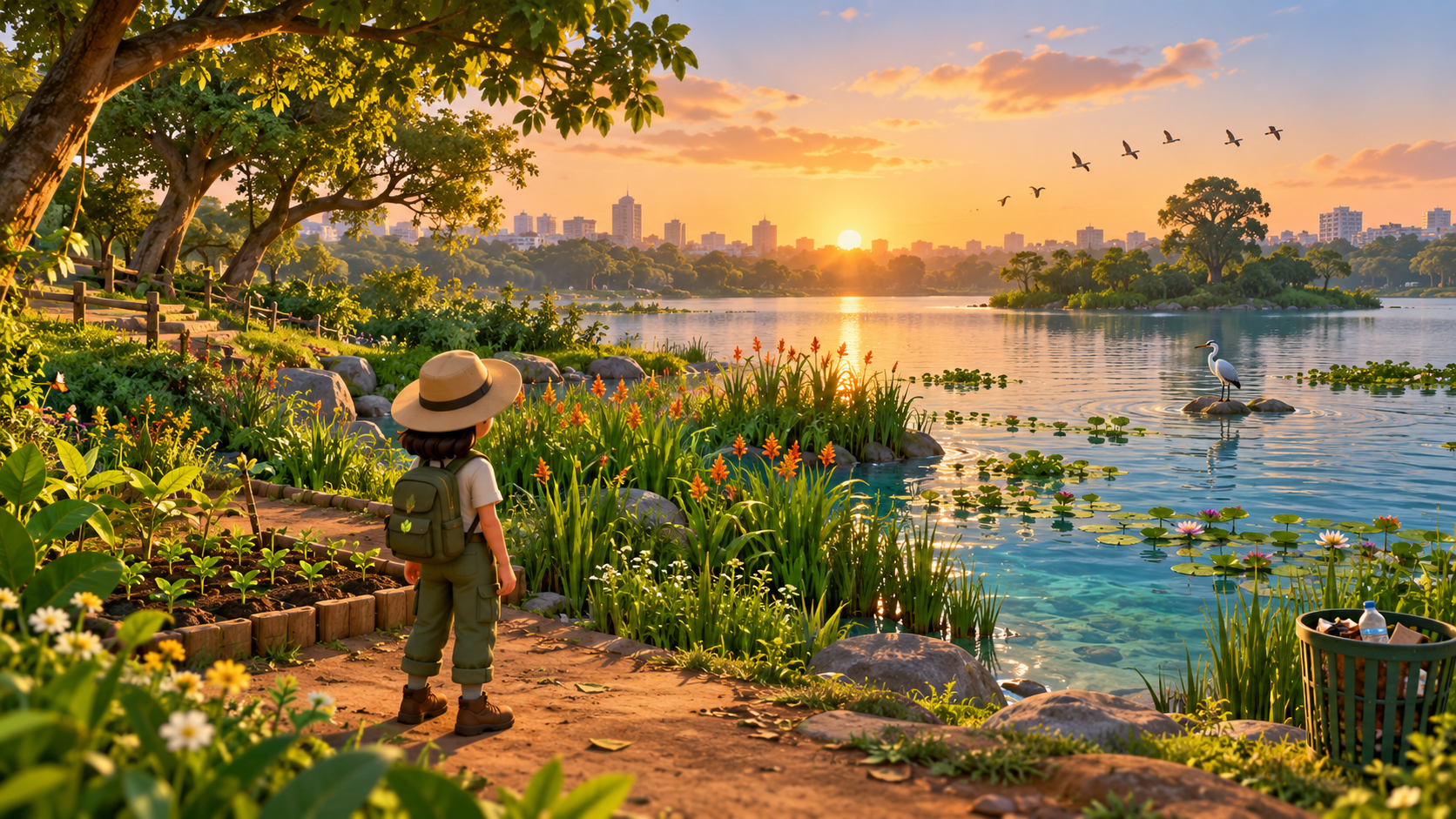
The setting is a fictional Bengaluru-inspired lakeside park. Its purpose is to make environmental concepts explorable through a small, repeatable learning loop, rather than claim that a game reproduces the complexity of a real lake.
What it does
Explore the park, collect shoreline litter, plant native seeds and clear inlet litter. A guided tour and field journal connect each action to visible changes in illustrative clarity, habitat and wildlife indicators. The deterministic simulation can be reset to compare the same starting conditions.
These are deliberately simplified teaching relationships. The lake, numerical scores and compressed plant growth are fictional. They are not measurements, scientific predictions or evidence of environmental improvement. Real restoration also requires treatment, monitoring and long-term maintenance.
How we built it
TypeScript and Three.js render a procedural WebGL scene; Vite builds the application, and Lucide supplies interface icons. The simulation uses explicit, reproducible state changes rather than AI inference. The repository contains setup instructions, the model and browser tests. No account, API key or backend is required to run the game locally.
LakeAlive existed before Arbiter Hacks and has been entered in other events. This entry presents that existing work; it does not claim it was built during Arbiter. This submission write-up was prepared with AI assistance. The game does not use runtime AI.
Challenges we ran into
The challenge is to make the interactions understandable while keeping a clear boundary between an illustrative model and ecological evidence. A learner needs to see what an action changed, understand the corresponding concept, and know that a game score is not a field measurement.
A 3D scene can make exploration engaging, but it also creates accessibility work beyond rendering the park. Improving the nonvisual equivalent remains an identified next step. The current prototype does not claim a completed accessibility evaluation or measured educational benefit.
Accomplishments that we're proud of
The existing game makes the restoration loop playable and repeatable. A judge can watch the linked demo, or follow the repository instructions with npm ci and npm run dev, start the guided tour, visit each restoration site, perform its action, inspect the indicators and reset the world.
The model and browser tests are available in the public repository for inspection. Explicit state transitions support comparing the same actions from the same starting conditions. Those properties make the implementation easier to examine without claiming that software tests validate the underlying ecological simplifications.
What we learned
Reproducibility helps explain a teaching model: reset allows a player to repeat an action and inspect the same relationship. Reproducibility does not make that relationship a scientific prediction. The model's omissions need to be part of the explanation, particularly when the subject is real environmental restoration.
The next useful evaluation is whether learners understand those relationships and limits, not only whether the game runs.
What's next for LakeAlive
Test the learning experience with students and educators, improve the nonvisual equivalent of the 3D scene, and refine the explanation of what the simplified model omits. Educational benefit and real-world impact have not been measured. These are proposed evaluation and accessibility improvements, not completed outcomes.

Log in or sign up for Devpost to join the conversation.