-
-
Research
-

Scheduler
-
Settings

Inspiration
Every AI I use forgets me. I paste my context in, get an answer, and it evaporates — the work never lands anywhere I own. Meanwhile my notes — the place where my actual knowledge lives — just sit there as dead text.
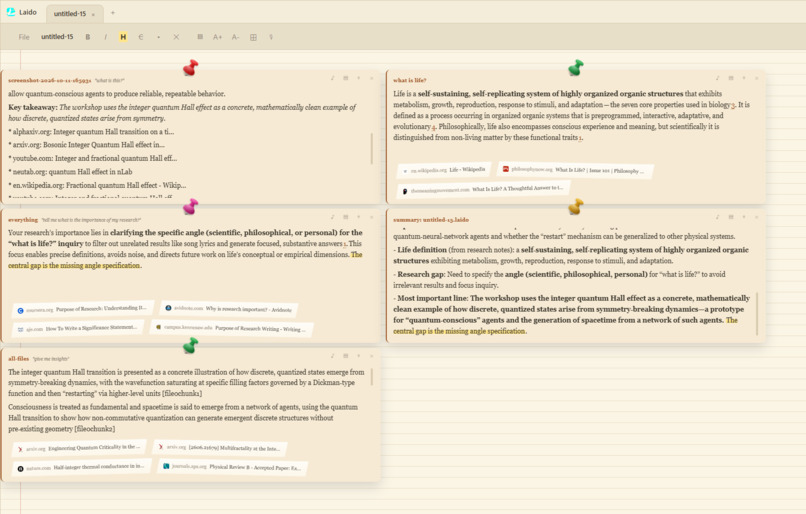
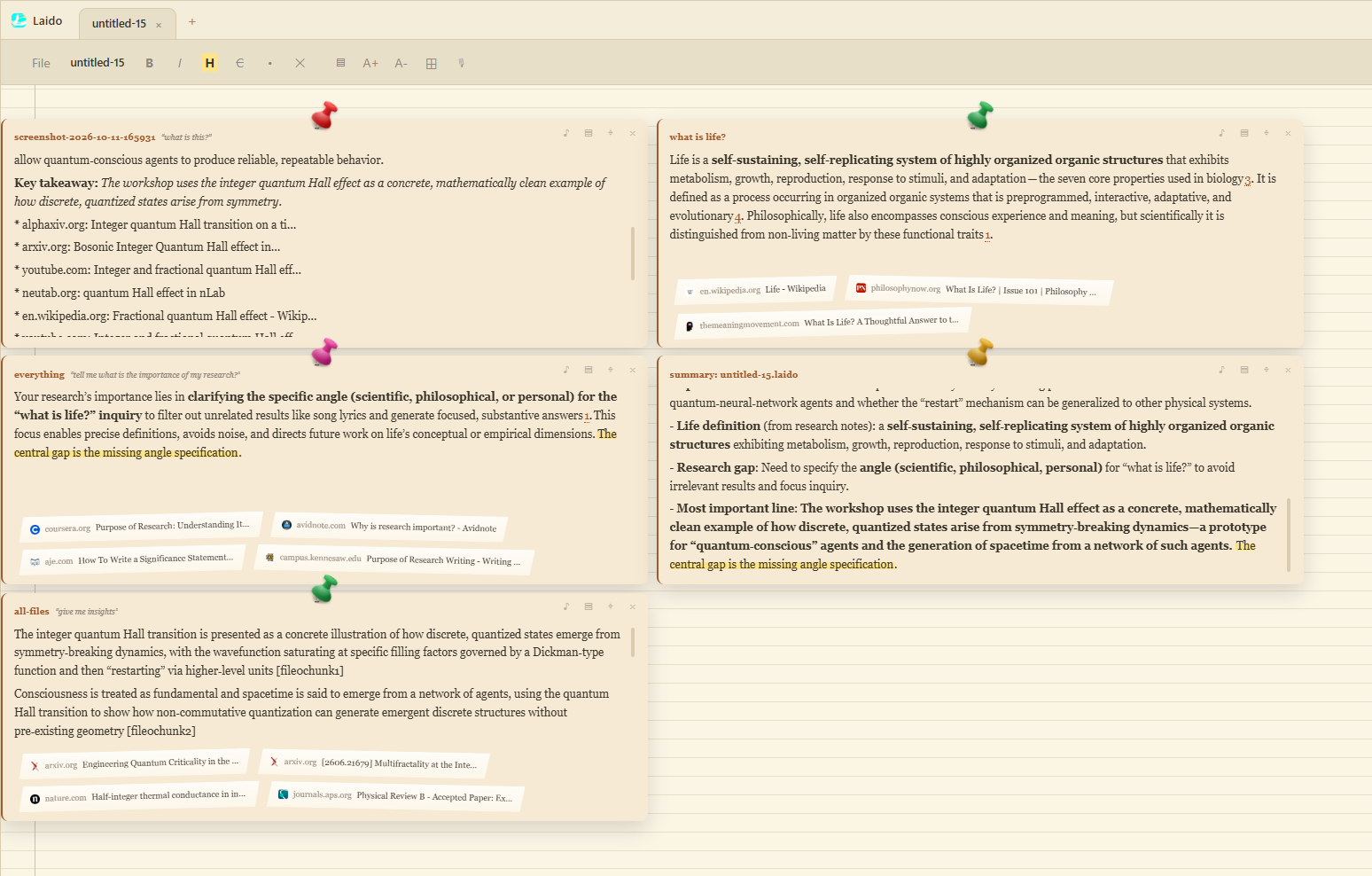
Laido started from one question: what if the notepad was the agent? Not a chat window beside your notes — the notes themselves are the memory, the interface, and the work product. You write; the agent reads, researches, simulates, schedules, and leaves every result on the page as an editable card. Your notes are the memory, and the memory is yours.
What it does
A real notepad — an infinite ruled sheet with draggable, resizable AI widgets living beside your text. Everything is plain markdown in .laido files inside ~/Documents/Laido.
- Hybrid retrieval over everything you own — vector search + BM25 + an entity graph + quantum-inspired lanes, fused with web research.
@askfuses your library + your notes + the web into one cited answer. - Research loops —
@loop 10 arxiv breakthroughs in quantization: each loop refines its own search angle, cites real papers, writes and runs a Python simulation of the central claim in a sandbox, and feeds the result into the next loop. - Scheduled autonomy —
@schedule daily 08:00 brief— the agent works while the laptop sleeps and writes the result into your notes. - Skills, voice, summaries — reusable multi-step routines written in plain lines; AssemblyAI voice notes (live streaming or record-then-transcribe);
@summaryover the whole sheet, widgets included.
How we built it
Rust + Tauri v2 backend, vanilla TypeScript + plain CSS frontend — one small binary for Windows, macOS and Linux. The vault is the sandbox: every path the agent touches is validated to resolve inside it, and outside files enter only through an explicit user upload.
Most of the engineering went into retrieval. Four lanes — per-phrase vector search, BM25, an entity/relation graph, and quantum-inspired scoring — fuse through reciprocal-rank fusion and interference re-ranking. The quantum lanes are real: the query is treated as a density matrix over its rewritten meanings, \( \rho = \sum_i w_i |v_i\rangle\langle v_i| \), and a chunk's relevance is the Born-rule mixture \( \mathrm{tr}(\rho\,\Pi_d) \) — weighted squared cosines, free at query time. A graph walk diffuses mass through the entity graph for contiguity, and a QPRP-style greedy re-pick rewards candidates that cohere with what was already chosen.
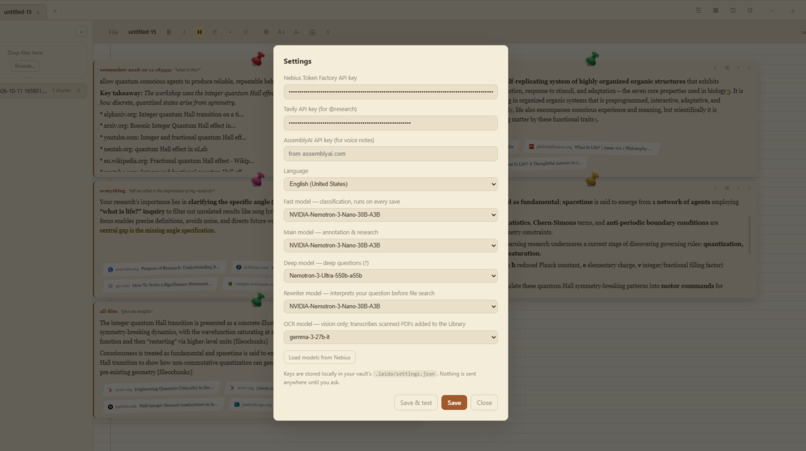
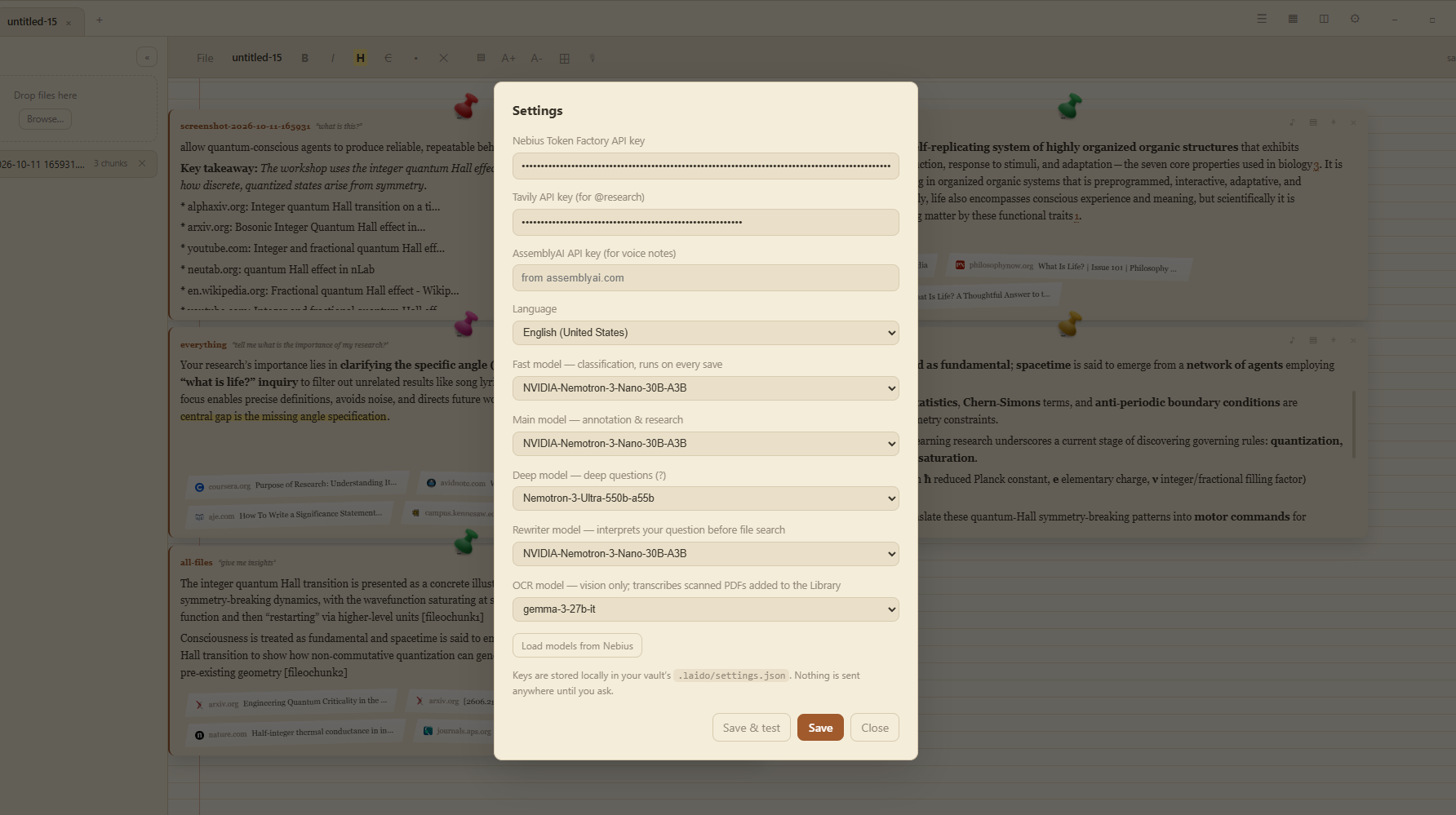
Every answer is a runtime call to Nebius Token Factory with NVIDIA Nemotron open models, routed by task cost:
- Nemotron 3 Nano 30B-A3B — query rewriting, entity-graph extraction, per-file digests, loop refinement, simulation-script generation
- Nemotron 3 Super 120B-A12B — grounded answers, summaries, research synthesis, loop cards
- Nemotron 3 Ultra 550B-A55B — deepest reasoning when a question demands it
- Token Factory embeddings (1024-dim) — index the library and the notes for every retrieval lane
Tavily powers the web-research lane at runtime (we'd love to be considered for Best Use of Tavily), and AssemblyAI handles optional voice notes. Everything else — notes, vectors, graphs, schedules, simulation scripts — is local plain files.
Challenges we ran into
- A single invisible character broke every command. Commands typed on a previously-saved blank line silently did nothing — the zero-width space that marks empty lines survives JavaScript's
trim(). Finding it took reproducing the parse byte by byte. - We lost our own library once. A corrupted index parsed as "empty", and the next upload overwrote it. We rebuilt the write path to refuse unreadable indexes, write atomically, and keep a backup generation — and the CI suite now proves the guard.
Accomplishments that we're proud of
A research loop that verifies itself. Every loop writes and runs a Python simulation of its own central claim in a sandbox, then feeds the result into the next loop. In real runs it computed surface-code thresholds (physical 1% error → logical 4.5×10⁻⁵) and distance scaling (d=3: 0.387 → d=7: 0.109) — numbers, not prose.
Retrieval we measured, not guessed. We benchmarked 11 retrieval methods on a real corpus with an LLM judge and shipped the winners: quantum-inspired lanes — density-matrix queries scored by the Born rule, a graph walk for contiguity, and QPRP-style interference re-ranking. Top-citation precision rose 0.60 → 0.80 (+33%) and contiguous-passage retrieval roughly doubled — at zero extra API calls per query.
An agent that works while you sleep.
@schedule daily 08:00 briefdelivers cited briefs and reviews into the notes overnight. The whole agent runs on Nemotron 3 Nano / Super / Ultra through Nebius Token Factory, routed by task cost — a heavy month of use costs about a dollar or two.A complete product, not a proof of concept. An infinite notepad canvas with draggable, resizable AI widgets; a month/week/day/agenda calendar; library ingestion with OCR for PDFs, slides and images; skills; voice notes via AssemblyAI (live streaming and record-then-transcribe); summaries, related notes, quizzes — one small Rust + Tauri binary for Windows, macOS and Linux.
A CI suite that simulates the whole app on every push. Sixteen end-to-end simulations run against live APIs on a throwaway vault, and a release pipeline publishes installers for all three platforms from a single tag. It already earned its keep: it caught a bug where our own notes had silently lost their vector lanes.
Privacy we can prove, not just claim. The vault is a hard sandbox enforced at every command boundary; notes are plain
.laidofiles the user owns and can copy anywhere; we verified no API key ever touches the repository; and the index guards make library loss impossible — a corrupt index now refuses to be overwritten and keeps a recovery copy.What we learned
Measurement beats intuition — the biggest retrieval jump came from a simulation, not a hunch. Open-weight models on open infrastructure make an always-on agent genuinely practical — a heavy month of use costs a couple of dollars. And plaintext is a feature: the entire agent memory is files the user can copy, read and keep forever.
What's next for Laido — The Notepad That Acts On What You Write
A managed inference tier so users don't need their own API keys, cross-device sync, and mobile capture — same plaintext vault underneath.

Log in or sign up for Devpost to join the conversation.