Final Report: https://docs.google.com/document/d/1uBGjEnkhp-i2_75mIUrbQWtclGlpMqnYS8_CIWcN1NE/edit
https://github.com/ERICEX2025/labquake-prediction
Progress Reflection: https://docs.google.com/document/d/1lgmG0rFokTD4dzVxJXg-D-awISSDl7zbhFiqQBIsdF4/edit?usp=sharing
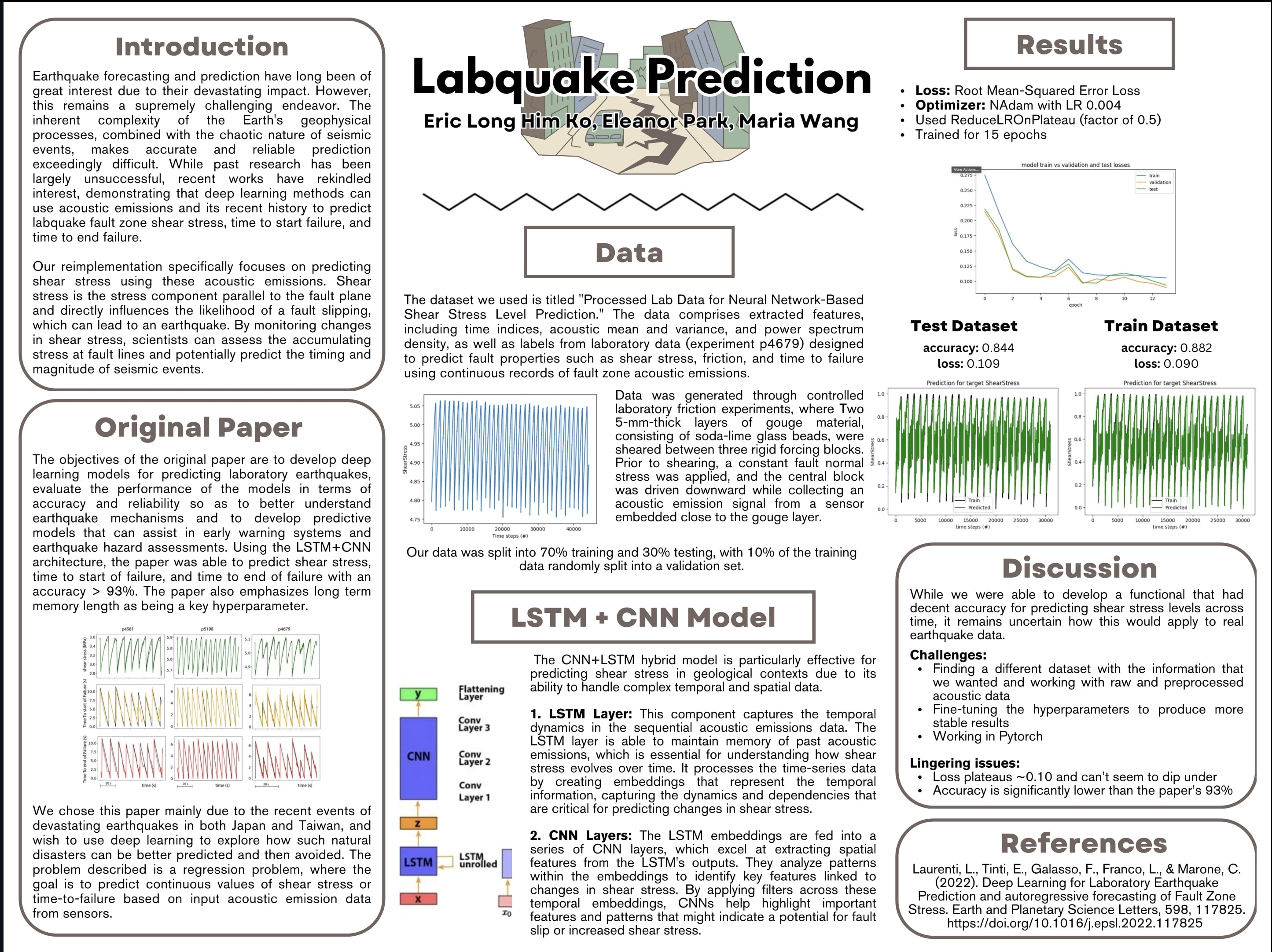
Title: Reimplementing a paper using a combination of LSTM (Long Short-Term Memory) and CNN (Convolutional Neural Network) architectures to predict Shear Stress of laboratory earthquakes using acoustic emissions.
Who: Eric Long Him Ko eko10 Eleanor Park enpark Maria Wang mwang272
Introduction: The objectives of the paper are to develop deep learning models for predicting laboratory earthquakes, evaluate the performance of the models in terms of accuracy and reliability so as to better understand earthquake mechanisms and to develop predictive models that can assist in early warning systems and earthquake hazard assessments.
We chose this paper mainly due to the recent events of devastating earthquakes in both Japan and Taiwan, and wish to use deep learning to explore how such natural disasters can be better predicted and then avoided.
The problem described is a regression problem, where the goal is to predict continuous values of shear stress based on input acoustic emission data from sensors.
Related Work:
In another paper, titled Attention Network Forecasts Time-to-Failure in Laboratory Shear Experiments, the research focuses on forecasting synthetic earthquakes or "labquakes" created in a controlled laboratory setting. Rocks under stress emit small bursts of energy known as acoustic emissions (AE), which are believed to contain predictive information about impending failure. The primary objective is to harness this AE data to forecast the time-to-failure (TTF) of labquakes. In the study, they used Conscience Self-Organizing Map (CSOM) to perform topologically ordered vector quantization based on AE waveform properties, leading to the creation of clusters. These clusters were analyzed over time to identify those with predictive capabilities. Subsequently, Long Short-Term Memory (LSTM) networks and attention-based networks were utilized to test the forecasting power of the selected AE clusters. The final findings was that the attention network was able to forecast TTF and shear stress within a reasonable amount of error for the majority of the test set and overall worked better than the LSTM model. Furthermore, through clustering, it is found that a subset of acoustic emissions contain sufficient information for these tasks and hence network training does not require continuous seismic data, which would make collecting the data and building the model easier.
Original paper implementation: https://github.com/lauralaurenti/DNN-earthquake-prediction-forecasting/blob/main/README.md
Data: The dataset we are using is titled "Processed Lab Data for Neural Network-Based Shear Stress Level Prediction," and it is publicly accessible under DOI 10.15121/1787545 with a CC license. This dataset comprises extracted features and labels from laboratory data (experiment p4679) designed to predict fault properties such as shear stress using continuous records of fault zone acoustic emissions. Features are extracted with a non-overlapping window from the original acoustic data. They include time indices, mean and variance of acoustic data, and power spectrum density across eight different frequency bands, encapsulated from a non-overlapping window analysis of the original acoustic recordings. The labels represent the shear stress levels during each window.
Methodology: The architecture of our model incorporates both LSTM (Long Short-Term Memory) and CNN (Convolutional Neural Network) layers for sequence modeling tasks. Initially, an LSTM layer processes the input sequence to capture long-term dependencies, crucial for understanding temporal progression. This is followed by three 1D convolutional layers, which enhance feature extraction initiated by the LSTM. The convolutional layers scan the sequence in a causal fashion, with each layer designed to progressively increase in complexity and feature detection capability. The first convolutional layer has a hidden size of 64, the second 128, and the third 256, with the last layer outputting the predicted value for the next time step. Training involves optimizing parameters using loss functions like MSE or MAE with optimizers such as Adam. This hybrid model aims to combine the benefits of LSTM for temporal accuracy with the robust feature extraction capabilities of CNNs, offering a potent solution for predicting events like laboratory earthquakes.
Metrics: Since this is a regression project, accuracy is the best metric to analyze the success of our project, which is also what the author used to quantify the results of their model.
Our core aim is to develop and refine a hybrid model combining LSTM (Long Short-Term Memory) and CNN (Convolutional Neural Network) layers, initially inspired by the best-performing model from the research. By adapting this approach within the Pytorch framework, and applying it to a new dataset with data augmentation strategies, we strive to achieve an accuracy surpassing 93%. Furthermore, our ambitious target includes testing and evaluating all models from the study—including LSTM and the Transformer Network—to determine the most accurate model for predicting laboratory earthquake events.
Ethics: Broader Societal Issues: While the intent behind earthquake predictions is noble, aiming to save lives and minimize property damage, there are potential downsides to consider. False alarms resulting from inaccurate predictions can lead to unnecessary panic, evacuations, or trauma within communities. This can erode public trust in the prediction systems and create unnecessary strain on emergency services. Additionally, there's a disparity concern: regions with fewer financial resources or less developed infrastructure might not benefit equally from accurate earthquake predictions due to limited access to early warning systems or preventive measures.
Data Collection Issues: Regarding data collection, the current reliance on laboratory-generated datasets raises certain considerations. While such data collection methods do not infringe upon individuals' privacy, there's a risk that the data may not accurately represent real-world earthquake dynamics. This could lead to the development of flawed prediction models, ultimately impacting the efficacy of disaster preparedness efforts. Furthermore, if future data collection endeavors were to involve actual earthquake data, there's a possibility that the methods used could be intrusive, potentially raising concerns about consent, privacy, and the ethical treatment of communities affected by earthquakes.
Division of labor: We anticipate data preprocessing to be very difficult, so we worked together to convert the data into a usable form. In general, we split parts to work on.
Built With
- colab
- python

Log in or sign up for Devpost to join the conversation.