-
-
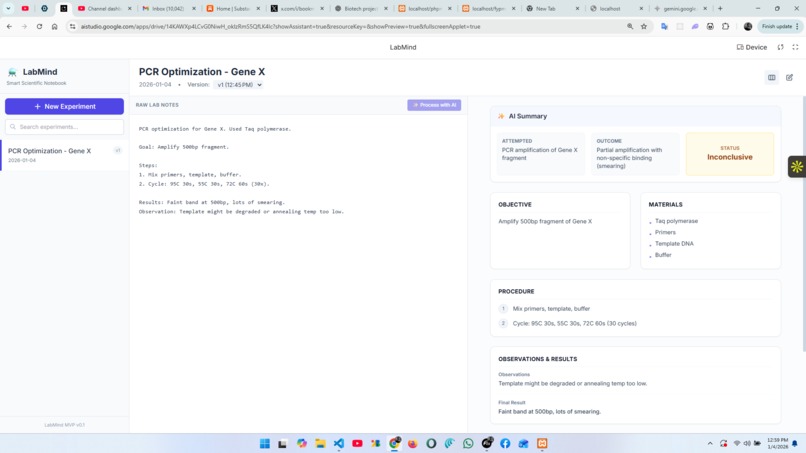
Note taking section
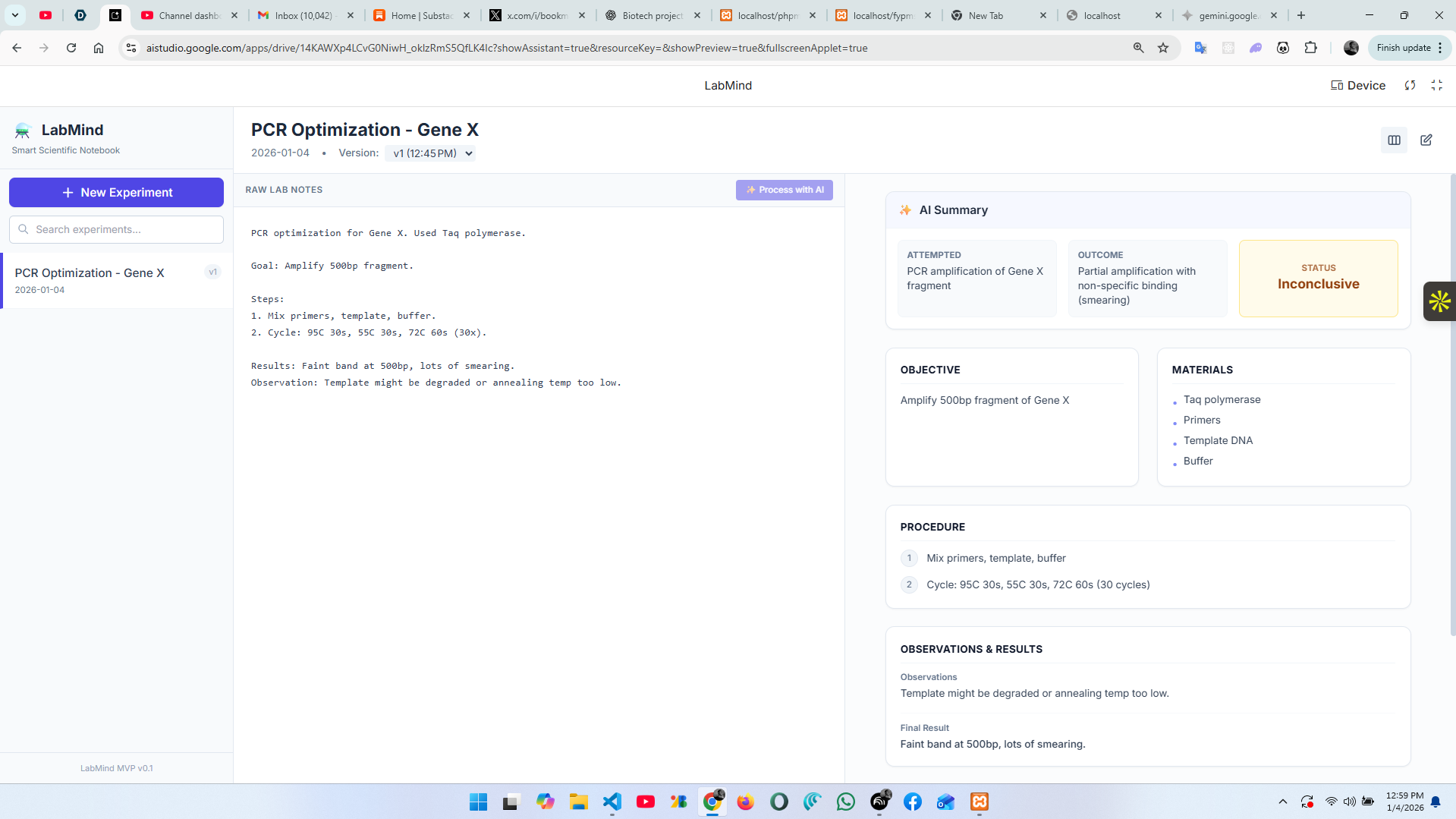
Inspiration
LabMind was inspired by a recurring inefficiency in scientific research: experiments often fail not because the science is flawed, but because knowledge is poorly preserved. In many academic and small biotech laboratories, experiment notes are written in unstructured formats, scattered across notebooks or files, and rarely revisited in a systematic way. When researchers leave a lab, their context and experimental reasoning frequently disappear with them.
At the same time, recent advances in large language models have made it possible for machines to understand and organize messy, human-written text. This created an opportunity to build a system that acts as a persistent scientific memory, helping researchers document, recall, and reason about experiments more effectively.
What it does
LabMind is an AI-powered smart lab notebook designed to improve experiment documentation, recall, and reproducibility. Researchers can enter experiment notes in free text, and the system automatically converts those notes into a structured, searchable experiment record.
Key capabilities include:
- Automatic structuring of experiment notes into objectives, materials, procedures, observations, and results
- Version control for experiments, ensuring that all changes are preserved and auditable
- AI-generated summaries describing what was attempted and what occurred
- Hypothesis-style suggestions for possible next steps
- Search and retrieval of past experiments using keywords or materials
LabMind does not make medical or biological claims. It functions strictly as a documentation and reasoning assistant.
How we built it
LabMind was built as a modular web application with a clear separation of concerns.
The frontend provides a web-based interface for creating, editing, viewing, and searching experiment records. The backend is implemented using a Python-based API that handles authentication, experiment logic, versioning, and AI integration. A relational database stores all experiment data in a structured and auditable format.
An external large language model is used to analyze raw experiment notes. The AI layer is constrained by strict system prompts that prevent hallucination, overconfidence, or medical claims. The overall data flow can be summarized as:
[ \text{Unstructured Notes} \rightarrow \text{AI Structuring} \rightarrow \text{Versioned Storage} \rightarrow \text{Searchable Knowledge Base} ]
This architecture allows LabMind to be useful immediately while remaining scalable for future expansion.
Challenges we ran into
One of the main challenges was controlling AI behavior. Language models tend to generate confident-sounding outputs even when information is incomplete. This required careful prompt engineering and explicit rules that force the AI to acknowledge missing data and frame all suggestions conditionally.
Another challenge was designing for trust. Scientific users require full transparency into how experiment records change over time. Implementing experiment versioning and audit trails added complexity but was necessary to ensure reproducibility and accountability.
Finally, maintaining a strict MVP scope was difficult. It was tempting to add advanced features such as image analysis or protocol automation, but staying focused on the core problem—documentation and recall—was essential.
Accomplishments that we're proud of
- Built a functional AI-assisted lab notebook with experiment versioning
- Designed a system that prioritizes reproducibility and auditability
- Successfully constrained AI behavior to act as a supportive assistant rather than an authority
- Created a clean, scalable architecture suitable for real laboratory workflows
- Developed a clear foundation for future collaboration and expansion
What we learned
This project highlighted the importance of restraint when applying AI to scientific domains. AI is most effective when it supports human reasoning instead of replacing it.
We also learned that in biotech software, trust and transparency outweigh novelty. Features such as version control, data ownership, and conservative AI behavior are critical for adoption. From a technical standpoint, the project reinforced the value of clean system design and modular architecture.
What's next for LabMind
Future development of LabMind will focus on expanding its usefulness while maintaining its emphasis on trust and reproducibility. Planned improvements include:
- Support for experiment images and microscope data
- Collaboration tools for multi-user labs
- Advanced search and cross-experiment analysis
- Compliance-friendly reporting and export features
- Pilot deployments with university and private research labs
The long-term vision is for LabMind to become foundational infrastructure for scientific memory—quietly improving how research is documented, shared, and built upon.

Log in or sign up for Devpost to join the conversation.