-
-
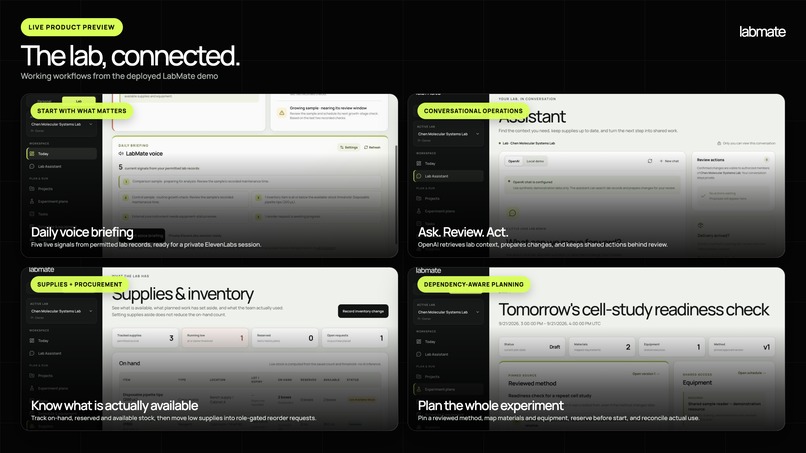
Labmate overview
Inspiration
We’ve both spent the past four years working in academic research labs, and we repeatedly saw the same inefficiencies: scattered spreadsheets, disconnected calendars, unclear task ownership, siloed protocols, inventory issues, and important knowledge living in people’s heads. As aspiring researchers, we wanted to build something that could bring those workflows together and reduce the time labs spend coordinating instead of doing science.
What it does
LabMate is a conversational, AI-powered operating layer for laboratories. It connects inventory, protocols, experiments, equipment, schedules, tasks, projects, files, purchasing workflows, and lab members in one place, while letting users interact through both traditional interfaces and natural-language/voice commands. It can support (not limited to) basic-science, translational, and clinical-lab workflows.
How we built it
We built LabMate with Next.js, React, TypeScript, PostgreSQL, Drizzle, OpenAI, and ElevenLabs integrations. We used OpenAI Codex to accelerate development, while we defined the product, workflows, design, permissions, safety logic, integrations, and testing ourselves, and iteratively debugged and refined the implementation.
Challenges we ran into
The biggest challenge was making a very feature-rich product still feel simple and usable, especially while following Nielsen’s usability heuristics. We also worked through API configuration, authentication, voice integration, database logic, permissions, and making sure AI actions were safe and reviewable instead of blindly executed.
Accomplishments that we're proud of
We’re most proud that LabMate is not just a mockup; it actually works as a connected lab operations system. It already supports persistent inventory, experiments, protocols, equipment booking, recurring duties, project handoffs, scheduling, AI actions, voice interaction, and multiple demo lab environments.
What we learned
We learned that AI becomes much more powerful when it is connected to real structured data and real actions, rather than just answering questions. We also learned how effective AI-assisted development can be when strong domain knowledge, product design, testing, and human decision-making guide the process.
What's next for LabMate
Next, we want to expand integrations with the tools labs already use, including calendars, cloud files, Slack/Teams, ELNs/LIMSs, procurement systems, and vendors. Long term, LabMate can become the intelligent operational layer connecting everything that keeps a lab running, from individual researchers to full lab teams and eventually more advanced clinical-lab deployments.
Built With
- betterauth
- elevenlabs
- next.js
- node.js
- openai
- postgresql
- react
- typescript

Log in or sign up for Devpost to join the conversation.