Inspiration
Scientific and academic research often involves repetitive, time-consuming workflows: finding relevant information, going through documents, extracting evidence, organizing findings, and turning them into useful conclusions.
We wanted to explore a different approach to AI—one that does more than simply answer questions.
That led us to build LabmateAI, an autonomous AI research partner designed to help users execute complex scientific research workflows.
What LabmateAI Does
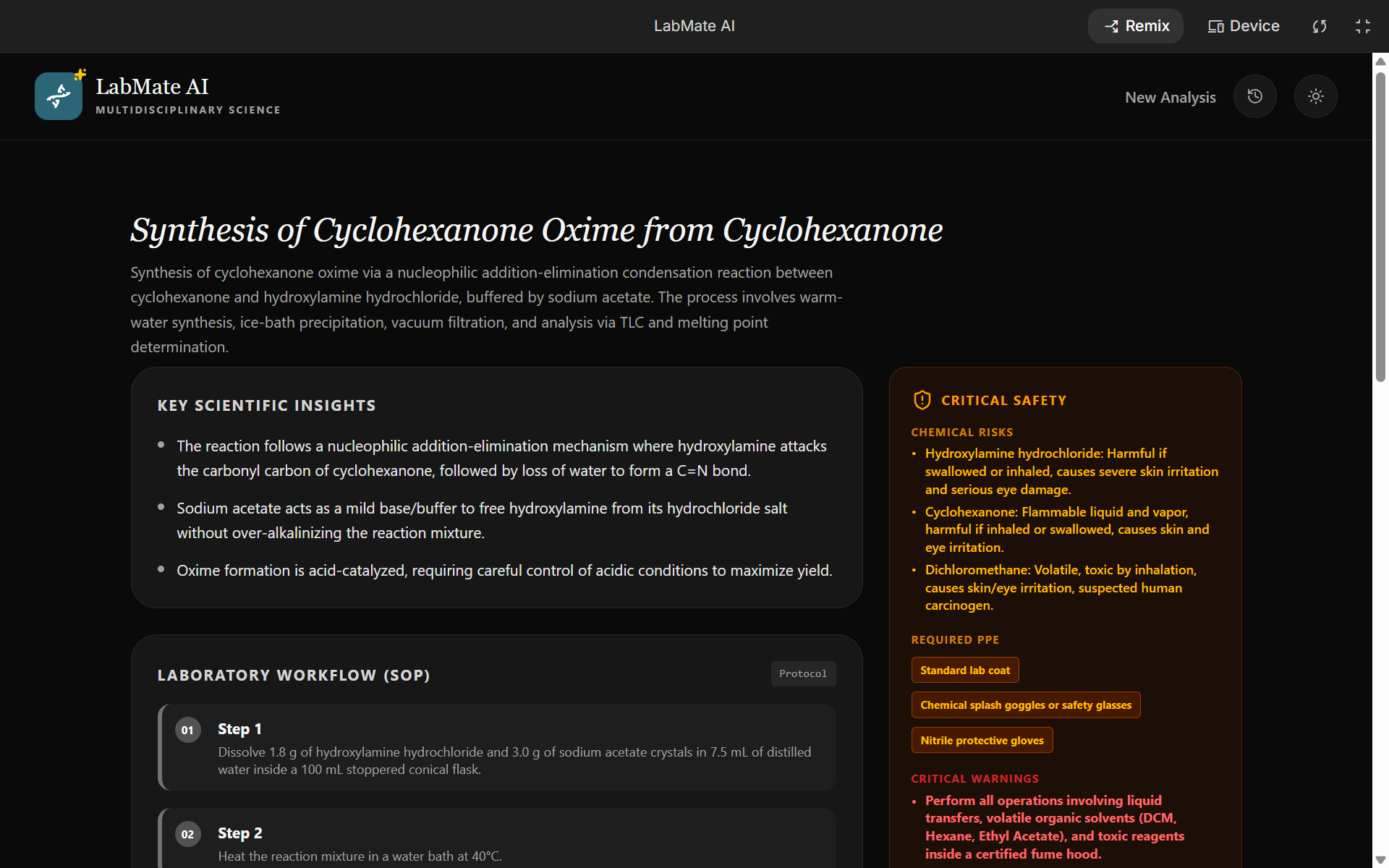
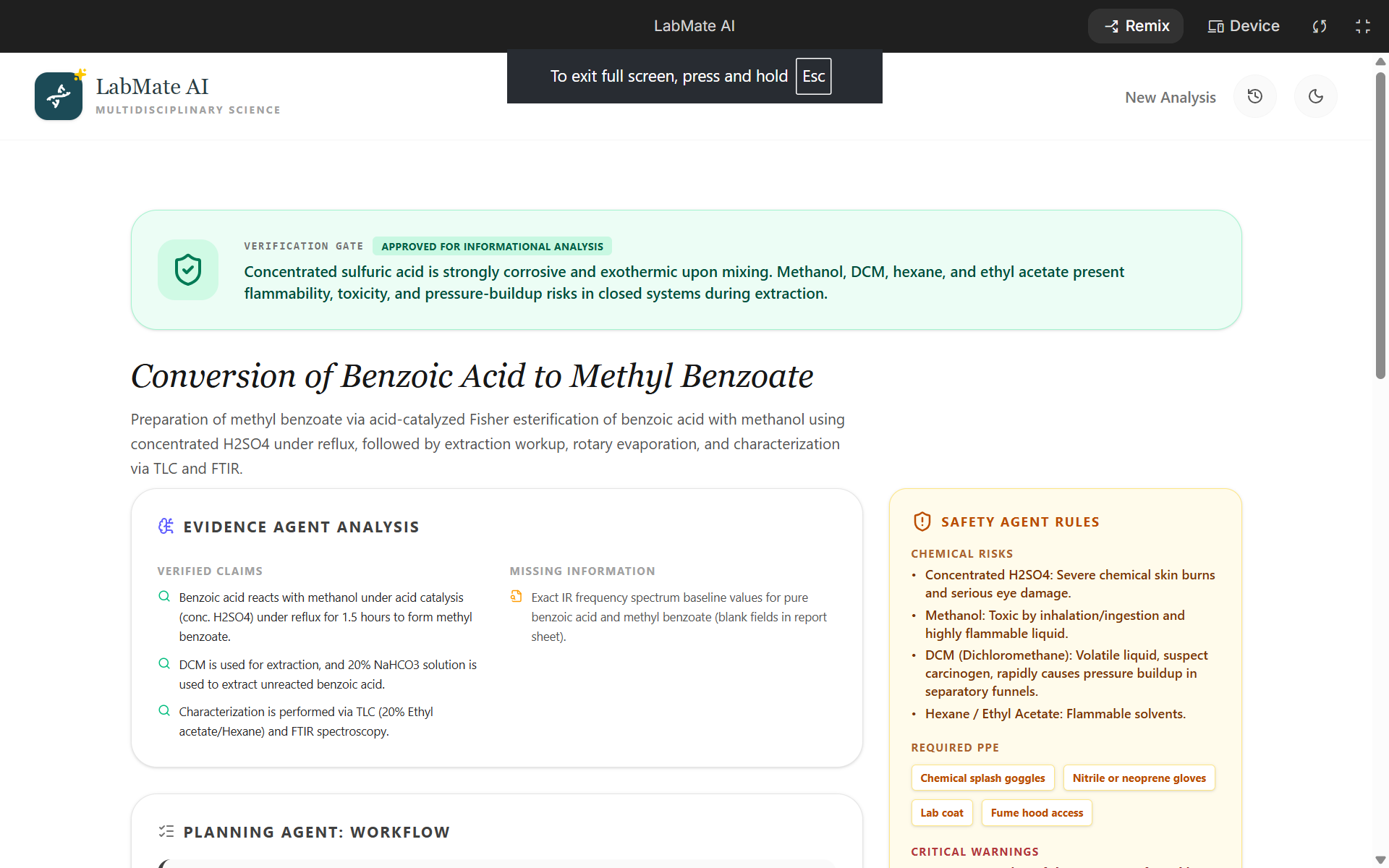
LabmateAI takes a research task from the user and turns it into an actionable workflow.
Instead of relying on a simple question-and-answer interaction, the agent can:
- Understand and break down a complex research task
- Plan the steps required to complete the task
- Retrieve relevant information and sources
- Use available tools to perform research actions
- Analyze and organize the collected information
- Generate a structured, evidence-backed result
- Maintain relevant context throughout the workflow
The goal is to move from "AI that answers" toward "AI that helps execute the work."
How We Built It
LabmateAI was built around Google's agentic AI ecosystem.
The core architecture combines Gemini with a Google agent framework and Google Cloud services. The agent coordinates the research workflow, uses tools when required, retrieves relevant information, and produces the final structured output.
At a high level:
User → LabmateAI Agent → Planning → Tools/Retrieval → Analysis → Structured Result
The application is designed so that the agent, rather than the user, coordinates the individual steps of the workflow.
What We Learned
Building LabmateAI taught us that creating an agent is much more than connecting an LLM to a chat interface.
We learned about:
- Agentic workflow design
- Tool calling and multi-step task execution
- Retrieval-augmented generation
- Managing context and state
- Connecting AI agents with cloud services
- Designing reliable AI workflows
- Evaluating AI-generated results
- Building and deploying an end-to-end AI application
One of our biggest lessons was that giving an AI model more capabilities is not enough—the workflow around those capabilities needs to be carefully designed.
Challenges
One of the biggest challenges was making the system behave like an actual agent rather than a conventional chatbot.
We had to think about how the agent should decide which steps to take, when to use a tool, how to organize retrieved information, and how to present the final result clearly.
We also faced challenges around integrating the agent with external services, managing application state, and deploying the system reliably on Google Cloud.
What's Next
We plan to continue improving LabmateAI with better research workflows, stronger source verification, improved agent evaluation, additional tools, and more reliable long-running task execution.
Our long-term vision is to make LabmateAI a practical AI teammate for students, researchers, and scientific workflows.
Why It Matters
AI can already generate answers in seconds.
We believe the next step is building AI systems that can understand a goal, plan the work, use the right tools, and help complete the task.
That's the idea behind LabmateAI.


Log in or sign up for Devpost to join the conversation.