-
-
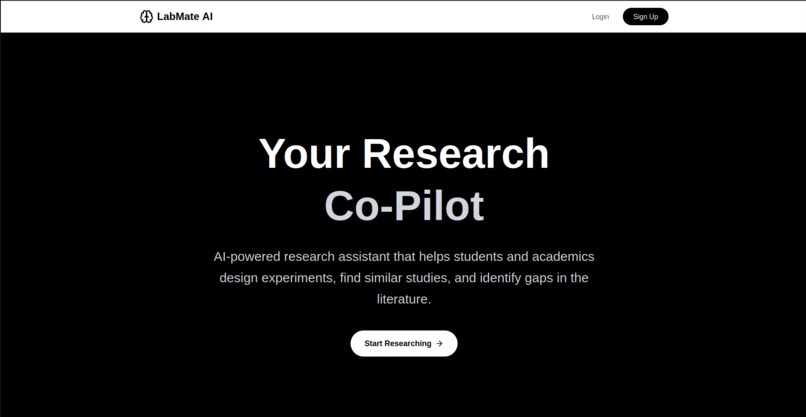
labmate
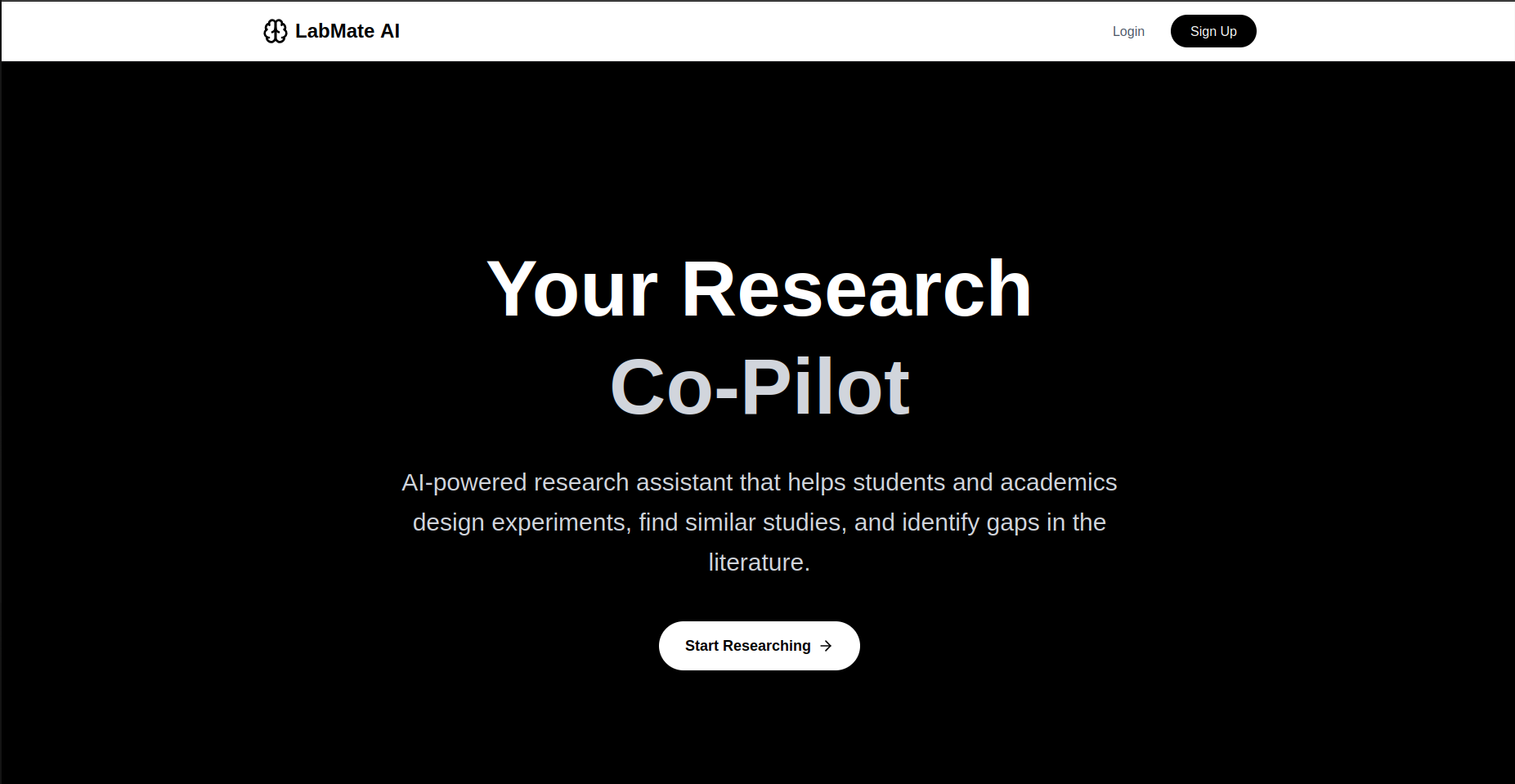
Inspiration
As students and researchers, we often struggle to navigate vast academic literature, identify what's already been studied, and more importantly — what's missing. I wanted to create a tool that bridges this gap, helping anyone from undergraduates to PhD candidates go from a research question to actionable insights quickly. This inspired me to build LabMate AI.
What it does
LabMate AI helps users:
- Design experiments
- Get summarized research on any question
- Find similar work
- Identify literature gaps
- And most importantly, do all of this with academic references.
How we built it
LabMate AI is a full-stack application built using:
- Frontend: Next.js (React)

- Backend: FastAPI

- Database: PostgreSQL
But the real power comes from how the Perplexity Sonar API was integrated, which enables deep academic research capabilities. We crafted custom prompts for four use cases:
- Research Summary

- Similar Work

- Literature Gaps

- Experiment Design
Depending on the task, I used either:
- sonar-deep-research for comprehensive, citation-backed answers

- sonar-reasoning-pro for reasoning-intensive tasks
I fine-tuned how prompts were structured and dynamically adjusted web search context for improved accuracy — especially when finding related work.
Users can save projects and revisit them later through a clean dashboard, making it perfect for iterative research workflows.
Challenges we ran into
Prompt Engineering: One of the biggest challenges was crafting prompts that reliably returned high-quality, citation-rich responses. I had to iterate on tone, phrasing, and task-specific keywords to align with Perplexity Sonar's strengths.
Handling Diverse API Outputs: Since different tabs (e.g., "Research Summary" vs. "Similar Work") required different models and settings, I needed to dynamically manage model selection and parsing of varied API responses.
Accomplishments that we're proud of
Seamlessly integrated Perplexity Sonar API to provide accurate, citation-rich research summaries and suggestions.
Built a full-stack system with Next.js, FastAPI, and PostgreSQL, including user authentication and persistent project saving.
Created an intuitive UX flow from question input to viewing, saving, and revisiting results.
Enabled four core research assistant features: summary, similar work, literature gaps, and experiment design, each supported with real academic sources.
Delivered a functional MVP under time constraints while maintaining clean design and reliability.
What we learned
How to effectively use the Perplexity Sonar API for deep academic research use cases.
The importance of prompt customization to align model output with user expectations.
Managing full-stack web application development, including authentication, state persistence, and asynchronous API integration.
Structuring a product that supports modular research tasks, while ensuring ease of use and scalability.
What's next for LabMate AI
Collaboration Features: Allow users to invite peers or advisors to collaborate on saved research projects.
Auto-Citation Tool: Automatically generate formatted citations (APA, MLA, Chicago) from references returned by the AI.
PDF Upload & Analysis: Enable users to upload research papers and ask questions directly about their content.
Notebook Integration: Add the ability to take notes, tag findings, and organize insights within each project.
Built With
- bcrypt
- fastapi
- html5
- javascript
- next.js
- passlib
- postgresql
- python
- python-jose
- sqlalchemy
- tailwindcss

Log in or sign up for Devpost to join the conversation.