Inspiration
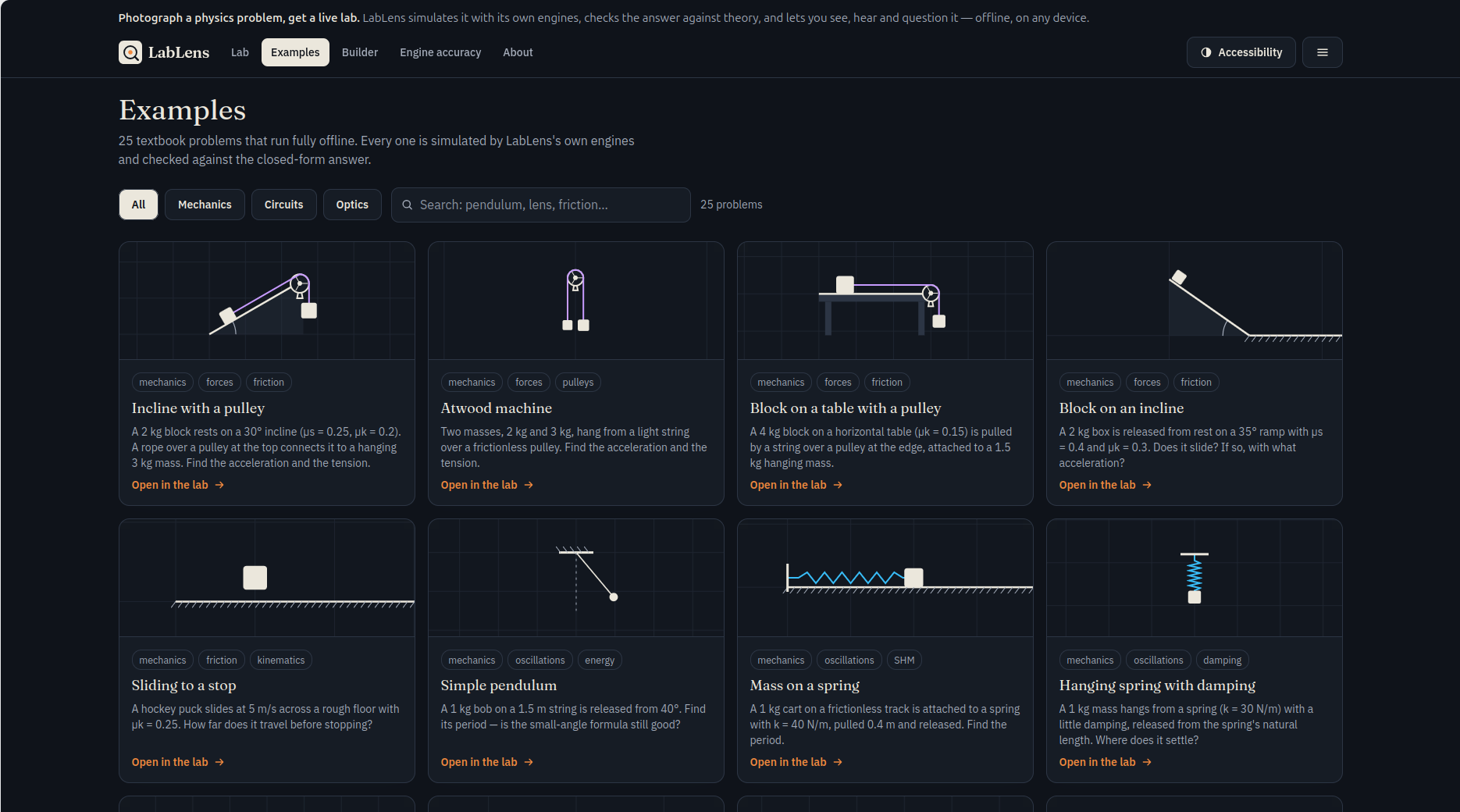
Most physics students meet a pulley as a drawing and an equation. They can compute a = 3.24 m/s² but never watch the block accelerate or ask "what if the hanging mass doubles?". In TIMSS 2019, only 36% of fourth-graders internationally attended a school with a science lab, and in South Africa 17.4% of public schools have one. For blind and low-vision students, diagram-heavy physics is closed off almost entirely. Existing simulators offer fixed menus of scenes, so none of them can simulate the problem on your worksheet. We wanted the worksheet itself to become the lab.
What it does
- Perceive: photograph a textbook diagram or a hand sketch, or type the problem. LabLens builds a typed Scene Graph using a free vision model (Gemini's free tier, or a local Ollama model for offline schools), validated and auto-repaired, or an offline rule-based parser. It then shows "Did I understand this correctly?" with what it read, what it assumed, and its confidence.
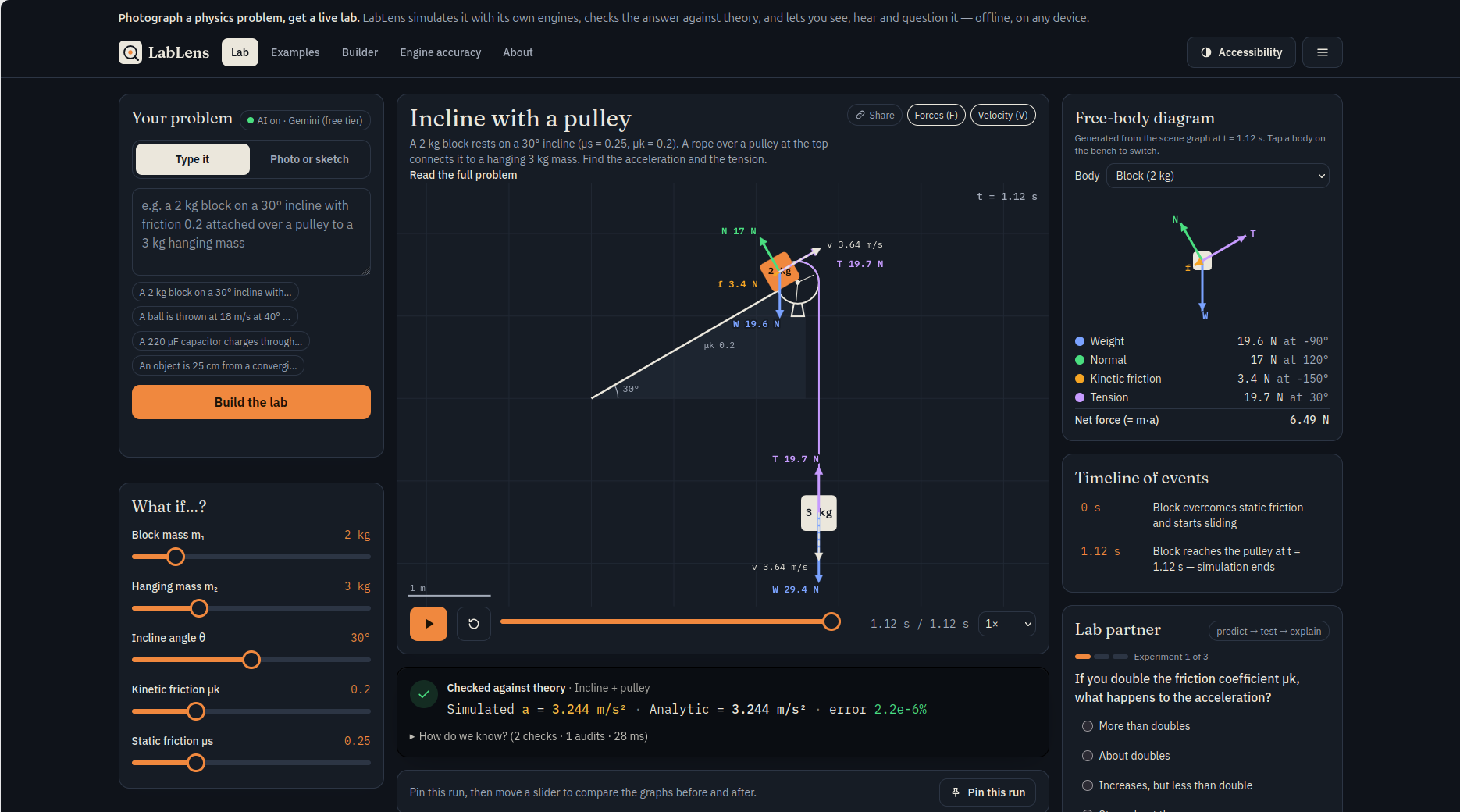
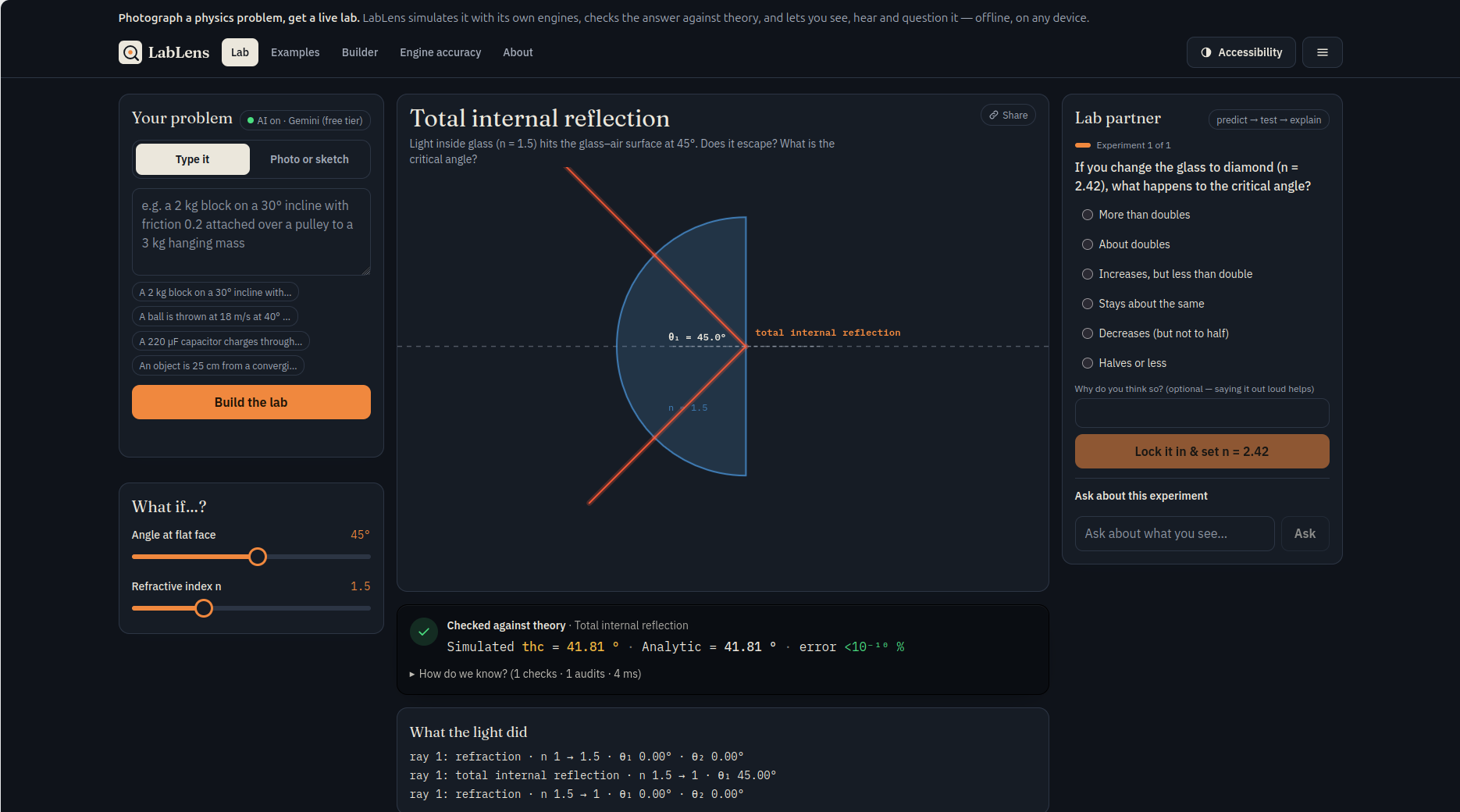
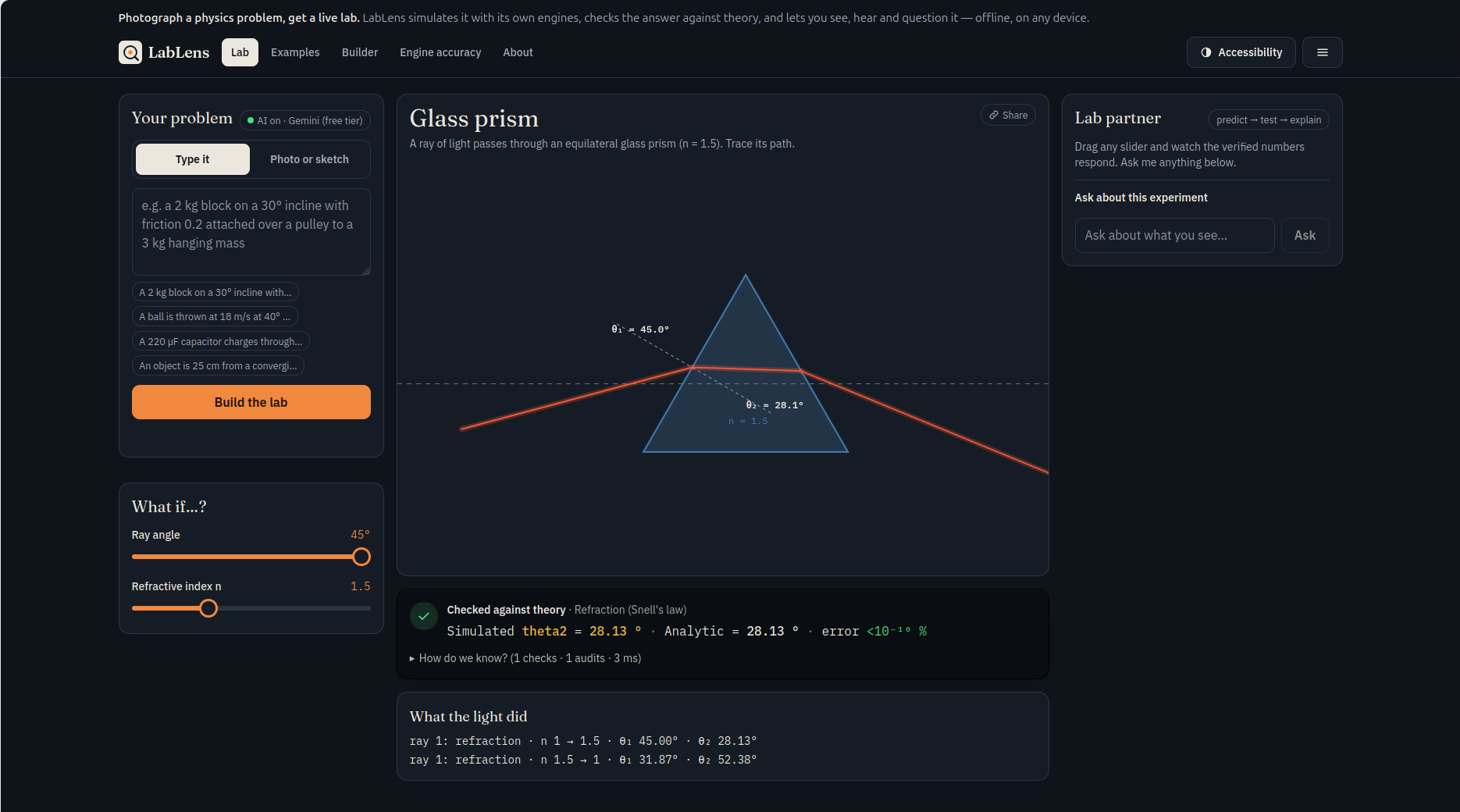
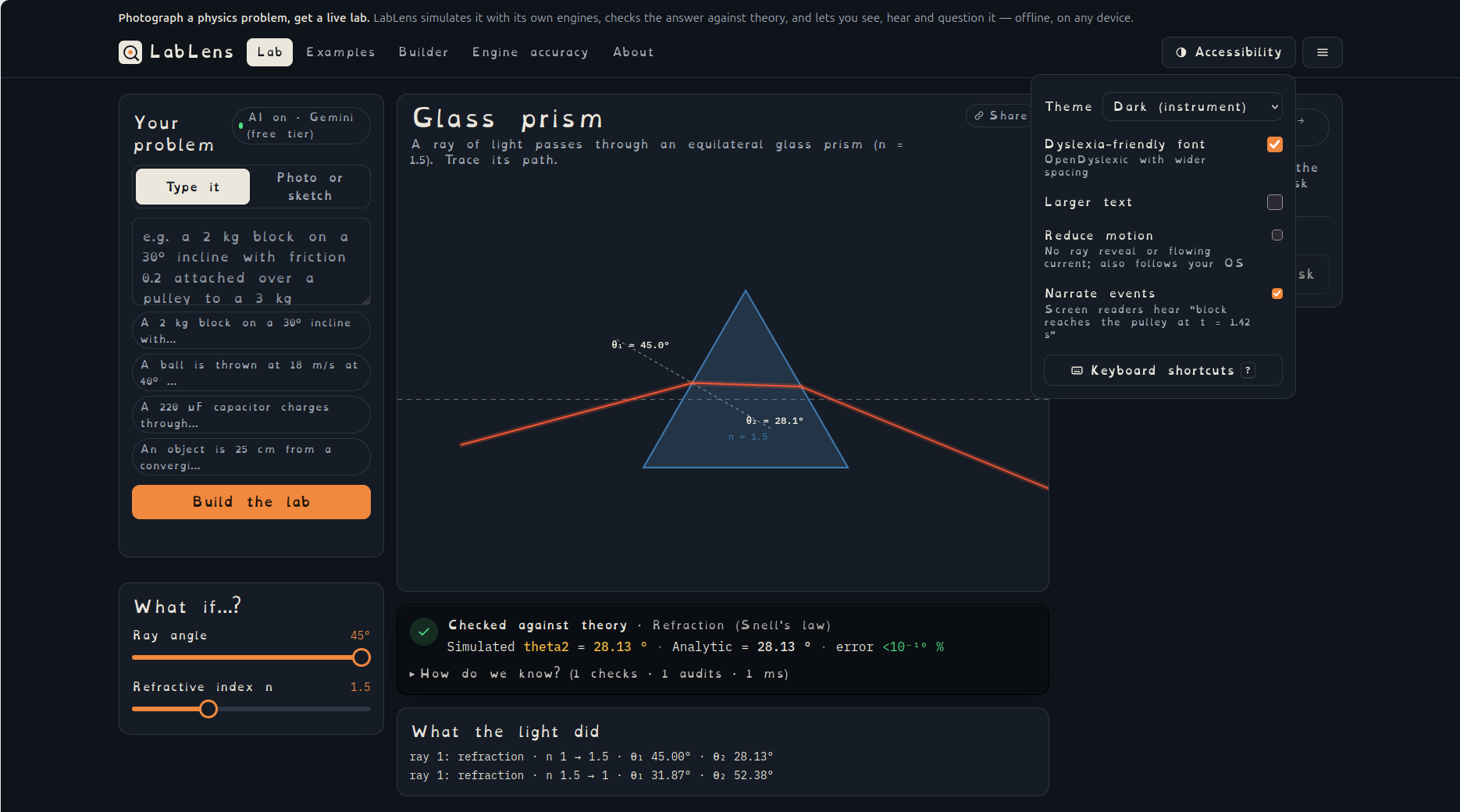
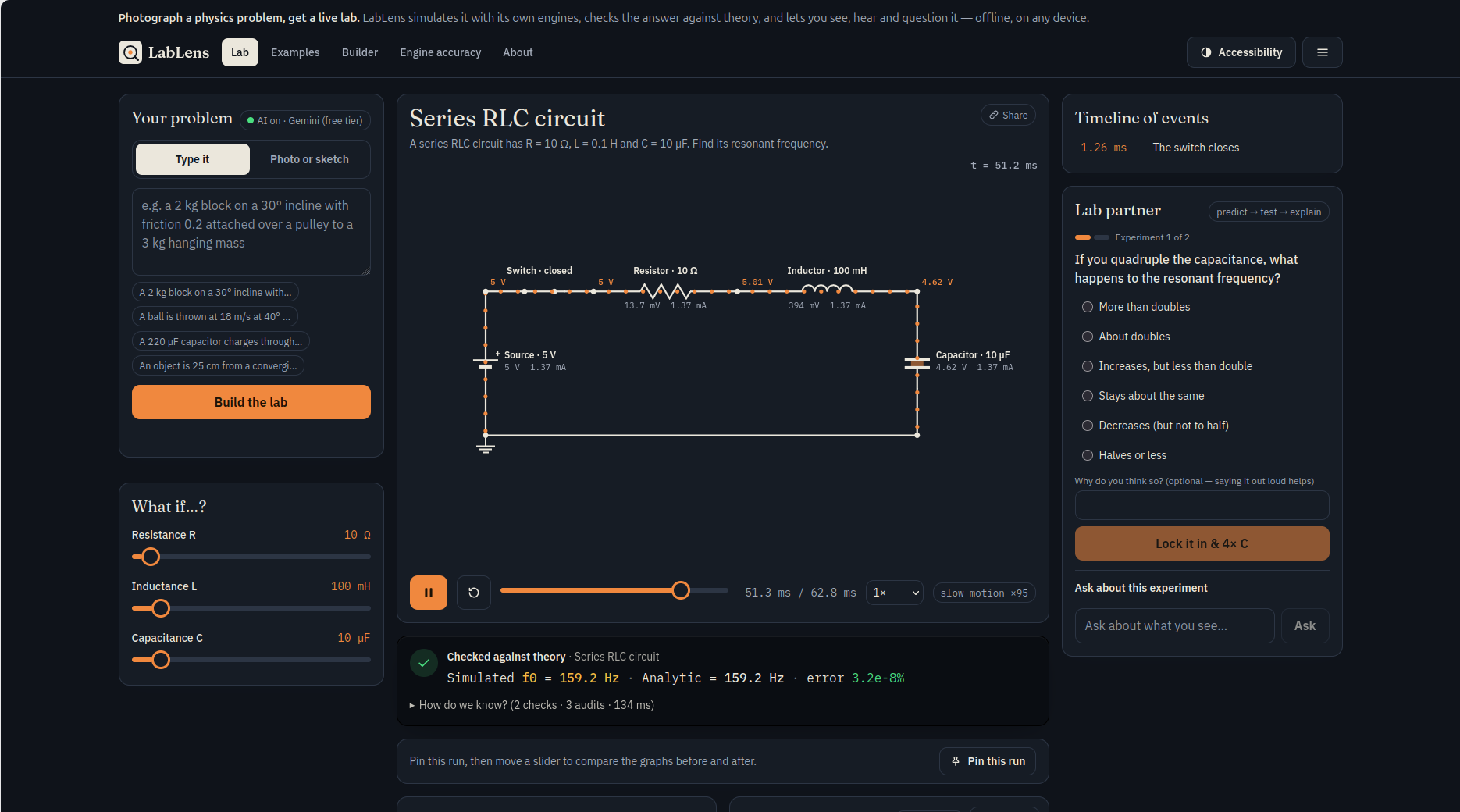
- Simulate: three engines we wrote from scratch. Constrained mechanics (ropes over pulleys, static and kinetic friction, springs, pendulums, collisions, drag); circuits by Modified Nodal Analysis (RC/RL/RLC transients, switches, AC resonance); a ray tracer (Snell's law, total internal reflection, mirrors, thin and thick lenses).
- Verify: every recognised problem shows Simulated a = 3.244 m/s² · Analytic = 3.244 m/s² · error 2e-6%, the answer key computed two independent ways. Every scene also passes energy, Kirchhoff, Tellegen or Snell audits.
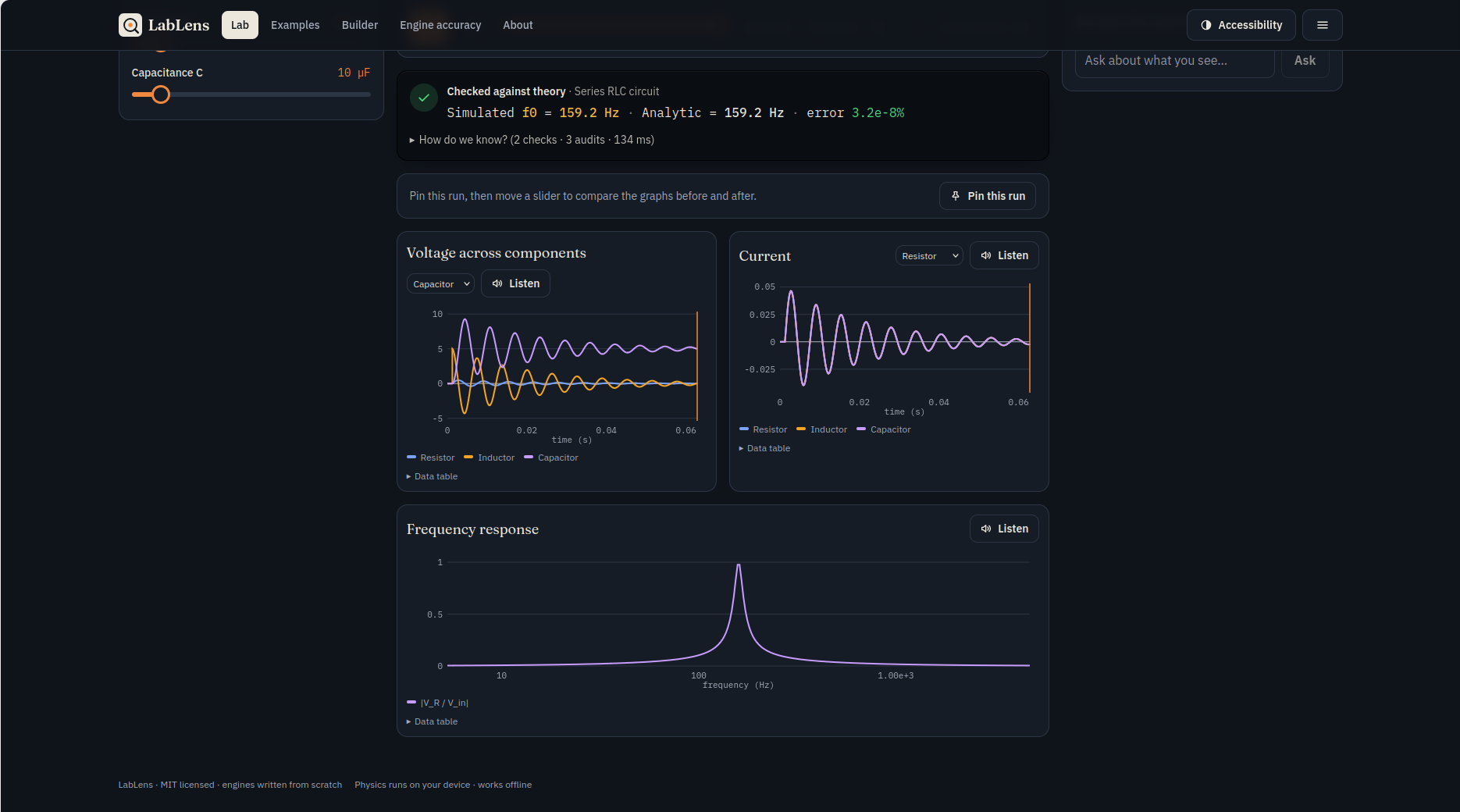
- Explore: sliders for every parameter, play/scrub, live plots, force arrows and an automatically generated free-body diagram.
- Learn: predict → test → explain. You commit to a prediction, LabLens runs the experiment, and the simulation decides whether you were right. With AI on, a Socratic tutor that sees the live lab proposes experiments.
- Include everyone: hear any graph (sonification), live narration for screen readers, full keyboard control, data tables, OpenDyslexic, reduced motion, and an offline PWA.
How we built it
TypeScript monorepo. @lablens/engine is framework-free: Lagrange-multiplier constraint solving with our own Gaussian elimination, RK4/Verlet/symplectic integrators with RATTLE-style projection, Coulomb friction with stick/slip detection, MNA with trapezoidal companion models and a complex AC solver, a 2D ray tracer with Fresnel transmission, and an analytic layer that recognises more than 20 textbook archetypes (including the exact large-angle pendulum period via the elliptic integral K computed with the AGM). The engines run in a Web Worker. The front end is React 19, Vite 8, Tailwind 4 and custom Canvas renderers, with Web Audio for sonification and Workbox for offline use. The AI layer is serverless functions with a provider-agnostic client that defaults to free models (Gemini free tier, or Ollama locally; OpenRouter, Groq and Claude optional) with the Scene Graph's JSON Schema in the prompt, Zod plus semantic validation, and a repair loop. Quality checks: 129 tests, a 39-case closed-form accuracy suite that also runs live in the app, CI (lint, format, types, tests, build), axe and Lighthouse audits.
Challenges we ran into
- A pendulum that leaked energy: RK4's intermediate stage points dipped about 10⁻⁷ m inside the string's circle, so the string was briefly treated as slack. Deciding engagement per step instead of per stage cut the energy error from 0.2% to 10⁻⁸ %.
- Switches in circuits: modelling a closed switch as a 1 µΩ resistor broke our Kirchhoff audit. Rewriting switches as exact branch equations, landing time steps exactly on switch instants and re-initializing the state fixed both the audit and the trapezoidal "ringing".
- Measuring periods honestly: zero crossings of position are biased for damped motion; velocity zero crossings are not.
- Making AI output trustworthy: a schema alone can't catch "this rope connects to a body that doesn't exist", so we added semantic validation and fed the exact errors back to the model.
Accomplishments that we're proud of
- 39/39 closed-form validation cases pass, most to better than 10⁻⁶ %. Measured integrator orders are 4.000, 2.000 and 1.002.
- Judges can rerun the whole accuracy suite in their own browser in about 2 seconds.
- axe: 0 violations across 7 pages × 2 themes. Lighthouse: accessibility 100, performance 93–97 (mobile, across runs) and 100 (desktop).
- The simulation, not a hard-coded answer key, grades the student's prediction.
What we learned
Constraint forces are worth computing exactly; they make free-body diagrams honest. Verification needs independent code paths. And accessibility features like sonification and narration turned out to be useful to every student, not just the ones we designed them for.
What's next
Classroom pilots and testing with blind students; a labelled benchmark of real worksheet photos to measure parsing accuracy; rigid-body rotation; diodes and transistors; wave optics; translations; teacher-shareable scene links.
Built With
- axe-core
- canvas
- eslint
- gemini
- lighthouse
- ollama
- pwa
- react
- tailwindcss
- typescript
- vercel
- vite
- vitest
- web-audio-api
- web-workers
- workbox
- zod


