🚀 LabLeap: The Trust Layer for Global Research
💡 Inspiration: The "Funding Desert"
I am a Media Studies scholar, not a computer scientist. I am using programming tools first time in my life. For the past year, I have been searching for a funded PhD position, and I hit the same wall that millions of other students face: The Funding Desert.
I found myself navigating fragmented university websites, sending cold emails to professors who never replied, and guessing if I was even eligible for their labs. On the other side, I spoke to professors who were drowning in thousands of unverified, "spammy" applications from students who hadn't even read their research papers.
I realized this wasn't a shortage of talent or money; it was a shortage of Trust. I decided to build LabLeap to bridge this gap using the power of Gemini 3.
🛠️ What it does
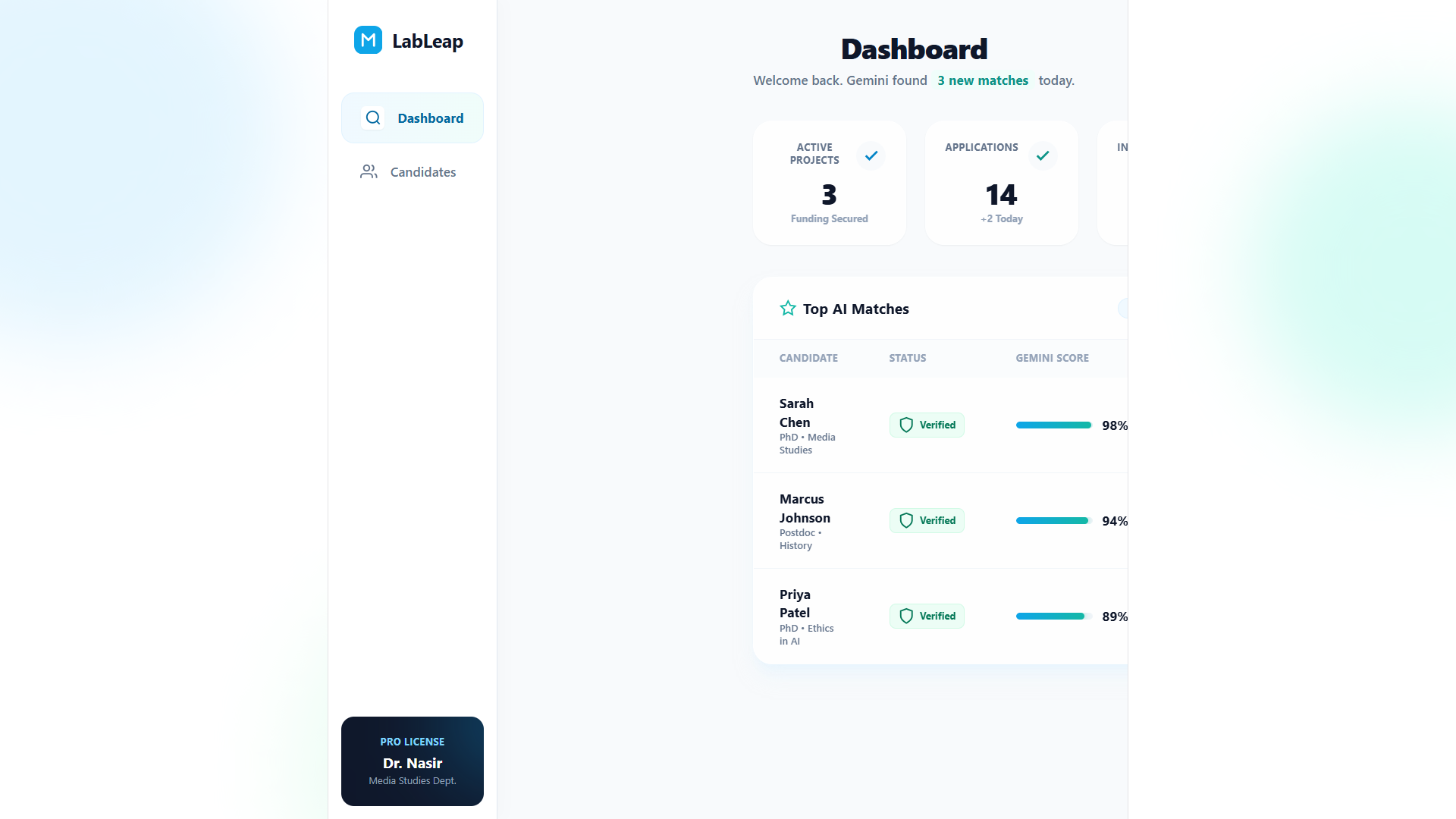
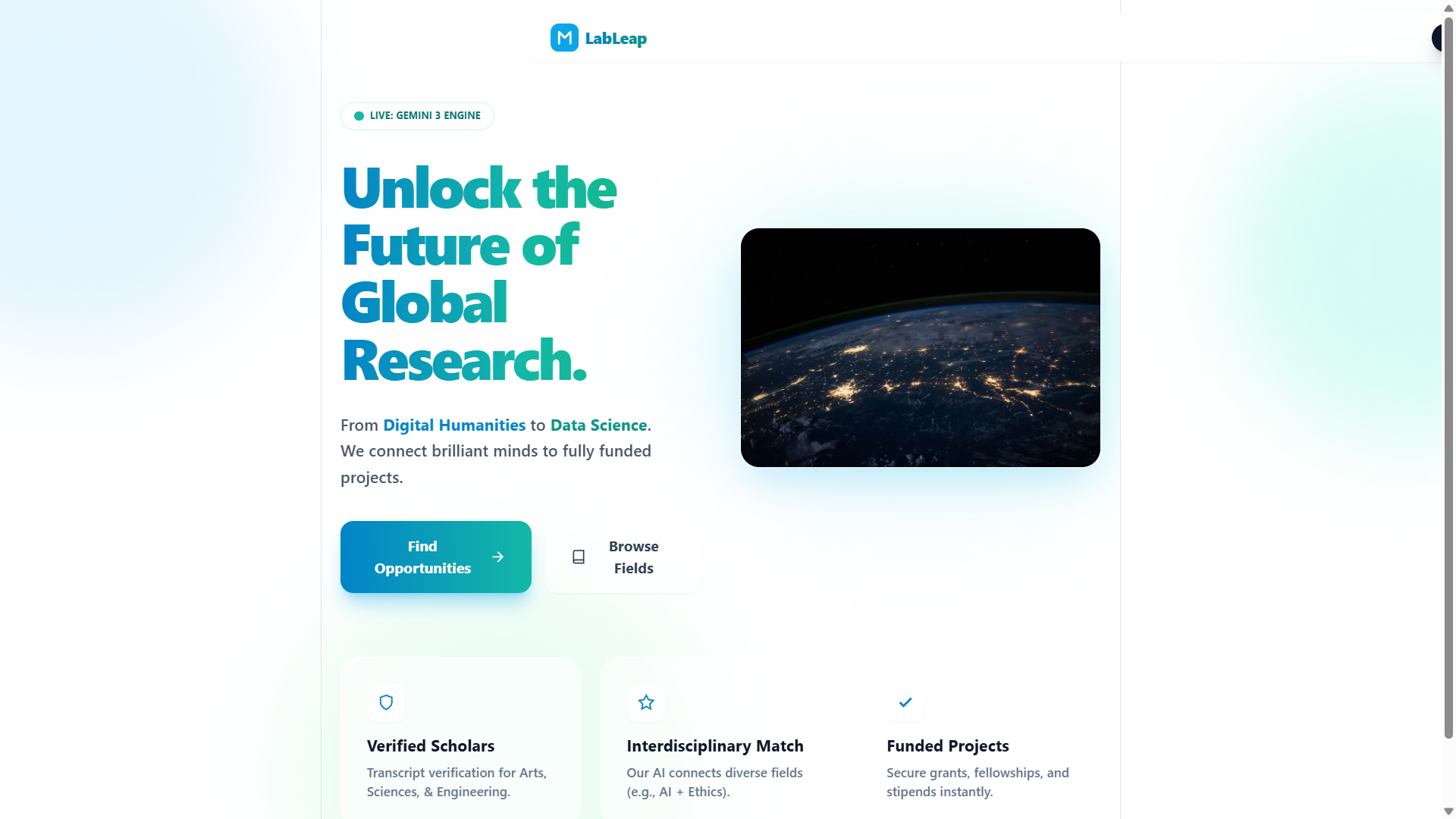
LabLeap is an agentic marketplace that connects verified scholars to funded research projects. Unlike traditional job boards, LabLeap uses Gemini 3 to act as a "Digital Registrar."
- Automated Verification: Students upload transcripts, and Gemini 3 extracts the data to verify GPA and coursework against university standards.
- Semantic Matching: Instead of keyword matching, our "Match Engine" reads a student's past research (via ORCID) and compares it semantically to a professor's project description.
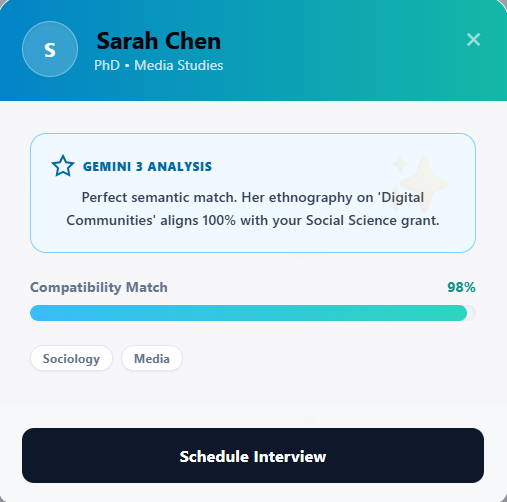
- Smart Compatibility: It generates a human-readable "Compatibility Report" explaining why a student is a good fit.
⚙️ How we built it (The Agentic Workflow)
As a non-technical founder, I built LabLeap entirely using Agentic Development tools. I didn't write the code; I directed the AI to write it for me.
- Architecture & Database: I used Gemini 3 Pro to design a scalable Firestore schema that distinguishes between
User:StudentandUser:Professorroles. - Frontend Engineering: I used Google Stitch to "vibe-code" the interface. I described a "clean, academic aesthetic with a modern startup feel," and the agent generated production-ready React components with Tailwind CSS.
- The Logic Layer: I used Google Antigravity as my IDE. I prompted it to build the verification logic, connecting the frontend inputs to the backend processing.
🧠 The Math Behind the Match
To ensure fairness, LabLeap calculates a Compatibility Score ($C_s$) using a weighted algorithm processed by Gemini's reasoning engine:
$$ C_s = \frac{w_1 \cdot S_{rel} + w_2 \cdot A_{perf} + w_3 \cdot P_{hist}}{100} $$
Where:
- ( S_{rel} ) = Semantic Relevance (How well the student's past work aligns with the lab's focus).
- ( A_{perf} ) = Academic Performance (Normalized GPA and coursework rigor).
- ( P_{hist} ) = Publication History (Verified citations from ORCID).
- ( w_{1,2,3} ) = Customizable weights set by the professor (e.g., valuing research over grades).
🚧 Challenges we ran into
- The "Hallucination" Risk: Early on, the AI would sometimes invent university names. I learned to implement "Grounding" by forcing the model to cross-reference inputs against a trusted list of accredited institutions.
- Prompt Engineering: Learning to speak "Agentic" was a curve. I realized that vague instructions lead to vague code. I had to learn to be extremely specific about data types and component structures.
🏅 Accomplishments that we're proud of
- Zero-Code Deployment: I successfully deployed a fully functional, interactive React application to Firebase Hosting without writing a single line of manual JavaScript.
- The "Wow" Factor: Integrating the Gemini 3 analysis modal (which explains the match reasoning) felt like magic the first time it worked.
🎓 What I learned
This hackathon proved to me that domain expertise > coding syntax. My background in Media Studies helped me understand the human problem of recruitment, while Gemini 3 handled the technical problem of implementation. I learned that in 2026, anyone with a vision can be a builder.
🔮 What's next for LabLeap
- Gemini Live Integration: We plan to add a feature where students can practice their viva voce (oral defense) with an AI agent trained on the professor's specific research style.
- Smart Contracts: Automating the stipend release process using blockchain to ensure students get paid on time, every time.
Built With
- firebase
- firebase-studio
- gemini-3-pro
- google-antigravity
- google-stitch
- javascript
- nano-banana
- react
- stackblitz
- tailwind-css


Log in or sign up for Devpost to join the conversation.