-
-
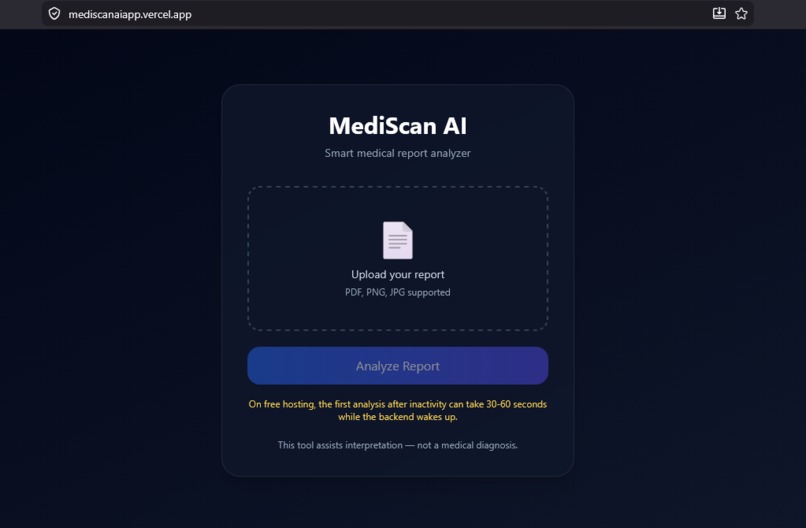
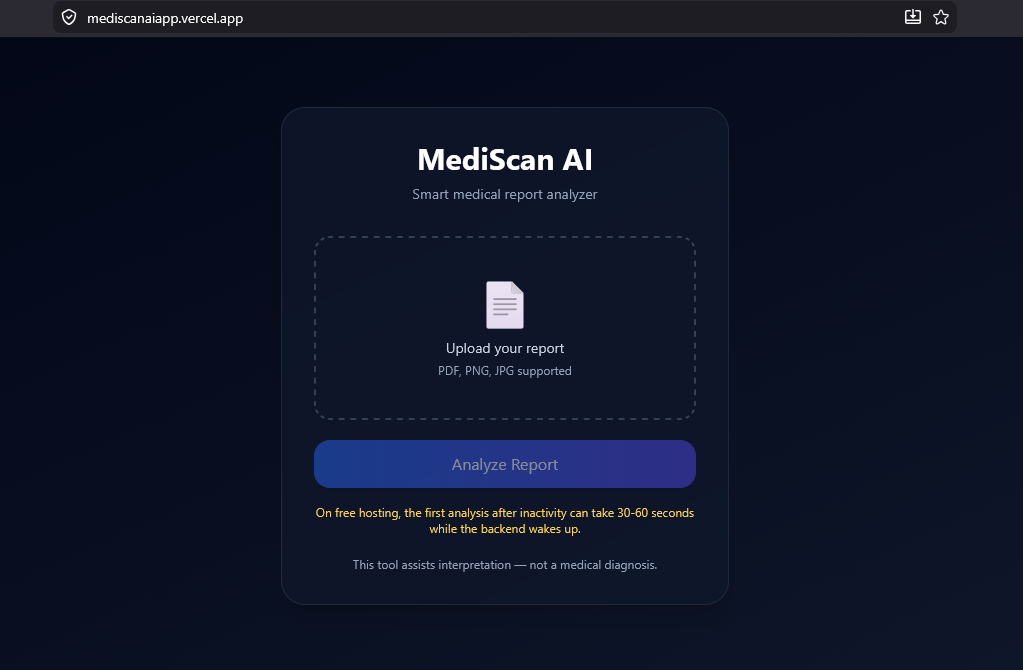
MediScan AI web interface for uploading medical reports and generating clear, AI-assisted analysis.
-
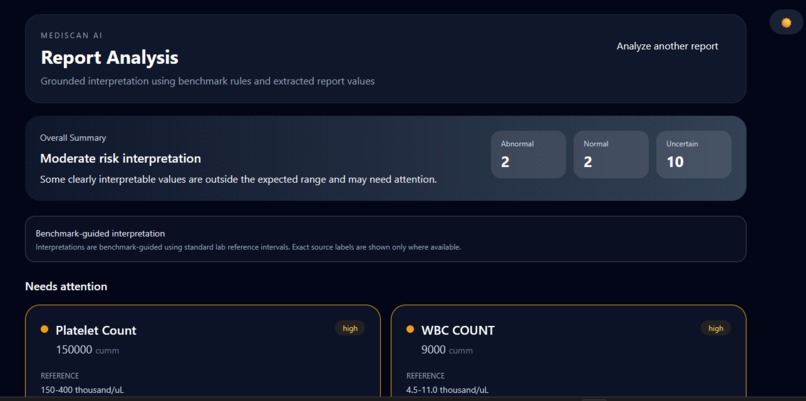
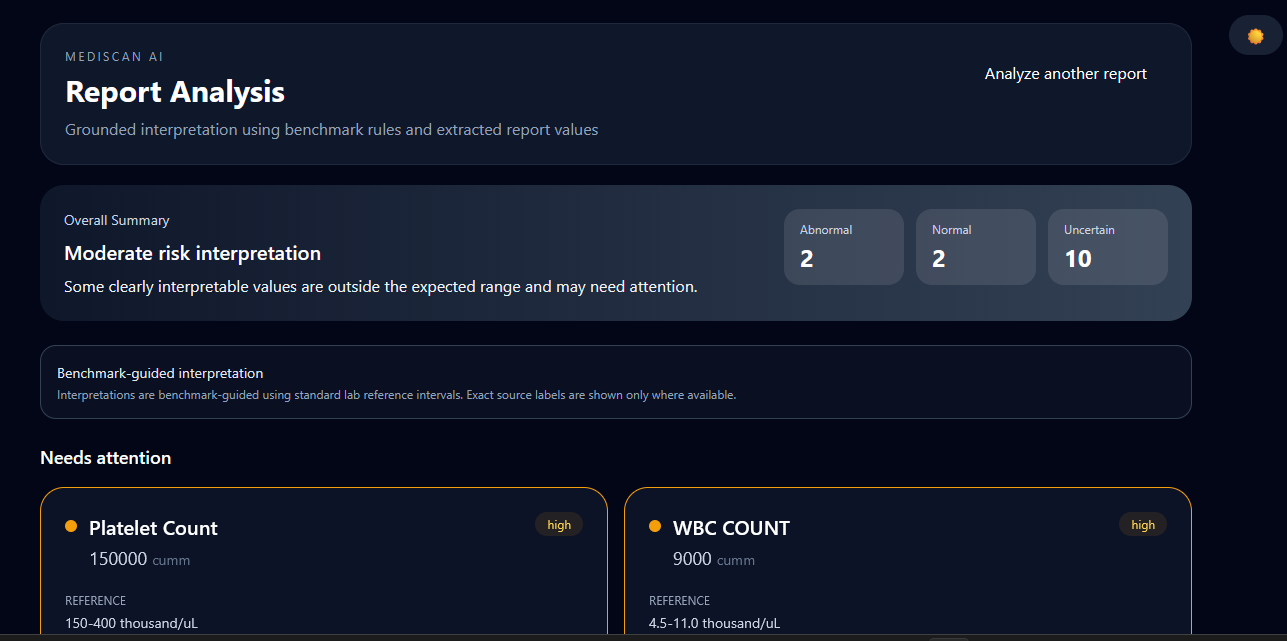
MediScan AI analysis dashboard showing benchmark-guided report interpretation, overall risk summary, and flagged values needing attention.
-
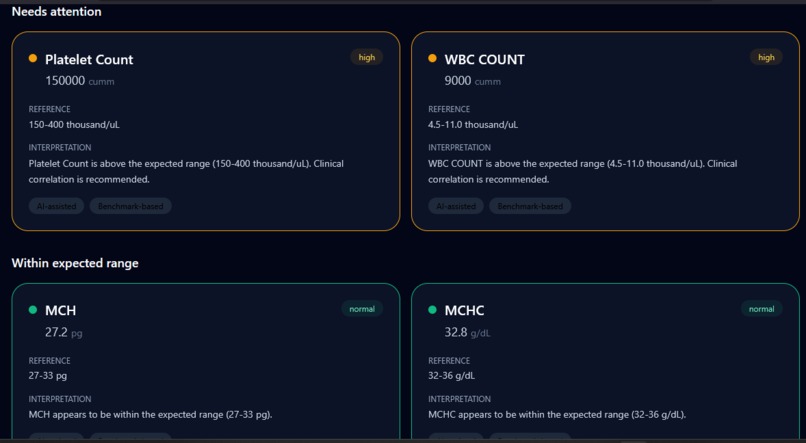
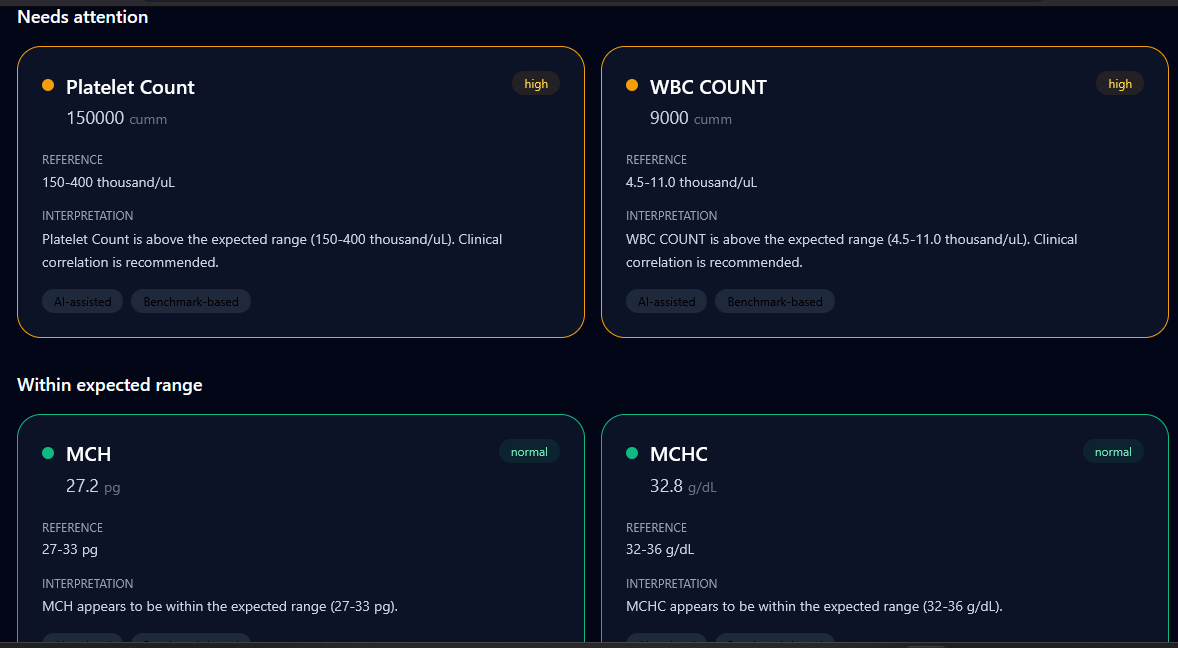
Biomarker cards with benchmark-based explanations
-
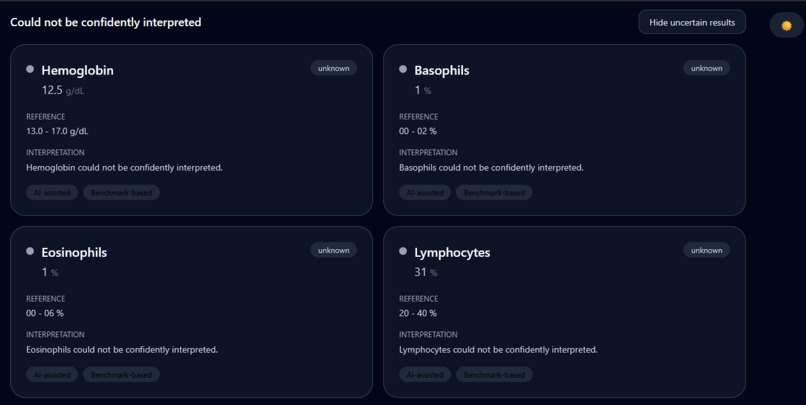
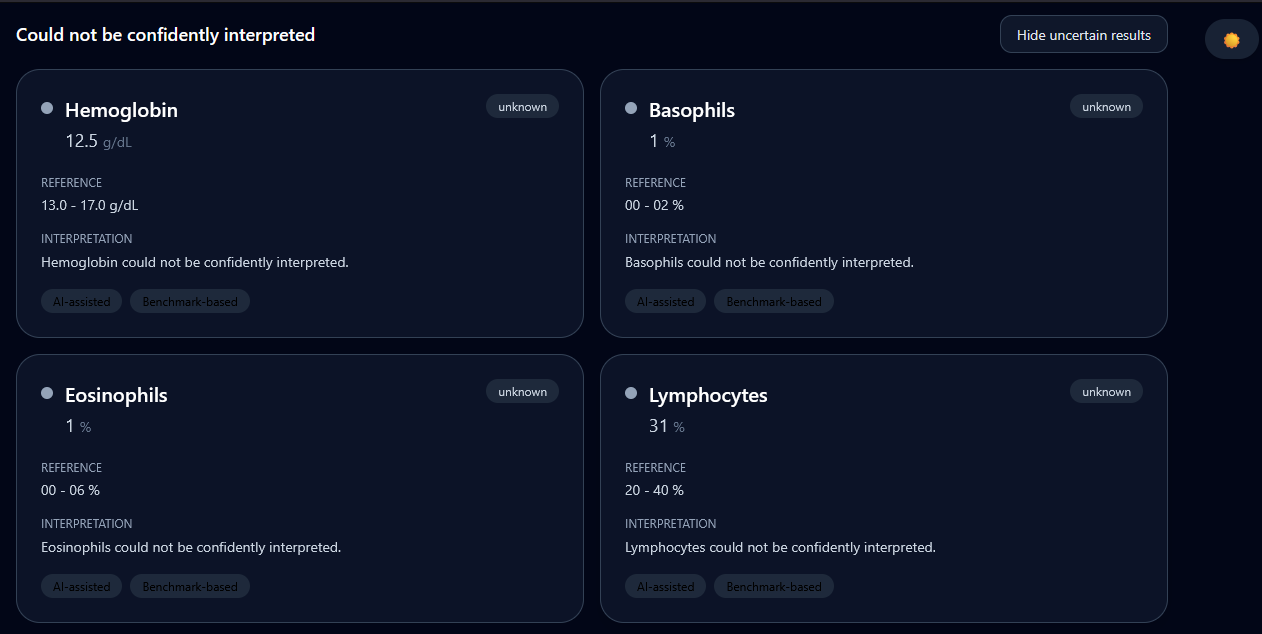
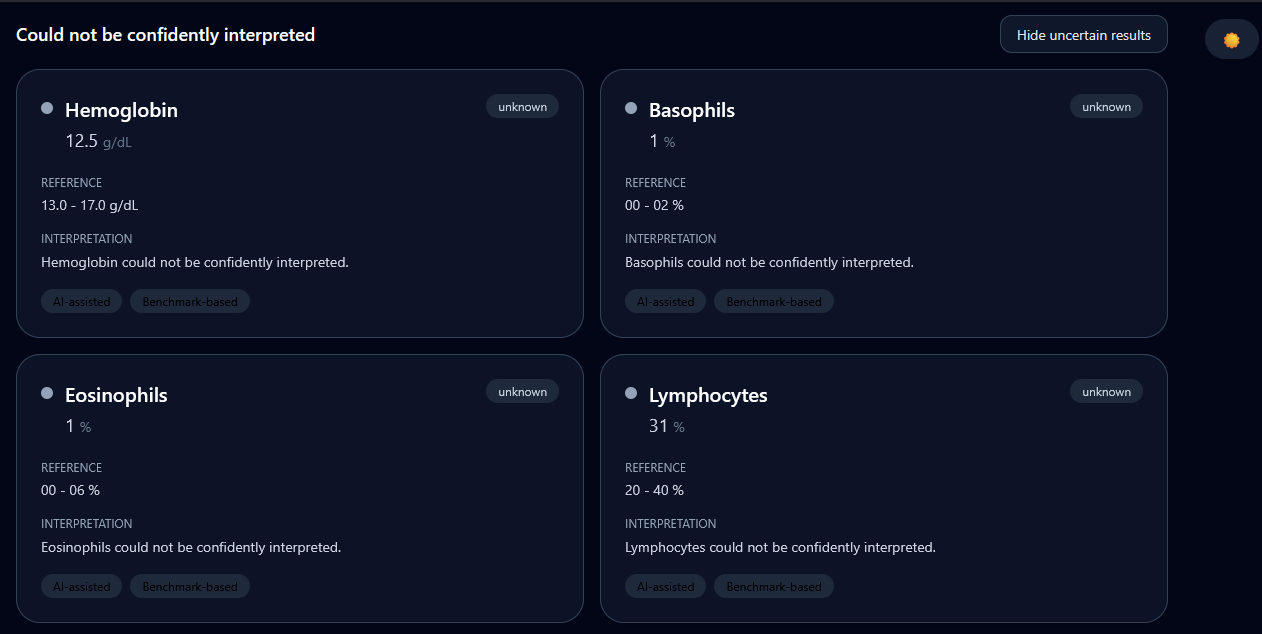
Uncertain-result cards in MediScan AI, clearly separating biomarkers that could not be interpreted with high confidence.
-
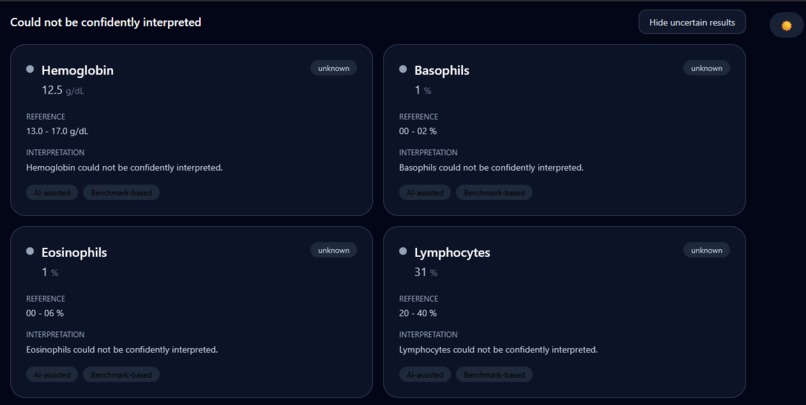
Follow-up Q&A for report interpretation
Inspiration
Understanding medical reports is still difficult for many people, especially when the report contains technical terminology, reference ranges, abbreviations, and values that are hard to interpret without a clinical background. In many cases, patients receive their lab results before they can speak to a doctor, which creates confusion, anxiety, and misinformation. This problem becomes even more serious in low-resource settings, where clear medical communication is not always accessible.
LabGuide AI was built to address this gap. The goal was not to replace clinicians or generate diagnoses, but to make health reports easier to understand in a safe, structured, and user-friendly way. The project was inspired by a simple question: how can AI help patients understand what is abnormal in a report, what those values may indicate in general, and what questions they should ask a doctor next?
What it does
LabGuide AI is an AI-powered health report explainer that transforms complex medical reports into clear, structured, and accessible explanations.
The system:
- extracts report text from uploaded images or documents,
- identifies important lab parameters and their measured values,
- compares values against reference ranges,
- labels each parameter as low, normal, high, or abnormal,
- generates plain-language explanations in an easier-to-understand format,
- highlights when medical follow-up may be necessary,
- and helps users prepare informed questions for a healthcare professional.
A central design principle was safety. The system does not claim to diagnose diseases; instead, it focuses on explanation, triage-style guidance, and communication support.
How we built it
The project was developed as a full-stack AI workflow that combines document processing, structured parsing, and large language model reasoning.
At a high level, the pipeline works as follows:
- Report ingestion: users upload a health report image or document.
- Text extraction / OCR: the report content is converted into machine-readable text.
- Structured parsing: important test names, values, units, and reference intervals are extracted into a more reliable format.
- Clinical interpretation layer: parameters are categorized based on whether they fall below, within, or above the normal range.
- LLM explanation layer: the structured findings are converted into plain-language summaries that are easier for non-experts to understand.
- Frontend presentation: results are displayed in a readable interface designed for accessibility and clarity.
The system architecture was intentionally designed so that AI is not used as a black box alone. Instead, rule-based structure and LLM-based explanation are combined to improve reliability and user understanding.
Challenges we ran into
Several challenges emerged during development.
The first challenge was that medical reports are not standardized. Different labs use different layouts, abbreviations, units, and reference range formats. Therefore, extracting reliable information from reports was much harder than simply reading text.
The second challenge involved safety and overclaiming. In healthcare, a system must be careful not to present speculative outputs as facts. Thus, one of the most important design decisions was to keep the project focused on explanation and guidance rather than diagnosis.
The third challenge was balancing technical depth with usability. A highly technical output may be correct but still be unhelpful for patients. Conversely, a very simple explanation may lose important context. We therefore had to iterate on the output format so that it remained understandable while still preserving medically relevant information.
Accomplishments that we're proud of
We are proud that LabGuide AI goes beyond a simple chatbot wrapper. The project combines OCR, structured medical value extraction, rule-based abnormality detection, and AI-generated explanation into a coherent workflow.
We are also proud that the project focuses on a real-world healthcare communication problem rather than a purely technical demo. The output is designed to be practically useful: it helps users see which values are abnormal, understand their general significance, and prepare for more meaningful conversations with healthcare professionals.
Most importantly, the project was built with a safety-first mindset. It aims to improve clarity and access to information without pretending to replace medical expertise.
What we learned
This project demonstrated that building AI for healthcare requires much more than connecting an LLM to a user interface. Reliability, structure, uncertainty, and user trust are just as important as generation quality.
We also learned that explainability matters greatly in patient-facing tools. Users need outputs that are not only intelligent, but also transparent, cautious, and actionable. In particular, combining structured extraction with language generation produced a much stronger system than using free-form prompting alone.
What's next for LabGuide AI
The current version is a strong foundation, but several important improvements are planned.
Next, we want to add:
- better support for different report formats and noisy scans,
- multilingual explanations for broader accessibility,
- stronger uncertainty detection when report data is incomplete or ambiguous,
- longitudinal comparison across multiple reports,
- and more rigorous evaluation of factuality, clarity, and safety.
The long-term vision is to develop LabGuide AI into a trustworthy AI-assisted health communication platform that helps patients better understand their reports while encouraging appropriate professional follow-up.


Log in or sign up for Devpost to join the conversation.