-
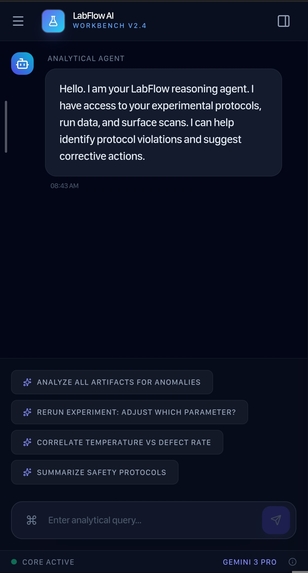
LabFlow AI Web App

Inspiration
I realized that in most research workflows, running experiments isn’t the bottleneck—analyzing them is. Experimental insight is scattered across spreadsheets, written protocols, and visual outputs, and stitching that context together is still a manual, repetitive process. I wanted to see if Gemini 3 could go beyond summarization and act as a reasoning agent—one that understands experiments holistically and carries that reasoning forward across multiple runs, the way a researcher does.
What it does
LabFlow AI is an autonomous multimodal experiment reasoning agent. It analyzes experimental artifacts across multiple runs to detect anomalies, infer cause-and-effect relationships, and recommend corrective actions.
LabFlow ingests structured data (CSV), protocols (PDF), and visual outputs simultaneously and reasons over them as a single system. It maintains continuity across experiments, allowing me to compare runs, identify what actually changed, and decide how to adjust the next experiment—without restarting analysis from scratch.
How I built it
I built LabFlow entirely in Google AI Studio using Gemini 3 Pro with Deep Reasoning enabled. Experimental data (CSV), protocols (PDF), and images are uploaded directly into Gemini’s multimodal context window, without external RAG pipelines or preprocessing. The app is structured as a reasoning agent rather than a single prompt, so it supports iterative analysis, cross-run comparison, and decision focused outputs over time.
Challenges I ran into
The main challenge was pushing the model beyond high level summaries into grounded, causal reasoning. I iterated on prompt structure to ensure Gemini consistently tied anomalies back to protocol constraints and supported conclusions with evidence drawn across multiple modalities.
Accomplishments that I'm proud of
- Built a true multimodal reasoning system, not a prompt wrapper
- Demonstrated continuity across multiple experiment runs
- Produced actionable, decision ready recommendations
- Kept the system minimal while still showing deep reasoning capability
What I learned
I learned that Gemini 3 Pro performs best when treated as a reasoning engine rather than a conversational assistant. Giving it full experimental context and letting it reason iteratively produces explanations that closely resemble expert scientific analysis.
What's next for LabFlow AI -– Multimodal Experiment Reasoning
Next, I plan to extend LabFlow into a longer running Marathon Agent that tracks experiments over extended time horizons, integrates live data streams, and proactively proposes follow up experiments. The goal is to reduce analysis overhead in real research environments and accelerate iteration in experimental science.
Built With
- ai-studio
- gemini-3-pro

Log in or sign up for Devpost to join the conversation.