-
-
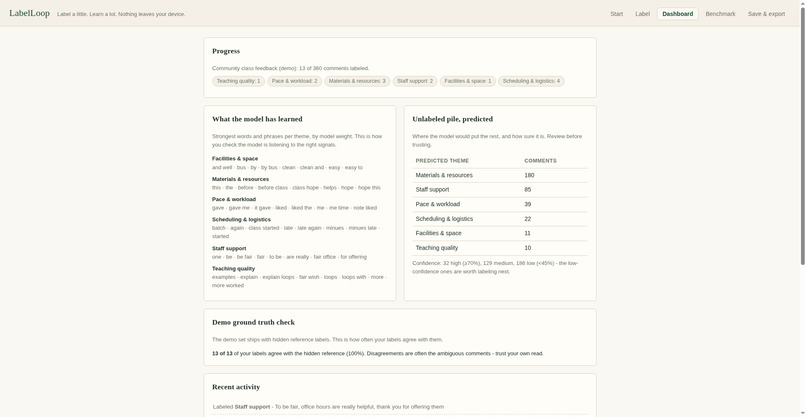
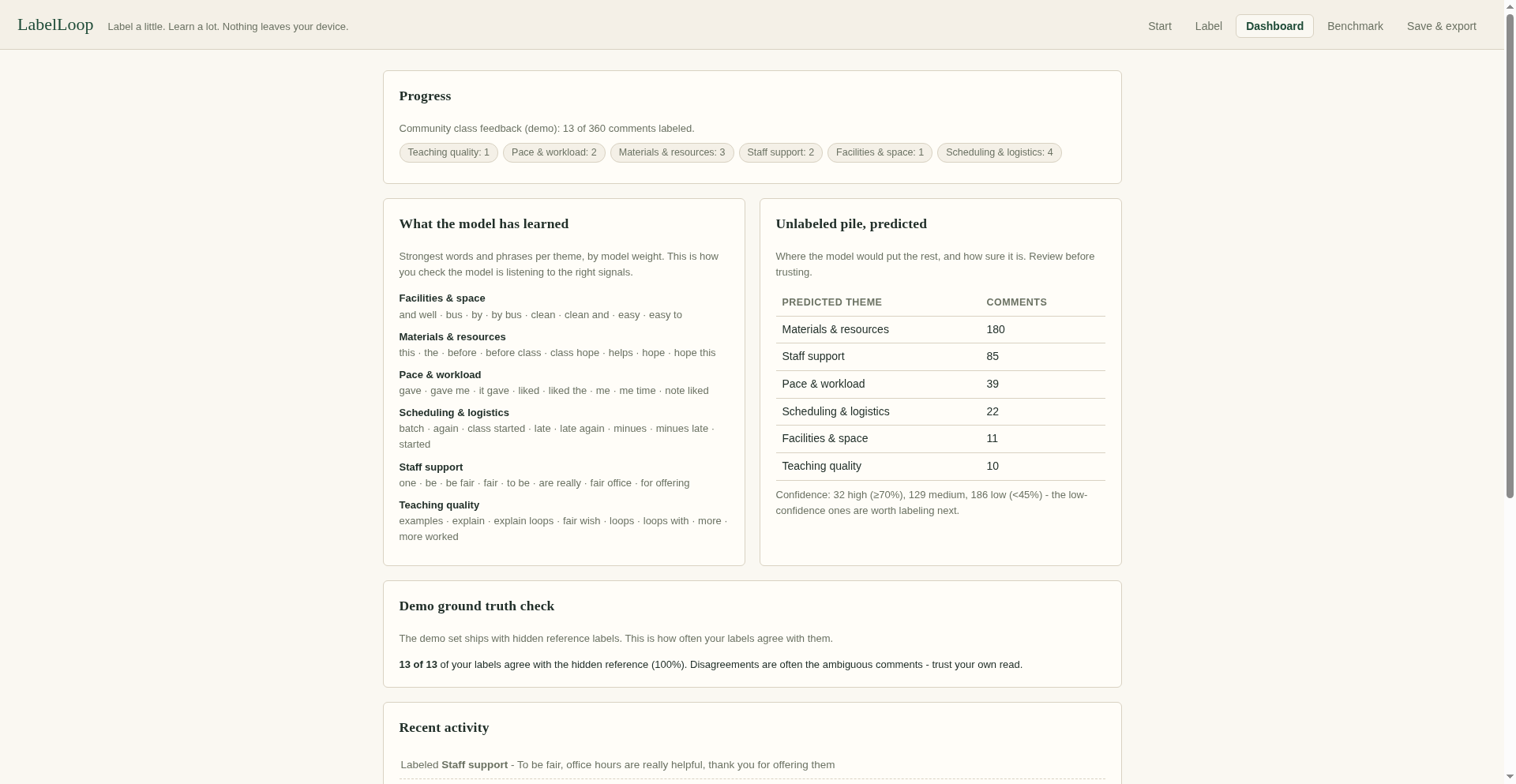
Dashboard: strongest words per theme, predicted split of the unlabeled pile, and a ground-truth agreement check.
-
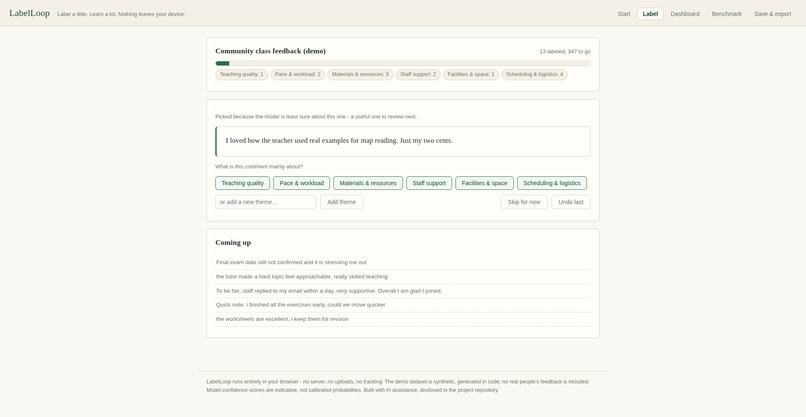
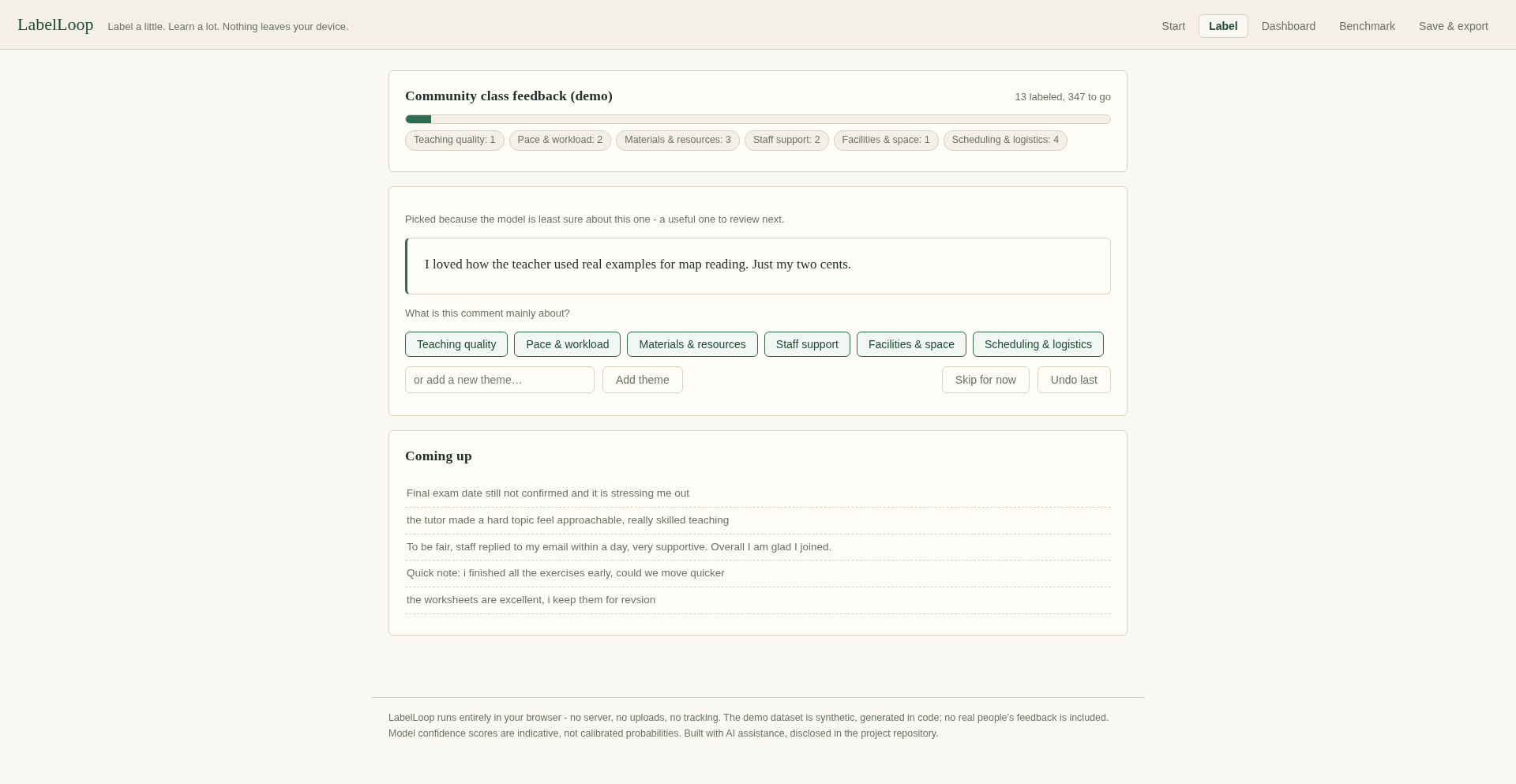
Active learning: the model trains in the tab and picks the comment it is least sure about next.
-
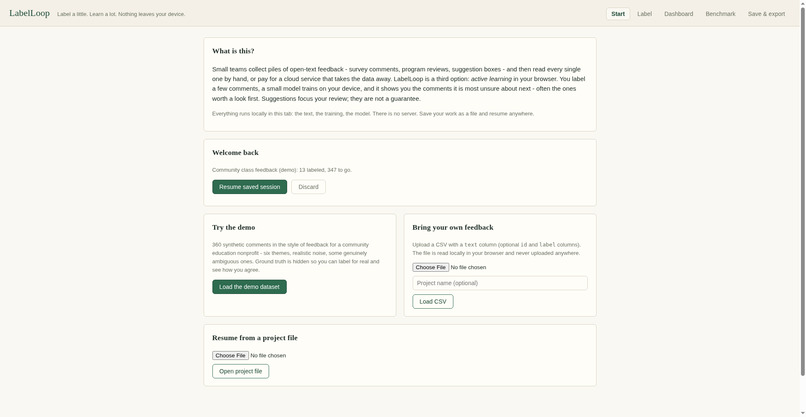
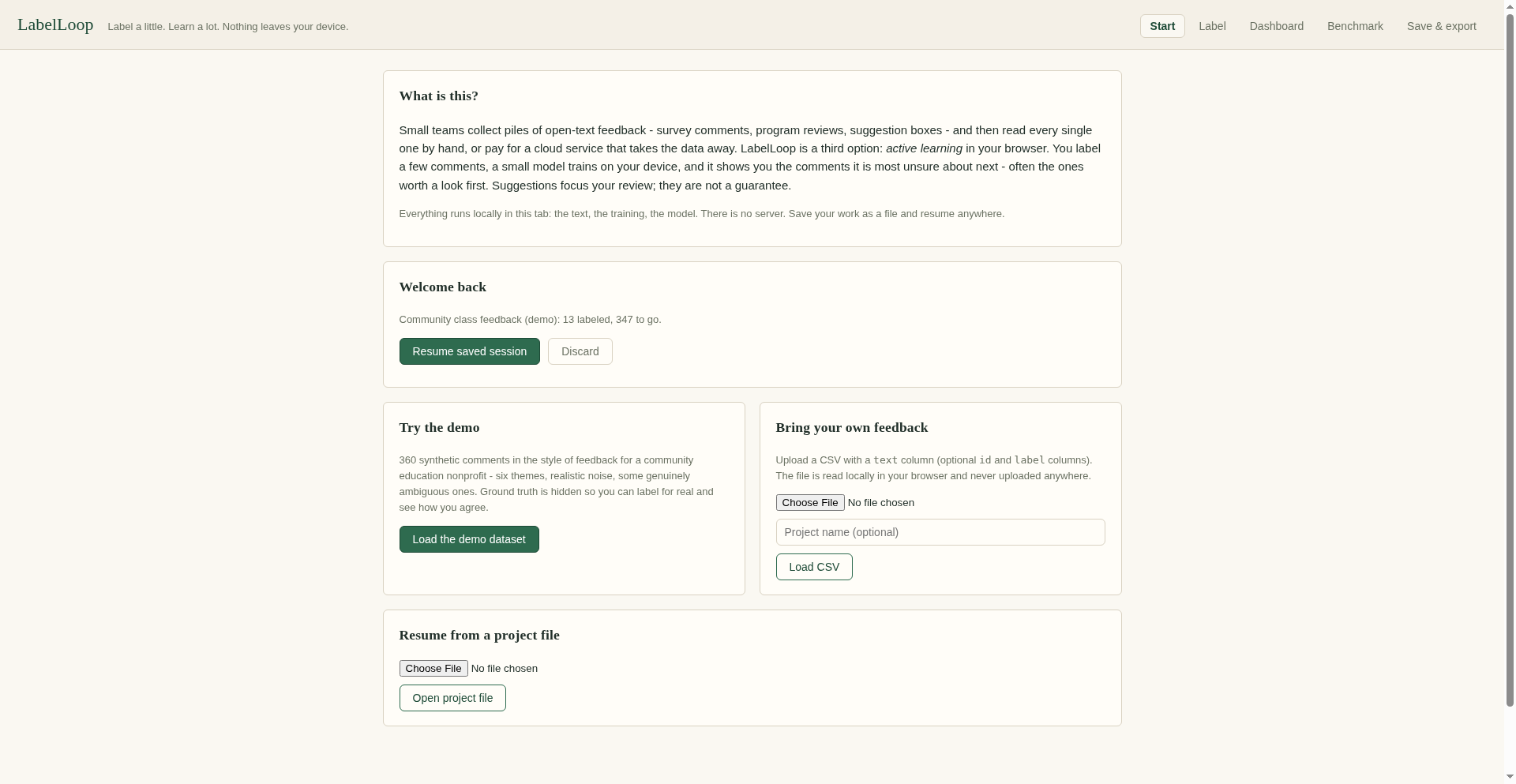
Start: load the synthetic demo or your own CSV. Nothing leaves the browser.
The problem
Small teams collect piles of open-text feedback - survey comments, program reviews, suggestion boxes - and then read every single one by hand, or pay for a cloud service that takes the data away. LabelLoop is a third option: active learning in your browser. You label a few comments, a small model trains on your device, and it shows you the comments it is most unsure about next - often the ones worth a look first. Suggestions focus your review; they are not a guarantee.
What it does
- Load your own CSV of open-text feedback, or try the built-in demo (360 synthetic comments about a community education nonprofit; ground truth hidden so you can label for real and see how you agree).
- Label comments one at a time. A multinomial logistic-regression classifier over TF-IDF word and character n-grams trains right in the tab after every few labels.
- Active learning picks what you see next: the comment the current model is least certain about, with a diversity guard so it does not just show near-duplicates. Early on, a cold-start round spreads labels across themes.
- A live dashboard shows the strongest words per theme (by model weight), where the model would put the remaining comments, and indicative confidence - explicitly not calibrated probabilities.
- An honest benchmark tab compares active picking against random picking on the same splits and starting labels across three fixed seeds, evaluated on a held-out 30% split the labeling strategy never sees. On this synthetic fixture active picking reached a fixed post-hoc macro-F1 threshold of 0.9 in 72 labels while random picking did not reach it within the tested budget - a descriptive result on this dataset, not a promised saving on other data. You can re-run the benchmark live in your own browser.
- Everything saves in your browser's local storage. Export your labels as CSV, a full project file (JSON) to resume anywhere, and a model card in Markdown.
Target users
Program coordinators, teachers, community organizers, UX researchers, and anyone with a spreadsheet full of comments they cannot paste into a cloud service - because the data is sensitive, the budget is zero, or both.
How it's built
Plain HTML, CSS, and JavaScript - no frameworks, no build step, no server. TF-IDF features and multinomial logistic regression are implemented from scratch in JavaScript and train synchronously in the tab. The benchmark harness (run_benchmark.mjs) shares the exact same model code as the app, so the published numbers are generated by the repository's code, not written by hand. Static hosting on GitHub Pages. 35 Node tests cover the model, the selection strategy, the CSV import/export, and the benchmark harness.
Challenges
Getting usable behavior from a tiny model on very few labels: the cold-start round and the diversity guard mattered as much as the uncertainty score. Also, writing about ML results honestly - the benchmark page states its seeds, splits, and post-hoc threshold, and says plainly that synthetic results demonstrate this implementation, not expected accuracy on real feedback.
Accomplishments
The whole loop works end to end in a static page: import, label, train, suggest, dashboard, benchmark, save, resume, export. The benchmark is reproducible by anyone, in the repo and live in the browser.
What I learned
Active learning is as much UX as math: what you show next, and what you say about why, shapes whether people trust the suggestions. Uncertainty sampling plus a diversity guard is simple and genuinely useful, but it is a focus aid, not a guarantee.
What's next
Better text features, per-theme progress targets, and optional embedding-based similarity for the diversity guard - still all client-side.
Disclosure
Built with AI assistance (design, code, and copy were drafted with an AI pair-programmer); disclosed here and in the project repository. The demo dataset is fully synthetic, generated in code; no real people's feedback is included.
Built With
- css3
- github
- html5
- javascript
- logistic-regression
- node.js
- tf-idf
