-
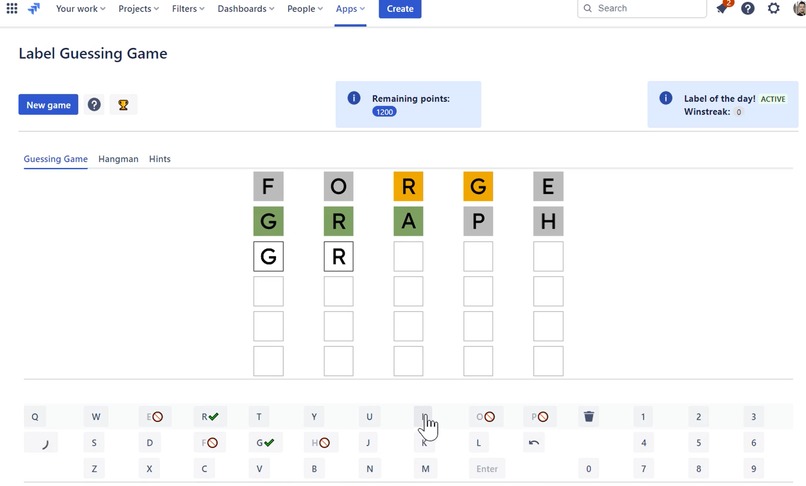
Guessing Game - User Interface
-
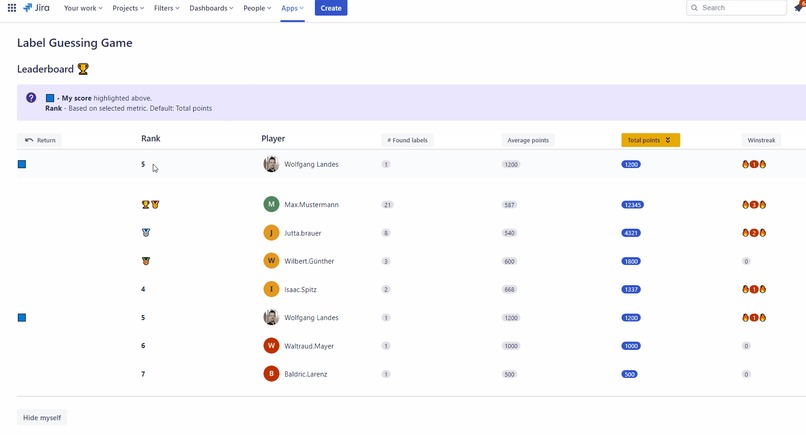
Leaderboard
Inspiration
Imagine unlocking the hidden knowledge within your company by playing a fun and competitive game. Label Guessing Game for Jira aims to give Jira users the opportunity to explore the various topics and facets of their company through the labels in their Jira instance. Join the game and let's uncover the hidden gems of your company together.
What it does
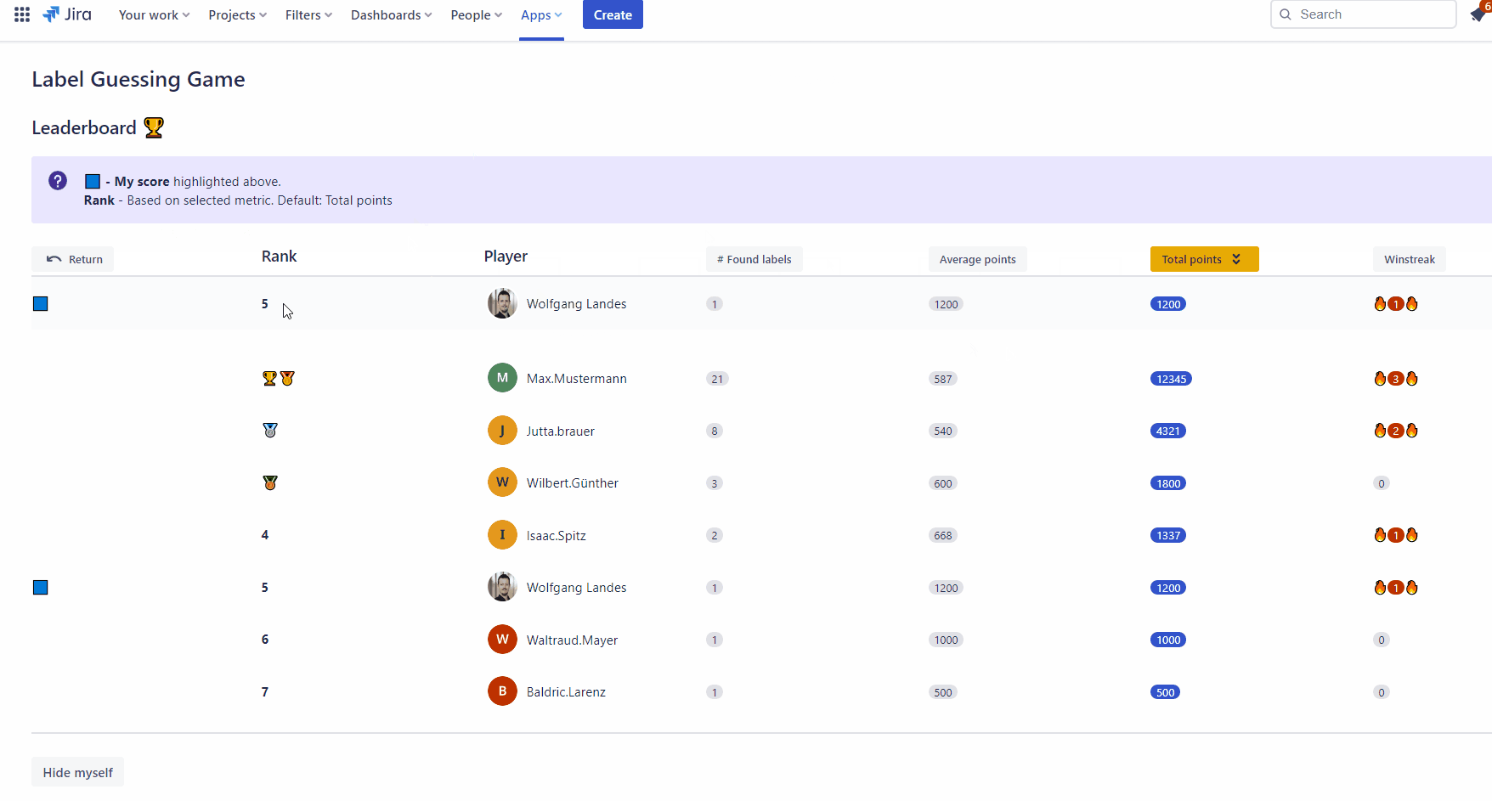
Label Guessing Game for Jira offers a unique and engaging way to explore the labels in your Jira instance by combining two popular word guessing games into one point-based system. Players compete to guess random labels from the Jira instance, with the daily first label shared among all players to encourage discussion and collaboration. Consistently guessing the label of the day will increase your win streak and earn bonus points for all labels found. In addition, players can request hints on label usage and compare their progress with colleagues on a leaderboard based on four metrics. The game also provides the option to opt-out of the leaderboard at any time.
How its built
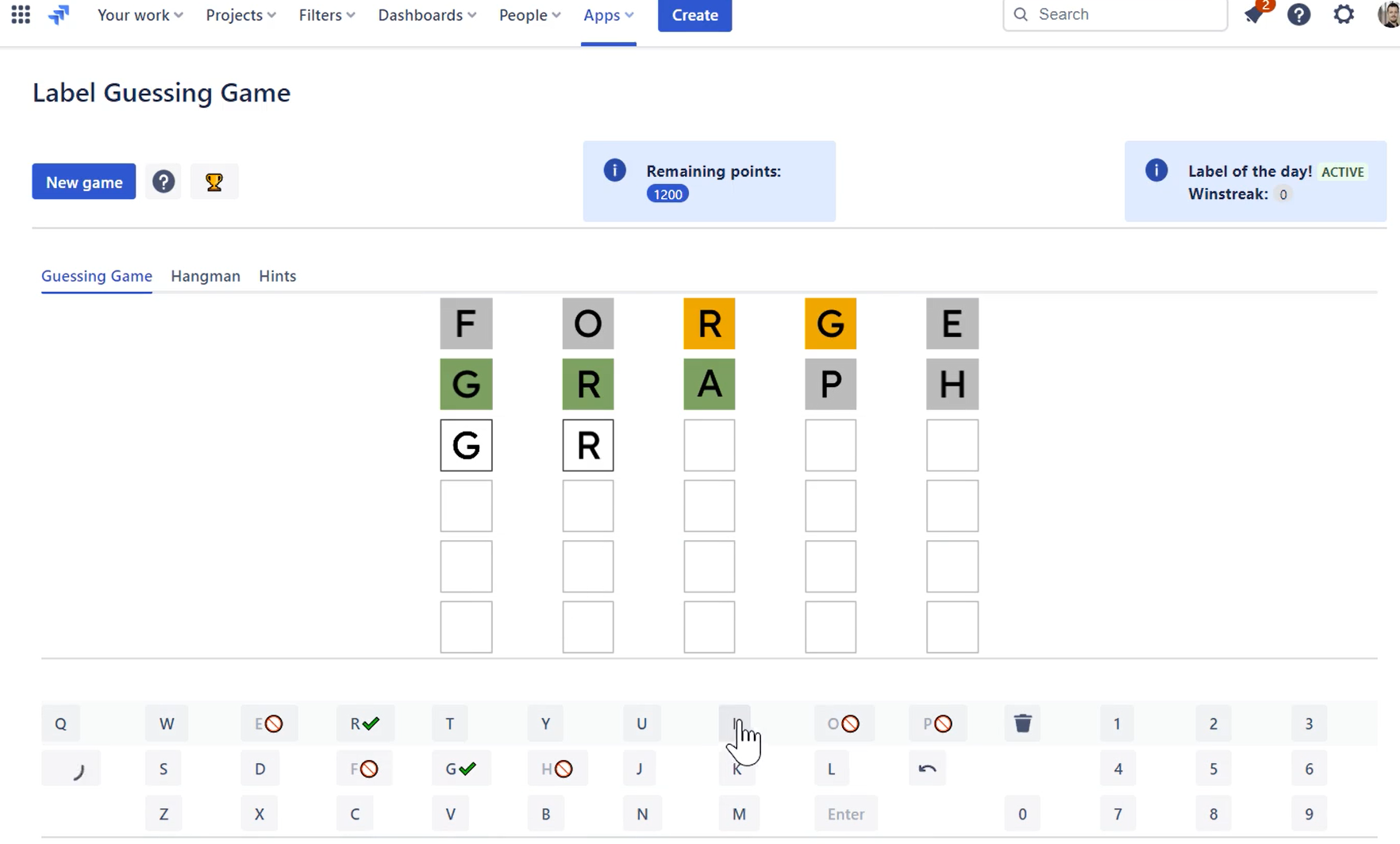
Label Guessing Game for Jira was developed by utilizing Forge's UI-Kit in Typescript, which enables to quickly build a robust app with Atlassian's native UI/UX. The game board is a dynamic table that adjusts columns based on label length and includes image components for each letter. These images change dynamically based on the state of the game, such as green, grey, orange, and transparent. The keyboard is also a table with buttons for each character. The leaderboard is another table that allows players to switch between metrics for ranking. While there are limitations to consider, UI-Kit seems like a valid option to built small apps and with client-side UI-Kit on the horizon maybe even bigger ones.
Challenges
1. Competitive integrity: What fun is a game that can be easily cheated? Ensuring fair play was a challenge as the goal was to provide as many hints on label usage and fun features as possible. However, it was necessary to avoid anything that would give players an unfair advantage, such as using Jira's native filter engine to find the missing label.
2. UI Layout: With limited options to put different UI elements horizontally next to each other than using the UI-Kit component table, creative design choices had to be made. In Label Guessing Game for Jira, 9 table components were used in various ways, including using them to position elements like the header.
3. Size limits in storage: The Forge storage API has a limit on the amount of data that can be stored in each key-value pair. This presented a challenge when creating the leaderboard, as a scalable way to paginate the key-value storage had to be found to avoid exceeding the size limit while maintaining fast loading times.
Accomplishments
1. Developing a point-based system to increase the strategic depth of basic word guessing concepts by combining them into one game.
2. Creating an intuitive and interactive user interface within the limitations of UI-Kit that adapts to label length and game state.
Learnings
Building with Forge UI-kit can be fast and efficient once the necessary workarounds for limitations are found. The table component is crucial for UI layout but could benefit from additional parameters. Forge & UI-Kit's limitations can be beneficial in forcing a more thoughtful approach to development. (Link feedback submission)
Forge & UI-Kit's limitations can actually be beneficial, in forcing a more thoughtful approach to development.
What's next for Label Guessing Game for Jira
There is potential to include new game modes, label hints, or expand the target words beyond just labels.


Log in or sign up for Devpost to join the conversation.