-
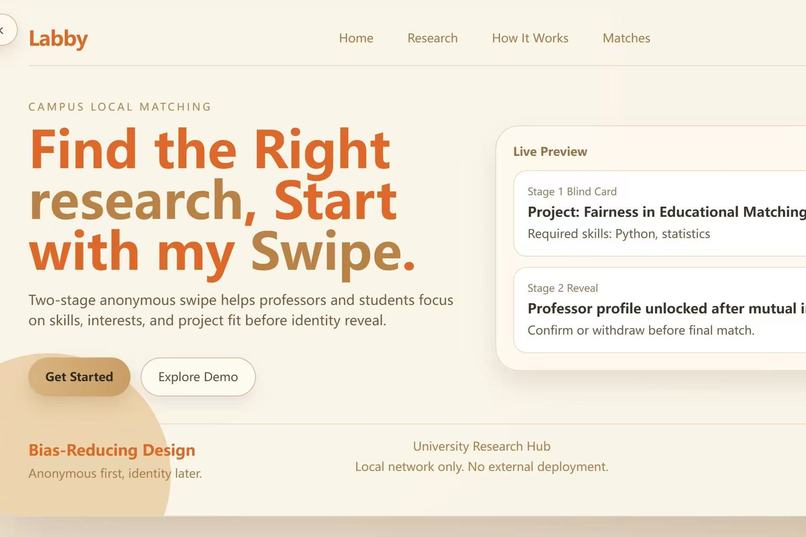
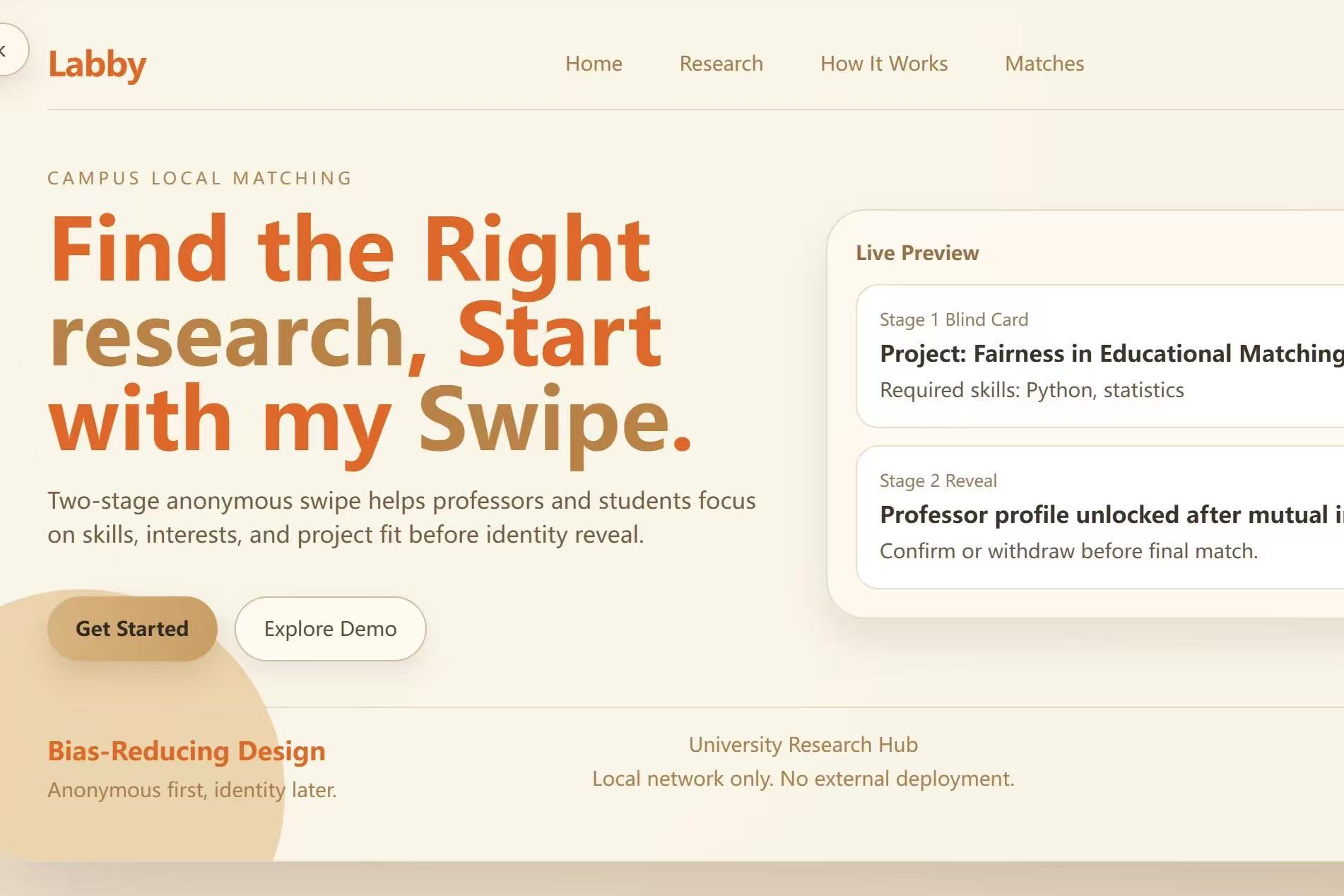
home page
-
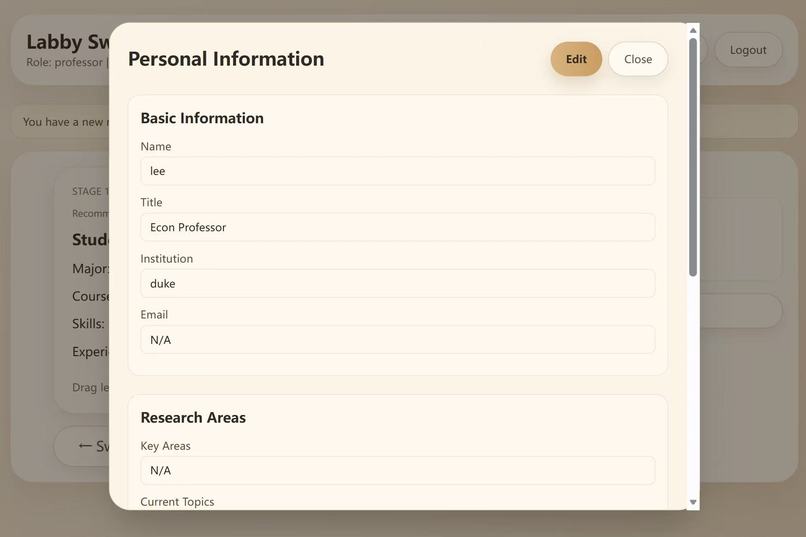
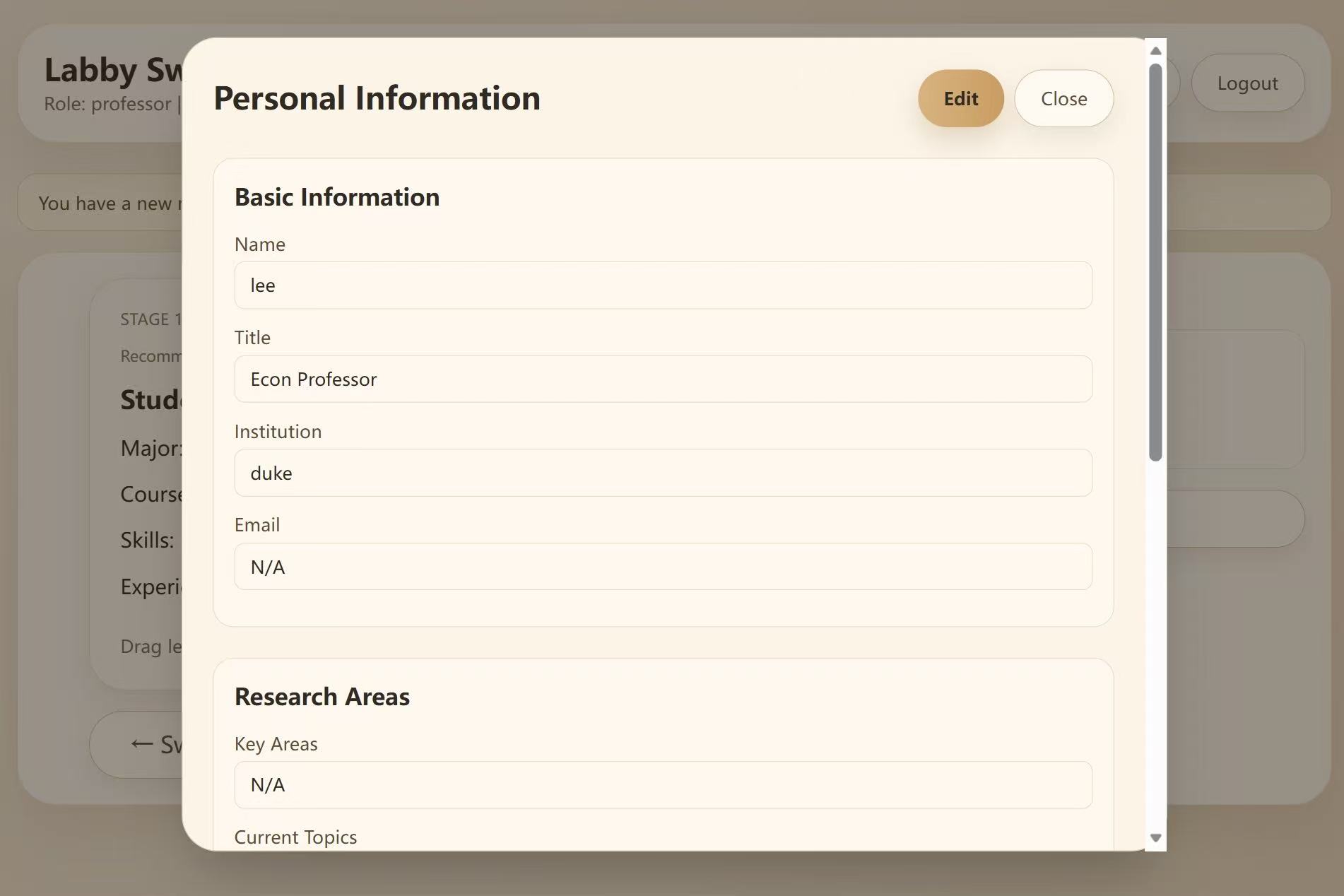
personal information
-
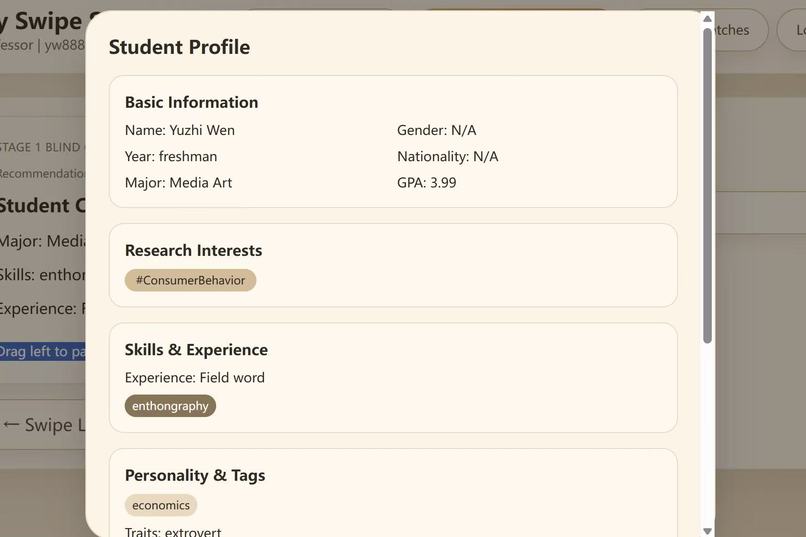
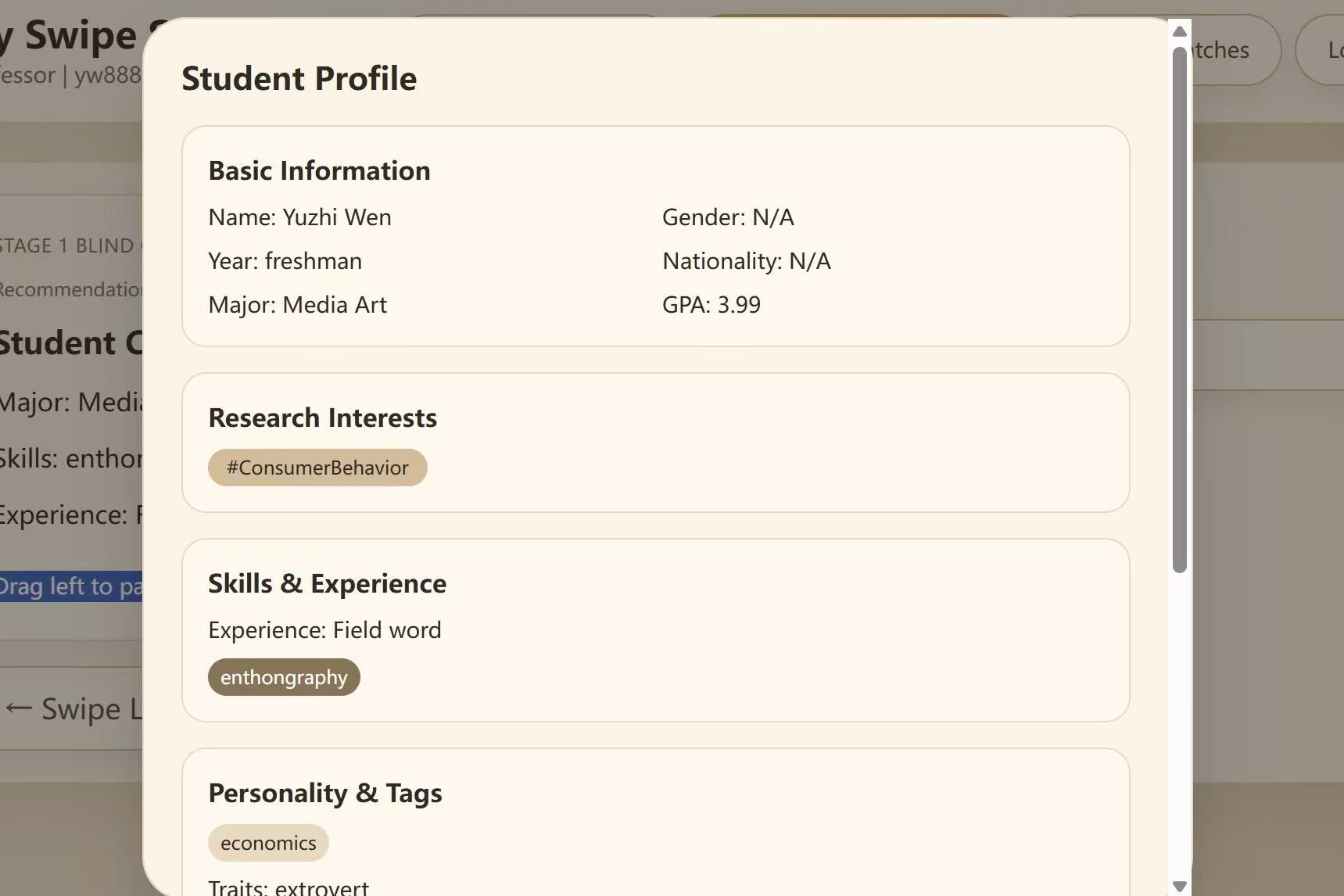
student profile
-
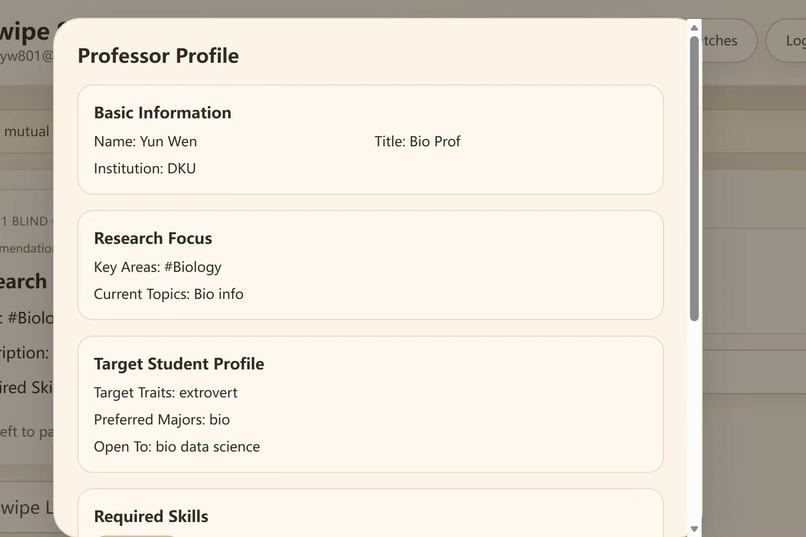
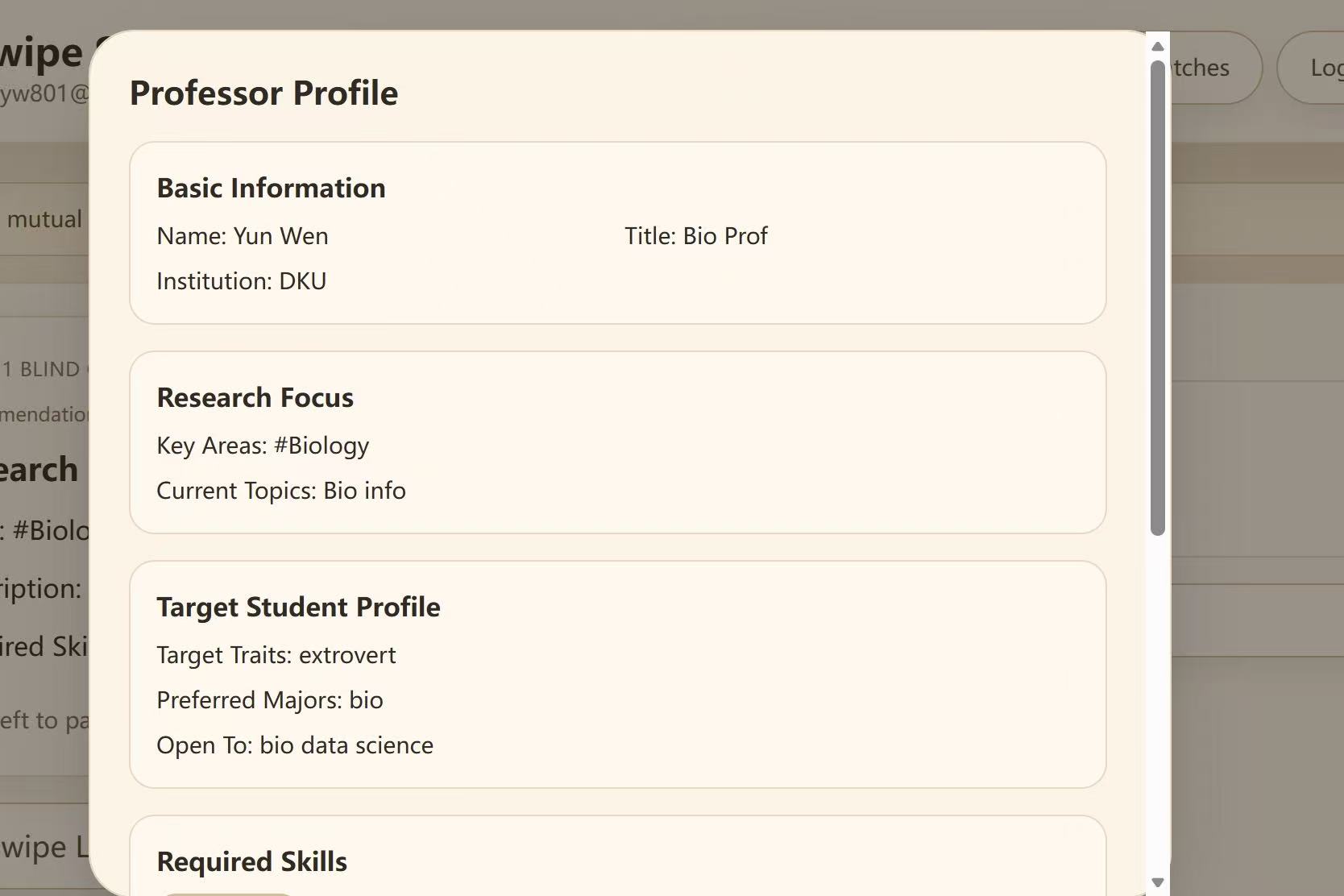
professor profile
-
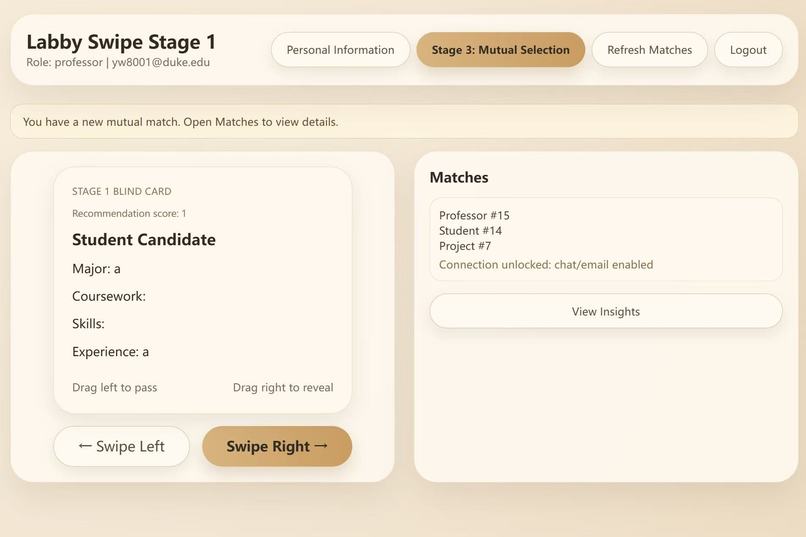
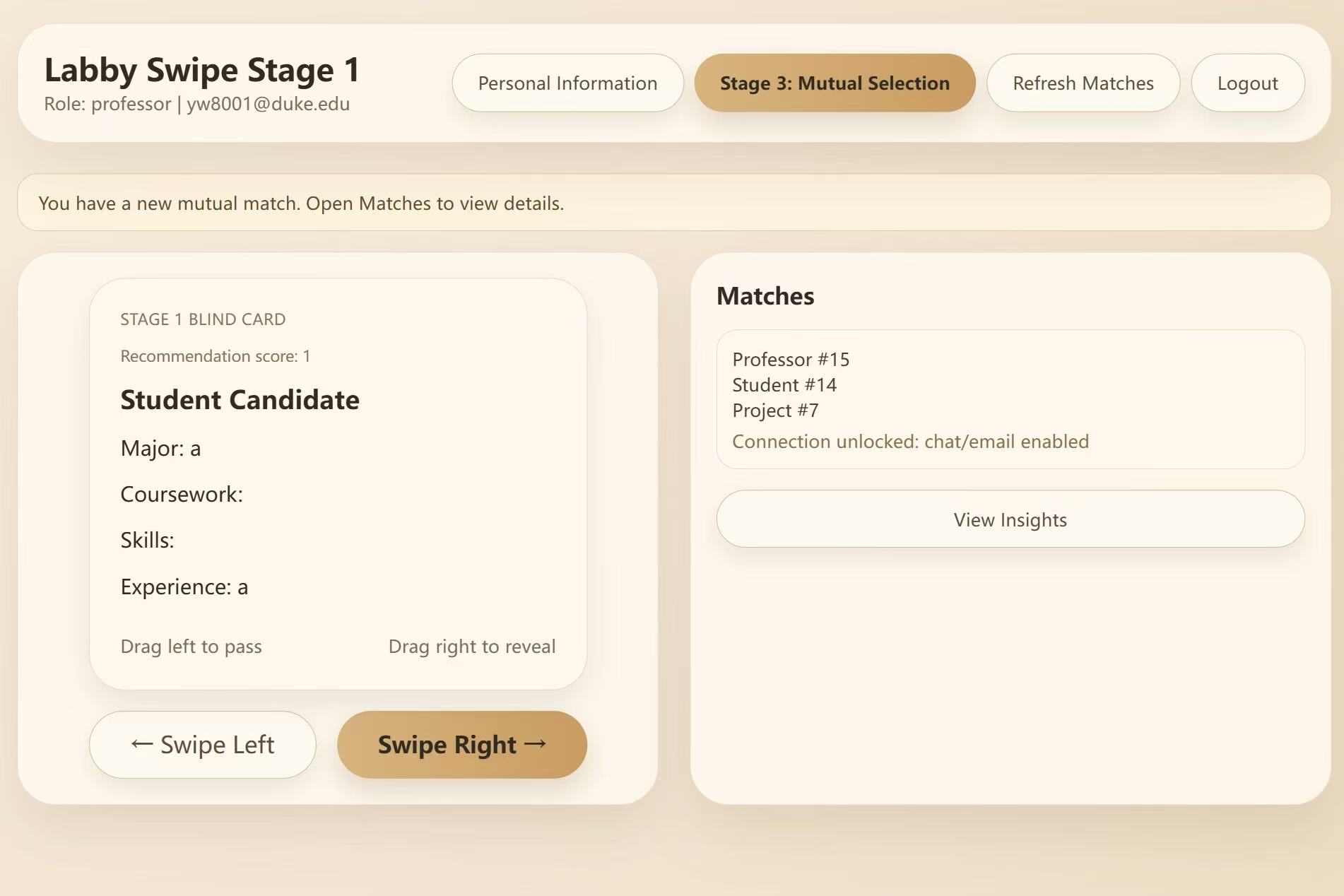
swipe stage
-
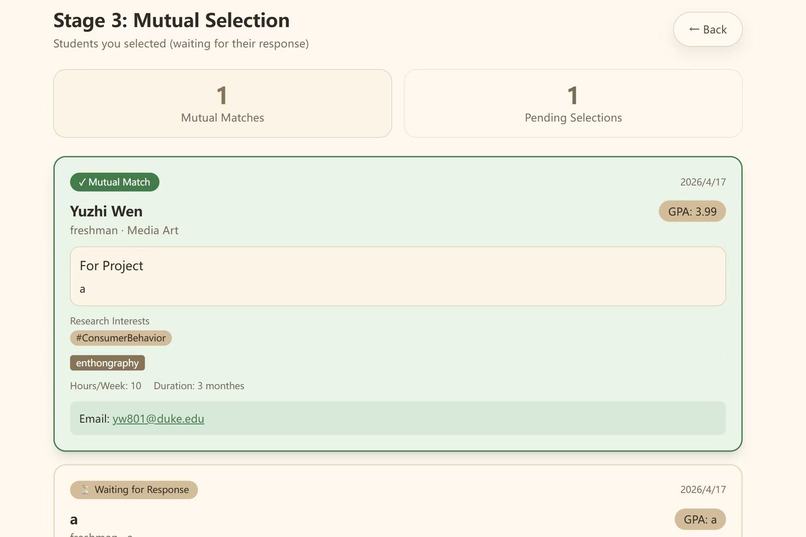
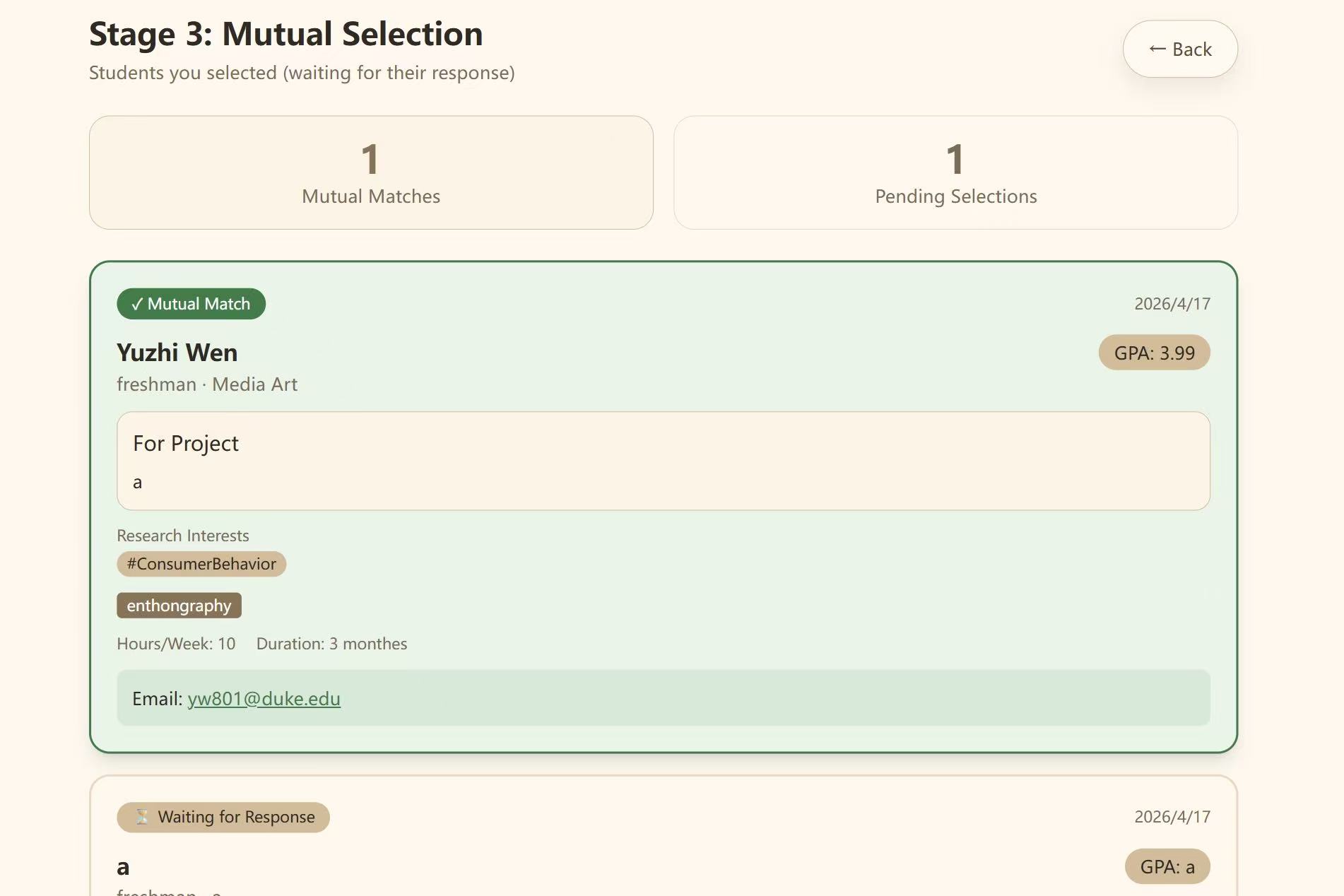
mutual match
Inspiration
Finding research opportunities in university should not feel like sending messages into a void. Today, students often have to search through scattered websites, email professors one by one, tailor resumes for each opportunity, and then wait for uncertain replies. At the same time, professors have to screen a large number of emails and resumes with limited time. In this process, hidden bias and information gaps can easily shape outcomes. Students may be overlooked because of their year level, limited prior experience, gender, nationality, or language background, even though everyone needs a first opportunity to start.
We built Labby to make this process more direct, fair, and efficient. Inspired by the swipe-based interaction of matching apps, we reimagined research matching as a two-sided platform where professors and students can discover each other more easily. Our goal was not to turn academic collaboration into a dating app, but to borrow an intuitive interaction model and apply it to a real educational problem: unequal access to research opportunities.
What it does
Labby is a professor-student matching platform for research projects and course collaborations. Professors can create project profiles with titles, descriptions, and requirements. Students can create personal profiles with their major, skills, and experience. After that, both sides enter a matching interface.
Professors browse student cards and choose whether they are interested. Students browse project cards, which also display the professor information behind each project, and choose whether the opportunity fits their interests. When both sides express interest, a mutual match is created. Users can then view their match list and continue the conversation from there.
In short, Labby helps:
- reduce hidden bias in early-stage screening
- improve matching efficiency for both professors and students
- lower the barrier for beginners trying to enter research
- make research opportunities more visible and accessible
How we built it
We designed Labby as a simple web-based prototype with a clear user flow:
- Users log in and choose whether they are a professor or a student.
- They complete their profile or project information.
- They enter the matching page and browse one card at a time.
- Likes are stored in the database.
- If both sides show interest, the system creates a mutual match.
- Returning users can go directly back into the platform and view their matches.
We focused on building the core interaction logic, including role-based flows, profile creation, project creation, card-based matching, mutual match detection, and match list display.
Challenges we ran into
One challenge was translating a swipe-based consumer interaction into an academic setting without making it feel unserious. We needed the product to stay playful and intuitive, while still feeling professional and trustworthy.
Another challenge was the matching logic itself. A professor is not matching with a project, but with a student; meanwhile, a student is not directly liking a professor, but a project posted by that professor. We had to carefully design the logic so that a mutual match could still be created in a clean and consistent way.
We also spent time thinking about fairness. Our project is based on reducing bias, so we had to consider what information should be shown at each stage, how profiles should be structured, and how to make the process feel more transparent than the traditional email-and-resume workflow.
Accomplishments that we're proud of
We are proud that we turned a familiar swipe interaction into something meaningful for education. Instead of optimizing for entertainment, we used it to address a real access problem in research opportunities.
We are also proud of the clarity of the user journey. From login to profile setup to matching and viewing mutual matches, Labby demonstrates a full product loop rather than just a static idea. Most importantly, we built a concept that is easy to understand, relevant to real student experiences, and scalable to broader academic collaboration contexts.
What we learned
We learned that many educational problems are not caused by a lack of demand, but by poor systems of access and connection. We also learned that interface design can shape fairness: the way people discover, evaluate, and respond to opportunities matters.
This project also taught us how to think more carefully about two-sided platform design. Building for both students and professors meant that every design decision had to work from both perspectives, not just one.
What's next for Labby
Our next step is to make Labby more intelligent and more realistic. We want to add stronger profile filters, recommendation ranking based on interests and skills, direct messaging after matching, and a cleaner system for reducing unnecessary bias in early screening. In the longer term, we see Labby as more than a matching tool. It could become a research opportunity infrastructure for universities, helping students access projects more fairly and helping professors recruit more efficiently.


Log in or sign up for Devpost to join the conversation.