-
-
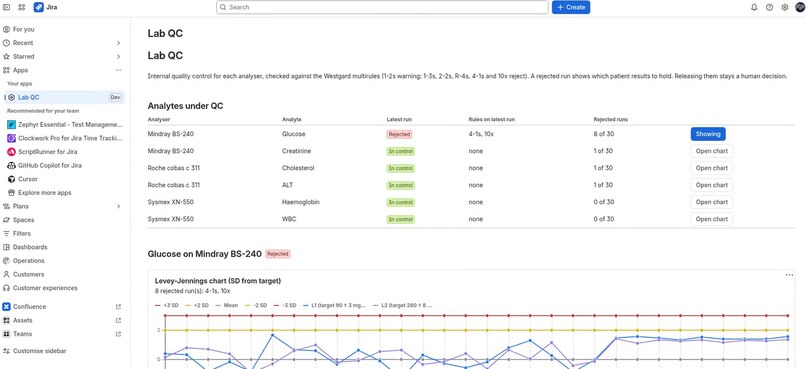
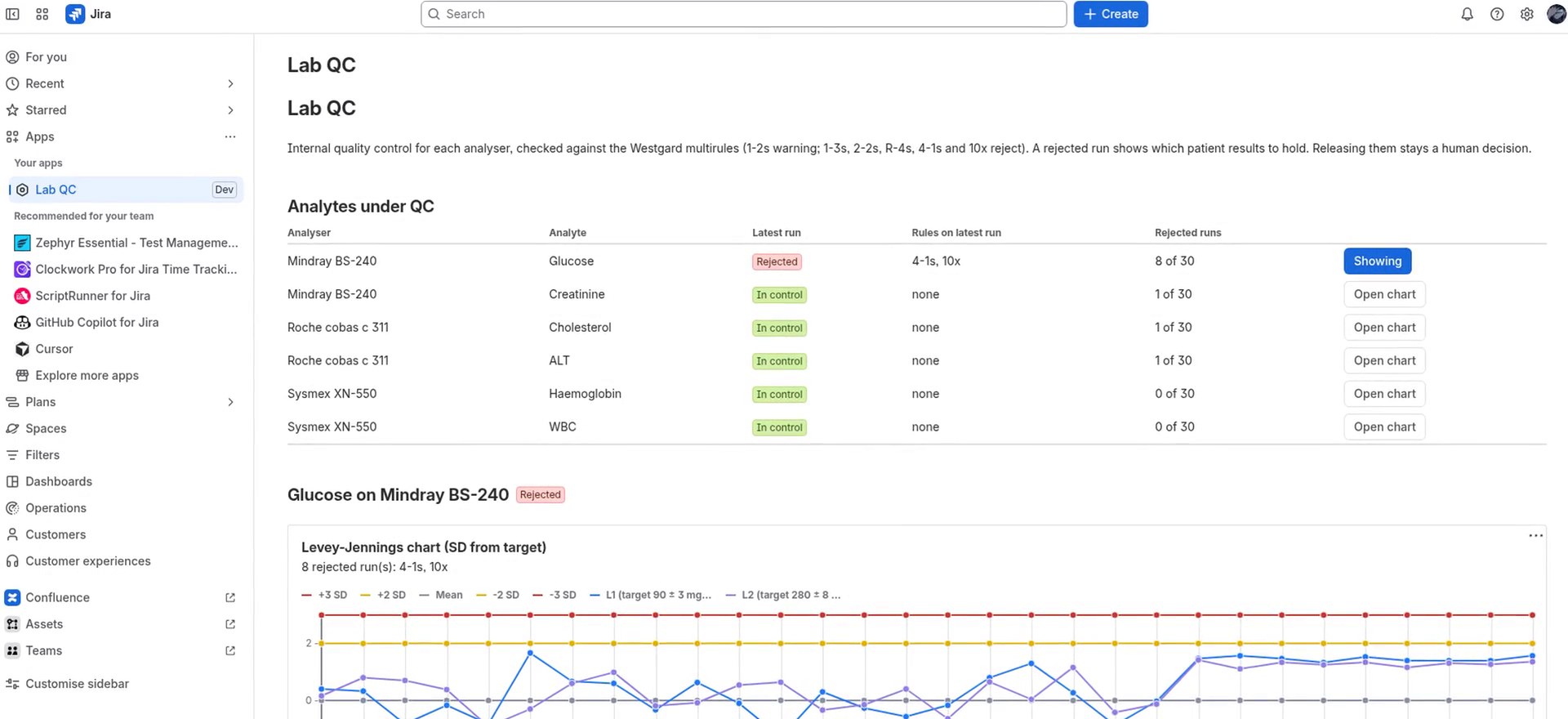
QC dashboard on Jira: every test on every analyser with its latest Westgard verdict
-
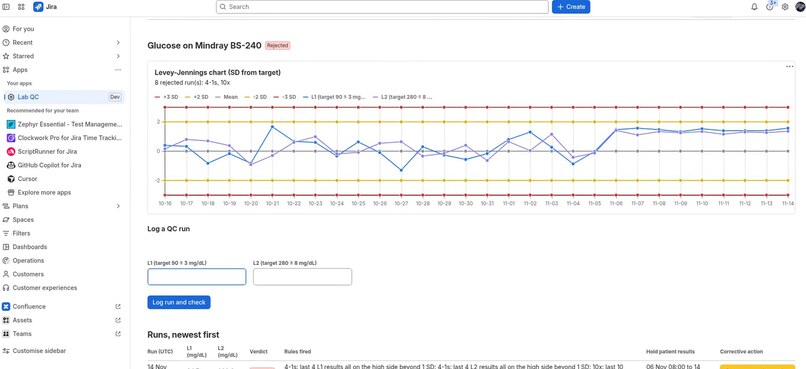
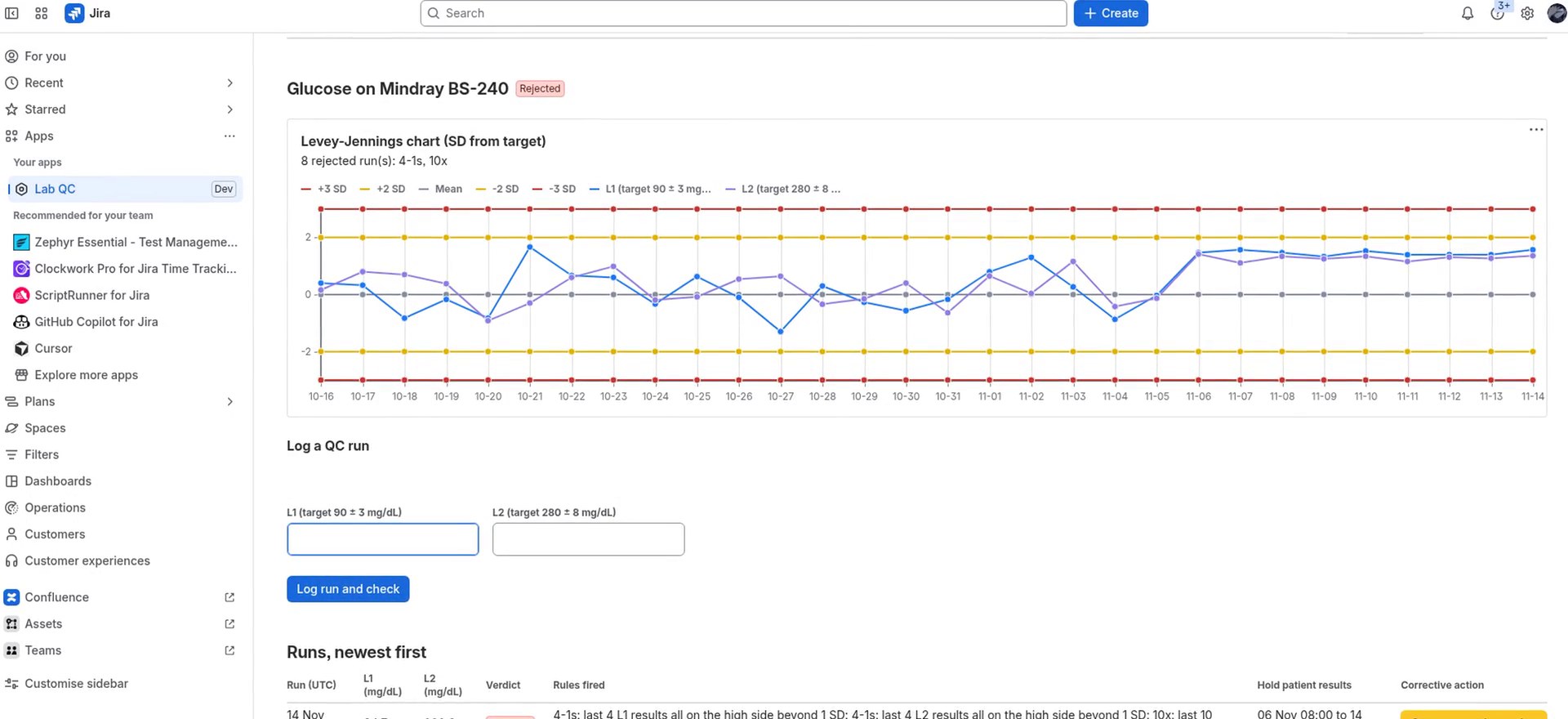
Levey-Jennings chart in SD units: glucose drifting high, rejected by 4-1s and 10x
-
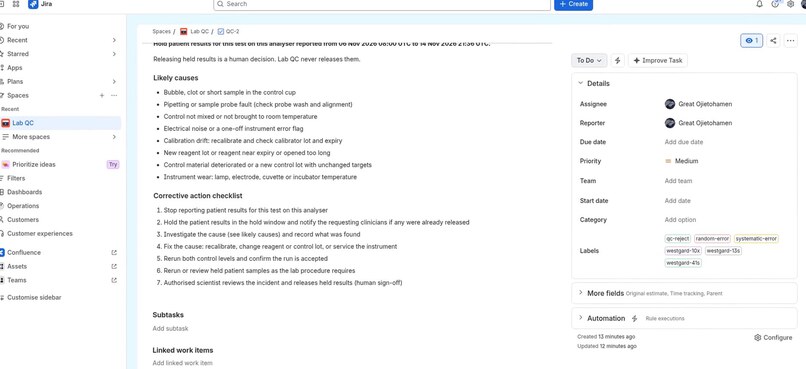
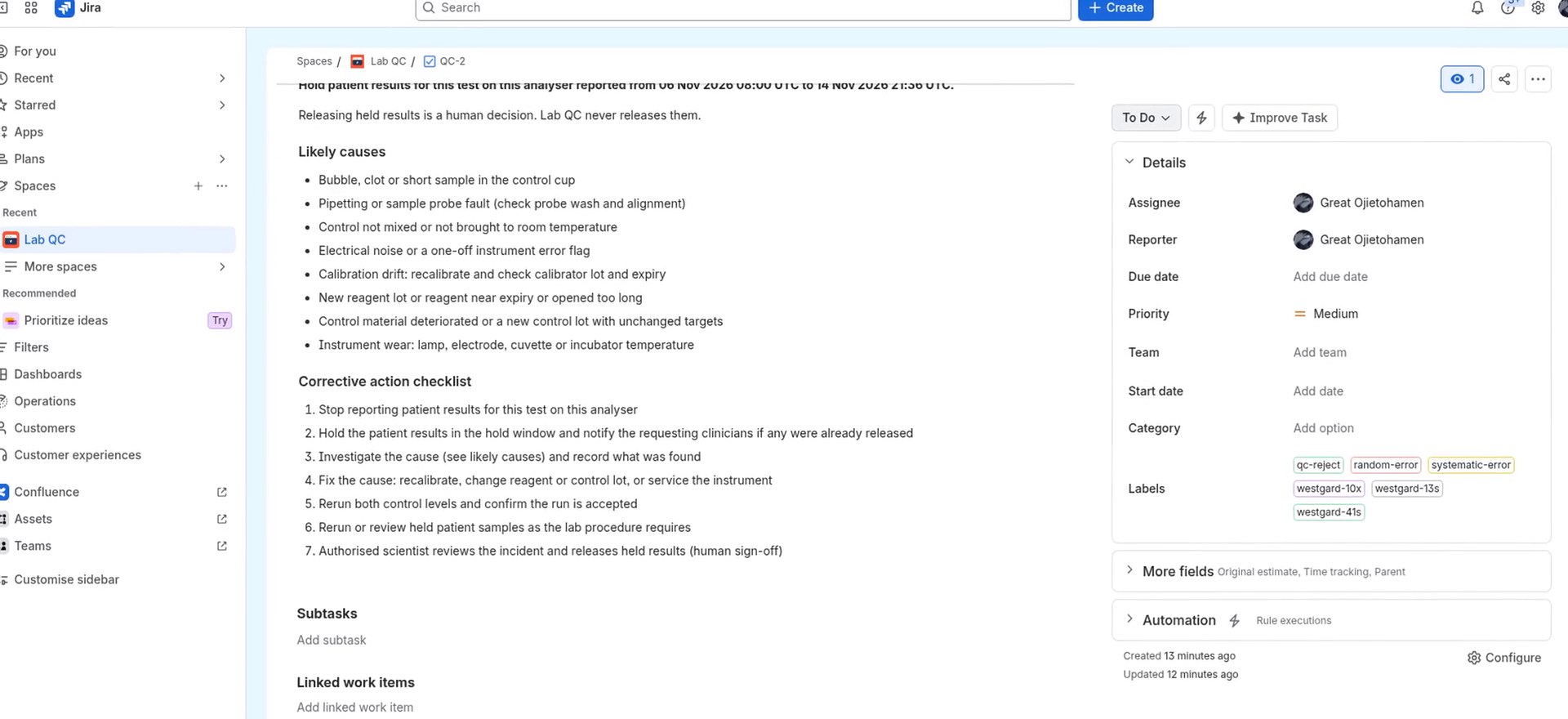
The Jira work item Lab QC opens: likely causes and a seven-step corrective action checklist
-
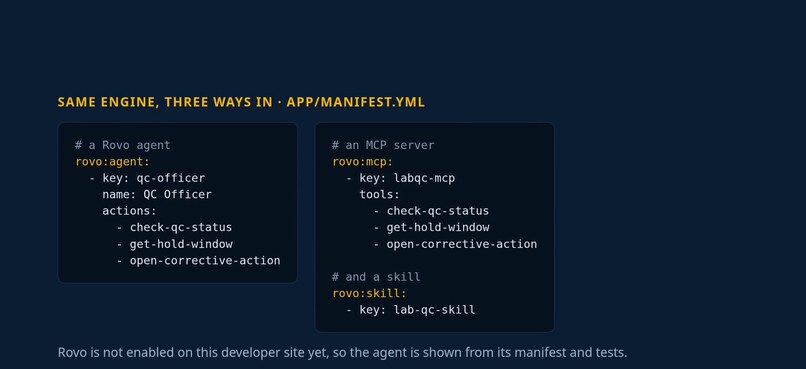
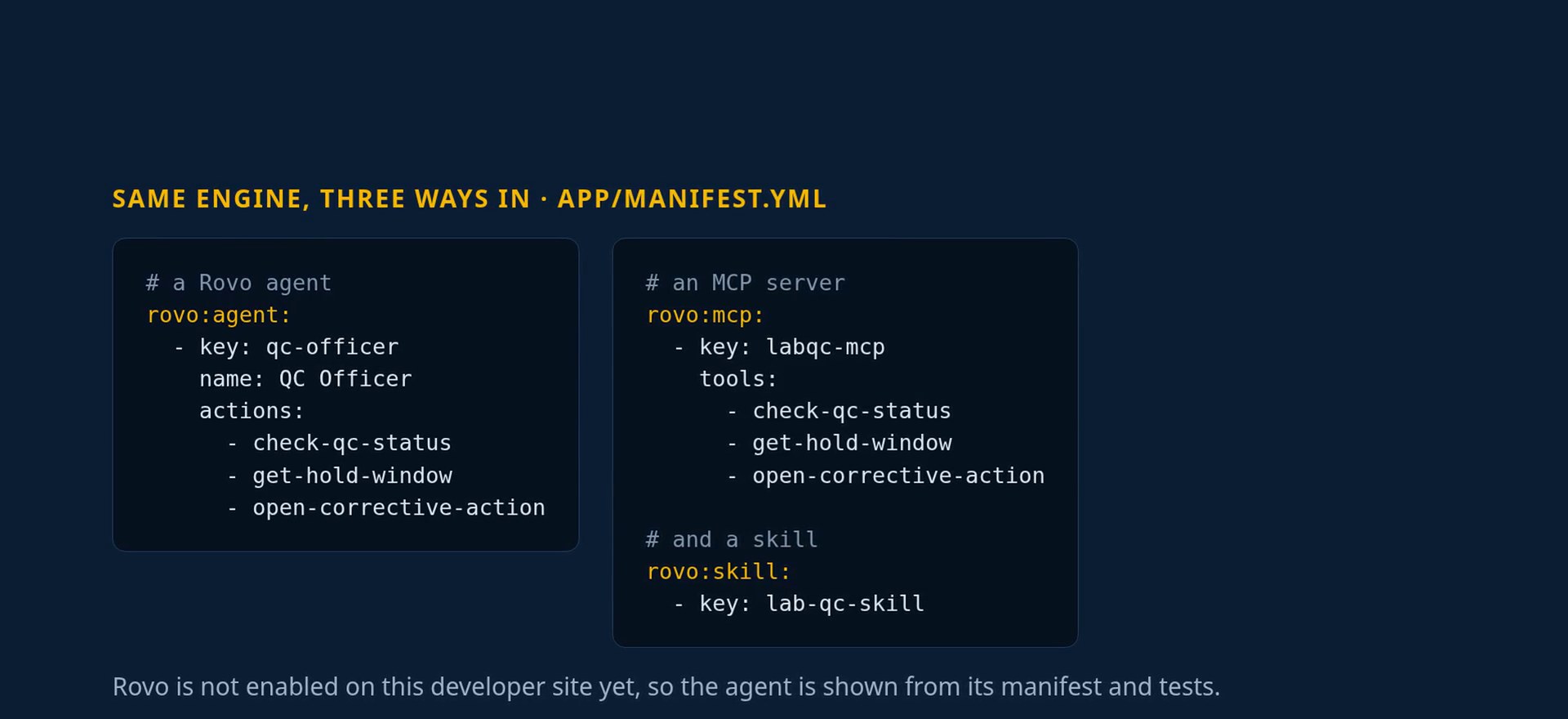
Same engine, three ways in: the QC Officer Rovo agent, an MCP server and a Rovo skill (manifest)
-
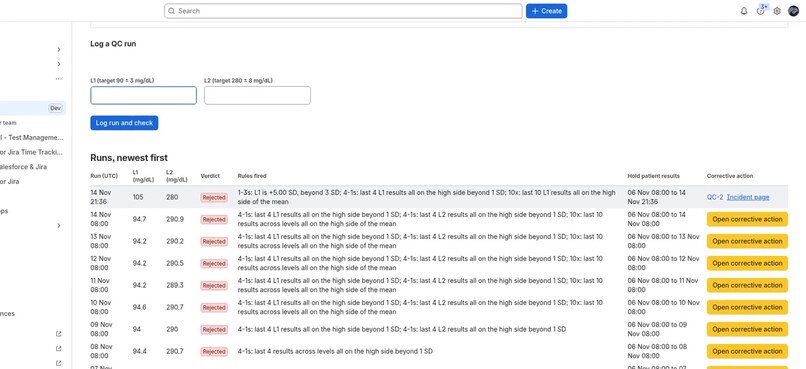
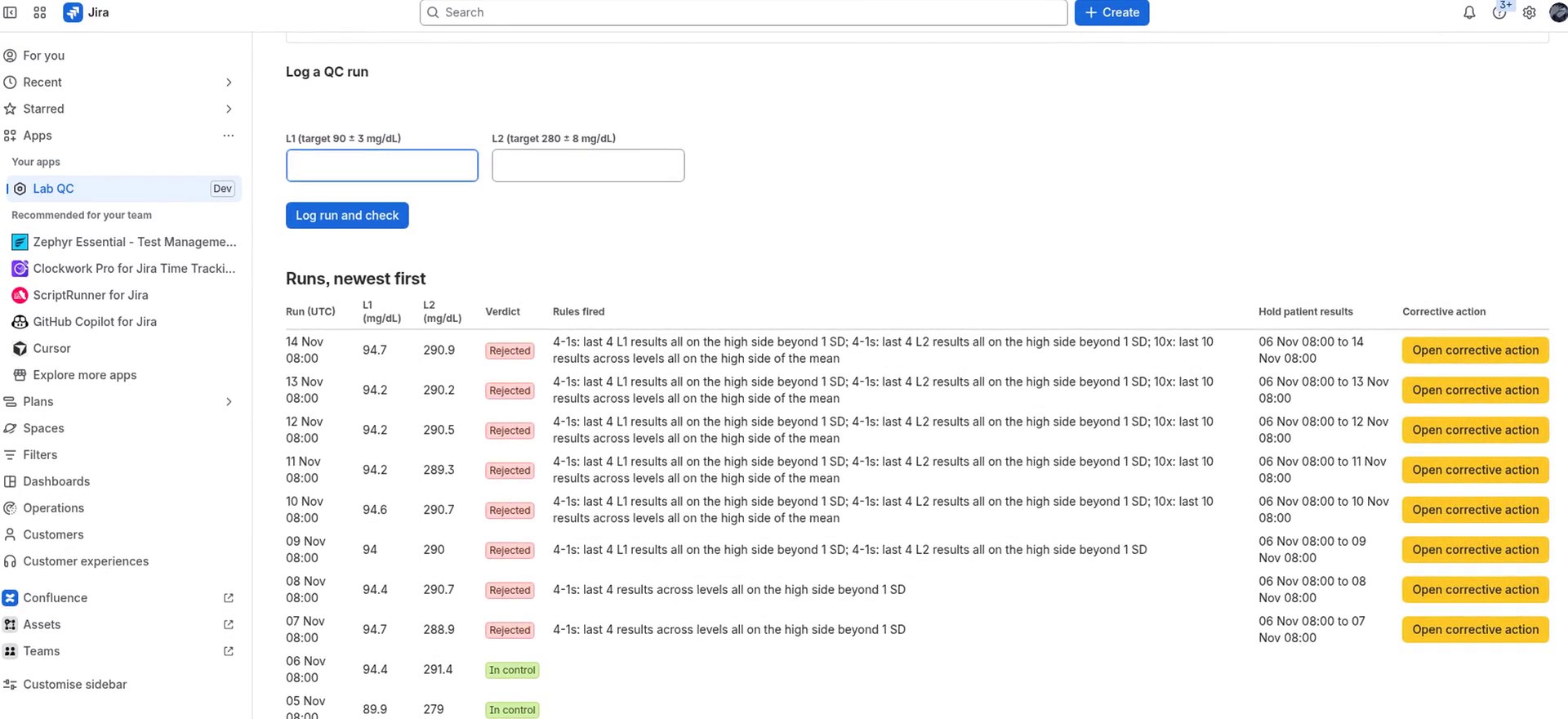
A new run logged at 105 mg/dL is rejected on the spot by 1-3s, with its own hold window and corrective action links
-
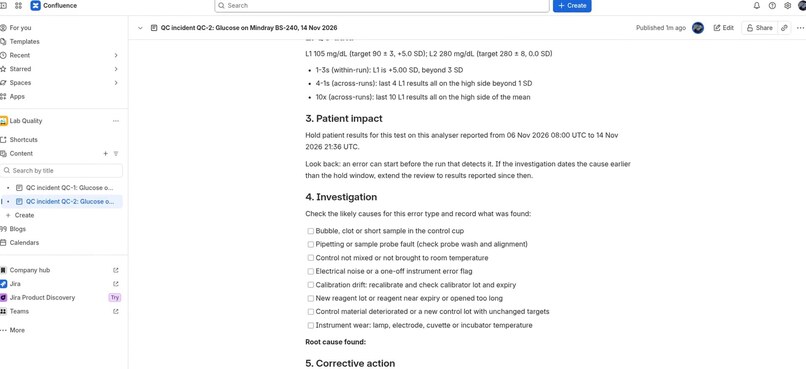
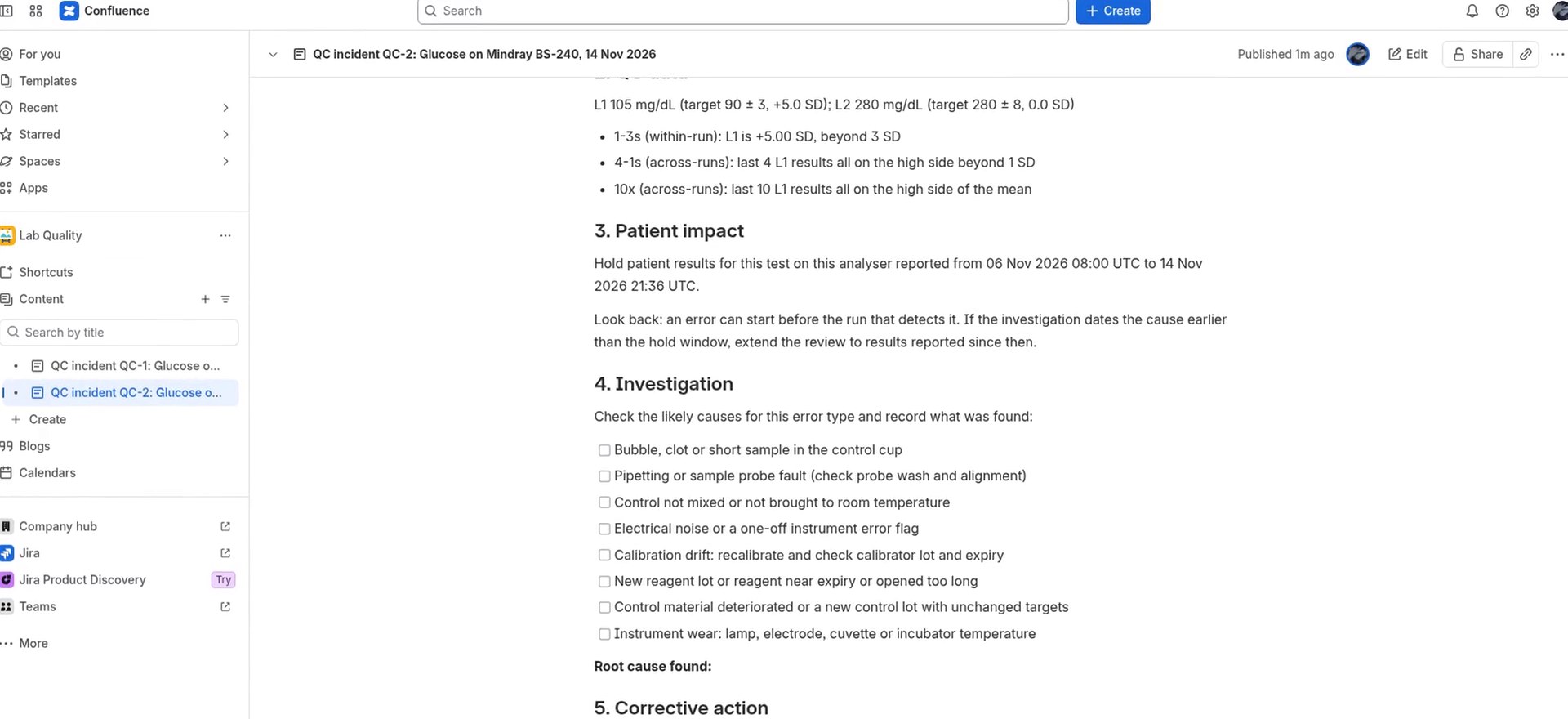
The linked Confluence incident page: patient impact, look-back note, investigation checklist
-
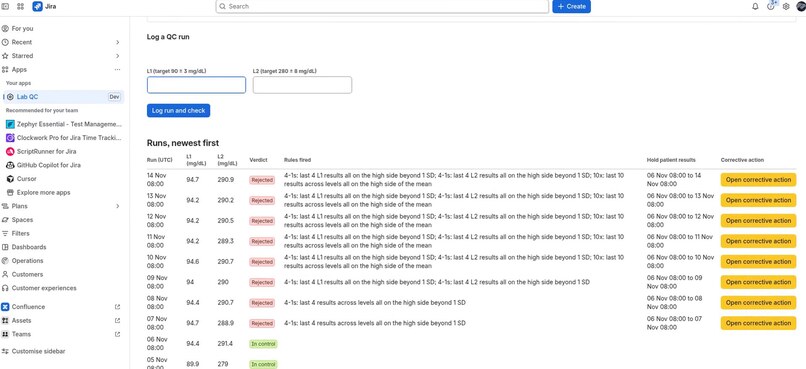
Runs, newest first: the rules that fired and the patient results to hold for each rejected run
-
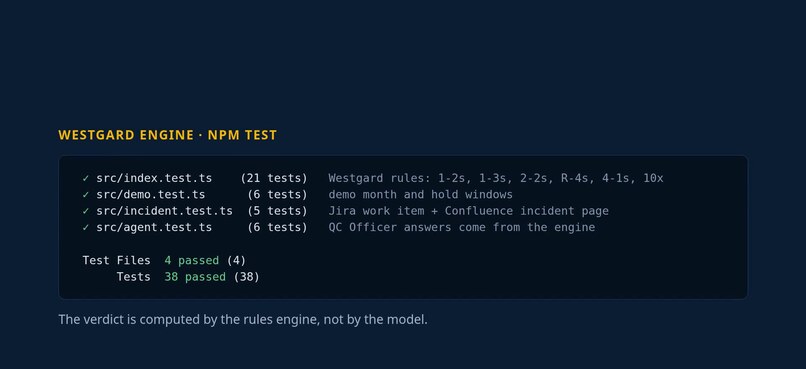
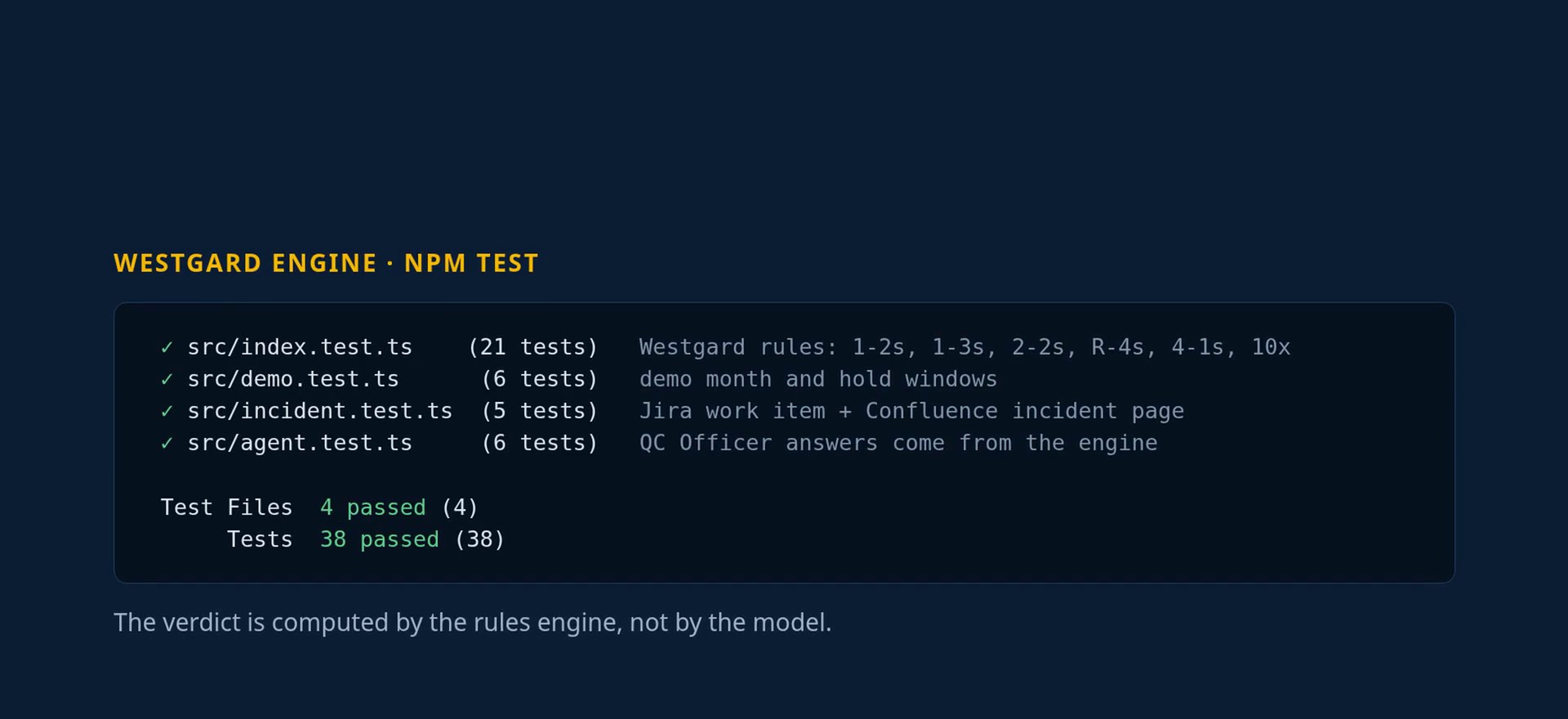
The Westgard engine is unit tested: 38 tests, and the agent answers from the engine, not the model

Inspiration
What it does
How we built it
Challenges we ran into
Accomplishments that we're proud of
What we learned
What's next for Lab QC
Inspiration
I trained as a medical lab scientist. Every shift, before a lab reports patient results, it runs quality control (QC) samples on each analyser and checks them against the Westgard multirules. When a rule fires, every patient result since the last good QC run is suspect: it has to be held, the cause found and fixed, and the whole thing documented for accreditation (ISO 15189, CAP). In most labs I know this lives in a paper logbook, a spreadsheet and someone's memory. The most error-prone step is the one that matters most to patients: "which results do we hold?"
What it does
Lab QC is a Forge app for Jira and Confluence with a Rovo agent.
- QC dashboard (Jira global page). Every test on every analyser with its latest Westgard verdict: in control, warning, or rejected, and how many runs were rejected this month.
- Levey-Jennings chart. Both control levels on one chart in SD units, with the mean and +/-2 SD and +/-3 SD lines, so a drift is visible at a glance.
- Westgard engine. Every run is checked against 1-2s (warning) and 1-3s, 2-2s, R-4s, 4-1s and 10x (reject), within a run, across runs and across levels. The verdict says which rule fired and why, in plain words ("last 4 L1 results all on the high side beyond 1 SD").
- Hold window. Every rejected run shows the patient results to hold: from the last accepted run to the failure.
- Log a run. New QC values are evaluated on the server the moment they are entered.
- One-click corrective action. Creates, as the signed-in scientist:
- a Jira work item with the rules, control values in SD, error type (random or systematic), hold window, likely causes for that error type and a 7-step checklist; and
- a linked Confluence incident page in accreditation format: summary, QC data, patient impact with a look-back note, investigation and corrective-action task lists, verification, a release sign-off table and references (ISO 15189:2022 7.3.7.2, CLSI C24, Westgard 1981).
- QC Officer (Rovo agent). Ask "Is the cobas c 311 OK for cholesterol this morning?", "Which patient results do I hold for the creatinine reject?" or "Open a corrective action for it." It also warns when the newest QC run is over 24 hours old.
- MCP server and skill. The agent's three actions are also exposed as an MCP server (
rovo:mcp) and a Rovo skill, so any agent can check QC before it trusts a lab result.
Safety line: the app holds results and never releases them. Release is a human sign-off by an authorised scientist on the incident page. The agent's verdicts come from the engine, not the language model, so it cannot be talked into a different answer.
How we built it
- Forge app, Node 24 runtime. Modules:
jira:globalPage(UI Kit, native render),rovo:agent, threeactionmodules,rovo:mcp,rovo:skill, and a resolver function. - Westgard engine in TypeScript with 38 unit tests (vitest), compiled into the app. It is pure: given the QC history it returns the verdict, the hold window and the corrective-action documents. The Jira page, the agent and the MCP tools all call the same shared core, so they always agree.
- Forge KVS stores each test's QC history and the corrective actions opened per run (a second click returns the same work item and page, no duplicates).
- Jira REST (
asUser) creates the work item with an Atlassian Document Format description and a remote link to the page. Confluence REST v2 creates the page in storage format with native task lists. - Demo month: 3 analysers, 6 tests, 2 control levels, 30 days, with real-world faults planted: a calibration shift on glucose (4-1s, 10x), a one-off outlier on creatinine (1-3s), levels pulling apart on cholesterol (R-4s), two high ALT runs in a row (2-2s), a lone warning on haemoglobin (1-2s) and a clean WBC month. Every rule fires. Tests check that each planted fault is caught by the right rule.
Challenges we ran into
- Getting the hold window right: it starts at the last accepted run, but a systematic error can begin before the run that detects it (the first day of the glucose shift passes QC). The app follows the rule and adds a look-back note on every incident page.
- Making the verdict impossible to edit from the browser or a prompt: evaluation only runs on the backend.
- Confluence storage format and Jira ADF have to be exactly right; both builders are unit tested for balanced tags and valid node types.
Accomplishments that we're proud of
- A rule engine a lab could actually trust, with a test for every Westgard rule and every planted fault.
- One click turns a QC failure into the documents an accreditation assessor asks for.
What we learned
Forge UI Kit, Rovo actions, rovo:mcp and how much of a lab's quality system maps naturally onto Jira (work) and
Confluence (records).
What's next for Lab QC
- Import QC results straight from analyser middleware (LIS / ASTM) instead of typing them.
- Sigma metrics per test to pick the right rule set automatically.
- Monthly QC summary page for the lab manager.
Built With
- confluence
- forge
- forge-kvs
- forge-ui-kit
- javascript
- jira
- mcp
- react
- rovo
- typescript
- vitest
