LabForg Bench — A Smarter Way to Run Scientific Experiments
Inspiration
Scientific experiments rarely happen in one place, at least when it comes to managing information. A researcher might have their protocol open in a PDF, measurements stored in a spreadsheet, photographs on their phone, notes written somewhere else, and reference documents scattered across different cloud storage services.
The problem isn't necessarily a lack of tools. It's that these tools don't communicate with each other.
I wanted to build something that would bring these different parts of an experiment together and make it easier to understand what happened, what went wrong, and how the results were obtained.
That's how LabForg Bench started.
What it does
LabForg Bench is a web-based scientific workspace designed to support researchers and students throughout an experiment, from the initial planning stage to the final report.
Instead of being built around a traditional AI chat interface, the platform organizes the entire experimental process.
Users can create research projects in different scientific fields, define their objectives and hypotheses, organize samples, prepare experimental protocols, and record observations as their work progresses.
The platform includes several interconnected tools.
Experiment planning: Researchers can choose their scientific field, define variables and controls, specify equipment and safety considerations, and build a structured experimental plan.
Live laboratory workspace: Users can work through their experiments step by step, capture images through their camera, dictate notes using speech-to-text, and ask an AI assistant for help understanding protocols or reviewing observations.
Document and evidence management: Protocols, scientific documents, images, and measurement files can be uploaded directly into the workspace. Supported files can be processed to extract readable information, allowing researchers to search their material, add notes, and select documents to use as context for AI assistance.
Scientific data analysis: LabForg can process numerical datasets, calculate statistics, visualize measurements, and flag potential anomalies. These calculations are performed using deterministic code rather than relying on AI-generated numbers.
Experiment history: Important actions, observations, uploaded evidence, warnings, and researcher decisions are organized into a chronological timeline.
Evidence review: Potential inconsistencies can be recorded for investigation, with AI interpretations kept separate from confirmed observations and measured facts.
What-if analysis: Researchers can explore alternative interpretations of their datasets, such as excluding a questionable measurement, without modifying the original data.
Laboratory notebook: The platform brings together the protocol, observations, evidence, calculations, and decisions into a structured report that can be exported and reviewed later.
LabForg also includes user accounts, research profiles, onboarding, project organization, and optional connections for importing or saving research files through supported cloud storage services.
How I built it
LabForg Bench was developed as a browser-based application using JavaScript, HTML, and CSS, with a focus on keeping the platform accessible without requiring expensive infrastructure.
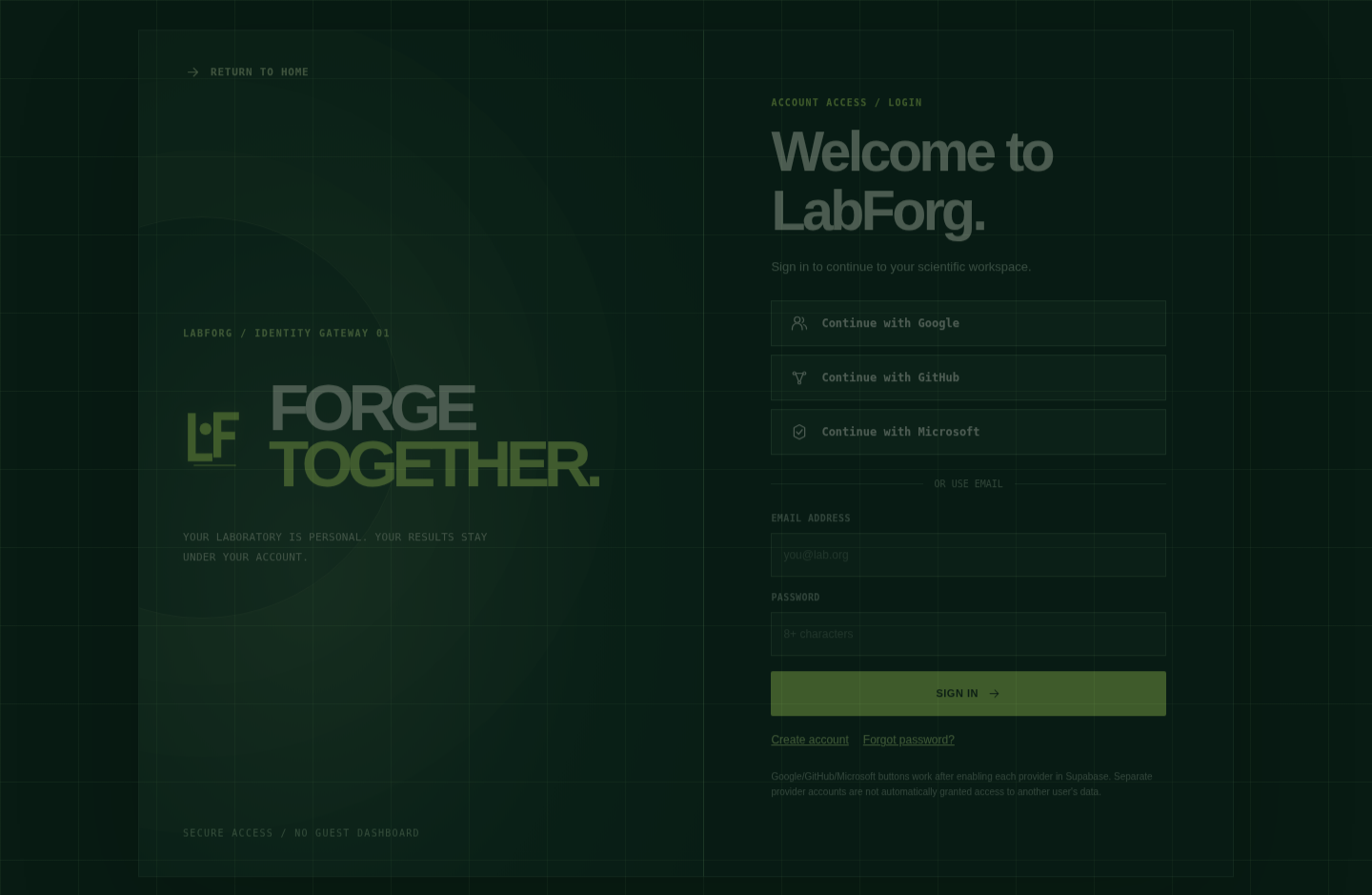
Supabase provides the authentication and database foundation. The application uses dedicated LabForg tables within an existing PostgreSQL project, with Row Level Security policies designed to keep users' research data private.
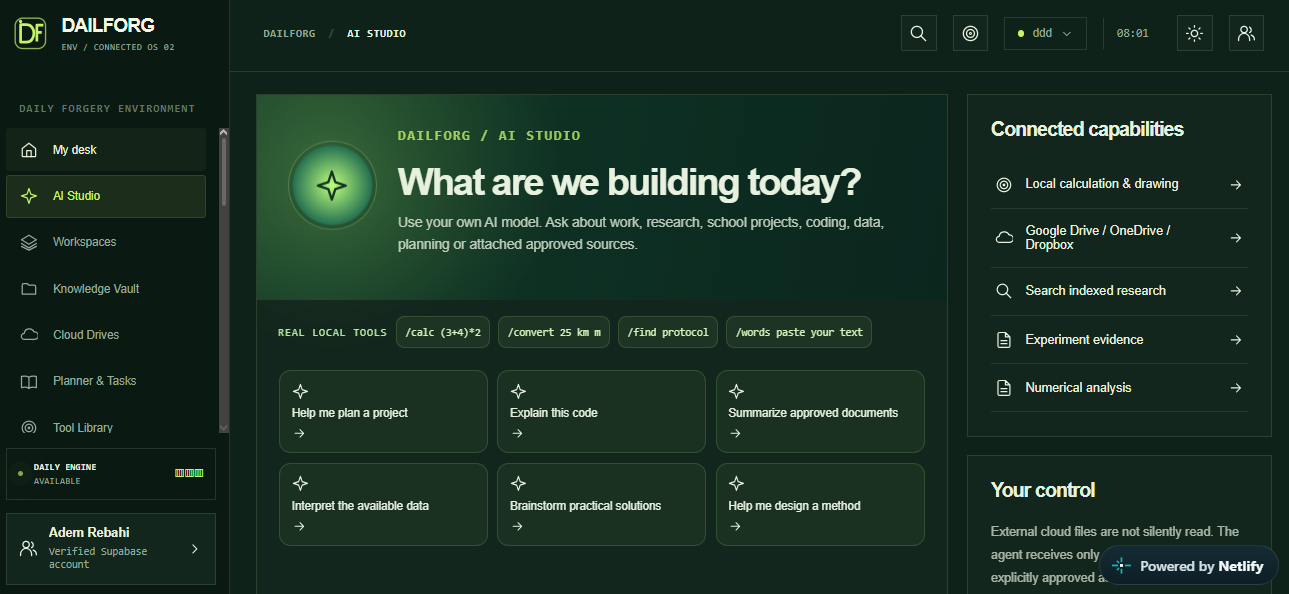
The interface was built around a dark-green scientific control-room aesthetic. I wanted it to feel like a professional research environment rather than a generic dashboard. The design uses animated interface elements, structured workspaces, contextual guidance, and responsive layouts.
The application uses browser camera capabilities for capturing experimental evidence and speech recognition for converting spoken instructions into text.
For AI-assisted features, LabForg supports configurable model providers. The idea is to let users decide which AI service they want to use rather than forcing everyone onto a single paid model.
Numerical analysis is handled separately from language-model reasoning. This allows the system to perform reproducible calculations while using AI for tasks such as explaining protocols, reviewing source material, and helping researchers investigate possible inconsistencies.
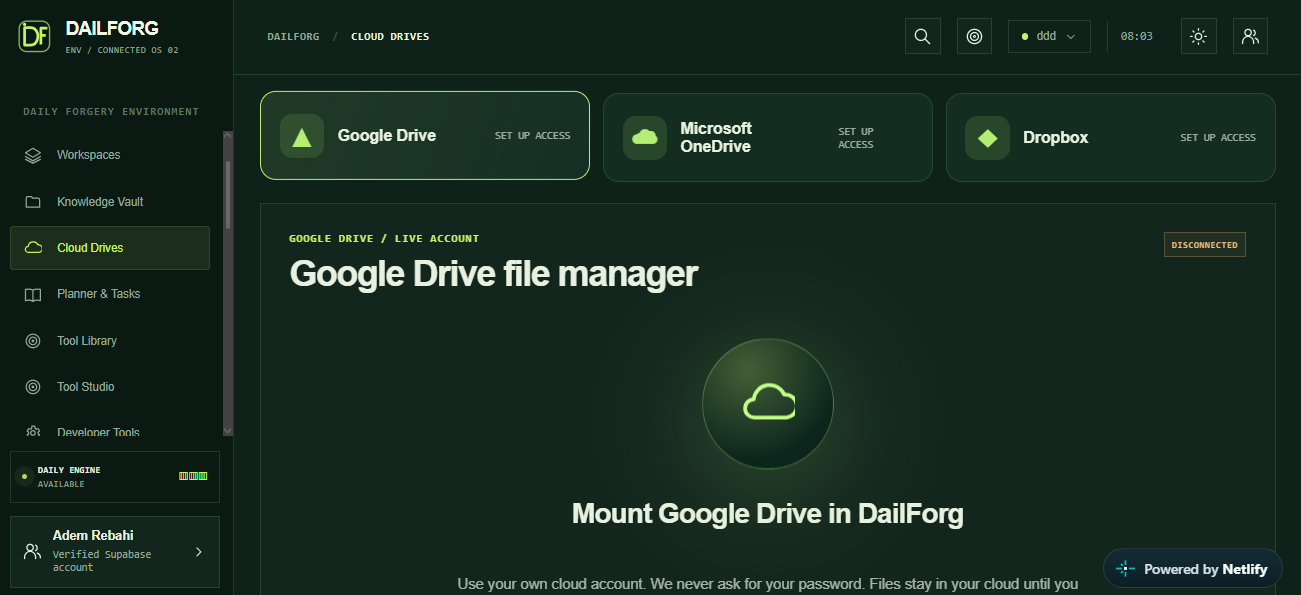
I also worked on external storage integrations, including Google Drive, OneDrive, and Dropbox, with OAuth-based authorization and file-handling workflows. These require the relevant provider configuration and permissions before they can be used with real accounts.
Challenges I ran into
One of the biggest challenges was deciding how much responsibility the AI should have.
In a scientific environment, an incorrect interpretation can be more damaging than simply giving an incomplete answer. I didn't want LabForg to automatically treat every AI-generated observation as a verified fact.
That led to an important design decision: measured data, researcher confirmations, and AI interpretations should remain distinguishable.
Another challenge was connecting different types of information. A PDF protocol, a photograph, a CSV dataset, and a handwritten note contain very different kinds of information, but they may all relate to the same experimental step.
Making these sources useful together required building a consistent experiment structure and evidence workflow.
Authentication and cloud integrations introduced additional complexity, particularly because each provider has its own authorization requirements, redirect rules, permissions, and API limitations.
Finally, I wanted the application to remain affordable. That influenced the decision to use browser capabilities, open-source technologies, deterministic calculations, and user-configurable AI services wherever possible.
Accomplishments that I'm proud of
The biggest accomplishment for me is turning LabForg from an idea for a laboratory assistant into a much broader scientific workspace.
I'm particularly proud of the experiment workflow, the evidence timeline, the numerical analysis tools, and the separation between measured results and AI interpretations.
The What-if analysis feature is another important part of the project. It allows researchers to investigate questionable measurements while preserving the original data instead of silently changing their records.
I'm also proud of the interface. A lot of effort went into making the experience feel like one connected environment, with guided project creation, research tools, animations, and a consistent visual identity.
Most importantly, LabForg is designed around helping people understand their experiments, not simply generating answers for them.
What I learned
Building LabForg changed the way I think about scientific AI.
At first, the challenge seemed to be giving an AI model access to different kinds of inputs. But I realized that multimodal capabilities become much more valuable when information from different sources can be organized, traced, and connected to actual decisions.
I also learned that an agentic system needs boundaries. An assistant should be able to identify possible problems and propose next steps, but researchers must remain responsible for confirming observations and making experimental decisions.
Another lesson was that building a large application isn't the same as building a usable one. Adding more tools doesn't help if people don't understand where to begin. That's why onboarding, contextual explanations, and guided experiment creation became important parts of the project.
What's next for LabForg Bench
There are several directions I'd like to explore further.
The first is deeper instrument integration, allowing LabForg to receive measurements directly from laboratory equipment rather than relying exclusively on uploaded files.
Another is more advanced experiment intelligence, where the platform can trace relationships between protocols, samples, images, measurements, and conclusions.
I'd also like to improve collaboration so research teams can work on shared experiments, review one another's findings, and maintain a complete history of changes.
Cloud storage connections could eventually support automatic synchronization, while AI-assisted review could become more context-aware as the experiment progresses.
The long-term goal is to make LabForg Bench a practical environment where researchers can plan, perform, understand, and reproduce experiments without constantly switching between disconnected applications.
Built With
- JavaScript
- HTML5
- CSS3
- Node.js
- Supabase
- PostgreSQL
- Supabase Authentication
- OAuth 2.0
- Google OAuth
- Microsoft Identity Platform
- GitHub OAuth
- Google Drive API
- Microsoft Graph API
- Dropbox API
- Browser MediaDevices API
- Web Speech API
- Configurable multimodal AI APIs
- Netlify
AI Development Disclosure
I used AI-assisted development tools during the creation of LabForg Bench, including help with implementation, debugging, interface development, and testing. The project's architecture, intended workflows, feature priorities, and product direction were developed through an iterative process of designing, building, reviewing, and refining the application.
AI is also part of LabForg's functionality, providing optional assistance with scientific documents, protocols, and experimental observations. Numerical calculations and recorded measurements are handled separately from AI-generated interpretations.
Built With
- ai
- gemini
- google-cloud
- javascript
- netlify
- node.js
- react
- supabase

Log in or sign up for Devpost to join the conversation.