Inspiration
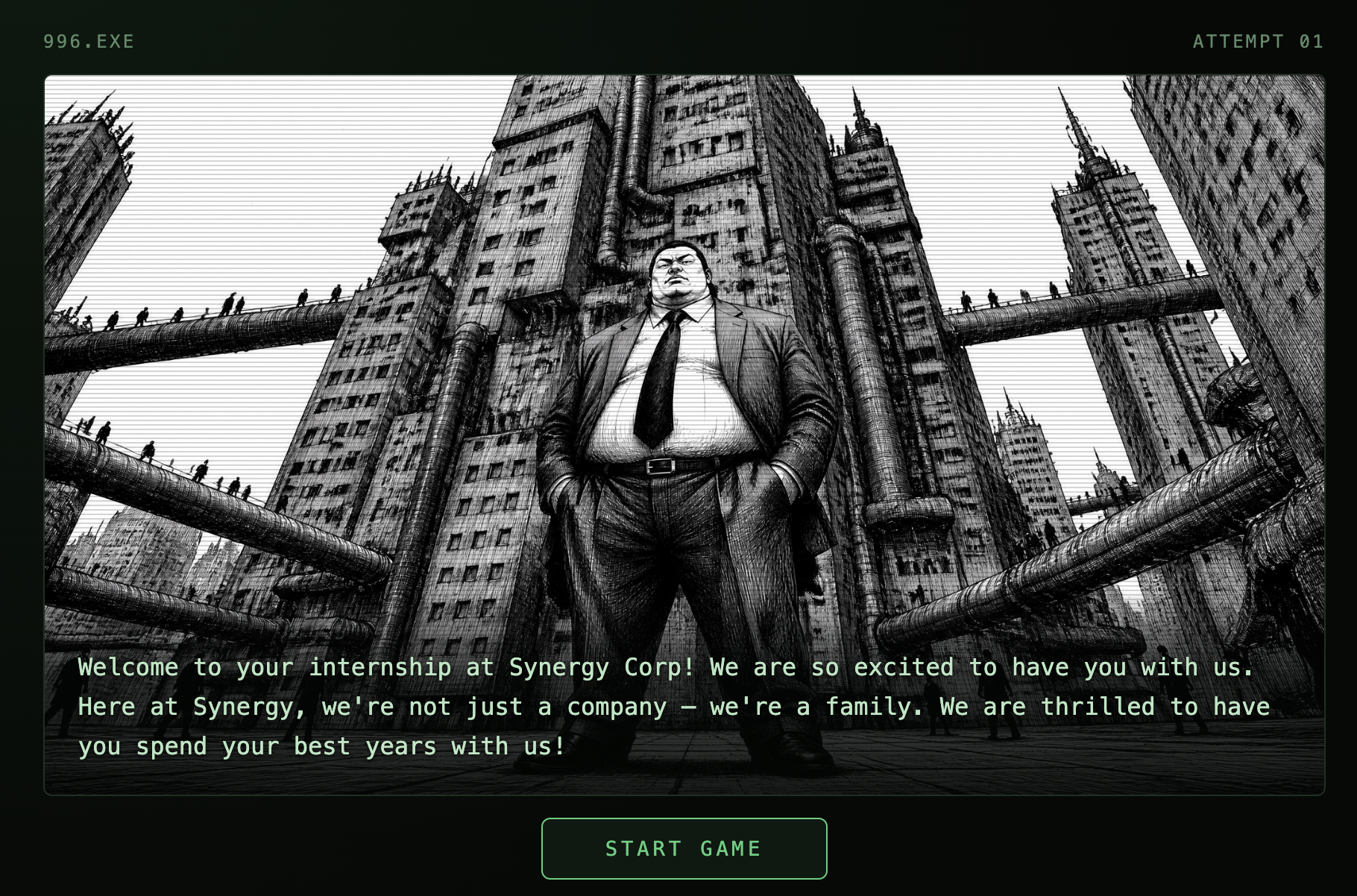
We were inspired by the strange rituals of company culture: performance reviews, mandatory team building, productivity tracking, corporate jargon, and the pressure to appear like the “perfect employee.” We wanted to turn those familiar anxieties into an absurd, dystopian office-comedy game.
What it does
LA28_996_A places the player inside Synergy Corp, where climbing the corporate ladder means surviving a series of increasingly ridiculous workplace scenarios. Each scene asks the player to complete an action by entering an object. An AI validation system determines whether that object demonstrates appropriate corporate ingenuity. A successful answer advances the player, while an unsuccessful answer sends them back to the beginning. The game also generates a customized version of each scene based on the player’s answer, making every attempt visually unique.
How we built it
We built the experience as a terminal-style JavaScript application served by a lightweight Node.js backend. The game uses: A finite-state machine to track unanswered, successful, unsuccessful, and final-win states A configurable JSON event and image manifest Gemini for contextual true-or-false semantic validation FLUX.2 Klein 9B for image editing based on the player’s submitted object Parallel API requests so validation and image generation happen simultaneously A full-screen visual interface with a terminal overlay and progress indicator Server-side environment variables to keep API keys out of the browser Each event has two base images: one shown while the player considers the prompt and another sent to the image-editing model. The generated result is displayed before the player presses Enter to continue. We built the experience as a terminal-style JavaScript application served by a lightweight Node.js backend, with an additional port for the PICO WebSpatial emulator. This allowed us to explore how the narrative could extend beyond a conventional browser and become a spatial, immersive office environment.
Challenges we ran into
One of our biggest challenges was turning an open-ended word into a consistent game decision. The validation model had to infer a rule from the scenario, account for the satirical “perfect employee” theme, and return only a strict boolean result. We also encountered changing model availability, truncated Gemini responses, API timeouts, malformed model output, and long image-generation cold starts. Coordinating validation and image generation without blocking or accidentally advancing the game required careful asynchronous state management. Finally, we needed generated images to feel connected to each scene while preserving the composition and visual language of the original artwork.
Accomplishments that we're proud of
We are proud that the game combines narrative writing, semantic reasoning, and generative imagery as parts of one coherent mechanic rather than using AI as a decorative feature. Alongside the desktop web experience, we created a PICO WebSpatial emulator port. This demonstrated that the game’s terminal interactions, generated scenes, and corporate-surrealist atmosphere could translate into a spatial-computing format.
We also built:
A reusable event system that can be expanded through JSON and JavaScript configuration Strict, fail-safe AI validation Parallel semantic-validation and image-editing workflows Explicit player-controlled progression Graceful fallbacks for missing images and unavailable services A responsive terminal interface that keeps the scene itself visually dominant Most importantly, the generated object becomes part of the story’s visual outcome, making the player’s language meaningfully affect the experience.
What we learned
We learned that AI outputs need strong contracts, defensive parsing, timeouts, and fallback behavior—especially when they control game state. We also learned that generative latency changes interaction design. Instead of treating waiting as an interruption, we incorporated validation and generation indicators into the terminal experience. On the creative side, we learned that absurdity works best when the underlying rules remain understandable. The scenarios can be surreal, but players still need enough context to reason about what Synergy Corp considers “correct.”
What's next for LA28_996_A
Next, we want to: Add more departments, scenarios, and branching corporate career paths Give each department its own visual style and workplace rules Improve validation with per-event constraints and structured AI responses Add persistent employee rankings, titles, and performance reviews Cache generated images and revisit previous attempts Introduce hidden endings based on patterns in the player’s answers Add sound design, environmental animation, and more dynamic terminal effects Turn the final promotion into a personalized AI-generated performance report Eventually, we imagine Synergy Corp becoming a replayable satire in which every promotion makes the workplace stranger—and escaping it more difficult. Expand the PICO WebSpatial port into a fully immersive Synergy Corp office Place prompts, generated scenes, and corporate interfaces throughout a spatial environment Experiment with gaze, controller, and hand-tracking input Use spatial audio and environmental transitions to make failed evaluations more dramatic Support additional immersive and mixed-reality platforms

Log in or sign up for Devpost to join the conversation.