-
-

Main Page
-
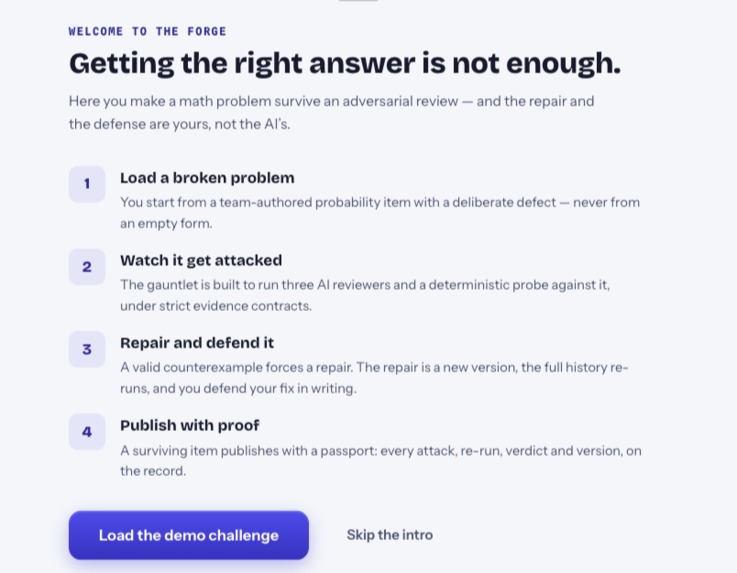
Onboarding
-
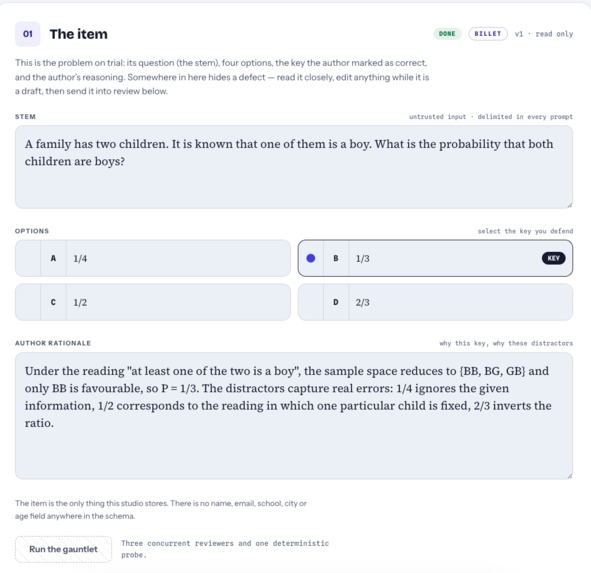
Demo Step 1
-
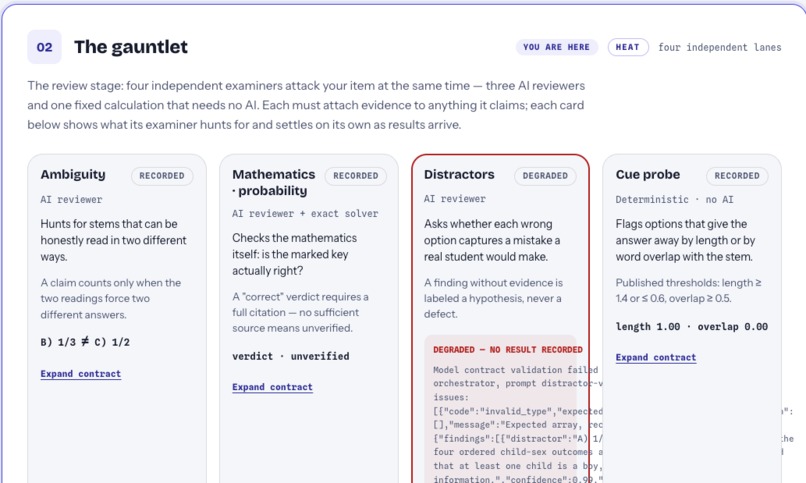
Demo Step 2
-
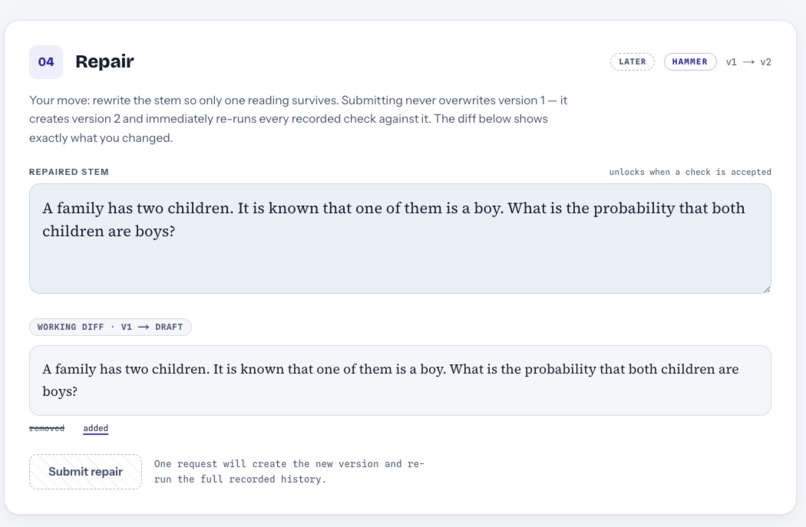
Demo Step 3

About the project
Inspiration
I have spent more than ten years preparing students for the university entrance exam in Chile, first as a math olympiad kid turned tutor, then as an engineer building an edtech platform for the PAES. That means I have watched, from the front row, the fastest transformation in how students learn that I have ever seen.
When AI arrived, something wonderful happened: students stopped getting stuck. The question that used to block them until the next class now gets unblocked in thirty seconds. But something quieter happened too. The same shortcut that unblocks them also lets them step around the problems that require real intellectual effort. They skip the slow maturation of concepts. They avoid the uncomfortable stretch where abstraction is built. They reach the answer without ever owning the reasoning.
I became convinced of a simple principle: if students use AI as an answer machine, they will not learn. The tool is not the problem. The direction of the interaction is.
And there is a deeper question underneath, one every student deserves to hear: you are not graduating into the world you were prepared for. You are graduating into a world where intelligence is suddenly everywhere. So what kind of person becomes more valuable when everyone has access to intelligence? A person who builds.
AI can democratize teaching. That part is already happening. The harder task, the one that keeps me up at night, is making sure we also democratize the skills students develop with AI. Everyone should know how to build, to argue, to defend an idea under pressure. If we only democratize answers, we will widen the very gap we promised to close.
La Forja is my answer to that. It flips the direction of the interaction.
What it does
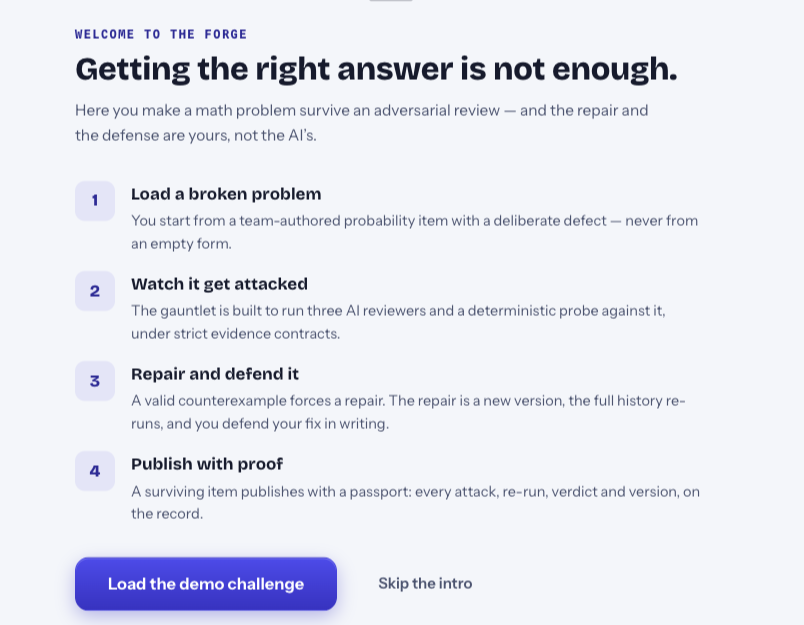
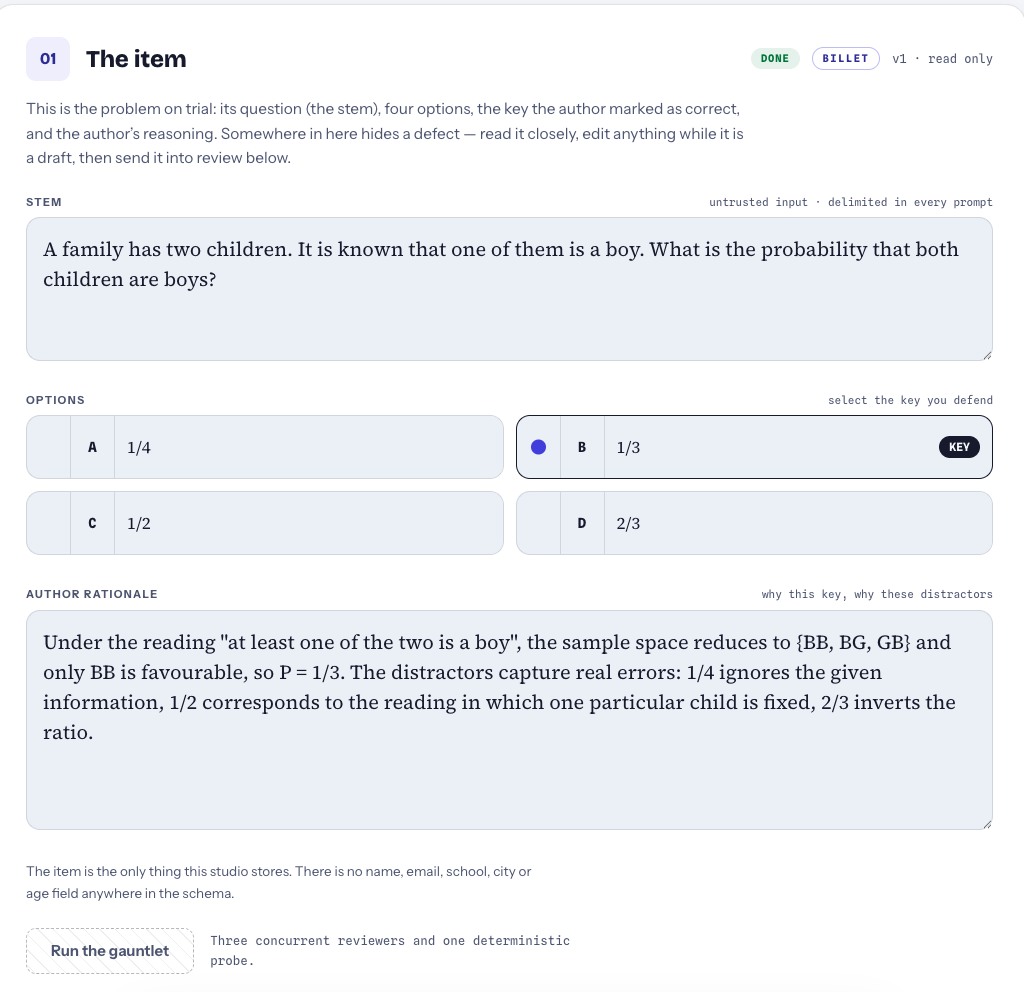
La Forja is an adversarial learning studio for high school and college mathematics. Students do not answer questions in La Forja. They author them.
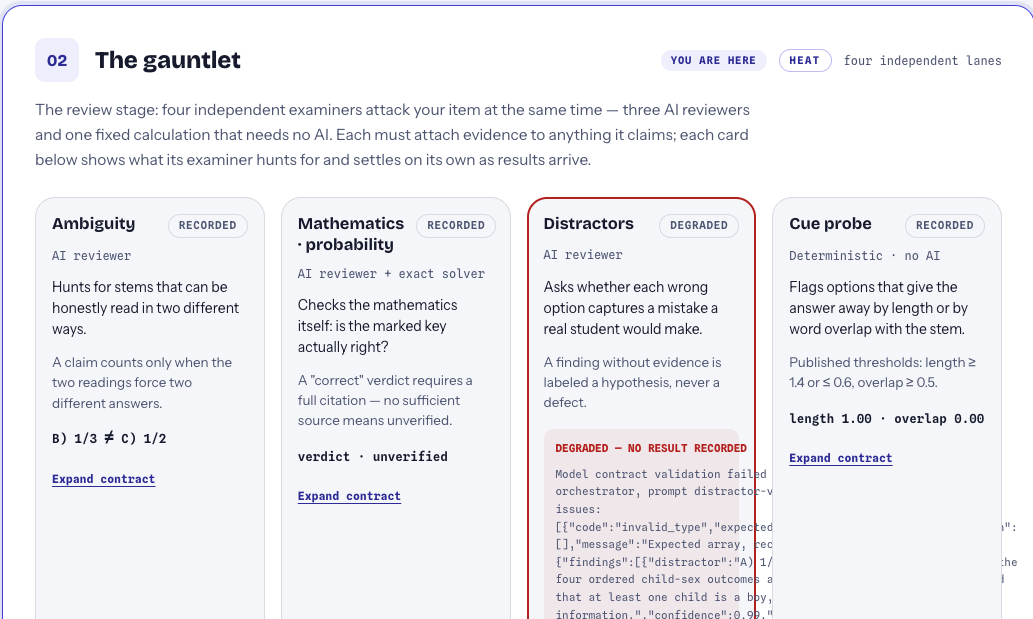
A student writes a math item: the stem, the alternatives, and a rationale for every distractor. Then GPT-5.6 goes on the attack. Three reviewers with different evidence contracts search the item for ambiguity, disciplinary errors, and weak distractors, while a deterministic probe checks for superficial answer cues. Every accepted finding must carry evidence: two conflicting interpretations that produce different answers, a cited source with the exact passage, or a reproducible heuristic. Never just a confidence score.
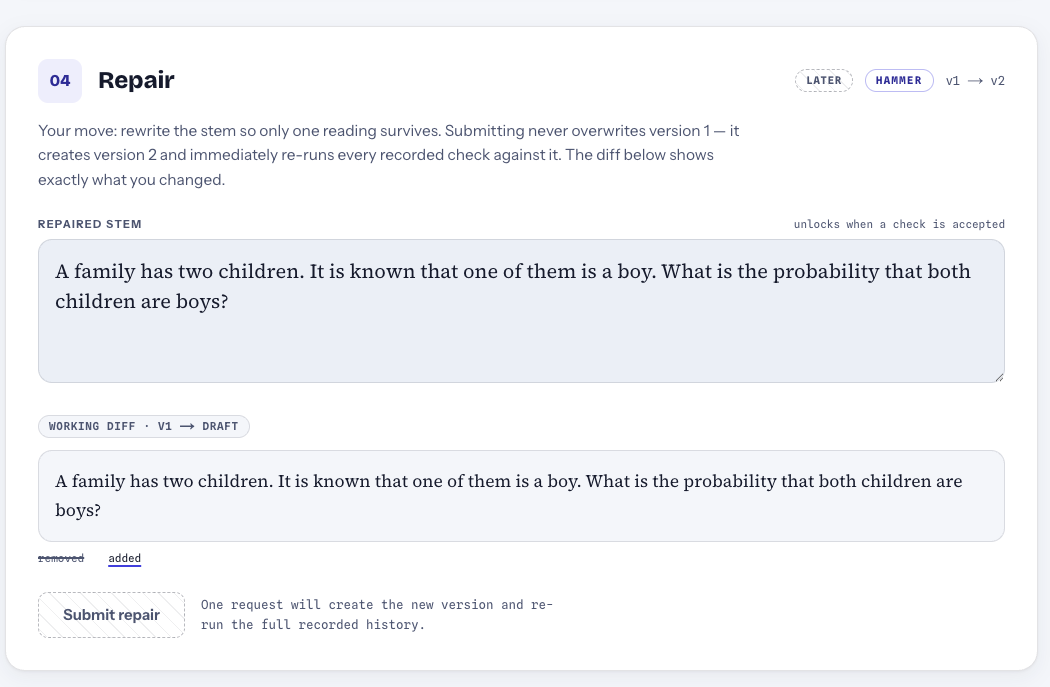
The AI does not generate the item and it does not hand over a canonical solution to copy. It challenges. The student owns the repair. When the item survives, the student defends it in a short written viva scored on an explicit rubric: name the misconception your distractor captures, explain why the correct alternative is unique, hold up under a variation of the problem. Only then is the item published with a passport: provenance, challenges, revisions, and rubric results, all auditable.
Every accepted check is re-run on each new version. Deterministic checks can never regress. Reasoning becomes observable under challenge.
Writing a good question demands deeper understanding than answering one. You must master the content, anticipate how others go wrong, and design distractors around real misconceptions. That is builder thinking, applied to mathematics. That is the skill we want every student to graduate with, not just the ones who can afford elite preparation.
How we built it
We built La Forja with Codex and GPT-5.6, and we kept the division of labor honest. Codex implemented the versioned state machine, the reviewer evidence contracts, the evaluation harness, and the deployment, while we chose the product contracts and the evaluation criteria. GPT-5.6 runs the parallel reviewers, the adjudication step, and the adaptive defense at runtime.
The architecture is deliberately boring where it should be boring: explicit concurrent calls with timeouts, JSON schema validation on every model output, a deterministic solver for the probability domain of our demo, and an application-level state machine where published versions are immutable and every repair creates a new version that must re-run the full history of accepted checks.
We also built a labeled smoke set of sixteen original items with seeded flaws, and compared a single general reviewer against the specialized gauntlet across repeated runs, reporting exact counts, false positives, latency, and cost. We would rather show honest numbers than impressive adjectives.
Challenges we ran into
The hardest challenges were epistemological, not technical. Our first drafts overclaimed: guaranteed quality, synthetic psychometrics, AI that never explains. We ran the project through two rounds of adversarial review and cut every claim we could not defend, which is fitting, because that is exactly what La Forja asks of students. Formalizing what "no regression" honestly means forced us to classify checks into deterministic invariants, re-executable counterexamples, and semantic judgments that must be re-adjudicated. Getting reviewers to produce evidence instead of opinions took careful contract design, because a model saying so is never final evidence in our system.
What we learned
That the most valuable thing AI can add to education is not speed but resistance. Productive struggle is not a bug to be optimized away, it is the mechanism of learning, and AI is astonishingly good at structuring it when you point it in the right direction.
The flame we want to relight
When I was training for the National Mathematics Olympiad, we had a forum called fmat.cl, a Chilean community for competition mathematics that is inactive today. Students would post their solutions and proofs, and other students would question them, poke at the weak steps, demand rigor. Defending a solution methodologically, in front of peers who genuinely wanted to find the flaw, remains one of the richest learning experiences of my life.
That forum is gone. La Forja is our attempt to recreate that experience and to spark that flame in a new generation of students: a place where getting the right answer is not enough, where you forge your reasoning, watch it get attacked, repair it, and stand up to defend it. Chile's PAES is our first proving ground. The mechanism is exam agnostic. The conviction is universal: in a world full of intelligence, we should be forging builders.## Inspiration
Built With
- codex
- gpt5.6
- javascript
- nextjs
- openai
- prisma
- react
- typescript

Log in or sign up for Devpost to join the conversation.