*Note: This website is hosted on Render’s free tier. Please wait about 30 seconds if the server is starting up after a new request.
Inspiration The AI transition is rapidly reshaping the global labor market, but in Vietnam, office workers, industrial workers, and students often face this shift with uncertainty. When a junior accountant in Hanoi asks, "Will AI take my job, and what should I learn?", the current options are either expensive human consulting or generic, often hallucinated listicles from single-shot LLM prompts.
For life-altering career decisions, trust is the ultimate bottleneck. We noticed that even with retrieval-augmented generation (RAG), LLMs would sometimes fabricate research papers or statistics to make their advice sound more convincing. We realized that to build a career compass people could actually rely on, we couldn't just give the AI better data—we had to build an agentic system capable of doubting, verifying, and correcting its own work.
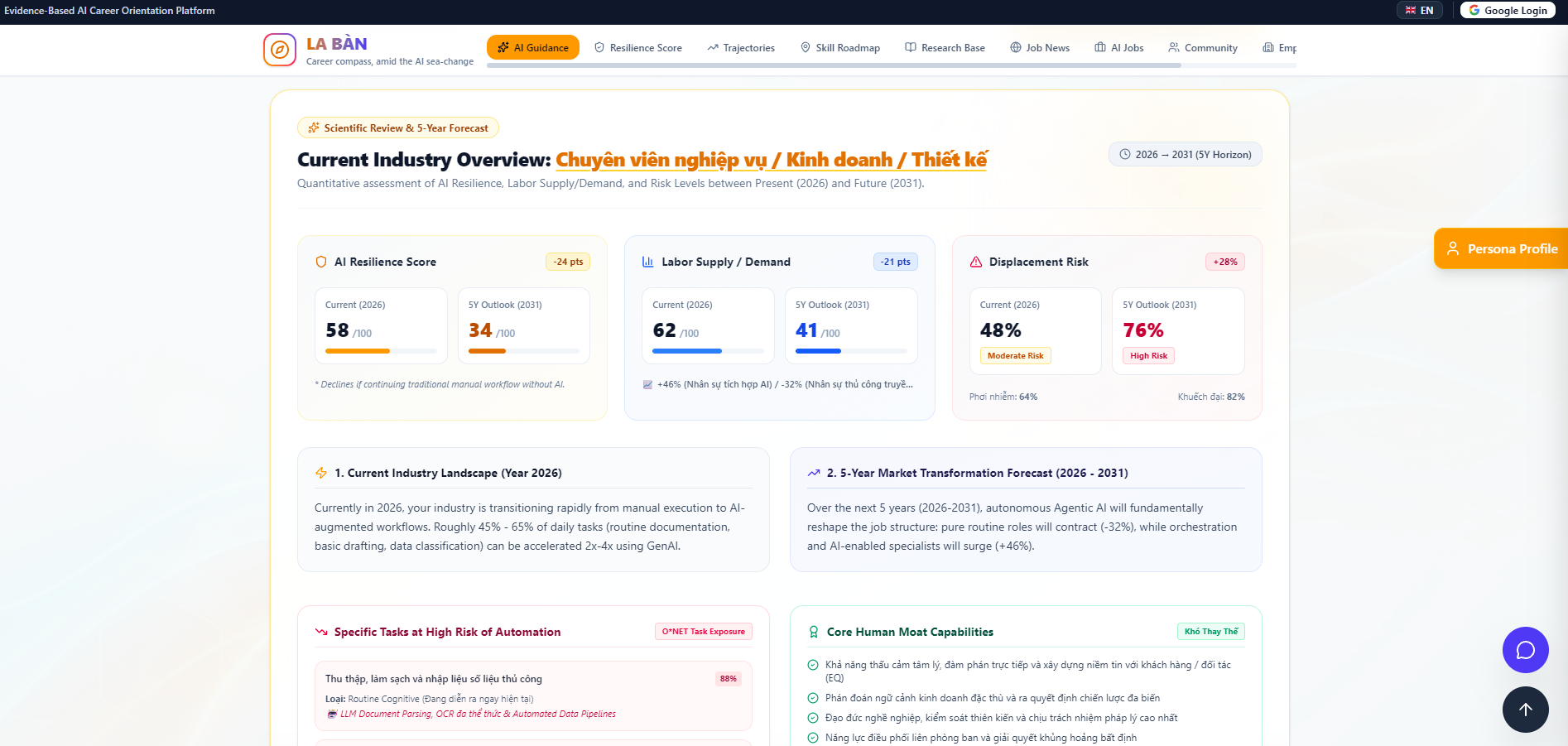
What it does La Bàn (The Compass) is an agentic web application that provides Vietnamese workers with highly personalized, evidence-grounded career transition strategies. Users input their current occupation and concerns, and the application outputs a detailed career trajectory, skill gaps analysis, and actionable next steps.
What sets La Bàn apart is the Agent Transparency Panel in the UI, which allows users to see exactly which curated sources (WEF, ILO, McKinsey, TopCV) the agents queried, and how the advice is strictly grounded in real labor market data.
How we built it We built La Bàn using a 4-Agent Pipeline architecture powered by the Gemini API:
Profiler: Normalizes the user's intake, extracts keywords, and flags risk levels. Evidence Gatherer: Uses Gemini function-calling to execute up to 6 deterministic tool calls (lookupOccupation, searchResearch, getOccupationNews) across curated data sources. Analyst: Synthesizes the gathered evidence into actionable advice, constrained by a strict system prompt to only cite the provided pack. Verifier: An LLM-as-a-judge guardrail. It checks schema validity and cross-references citations against the gathered evidence. If it detects a hallucination, it triggers a repair loop (up to 2 retries) to fix the Analyst's output before rendering. The frontend is built with React, Vite, and TailwindCSS, utilizing libraries like recharts and framer-motion for data visualization and smooth interactions. The backend is a lightweight Express/Node.js server. To ensure the submission is fully self-contained and reproducible for judges, we deliberately removed external database dependencies (like Firebase) and replaced persistence with localStorage.
Challenges we ran into Our biggest challenge was "lazy hallucinations". In our initial single-shot baseline, 2 out of 26 citations across 12 test personas were completely fabricated—the LLM invented research papers to support its points.
We initially thought simply adding a retrieval tool would fix this. However, we found that retrieval alone did not stop citation fabrication (grounding stayed at 91.7% with 2 hallucinations). The LLM would read the real context but still hallucinate additional details to sound smarter.
Accomplishments that we're proud of By implementing the Verifier agent and the repair loop, we completely eliminated hallucinations. In our automated evaluation suite across 12 diverse personas (including edge cases like garment workers and farmers):
Evidence grounding rate jumped to 100%. Hallucinated citations dropped to exactly 0. We achieved a 12/12 schema-valid execution rate, with the system successfully recovering from parse errors automatically. What we learned We learned a critical lesson about the frontier of agentic engineering: When reliability matters, you must build agents that can reject and retry their own output. Providing more context (RAG) is insufficient for high-stakes domains; deterministic verification and self-correction loops are mandatory.
What's next for La Bàn We plan to expand our deterministic tools to integrate directly with live job boards in Vietnam (like TopCV or VietnamWorks) to provide real-time salary and demand data. We also aim to add a localized "skills taxonomy" graph to help blue-collar workers map their current physical skills to emerging tech-adjacent roles.
Built With
- ai-agentsmulti-agent-system
- framer-motion
- gemini
- llm-as-a-judge
- node.js
- prompt-engineering
- react
- recharts
- typescript
- vite


Log in or sign up for Devpost to join the conversation.