Inspiration
Language note: I do not read, write, or speak English. I wrote my ideas and experiences in Japanese, and ChatGPT helped translate and organize them into English. The story, decisions, and opinions in this submission are my own.
I am a 44-year-old homemaker in Japan. I am not a software engineer. I did not know how to code, and I did not understand most technical terminology when I started.
I had also just begun rebuilding my life after depression.
L’avian Core began from a very practical question:
Why should one small-business owner have to remember, coordinate, enter, check, and update everything manually?
Small-business owners are often expected to manage many disconnected tools, repeat the same information across multiple systems, and make hundreds of small decisions every day.
For someone already carrying limited time, energy, money, or confidence, that burden can make starting or running a business feel impossible.
I did not want to build another application that gives people more screens to manage.
I wanted to build an AI-native operating system that could understand one request, coordinate the necessary work, update the correct records, and return to the human only when judgment or approval was truly required.
L’avian Core was conceived over approximately six weeks and built into a working system in roughly two weeks.
The entire project was created on an iPhone 14 Pro.
No computer was used.
System design, prompt design, AI-assisted implementation, GitHub operations, Vercel deployment, API integration, Google Sheets synchronization, testing, debugging, submission preparation, and demo recording were all completed from the iPhone.
L’avian Core began as a way to reduce cognitive load in my own future business.
It became proof that advanced business systems do not have to be limited to engineers, technical teams, or large companies.
A non-technical person with a clear purpose, strong operational rules, and the right AI partner should be able to build serious software too.
What it does
L’avian Core turns one customer request into a complete, structured business workflow.
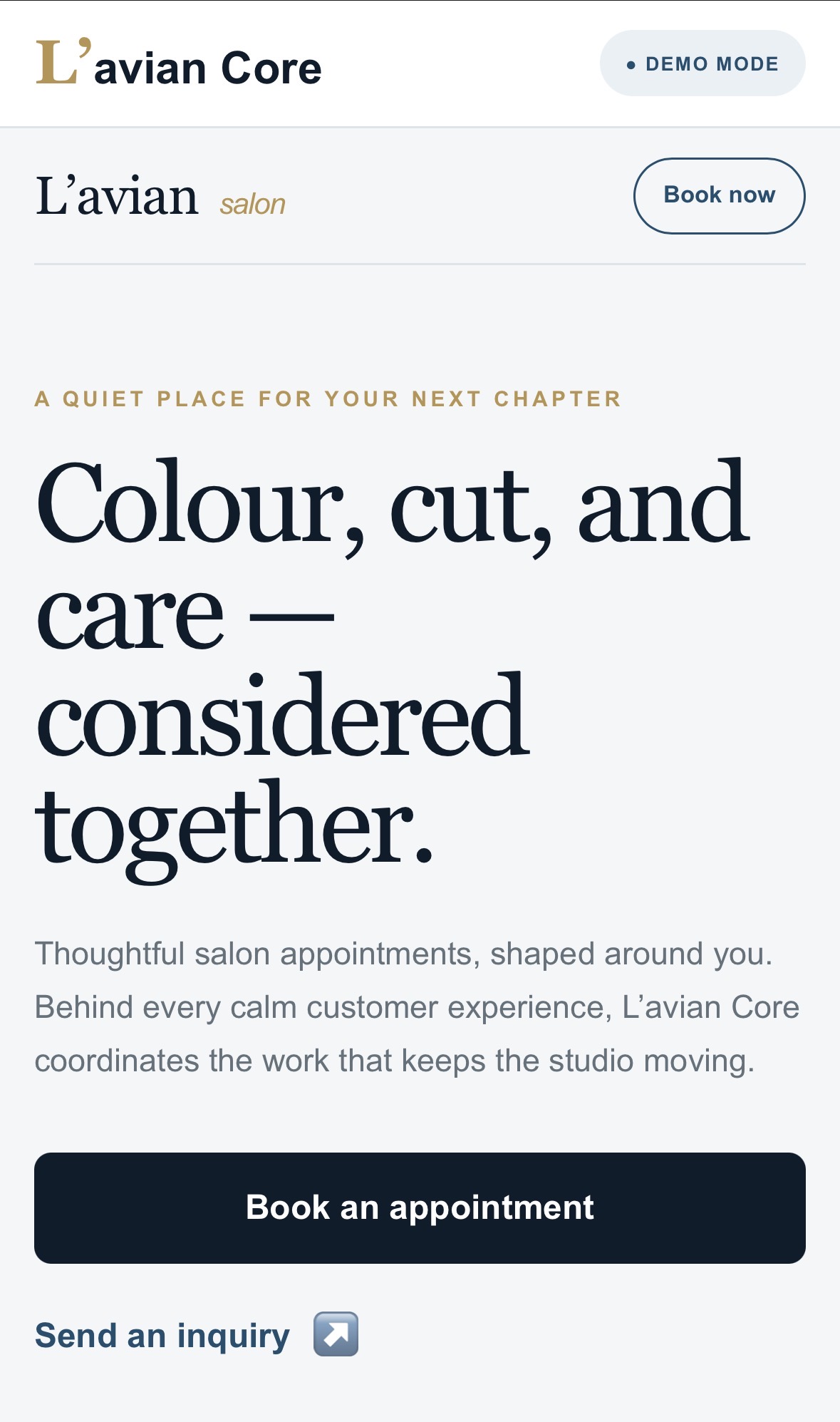
The Build Week submission demonstrates this through a salon booking workflow.
A customer submits a booking request.
The AI extracts and structures the relevant information, including:
- customer name
- requested service
- preferred date and time
- staff or resource requirements
- price
- payment status
- inventory impact
- workflow status
The request is then transformed into an operational sequence.
The system can coordinate:
- customer request intake
- structured data extraction
- booking preparation
- human approval
- service confirmation
- payment handling
- inventory updates
- workflow status updates
- Google Sheets synchronization
- operational recordkeeping
The goal is not to remove the human.
The goal is to remove unnecessary human work.
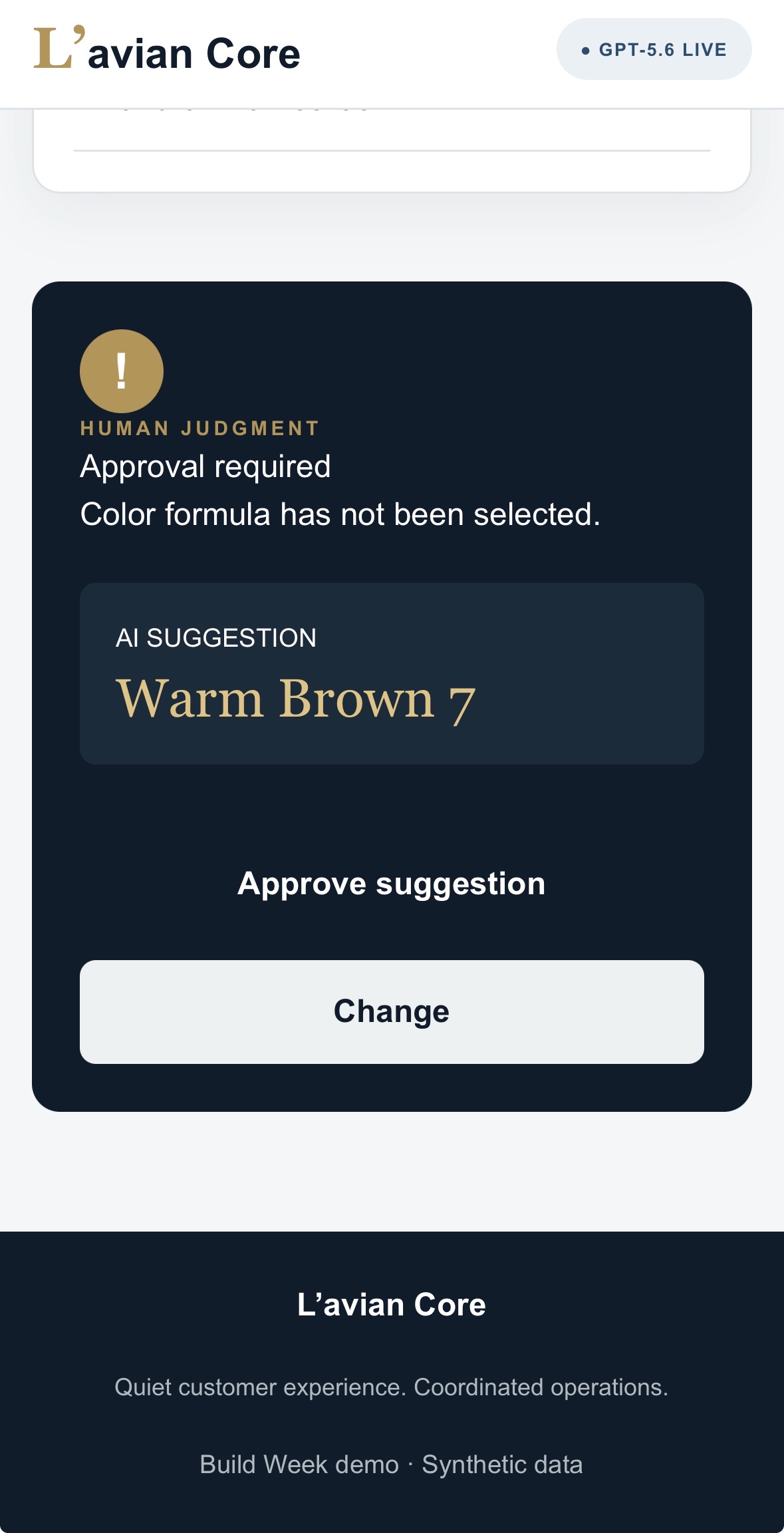
L’avian Core keeps human approval where judgment matters, while allowing routine coordination, record updates, and system handoffs to be handled by AI.
The salon demo is only one implementation.
The underlying concept is an AI-native business operating layer that can be adapted to many small-business workflows.
How we built it
I built L’avian Core with ChatGPT as my technical partner.
I did not begin with coding knowledge, a development team, or a computer setup. I worked primarily from an iPhone 14 Pro and learned each step while building the product.
ChatGPT helped translate my business ideas into technical requirements, generate and revise code, explain errors in plain language, and guide the deployment process.
The production demo was built with:
- Next.js
- React
- TypeScript
- Tailwind CSS
- OpenAI API
- Google Sheets API
- Vercel
- GitHub
The workflow is divided into three clear stages:
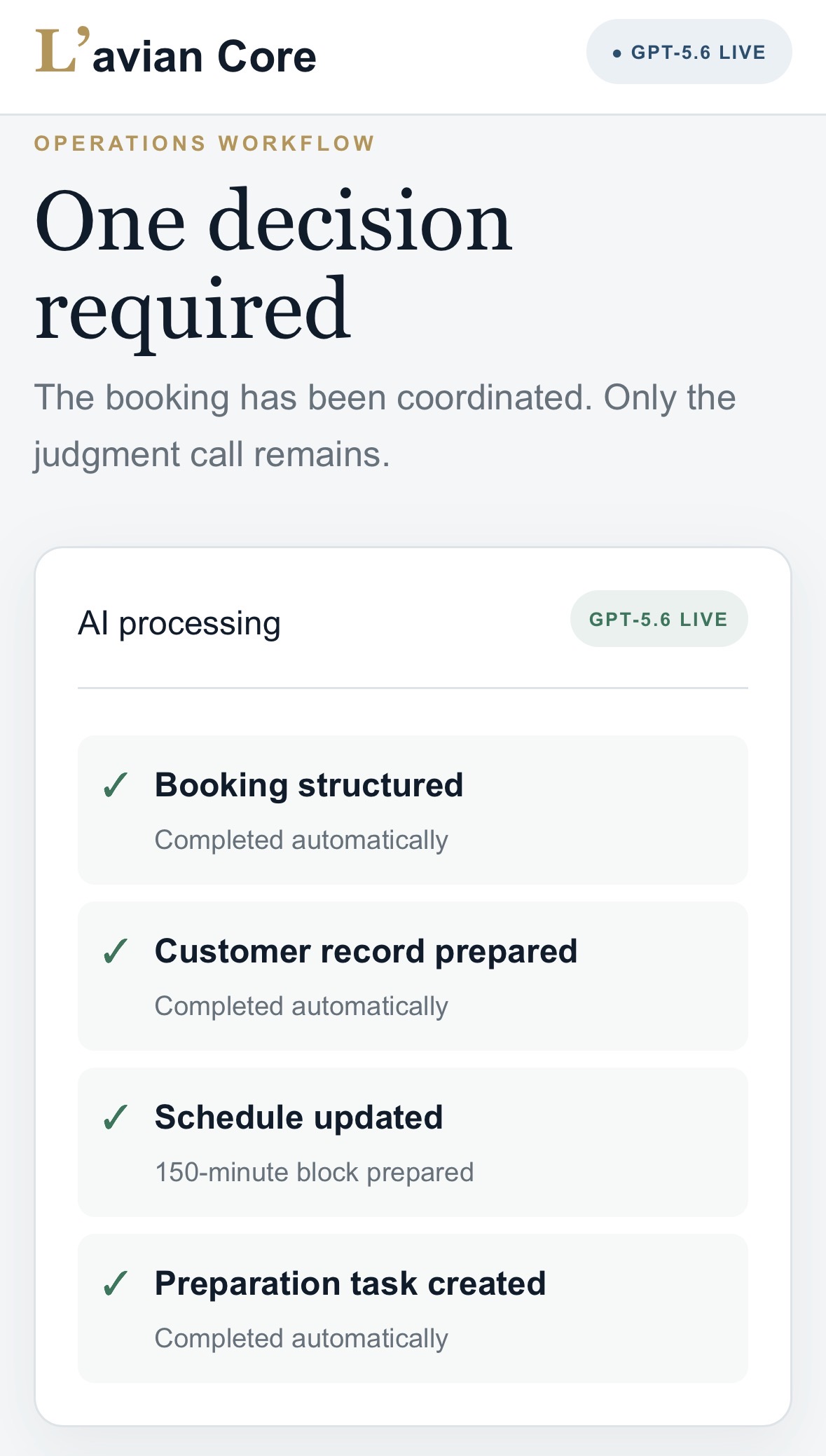
AI interpretation
The OpenAI API reads an unstructured customer request and converts it into structured business data.Human approval
The system preserves a checkpoint so important decisions remain under human control.System execution
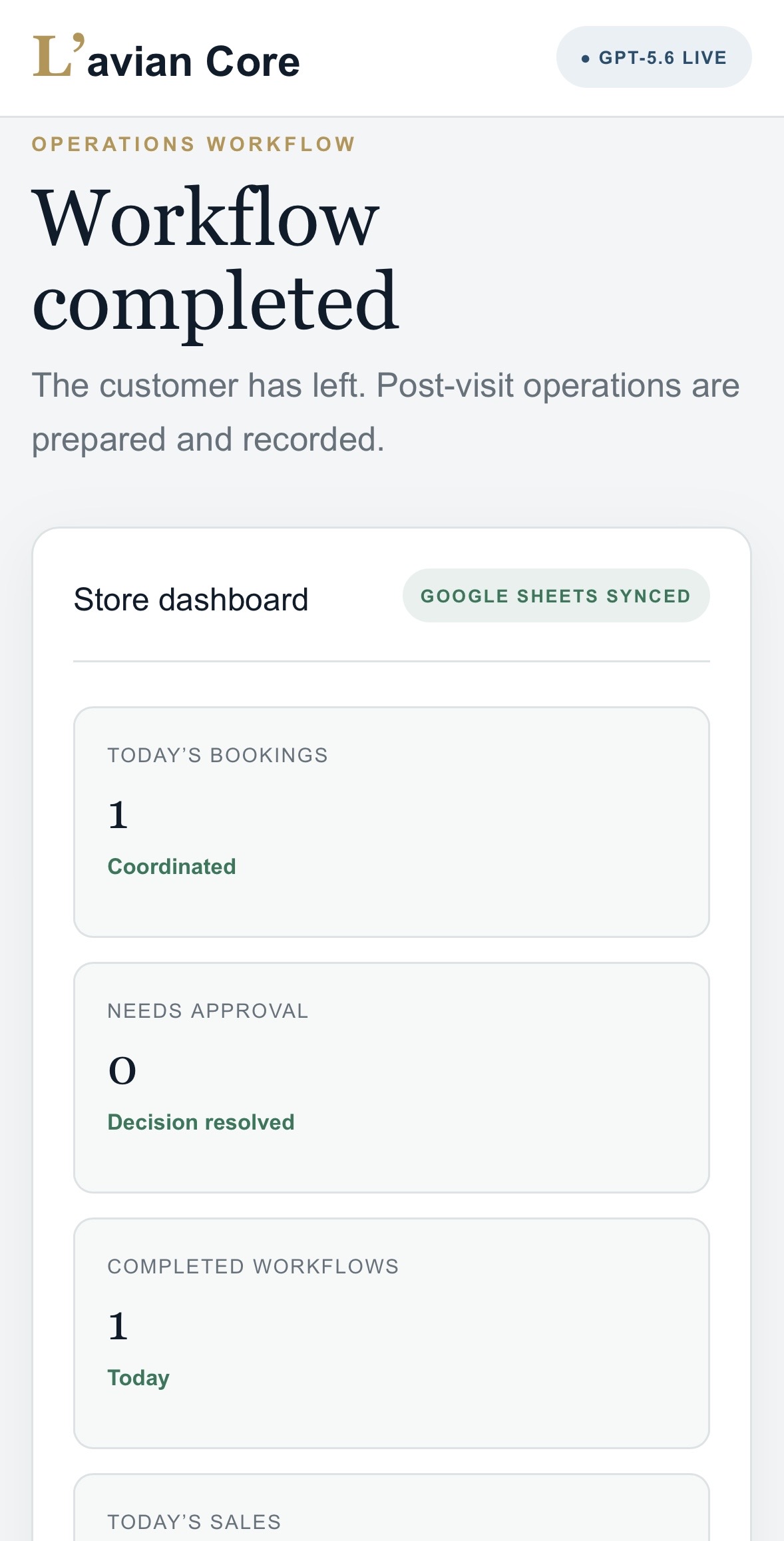
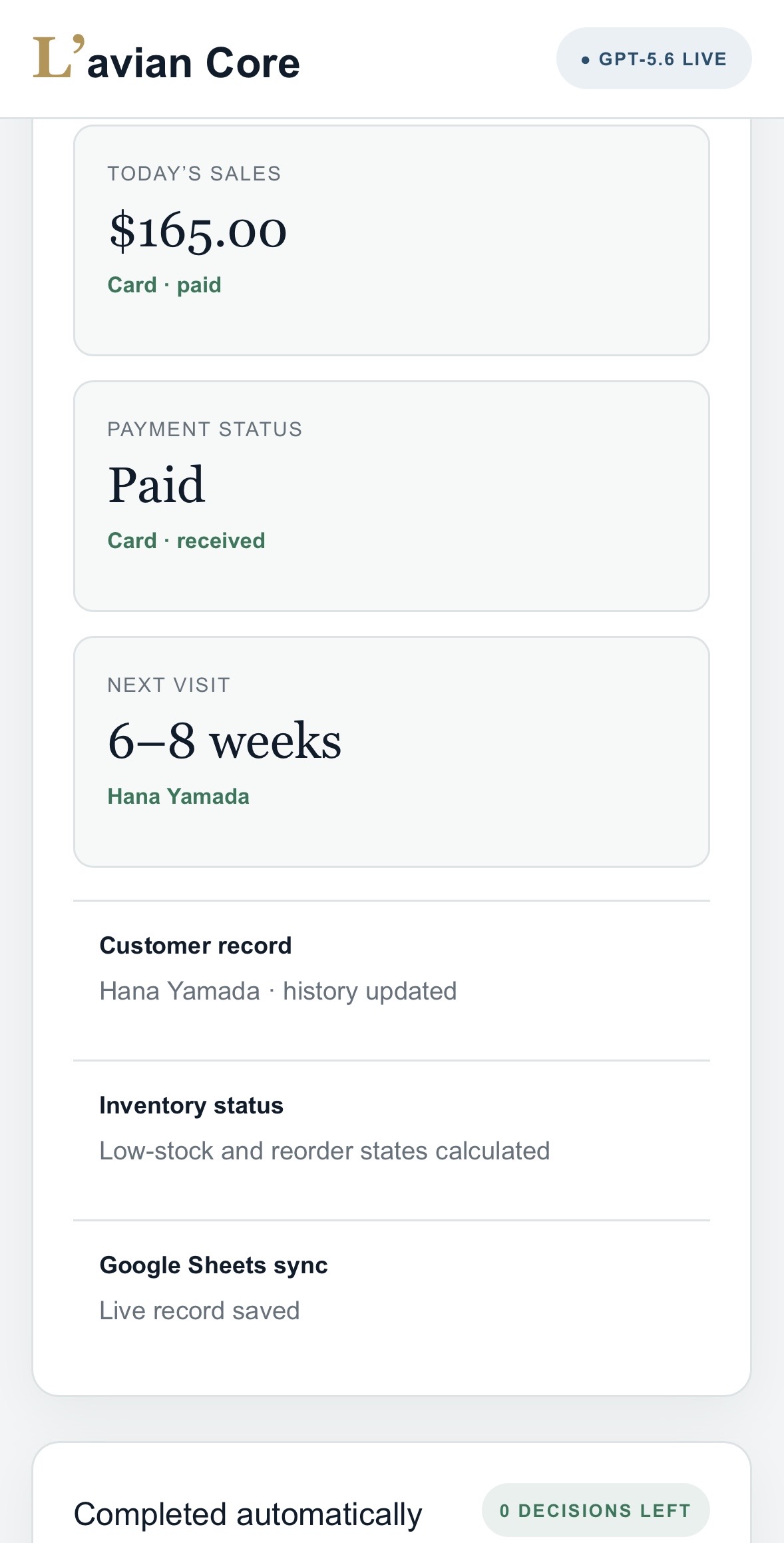
Approved data is synchronized to Google Sheets, where customer records, reservations, visit history, accounting, and inventory are updated.
This architecture matters because the AI is not only generating text. It is interpreting, coordinating, and executing operational work while keeping the human responsible for final judgment.
The most important part of the build was not writing code quickly. It was repeatedly testing the full production path until the OpenAI processing, approval flow, inventory updates, and Google Sheets synchronization all worked together.
Challenges we ran into
The hardest challenge was not learning a single technology. It was learning how all the pieces had to work together.
I was building without a technical background, without a development team, and mostly from an iPhone. Every error message was unfamiliar, and even simple terms could slow me down.
The main technical challenges included:
- turning AI output into reliable structured data
- keeping AI interpretation, human approval, and system execution separate
- connecting the OpenAI API to a production workflow
- restoring a missing server-side synchronization route
- configuring Google Sheets API access and service account permissions
- keeping accounting and inventory updates consistent
- handling API quota and billing issues
- deploying and testing the full system on Vercel
There were many points where the demo appeared to work visually but failed somewhere behind the scenes.
So I kept testing the entire path:
customer request → AI processing → human approval → accounting → inventory → Google Sheets
The breakthrough came when every part worked together in production.
This project taught me that building with AI is not about avoiding difficulty. It is about making difficult systems understandable enough for an ordinary person to keep moving forward.
Accomplishments that we're proud of
I am proud that L’avian Core became a working production demo, not just an idea, mockup, or presentation.
One month earlier, I did not know how to code or understand most development terminology. I am a 44-year-old homemaker in Japan, rebuilding my life after depression, and I built this primarily from an iPhone 14 Pro with ChatGPT as my technical partner.
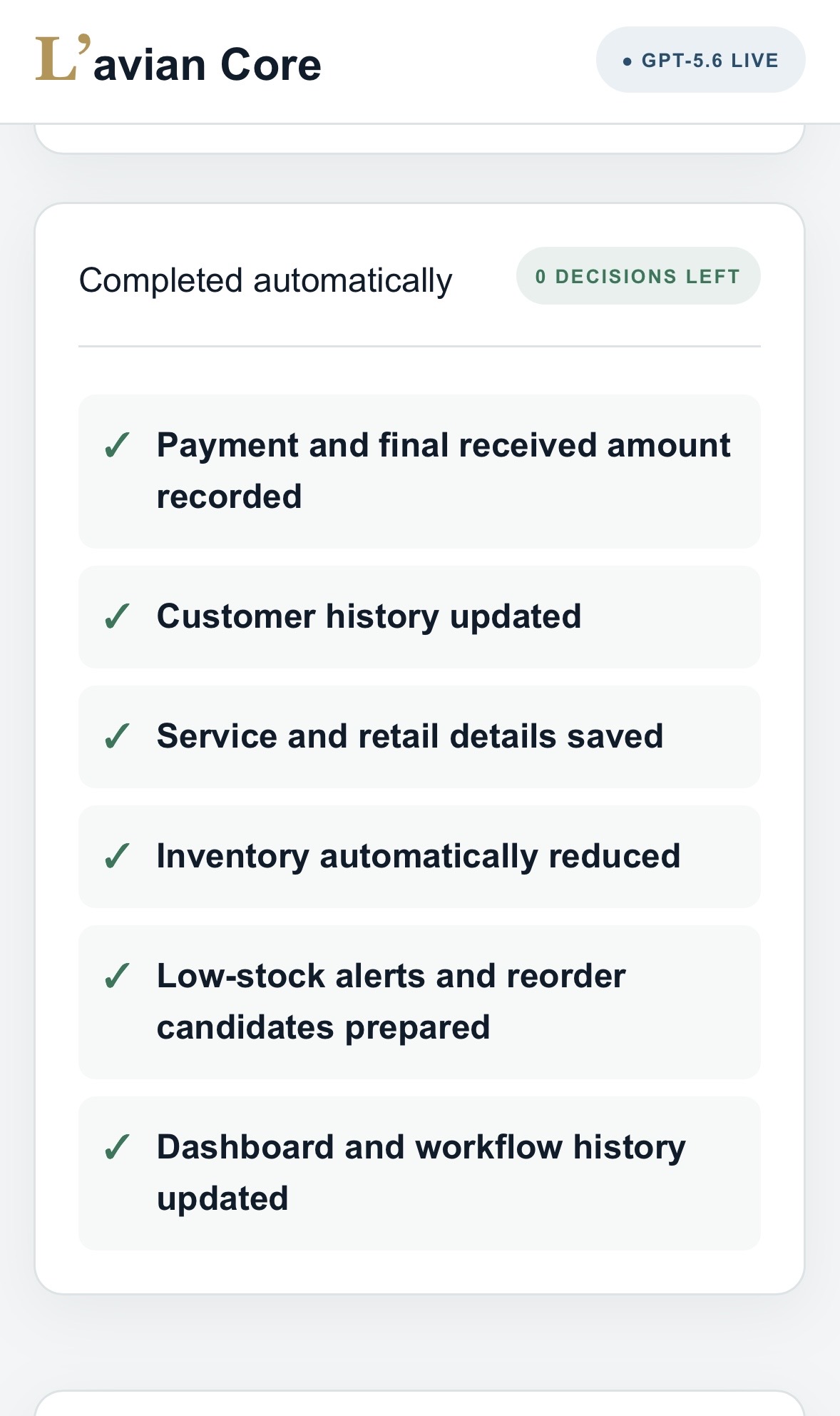
The completed workflow now successfully:
- processes a customer request with the OpenAI API
- converts unstructured text into structured business data
- preserves a human approval step
- creates and updates customer records
- creates reservation and visit records
- updates accounting data
- deducts inventory automatically
- detects low-stock and out-of-stock conditions
- synchronizes the final result to Google Sheets
- runs as a deployed production web application
I am especially proud that the AI is not simply producing an answer on a screen.
It is coordinating real operational work across customer management, reservations, accounting, inventory, and recordkeeping.
For me, the biggest accomplishment is proving that someone without a technical background can use AI not only to learn about software, but to build and operate a real system.
L’avian Core is both a product and evidence of what becomes possible when advanced AI tools are made understandable to ordinary people.
What we learned
I learned that useful AI is not defined by how impressive its answers sound.
It is defined by whether it can reduce real work, preserve human control, and leave reliable records behind.
The most important lesson was to separate the workflow into three stages:
AI interpretation
The AI understands an unstructured request and converts it into structured data.Human judgment
Important decisions remain visible and require approval.System execution
Approved information updates the operational records automatically.
This separation made the system easier to test, audit, and trust.
I also learned that non-technical users do not necessarily need simpler ideas. They need technical complexity translated into understandable steps.
ChatGPT did not replace my judgment. It helped me express that judgment in a form the system could execute.
Most importantly, I learned that AI can dramatically lower the barrier to building software, but only when the human remains clear about the purpose, rules, and final standard.
L’avian Core taught me that someone without a technical background can still design a serious operational system when AI acts as a translator, builder, and debugging partner.
What's next for L’avian Core
The next step is to turn the current working salon demo into a reusable operating system for small businesses.
The salon workflow is only the first implementation.
The same Core can be adapted for:
- beauty and wellness services
- fitness and lesson businesses
- appointment-based operations
- real-estate workflows
- sales workflows
- retail operations
- inventory-based businesses
- shipping-based businesses
- service businesses
- other small businesses that rely on repeated coordination and manual recordkeeping
Future development will focus on:
- reusable industry templates
- configurable workflow modules
- stronger human-approval controls
- automated monitoring
- error detection
- exception handling
- clearer audit trails
- structured version management
- structured build management
- backup and recovery
- role-based AI governance
- easier setup for non-technical owners
- flexible interfaces across LINE, email, web forms, and other channels
- deeper Google Workspace integration
- reusable operational masters
- safer financial controls
- inventory and purchasing coordination
- automated document generation
- AI self-diagnosis
- AI-assisted maintenance
My long-term goal is not to build another software product that people have to manage.
It is to build an AI-native operating layer that understands how the business works, coordinates routine operations, updates the correct records, and asks the human only when judgment is truly required.
I also want L’avian Core to become proof that advanced business systems do not have to be limited to engineers or large companies.
A non-technical person with a clear purpose, strong operational rules, and the right AI partner should be able to build serious software too.
I did not begin with a computer, a technical background, or a large budget.
I began with frustration:
- repetitive entry
- forgotten follow-ups
- scattered information
- unnecessary decisions
- disconnected tools
- work that people perform only because no system connects the pieces
L’avian Core grew from eliminating those burdens one by one.
The Build Week salon demo is one visible example.
The larger goal is a business operating system that reduces the amount of attention, memory, and manual coordination required from ordinary people.

Log in or sign up for Devpost to join the conversation.