Inspiration
As LLMs become more integrated into our daily lives, they’re taking on more complex tasks. But with this complexity comes vulnerability—especially to attacks like prompt injection. And let’s face it: not everyone is a security expert. What if AI could anticipate all potential attack scenarios, simulate them, and help secure your app without you needing to know every detail of cybersecurity? That’s what inspired us to create L'arene—a fully autonomous security consultant that protects your LLM applications from unseen threats while handling the complexities of security for you.
What it does
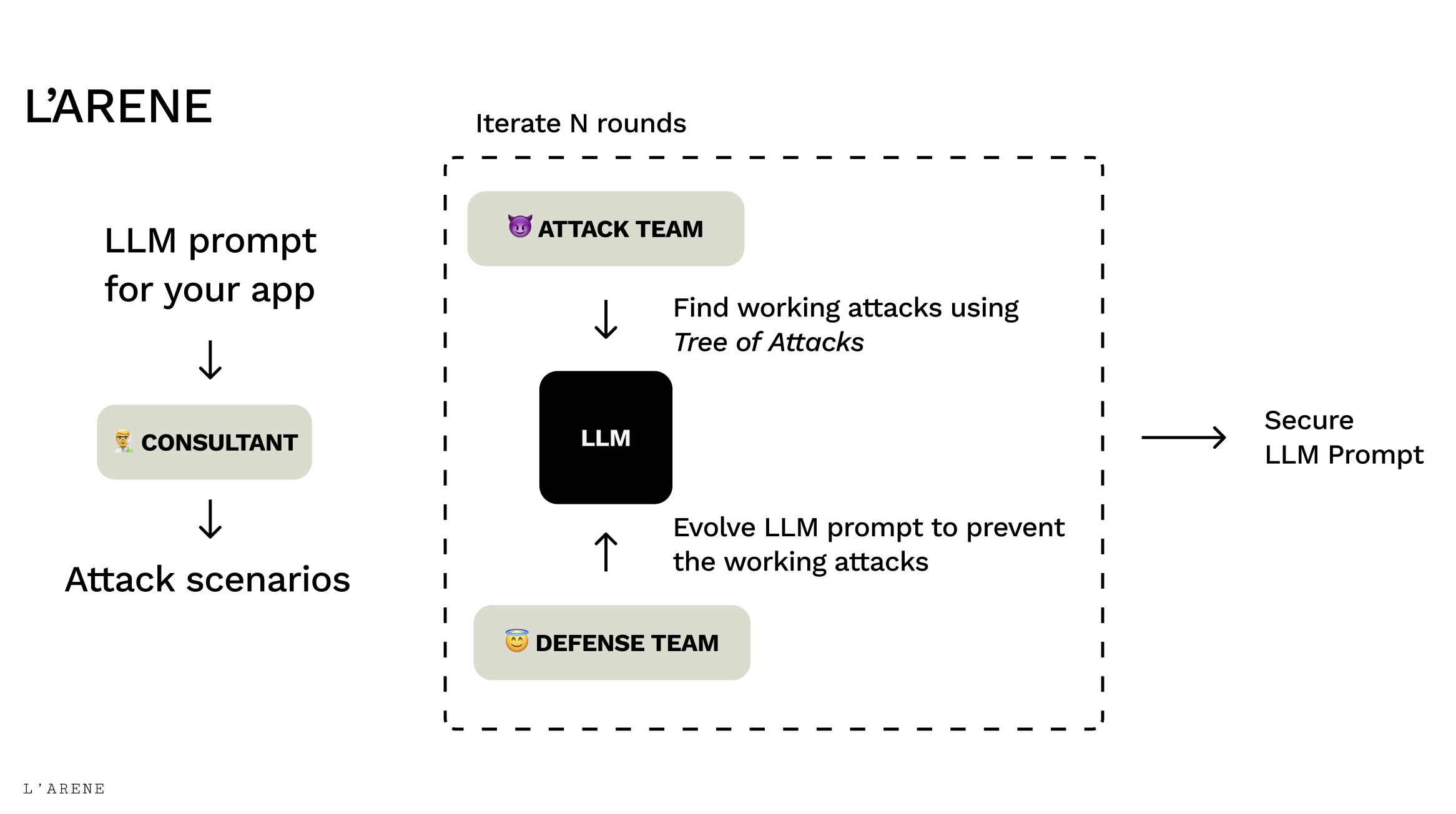
L'arene is a multi-agent system that autonomously identifies potential attack scenarios, launches simulated attacks in a sandbox, and evolves your LLM’s defenses to strengthen security. It automates the entire process, freeing you from the tedious and brute-force task of generating attack prompts to test your system’s robustness. By continuously evolving both attack strategies and defenses, L'arene ensures your LLM application stays secure against even the most sophisticated threats.
How we built it
We used LangChain to structure the system and extended the "Tree of Attacks with Pruning" algorithm from this paper: Tree of Attacks with Pruning. This allowed us to simulate and iteratively evolve attack and defense strategies.
The system consists of several specialized LLM agents:
- Security LLM: Generates possible attack scenarios and identifies risks.
- Attacker LLM: Evolves attack prompts to create more sophisticated threats.
- Defense LLM: Evolves defense prompts to counter the identified attacks.
- Judge LLM: Scores the success of the attack, providing feedback on the effectiveness of both the attack and defense.
We implemented two key algorithms:
- Tree of Attacks: The system improves attack prompts by generating B mutations at each step. Ineffective paths are pruned, allowing more focus on high-potential attack vectors, ensuring wide coverage of vulnerabilities.
- Tree of Defenses: Similarly, defense prompts evolve through iterations, countering increasingly advanced attack scenarios. The system prunes weaker defenses, ensuring that only the most robust prompts are applied to protect the LLM.
This dual-tree structure ensures that both the attacks and defenses continuously improve, enhancing the overall security of the LLM application.
Challenges we ran into
Our consultant, attacker, and defense agents sometimes generate attacks that are not possible or don't make sense. We need more investigation into this. We used few-shot learning with in-context learning to educate them more about what prompt injection attacks are actually possible, although there is still room for improvement.
Accomplishments that we're proud of
We successfully implemented a fully autonomous system that can continuously evolve both offensive and defensive strategies, offering comprehensive protection against complex attack vectors.
What we learned
We gained deeper insights into the vulnerabilities of LLM applications and how multi-agent systems can autonomously defend against them using iterative processes and evolving strategies.
What's next for L'arene
Our next steps for L'arene include enhancing its capabilities by expanding the range of attack vectors and improving the efficiency of both the attack and defense evolution processes. We plan to introduce real-time monitoring for ongoing security updates, enabling L'arene to provide continuous protection as new vulnerabilities emerge.
Additionally, we are excited to make L'arene an open-source project, allowing the community to contribute, collaborate, and integrate L'arene into various applications. By fostering a community-driven development process, we aim to keep pushing the boundaries of LLM security and evolve L'arene into a comprehensive security framework for AI applications.

Log in or sign up for Devpost to join the conversation.