-
-
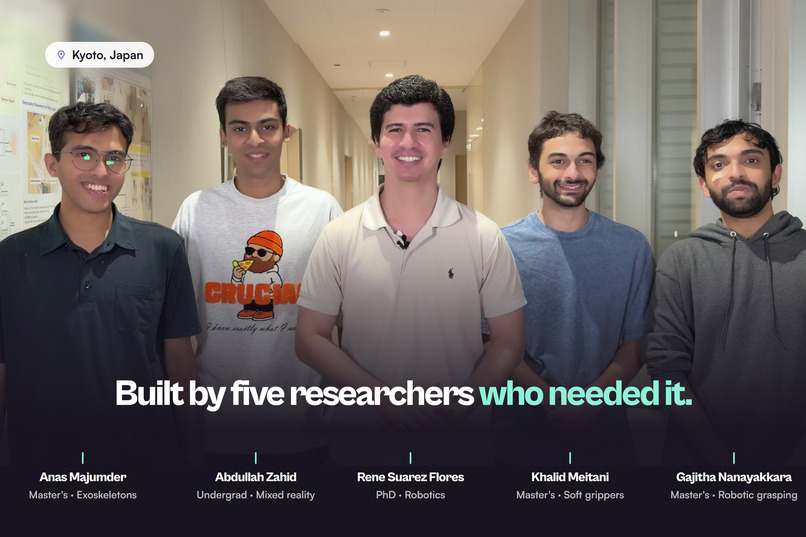
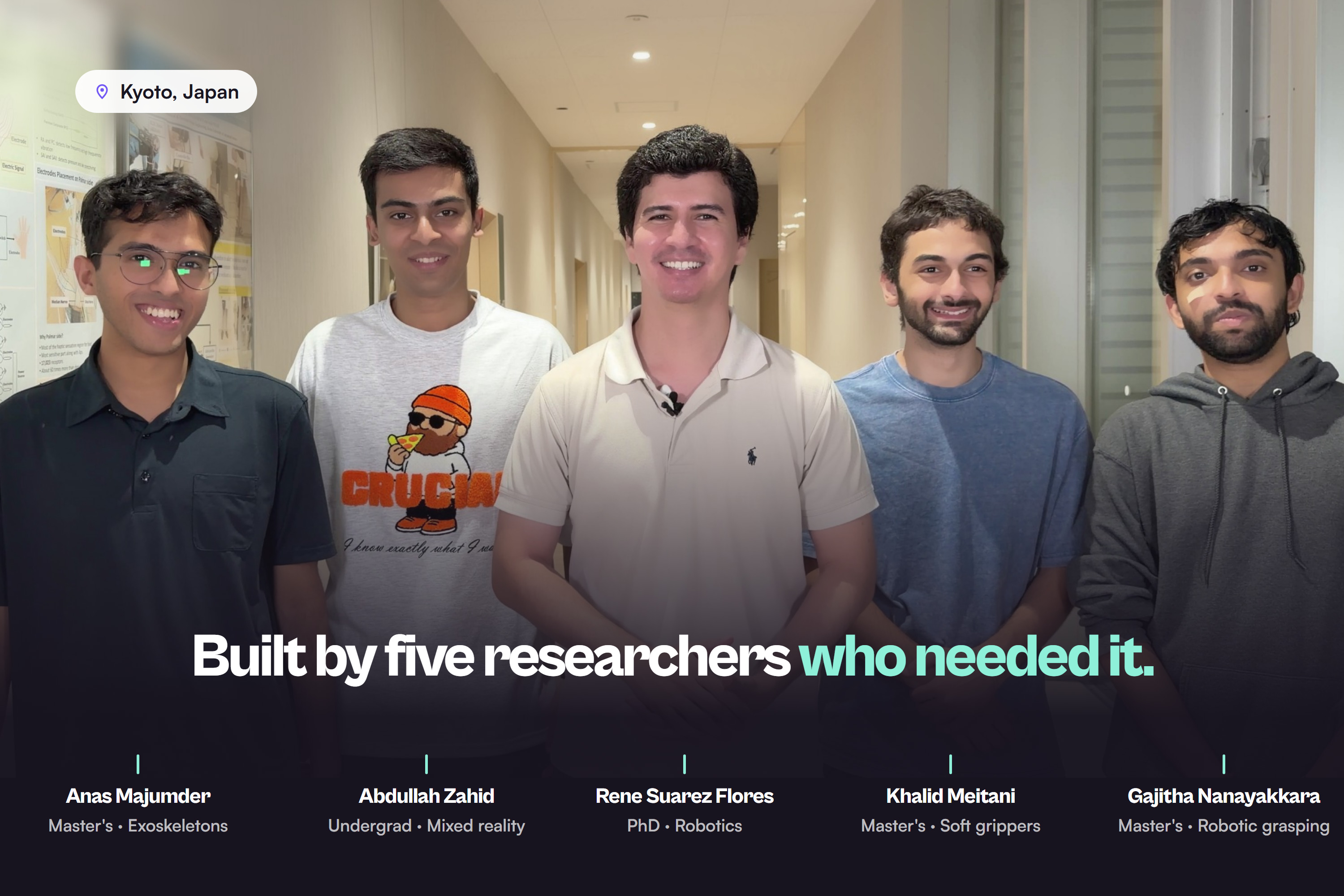
Five robotics researchers in Kyoto: one PhD, three master's and one undergraduate student, building Kyorabo alongside our research.
-
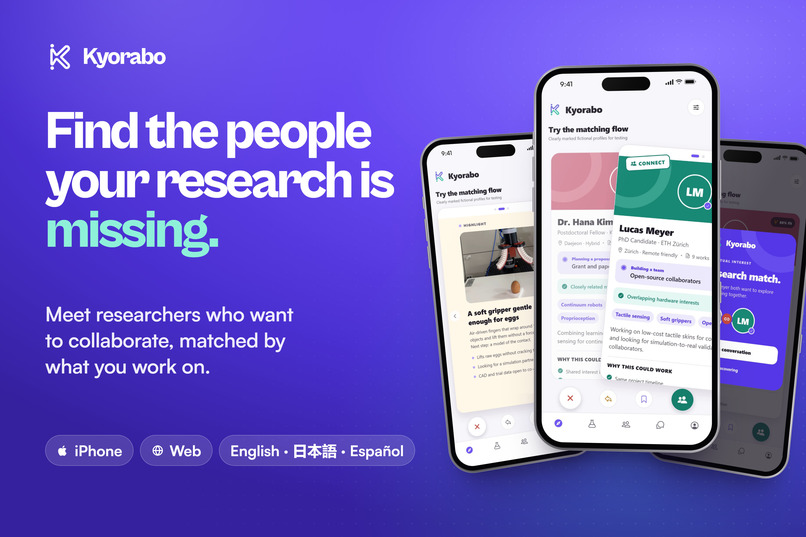
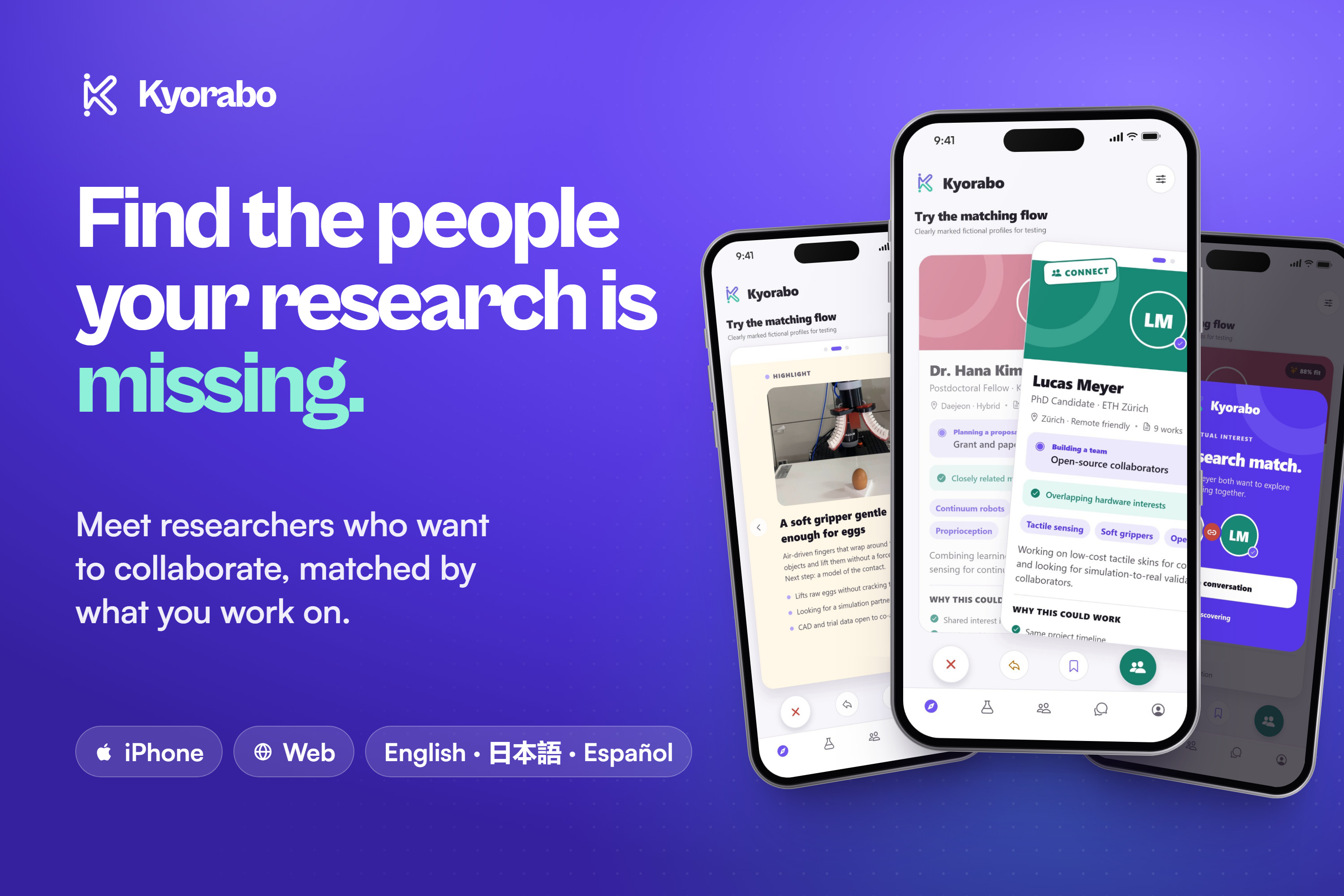
Kyorabo matches researchers and students by what they work on, need and can offer.
-
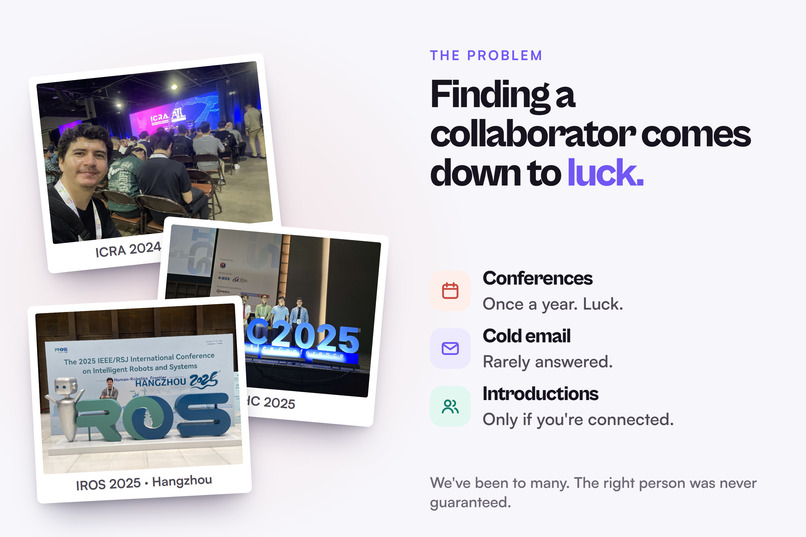
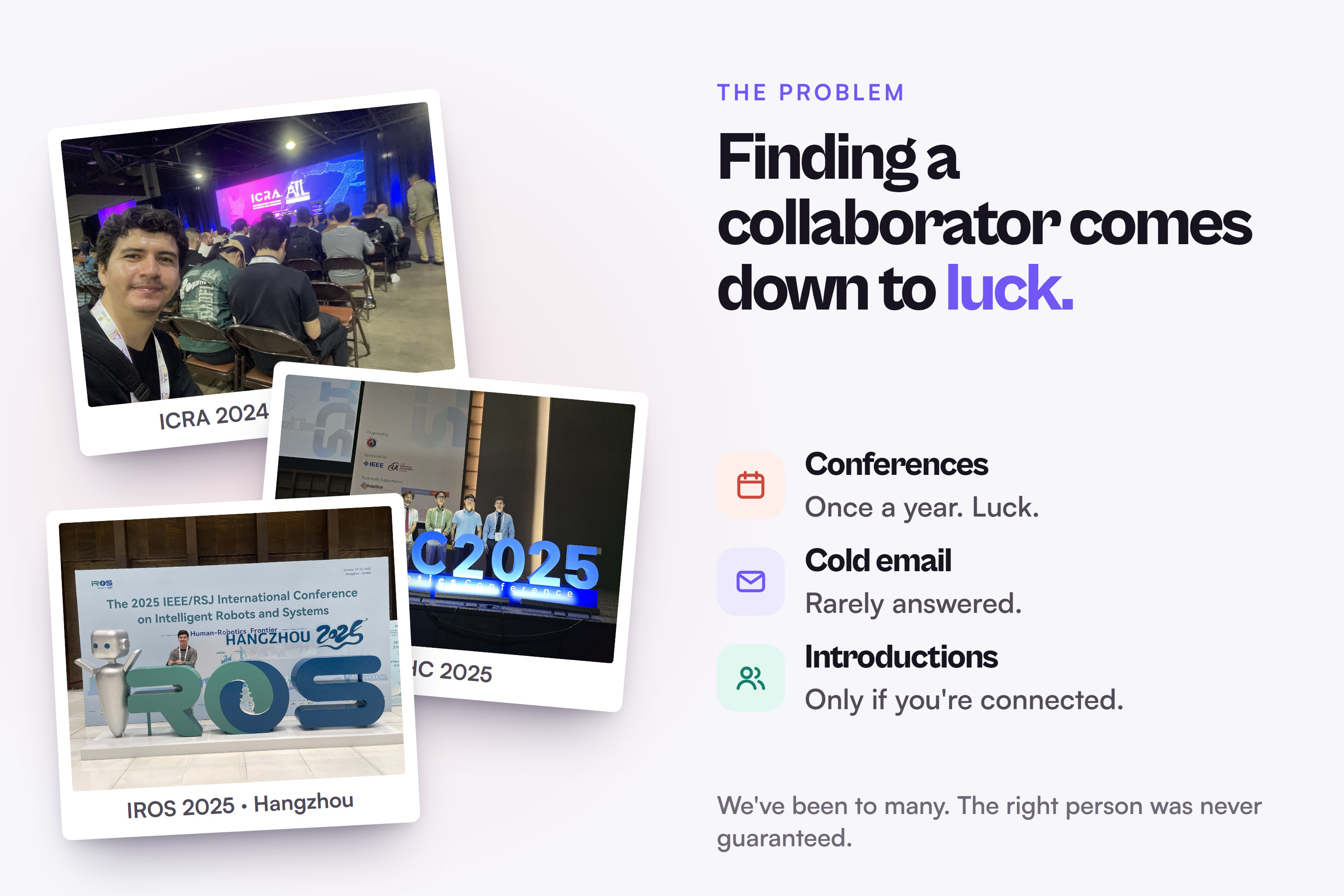
Conferences, cold email and introductions all depend on luck, timing or who you know. These are our own conference photos.
-
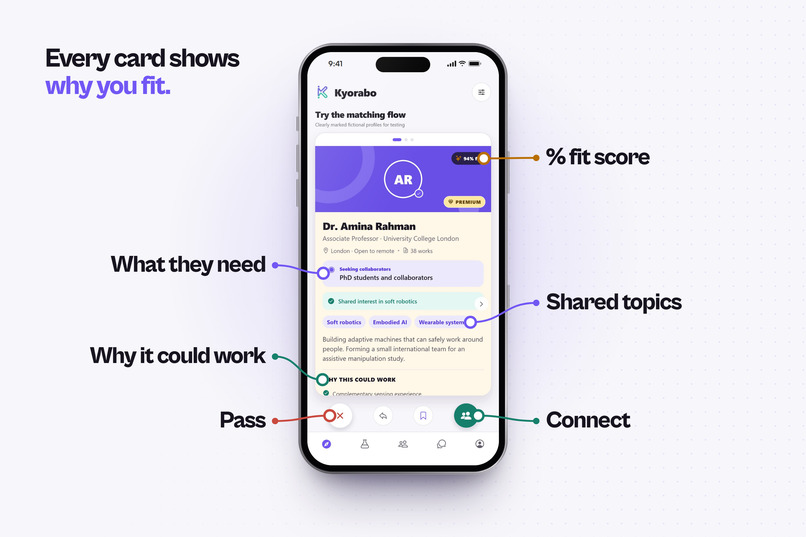
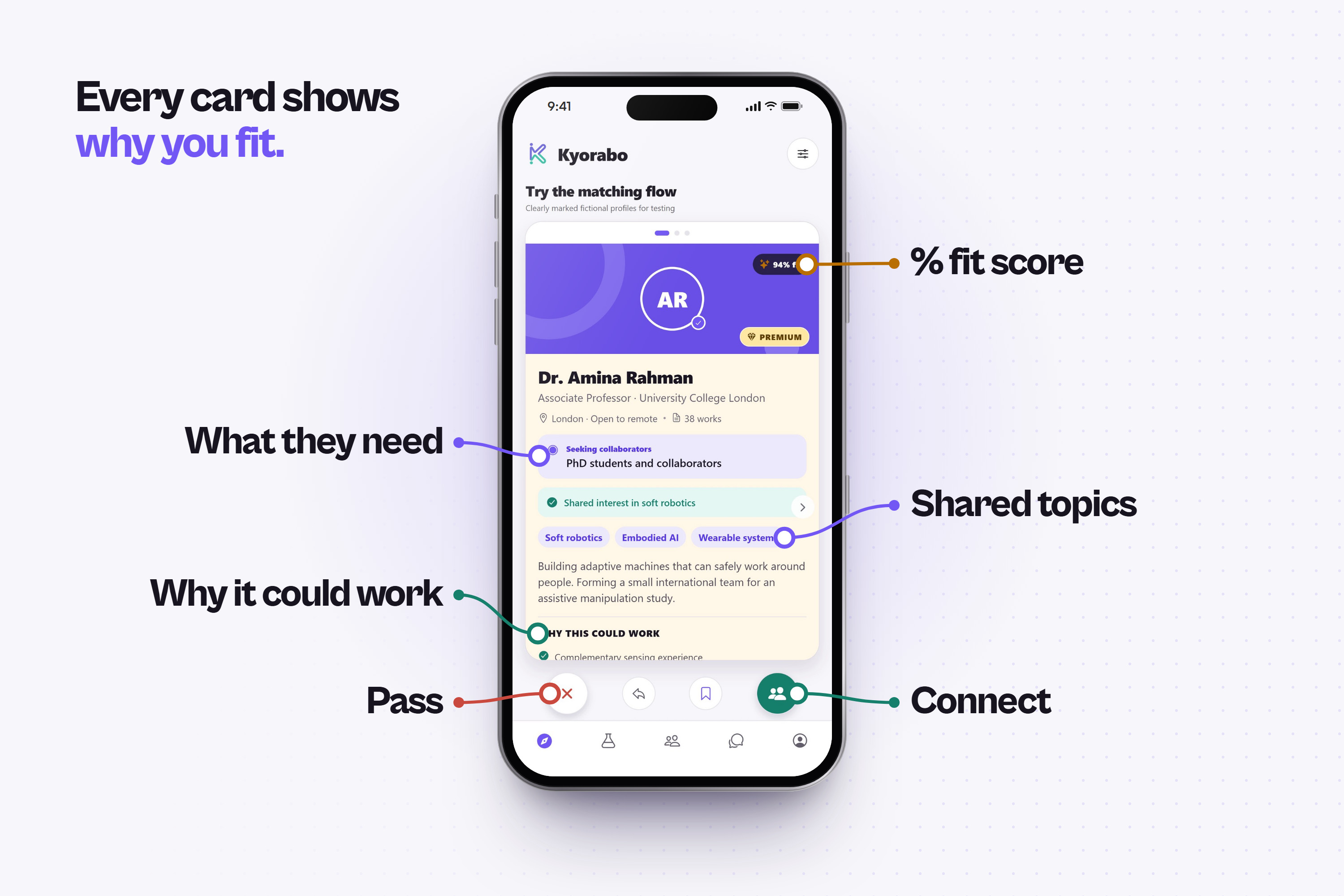
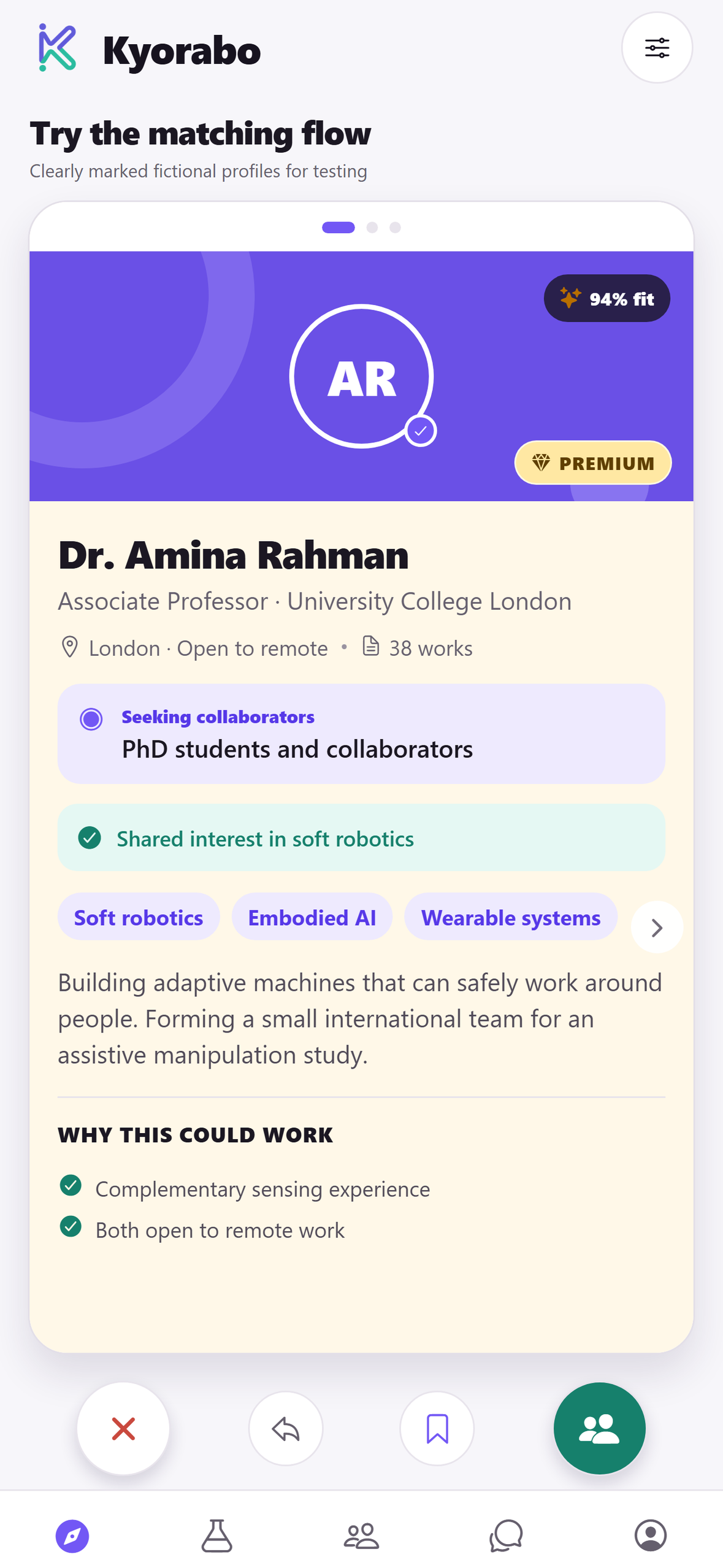
Each card shows a % fit score from shared fields, topics and goals, plus plain-language reasons why a collaboration could work.
-
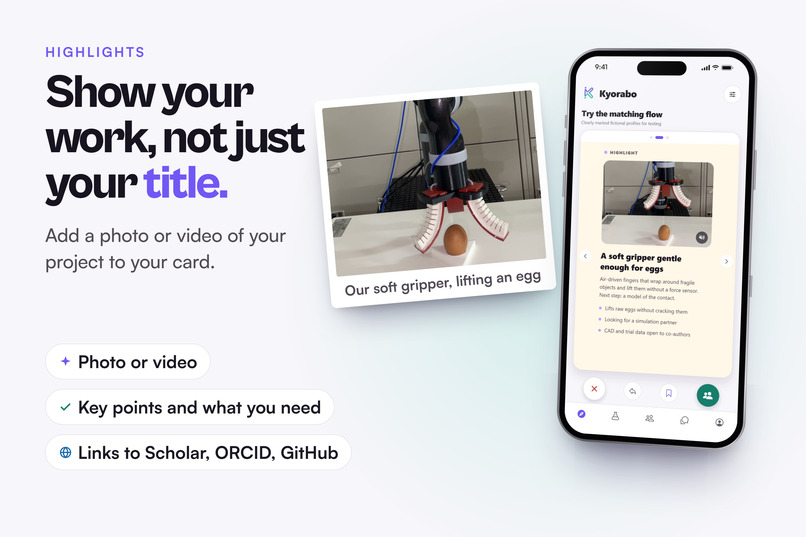
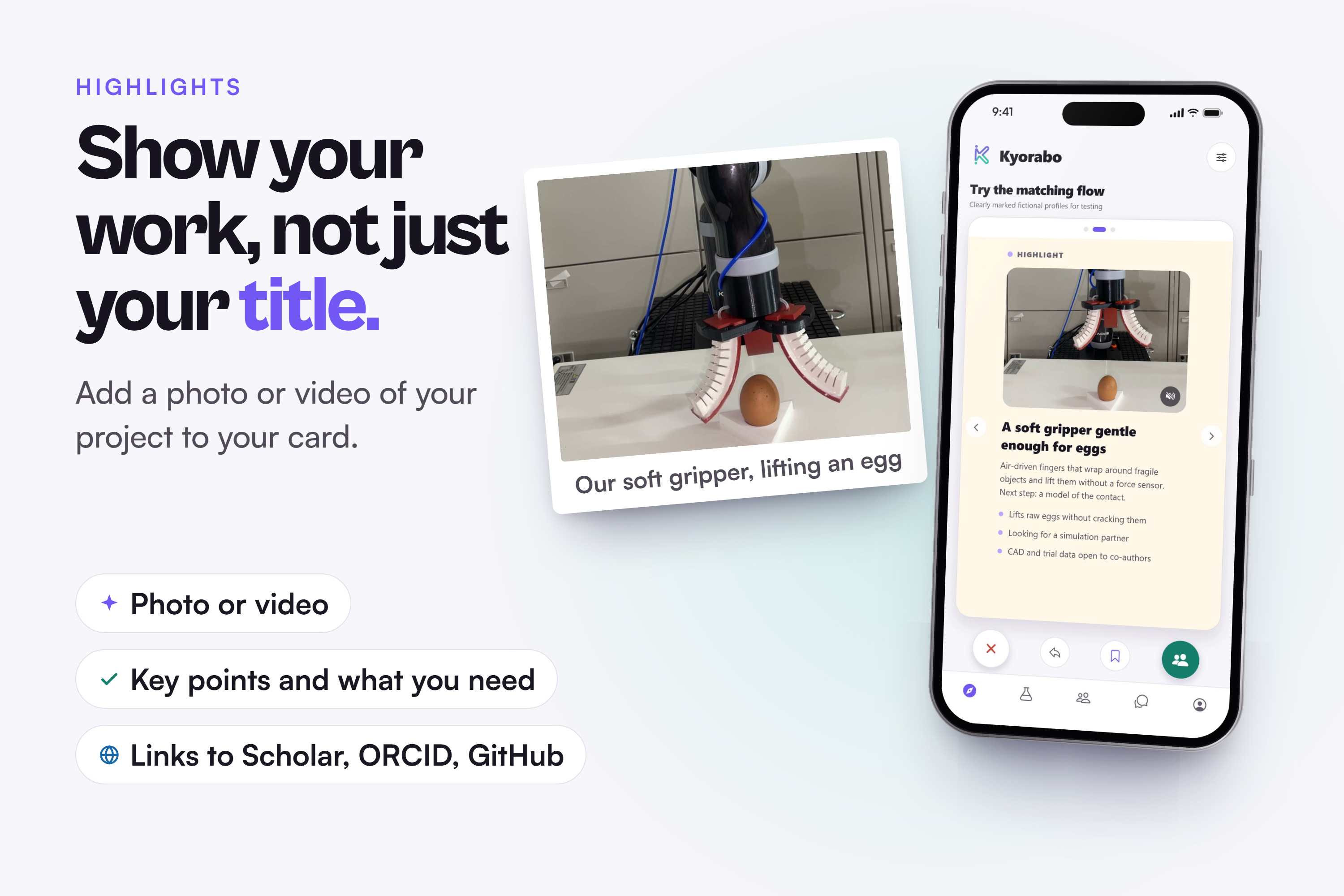
Highlights put a photo or video of your project on your card, like our soft gripper lifting an egg, plus key points and links.
-
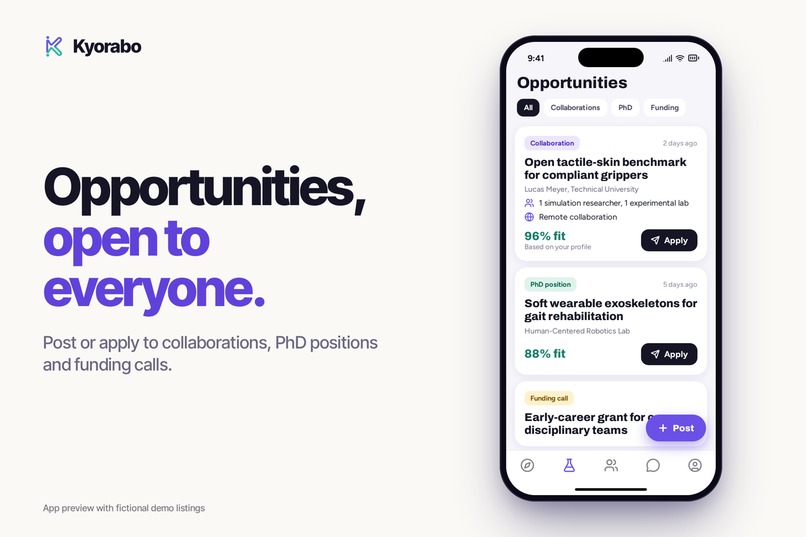
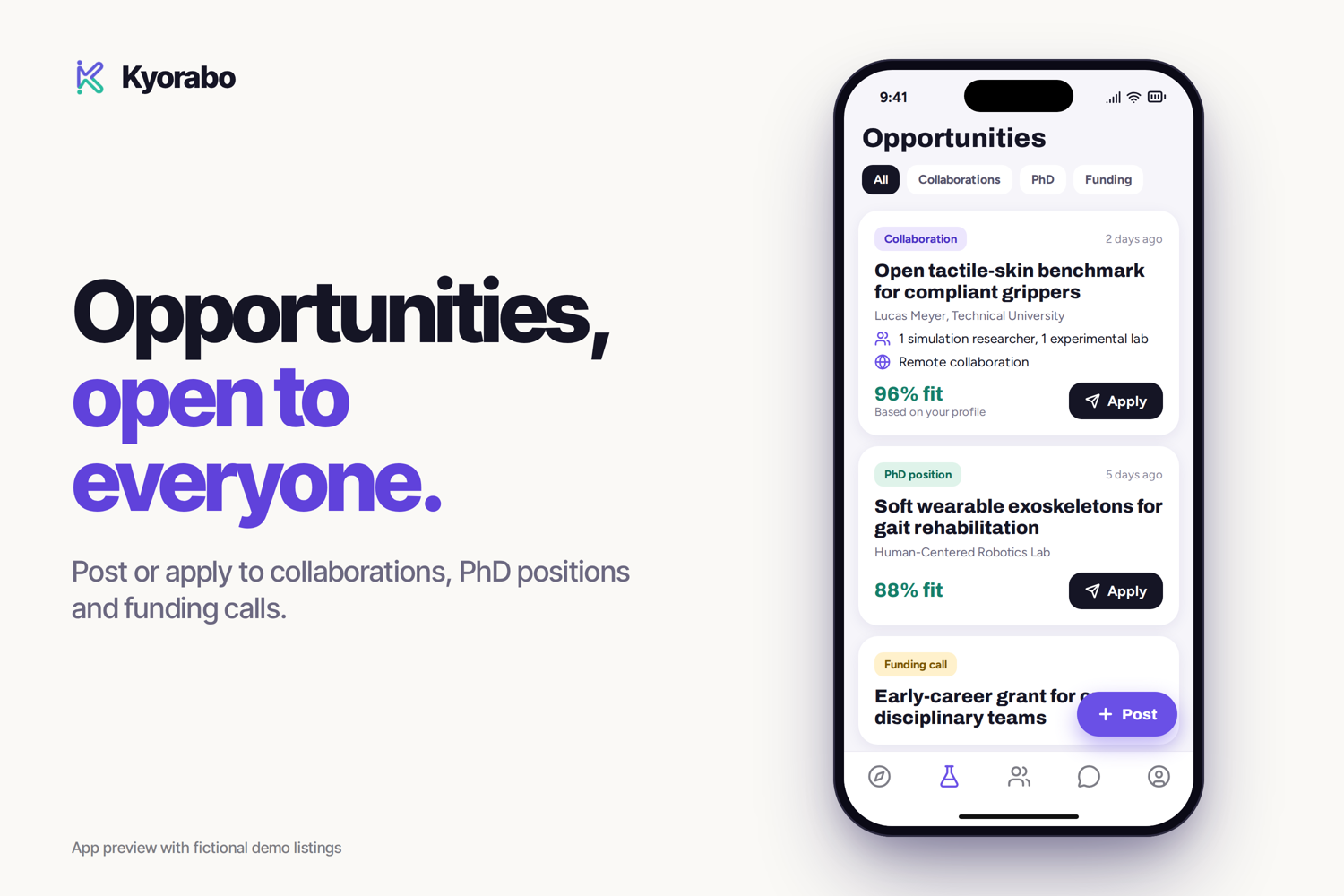
"Browse, post and apply to research opportunities, each with a fit score based on your profile.
-
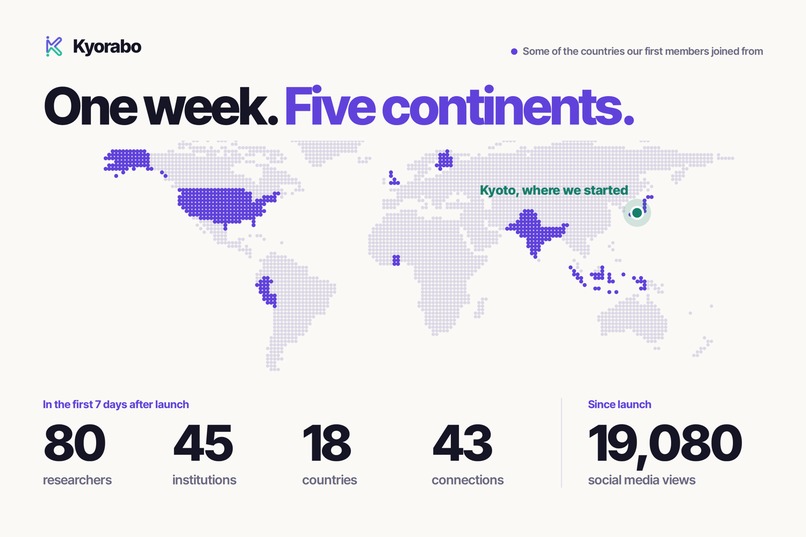
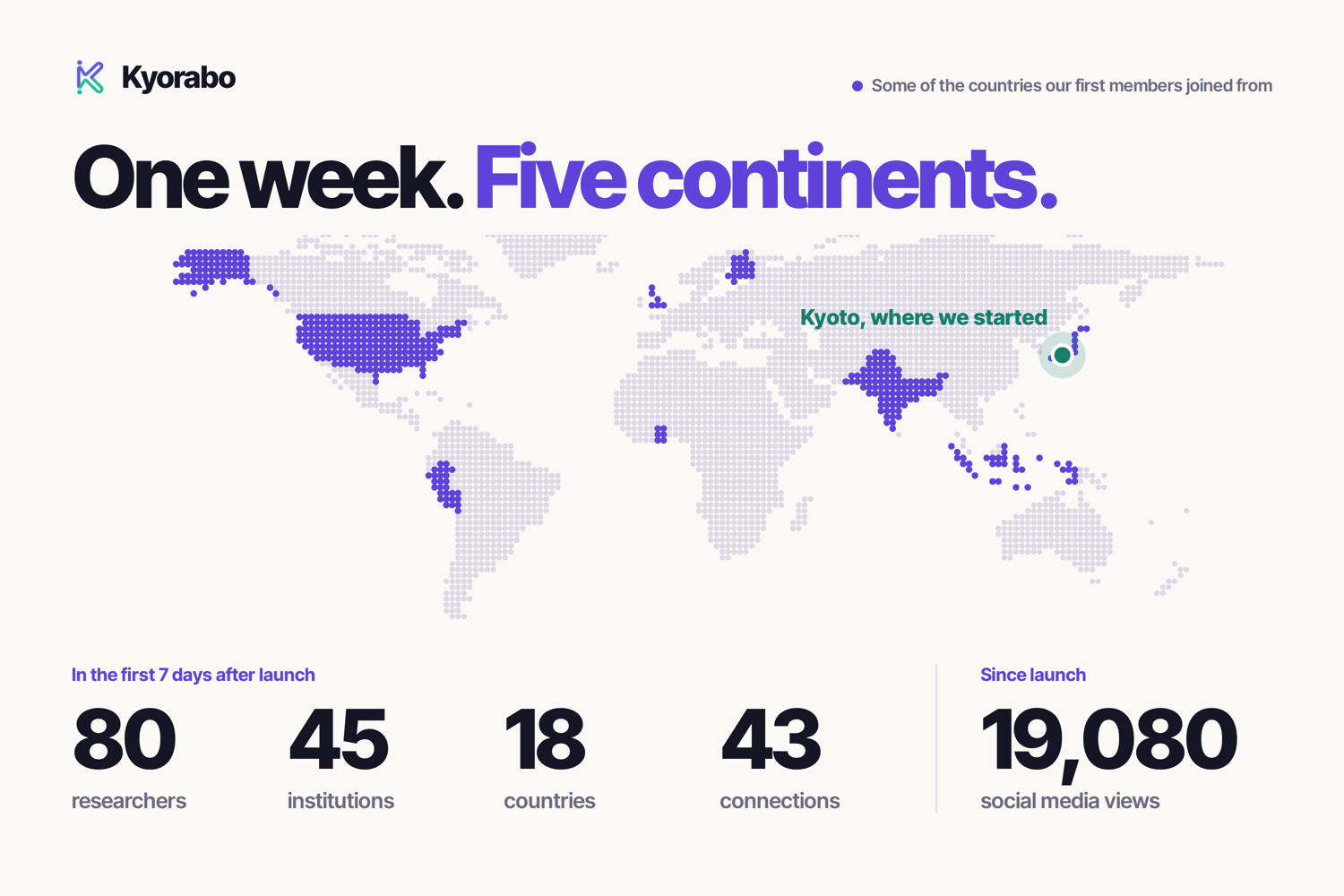
One week after launch: 80 researchers, 45 institutions, 18 countries, 43 connections, with over 19,000 views on social media.
-
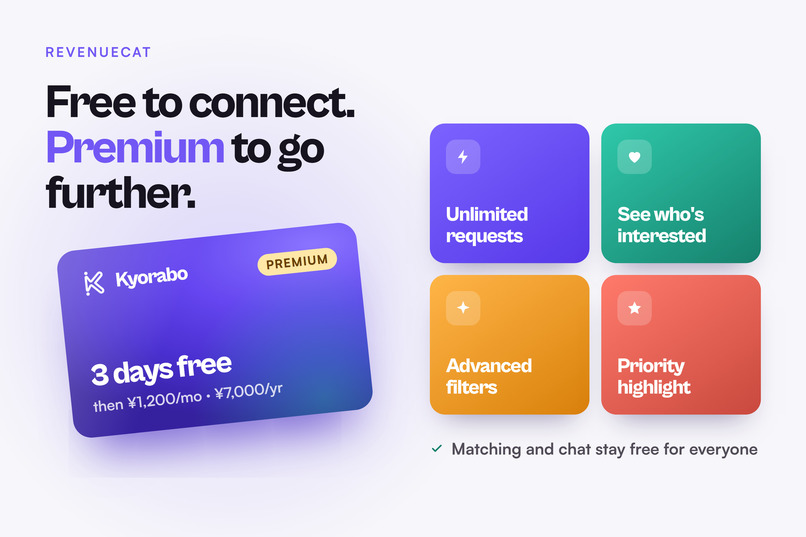
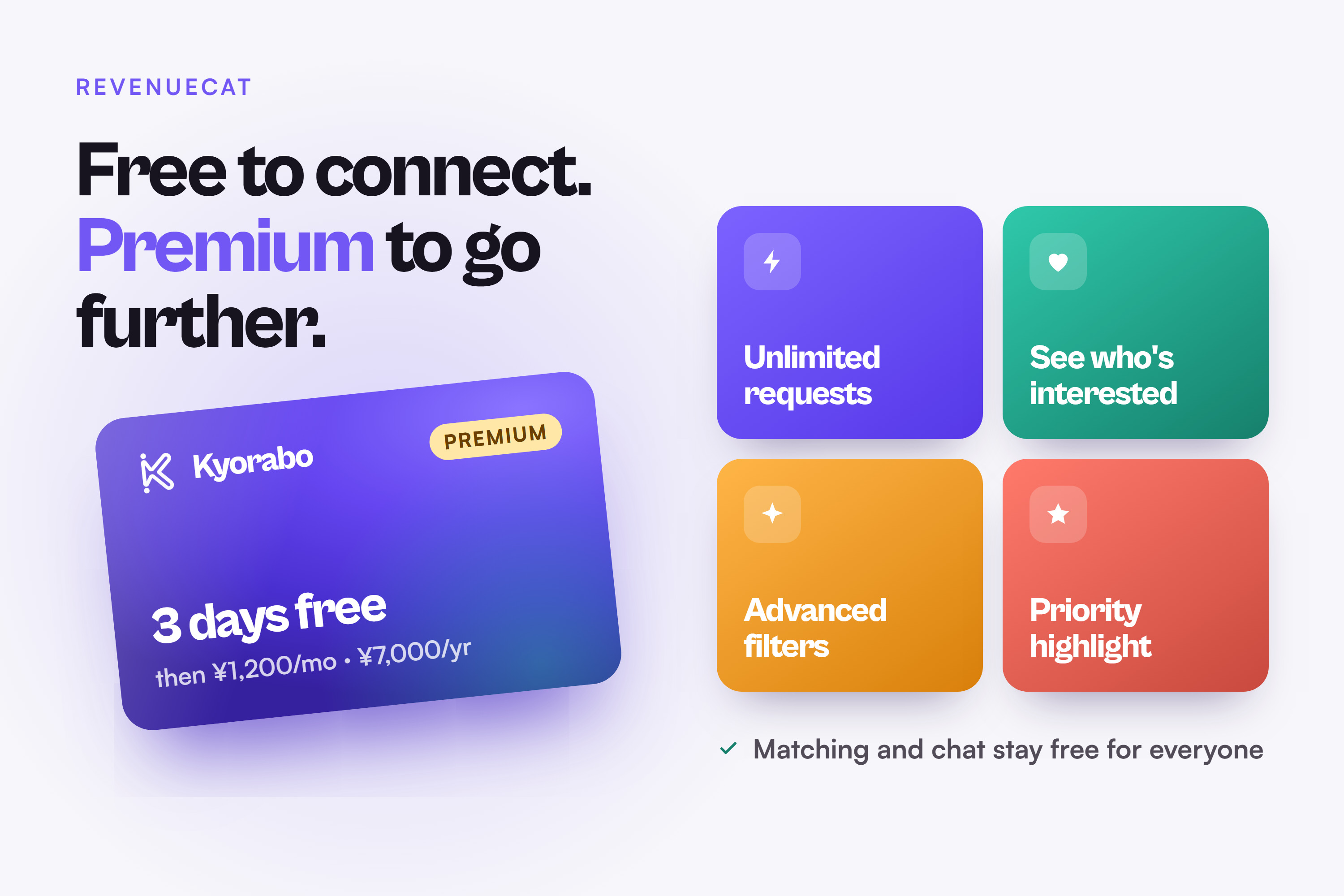
Premium via RevenueCat: unlimited requests, see who's interested, advanced filters and a priority highlight. 3-day free trial.
-

App icon: Kyorabo - built by researchers for researchers.
-
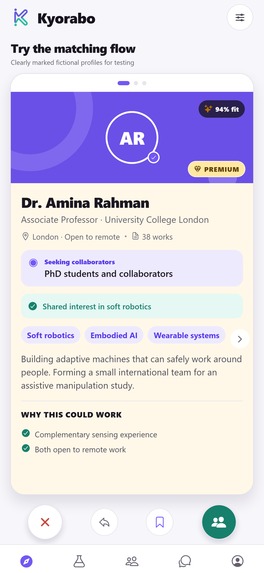
The Discover screen: a researcher card with a fit score, what they're looking for, shared topics and why it could work.

Inspiration
Science is a team sport; the most influential research starts with finding the right collaborator. A paper written with collaborators is 6.3 times more likely to become highly cited than one written alone (Fortunato et al., Science, 2018). We are five researchers in Kyoto, Japan, working across robotics, exoskeletons, mixed reality, and more. Our research projects need expertise in far more areas than any of us can cover alone, so we also need collaborators. Yet the way researchers find each other hasn't changed:
- Conferences. We have been to many and met lots of brilliant people, but finding the right person comes down to luck, and those encounters rarely turn into a collaboration. Miss one, and you wait a year for the next.
- Cold email. You email the authors of papers you've read. Most never reply, and even when they do, you still don't know whether they want to collaborate.
- Recommendations. An introduction from a supervisor or colleague works best, but only if you already know the right people. A new researcher, or someone starting a new lab, doesn't.
All three depend on being in the right place, at the right time, with the right network.
Kyorabo doesn't replace them. It adds a channel that needs none of the three: open it any day of the year, from anywhere, knowing nobody, and meet collaborators whose research fits yours and who want to work with you.
What it does
Kyorabo is a mobile app that matches researchers and students by research intent: what they work on, what they are looking for, and what they can offer. It is not ranked by prestige or citation count.
1. Build a profile around what you need
Onboarding takes a few minutes and has three steps:
- Account type and role: individual or organization, then your role.
- Basic identity: name and current institution.
- Research identity: field, topics, keywords and collaboration goals.
2. Discover: swipe through potential collaborators
Discover shows one researcher at a time as a card with their role, institution, topics, what they are seeking, their Highlights, and a fit score calculated from the fields, topics and goals you share. Each card also explains why this could work, for example:
"Shared topic: soft actuators" "Both open to remote work"
- Swipe right (Connect) to send a connection request.
- Swipe left (Pass) to move on.
- Save a profile to a shortlist to decide later, or Undo your last decision.
- Filter the deck by career stage and field.
3. Mutual interest before contact
A right swipe is private. When two researchers have each independently swiped right on each other, it becomes a Research Match: both are notified and a private chat opens.
No cold outreach. No unsolicited DMs. No wondering whether the other person wants to talk.
4. Opportunities: a noticeboard for research
The Opportunities tab lists collaborations, PhD positions, funding calls and more. Any member can post an opportunity, others apply in the app, and the poster accepts or declines each applicant. Institutions and organizations have their own account type for posting.
5. Free and Premium
The core promise is free: build a full profile, see verification badges, swipe, match, chat, and browse, post and apply to opportunities, all without paying.
| Free | Premium | |
|---|---|---|
| Connection requests | 10 per day | Unlimited |
| Passing and saving | Unlimited | Unlimited |
| Project highlights | 1 per user | Up to 3 per user |
| Filters | Career stage, field | + fields to explore, connection purpose, verified-only |
| Who's interested in you | You know someone is, not who | See who before you swipe |
| Visibility | Standard | Priority placement for relevant members |
| Badge | — | Premium badge |
Plans: monthly and yearly with a 3-day free trial, plus a one-time Founding 30 lifetime plan for our first 30 supporters only. In Japan: ¥1,200/month, ¥7,000/year, ¥16,000 lifetime, with equivalent prices in other stores.
Kyorabo is available in English, Japanese and Spanish, with more languages coming.
How we built it
- App: Expo and React Native in one TypeScript codebase with Expo Router. The swipe deck uses Reanimated and Gesture Handler: cards tilt as you drag and CONNECT/PASS stamps fade in. Every animation respects the system's Reduce Motion setting, and every control has an accessibility label.
- Backend: Supabase for Auth (email, Google, Sign in with Apple), Postgres with row-level security, Realtime for chat, Storage for photos and video, and Edge Functions for verification, the ORCID callback, email, push notifications, event reminders, media cleanup and the RevenueCat webhook.
- Reciprocity in the database: a Postgres trigger creates the match when the second like arrives, and row-level security allows messages only between matched members. The rule can't be bypassed from a modified client.
- Around the app: Resend for email, Expo push notifications, opt-in PostHog analytics for the activation funnel, and EAS Build/Update for releases.
- Website: kyorabo.com, built with Astro on Cloudflare Pages in English, Japanese and Spanish.
Monetization with RevenueCat
Our rule: never put a paywall between two researchers. Premium sells reach and speed to heavy users, not access to the community.
react-native-purchasesand RevenueCat Paywalls, with onepremiumentitlement and one offering (monthly, annual, lifetime).- Contextual paywall: hitting the daily limit, tapping a locked filter, or tapping "see who's interested" each opens a paywall headlined with the exact benefit you just reached for.
- Server-trusted entitlements: the RevenueCat webhook writes entitlement changes into Supabase, so Premium is checked on the server, not trusted from the device.
- A deliberate price ladder: yearly is about 51% cheaper than paying monthly, and Founding 30 rewards the earliest supporters who fund the servers.
Challenges we ran into
An empty room on day one
A matching app is only as useful as the people in it, so we started filling the room before it opened. Weeks before launch, we began posting on our social channels and ran a public countdown to 30 August. On launch day, we started at our own university in Kyoto, announced Kyorabo on robotics-worldwide, and our supervisor shared it with his network. Within a week, 80 researchers from 45 institutions had joined.
Turning attention into sign-ups
Reach came fast, but action didn't. In the last 30 days our Instagram was seen almost 10,000 times by about 3,600 people, three-quarters of whom don't follow us, yet only 16 tapped through to the link.
Our numbers showed a clear pattern: posts about the product got views, while posts useful to a researcher on their own got action. A guide to emailing a researcher you have never met had the highest engagement rate of anything we posted.
Researchers don't share one vocabulary
Potential collaborators often describe the same idea in different words, such as mechanical logic, embodied computation and morphological control, so a plain keyword match misses them. We added field aliases, so a search for robotics also finds actuators, grippers and exoskeletons, and made "explore a new field" a collaboration goal of its own.
Making a community of strangers safe
A new channel only helps if people feel safe being visible, especially students. Mutual interest before contact, verification, reporting and blocking are all enforced on the server, not just in the interface.
Building alongside our research
All five of us kept our own theses and experiments running while we built, launched, and promoted Kyorabo.
Accomplishments that we're proud of
Science is meant to be shared. Our goal is to make collaboration easier within a field and across disciplines, for anyone, wherever they work.
From one university to five continents in a week
We started at a single university in Kyoto. Seven days after launch:
- 80 researchers had built a profile
- 45 institutions
- 18 countries
- 5 continents
- 43 connections made in the app
Well beyond the usual hubs
Members joined from the University of Bristol, Texas A&M, the University of Turku and the Indian Institute of Science, and from Ashesi University (Ghana), LUMS (Pakistan), Institut Teknologi Sepuluh Nopember (Indonesia), North South University (Bangladesh) and Universidad Nacional de Ingeniería. Many work far from the usual conference circuit, exactly where the old channels fail.
The collaborator you need is rarely down your own hallway, and now they don't have to be.
Built around what researchers asked for
- Shorter onboarding: feedback from our closed test cut the required profile steps from 8 to 3.
- Message reactions: a small addition our testers asked for.
- Highlights: a photo or video of your project, so your work shows and not just your title.
- Multilanguage: English, Japanese, and Spanish, so more researchers can use Kyorabo in their own language.
Reaching researchers where they already are
- Social media: we post in English and Japanese on Instagram, LinkedIn, Bluesky, Threads and TikTok, including an animated series with our mascot.
- University press: our university is publishing a feature on Kyorabo across its official channels, built from a press kit we produced.
- In person: we prepared NFC cards that open Kyorabo with one tap to share in a lab or at an event.
- At conferences: we applied to the IROS 2026 startup program to present Kyorabo at two soft robotics workshops, bringing Kyorabo into the very hallway it adds to.
What we learned
- The need is global, not local. We started at one university in Kyoto, and within a week researchers from 45 institutions in 18 countries had joined, many far from the usual conference circuit.
- The problem is shared. When we asked "How did you find your last research collaborator?", researchers described the same three routes we had: conferences, cold email, and introductions.
- Researchers act when the fit is clear. In the first week, members made 43 connections, which shows they'll reach out when they can see why someone fits.
- Reach is not action. In 30 days, our Instagram was seen 9,967 times by 3,648 accounts, 74% of whom don't follow us. Only 16 tapped through to the app. Views tell you who noticed; taps tell you who cared.
- Useful beats promotional. Our guide to cold-emailing a researcher had the highest engagement rate of anything we posted. Researchers trust a tool that helps them before it asks for anything.
- People trust people. Our best-performing video was a founder on camera telling the real story of needing one collaborator, not a polished product demo.
What's next for Kyorabo
- Events mode is built and waiting for release: see who else is attending the same conference and meet them there. It turns the hallway luck that started this project into a plan.
- More institution accounts on the Opportunities board.
- Better matching signals, learned from which Research Matches actually become collaborations.
Built With
- astro
- cloudflare
- eas
- english
- expo-router
- expo.io
- google-auth
- japanese
- orcid
- postgresql
- posthog
- react-native
- resend
- revenuecat
- revenuecat-paywall
- sign-in-with-apple
- spanish
- supabase
- typescript


Log in or sign up for Devpost to join the conversation.