Inspiration:
It started with a research rabbit hole. Three of us spent days studying what happens between a buyer paying and the package arriving, and kept finding the same thing: when something goes wrong in that gap, the small seller pays for it. A buyer writes "refund me," the seller is asleep or busy, and by morning a PayPal dispute is open and the sale and money are gone.
What it does
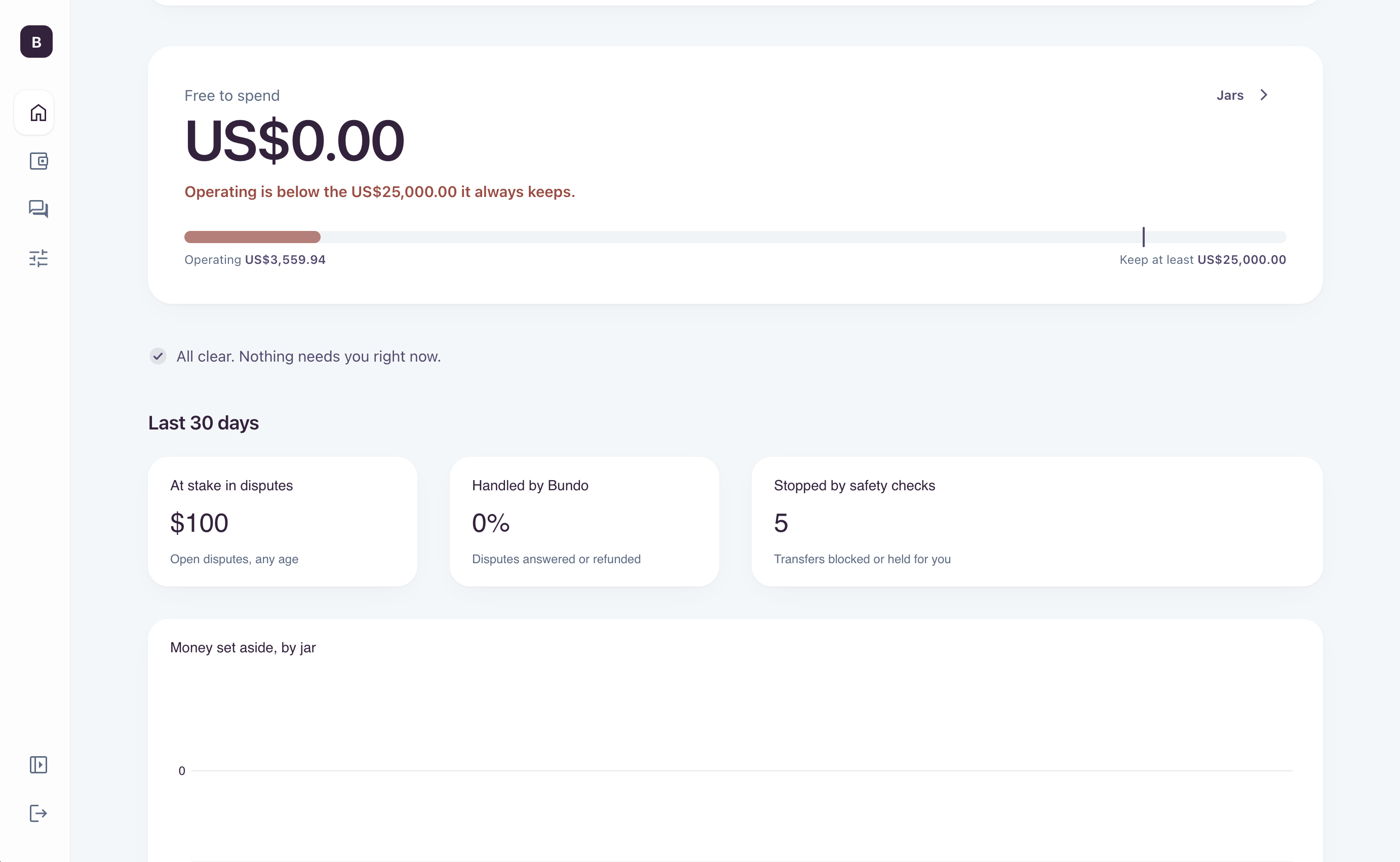
BundoPay is an AI back office for small merchants who get paid through PayPal. The problem: a merchant’s PayPal balance looks like one number, but it’s really three kinds of money: what they need to run the business, tax they owe, and money that disputes could claw back. Most merchants spend it all, then get caught out at tax time or by a chargeback.
What it does:
Treasury: automatically sets money aside into separate reserves for tax, disputes and ad spend, using rules the owner writes in plain English. Disputes: an AI agent reviews each PayPal dispute and refunds the small ones on its own. Anything above the owner’s limit waits for their approval.
Why it’s safe:
The AI only drafts rules. Code checks every transfer against hard limits: a minimum balance to keep in the business, an amount it can move on its own, and weekly caps. Anything bigger needs one tap from the owner. Chat messages can never approve a transfer. Every step goes into a record that can’t be edited without it showing.
Where it stands:
BundoPay runs on PayPal’s sandbox. It sends test refunds, routes bigger requests to the seller for approval, and records every decision. Our next step is applying to become a PayPal partner, so sellers can connect their real accounts.
How we built it
BundoPay is a Next.js + TypeScript frontend on Vercel and a Python FastAPI backend on Render, with Supabase for the Postgres database and logins. It connects to PayPal’s sandbox APIs for disputes, refunds and transfers, and signature-verified webhooks tell it when a dispute opens.
Our AI assistant, Bundo, runs on Google Gemini. It reads each dispute’s evidence and recommends what to do: small disputes are refunded automatically, and bigger ones wait for the seller to approve.
The AI never moves money on its own. Every transfer goes through a safety engine written in plain code that checks limits and verified accounts, then allows it, asks the seller, or blocks it. Text in a dispute or chat can’t get around those checks. Every action is also recorded in a tamper-evident audit log, and a pytest suite tests the money logic.
Challenges we ran into:
At the start, we had never used PayPal and had little financial background, so we didn’t know which problems were worth solving. Once we picked one, we struggled to work out how to build it with the technologies we had to learn along the ways. Letting the AI help without letting it move money. We wanted Bundo to make real decisions, but an AI that can be talked into a refund is dangerous. We kept the AI and the safety engine completely separate, so nothing in a dispute, email or chat can approve a transfer. Never paying twice. Retries, webhooks and background jobs can all fire the same action more than once. We gave every movement an idempotency key, enforced in both our database and PayPal’s API. Working with PayPal’s sandbox. Test disputes and webhooks don’t always behave like real ones, so we built a demo mode and test accounts to make the flows easy to run. Hosting it for free. Splitting the app across Vercel, Render and Supabase meant keeping settings and signing keys in sync across all three. A mismatch quietly broke the shared judge login until we fixed it.
Accomplishments that we’re proud of:
We’re proud that we chose a real problem and stuck with it. With guidance from our school mentor, we turned a rough idea into one clear question: how can an AI agent refund a buyer safely, without ever spending more than the seller allows? We worked through that together, as a team, every single day. This was our first hackathon, and we showed up, argued, learned and kept improving the idea until it was something we believed in.
What we learned:
The biggest lesson is that you don't need to be an expert to start. None of us had built something like this before. It was our first hackathon, and at the beginning we didn't understand half the tools we ended up using. We learned by building: researching, getting things wrong, asking questions, and fixing them one step at a time. Along the way we picked up how a payment flow works and why an AI agent needs firm limits that it can't talk its way past. Mostly, we learned that starting before you feel ready is what turns an idea into something real, and that a team willing to keep learning can get there. We learnt how to use PayPal sandbox, we learnt the correct use of our AI tools
What's next for KYNETIC : BundoPay runs in PayPal’s sandbox today. Next, we’ll apply for PayPal partner approval so merchants can connect their real accounts, then run a pilot with a small group of merchants, and later add more payment providers beyond PayPal.
Built With
- ag-grid
- ag-studio-ai
- fastapi
- gemini
- nextjs
- paypal
- paypal-agent-toolkit
- paypal-checkout-sdk-v6
- paypal-disputes-api
- paypal-payouts-api
- paypal-tracking-api
- paypal-webhooks
- typescript
