-
-
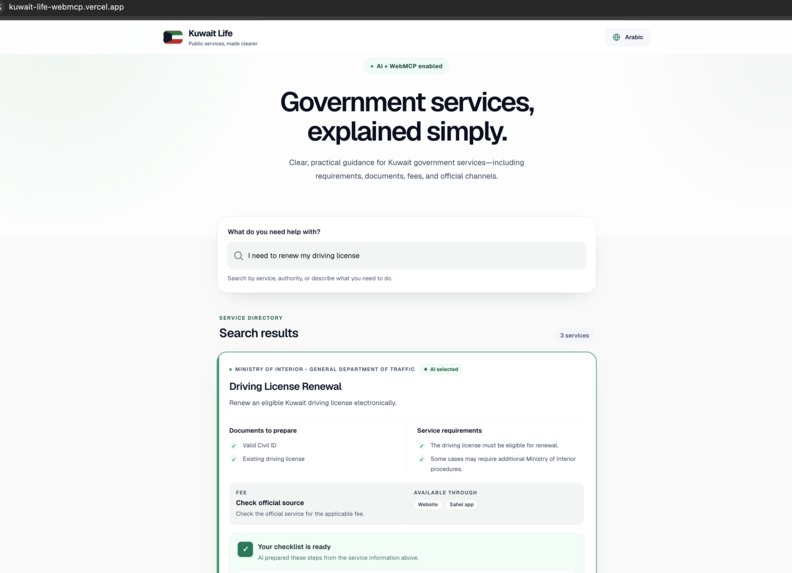
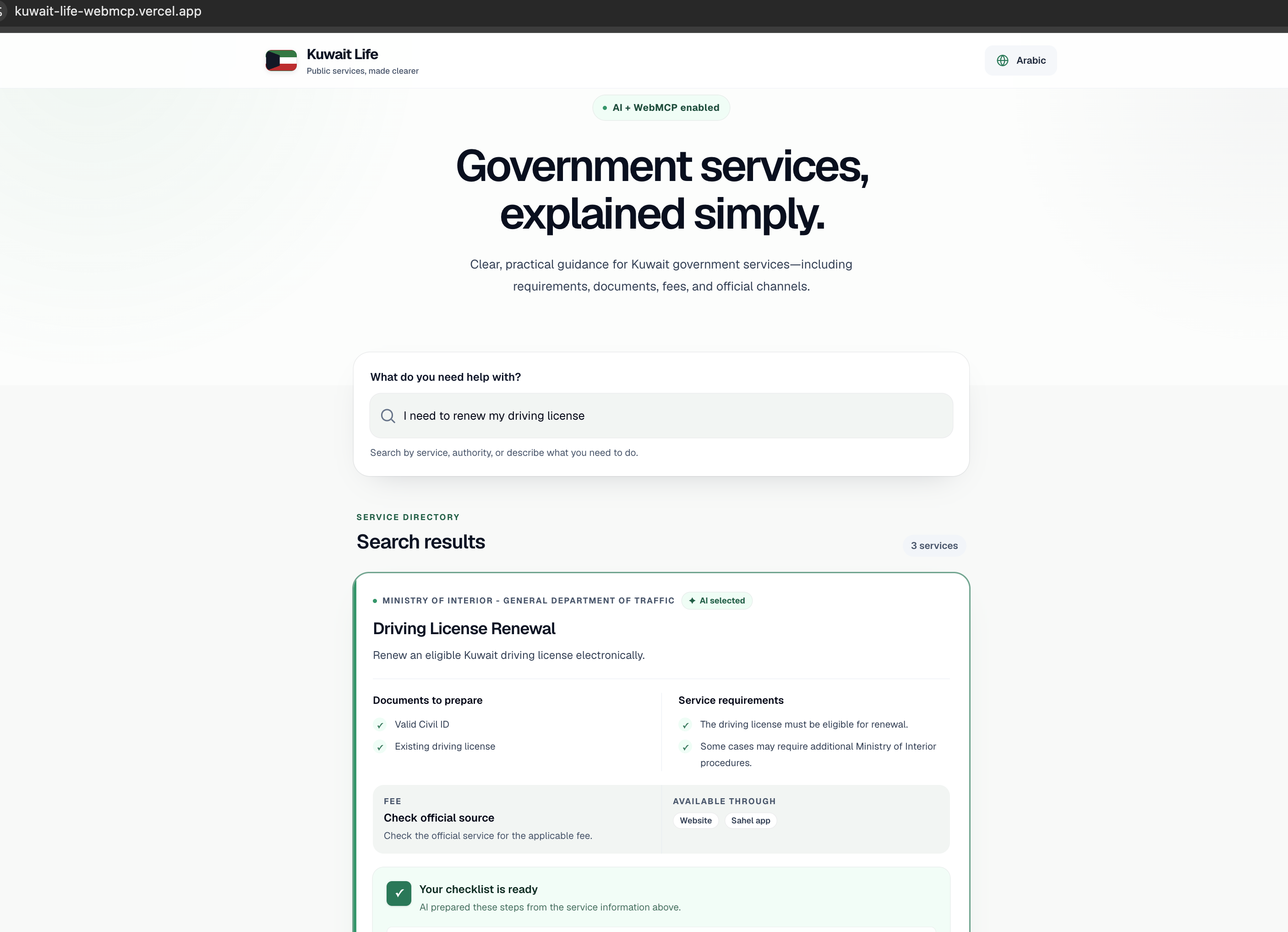
Kuwait Life bilingual government-service search and service directory.
-
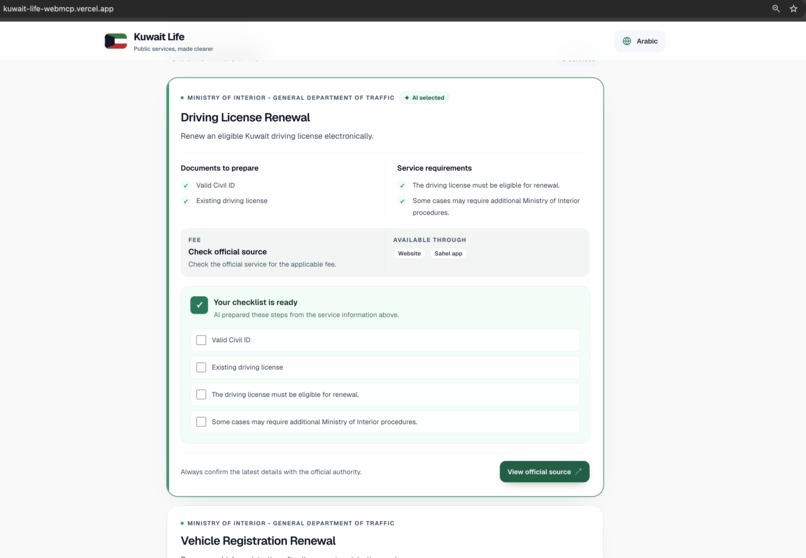
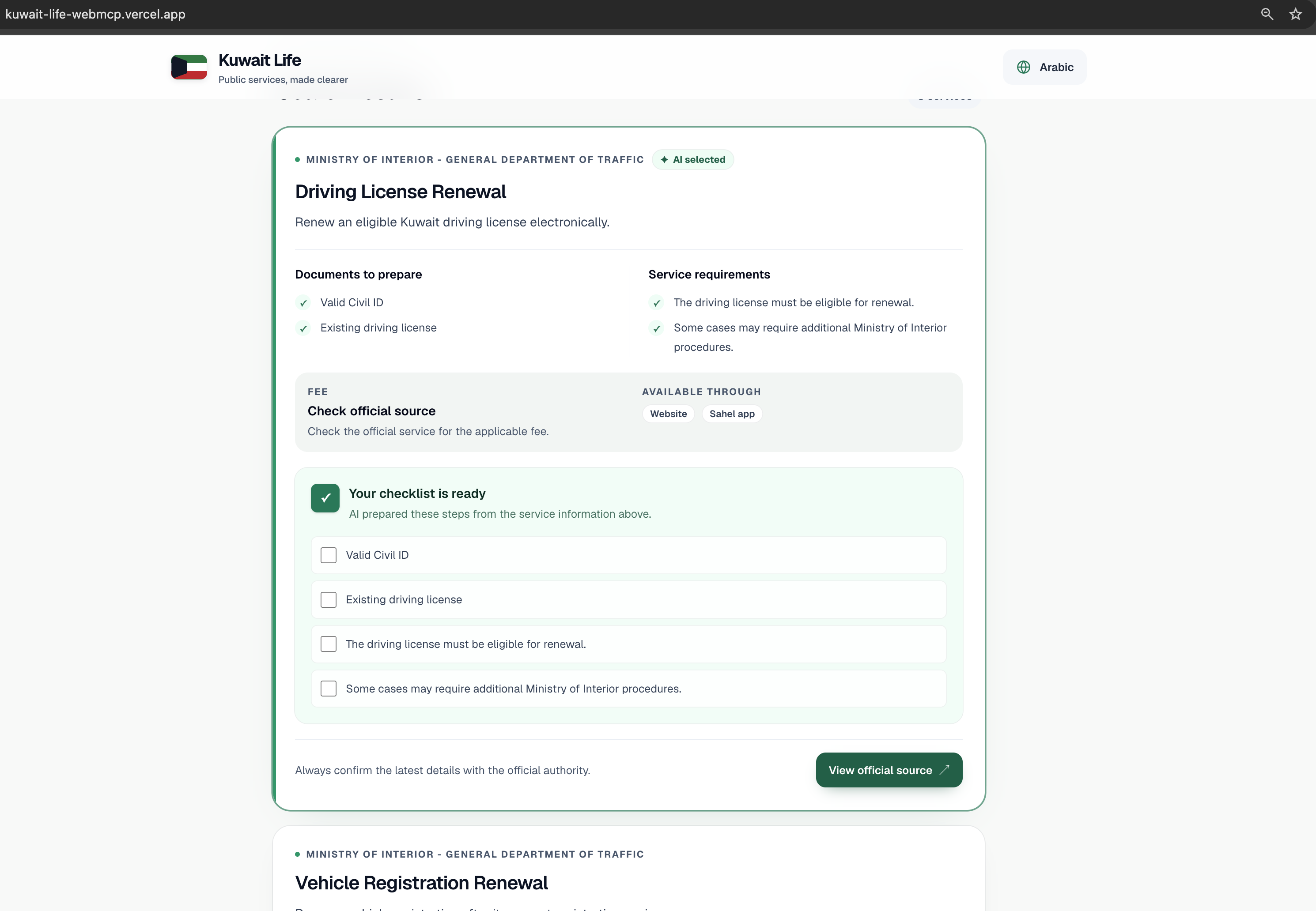
WebMCP-selected service with AI-generated checklist for Driving License Renewal.
Inspiration
Kuwait residents often know what they need to do, but not the exact government service or required documents.
For example, someone may simply say:
"I need to renew my driving license."
or:
"My residency was renewed and I need my Civil ID."
I built Kuwait Life to make all users to use normal language to find the services they need.
What it does
Kuwait Life is a bilingual English/Arabic guide for Kuwait government services.
Users can describe what they need in natural language and the application helps identify the most relevant service.
The current MVP includes:
- Civil ID Renewal for Non-Kuwaitis
- Driving License Renewal
- Traffic Violation Inquiry and Payment
- Vehicle Registration Renewal
For each service, Kuwait Life presents:
- responsible authority
- documents to prepare
- service requirements
- fee information
- available service channels
- official government source
The interface supports both English and Arabic, including full RTL layout for Arabic.
Why WebMCP
The main feature of Kuwait Life is its WebMCP integration.
Instead of an AI browser agent having to inspect the page visually, find controls, and simulate clicks, Kuwait Life exposes structured capabilities directly to WebMCP-compatible agents.
The application currently exposes two WebMCP tools:
find-kuwait-government-service
This tool accepts a natural-language request such as:
"I need to renew my driving license."
It searches and ranks the available government services and returns structured service information.
The same human-facing webpage also updates automatically, highlights the best matching service, and displays an AI selected state.
create-kuwait-service-checklist
After a service has been selected, an agent can call this tool to create a practical checklist containing the documents and requirements for that service.
The checklist appears directly inside the webpage, where the human can continue interacting with it and mark items as completed.
This creates a shared workflow between the AI agent and the person instead of replacing the website with a chatbot.
Human + Agent Collaboration
The experience is designed around both humans and AI agents using the same application:
Human describes a situation
        ↓
AI agent discovers WebMCP tools
        ↓
Agent finds the relevant service
        ↓
Kuwait Life highlights the result
        ↓
Agent creates a checklist
        ↓
Human works through the checklist
        ↓
Official government source
How I built it
Kuwait Life was built with:
- Next.js
- React
- TypeScript
- Tailwind CSS
- WebMCP
- Vercel
Government-service information is stored as structured application data.
A search-ranking layer evaluates natural-language requests and ranks matching services.
WebMCP tools are registered using document.modelContext.registerTool() and reuse the same search and service logic used by the human-facing application.
Custom browser events connect WebMCP tool execution with the React interface so agent actions can visibly update the webpage.
Challenges
One of the main challenges was working with WebMCP in my first time and learning it concept.
Another challenge how to design the AI experience so that it enhances website.
What I learned
This project helped me understand how WebMCP can make websites more agent-friendly.
Instead of forcing AI agents to infer how a website works from its visual interface, websites can expose reliable structured actions directly to agents.
Privacy and Safety
Kuwait Life does not collect Civil ID numbers, passport information,or government login credentials.
It does not submit government applications, process government payments, or access private government databases.
The application provides informational guidance using public information and directs users to official government sources for the actual service.
Kuwait Life is an independent informational project and is not affiliated with the Government of Kuwait.
Built With
- css
- next.js
- react
- tailwind
- typescript
- vercel
- webmcp


Log in or sign up for Devpost to join the conversation.