-
-
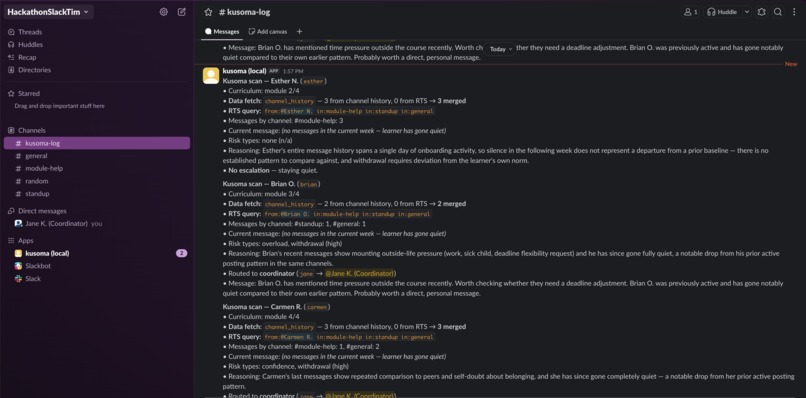
kusoma-logs
-
kusoma_logo
Inspiration
Uganda completes Primary Seven for less than half the children who start Primary One — 739,204 out of 1.7 million enrolled. At secondary level, only 352,929 of 508,769 students who begin Senior One make it to Senior Four. More than 40% of primary pupils and 30% of secondary students drop out before finishing. Even at Makerere University, Uganda's flagship institution, an estimated 1,000 students drop out every year, largely from economic hardship, proving this isn't only a rural primary-school problem, it follows learners all the way to university and into every cohort-based program in between: bootcamps, scholarship cohorts, vocational training, online courses.
The official story is always told after the fact : a missed exam, a failed term, a final dropout record. But by the time a dropout is recorded, the learner checked out weeks earlier, and the signs were almost always there the whole time: a question asked three times because they were too embarrassed to push for a clear answer, a message posted at 1am, a person who used to joke around in the cohort channel going quiet. None of that shows up on a dashboard. It shows up in chat.
We built Kusoma because we believe the conversation a cohort is already having, in Slack, contains the earliest and most honest signal of who is struggling weeks before any formal system would catch it. And we built it with an explicit eye toward scale: a single bootcamp cohort is the smallest unit this can run on, but the same engine of reading informal signal, cross-referencing it against where a learner should be, and routing one specific, human, non-punitive nudge — is the seed of something that could eventually operate at the scale of a national education monitoring effort, the kind Uganda's own statistics make clear is urgently needed.
What it does
Kusoma watches a training cohort's public Slack channels (never private DMs) for five distinct kinds of struggle signal, because dropout research shows struggle isn't one thing:
- Academic — the same question asked more than once, left unresolved
- Overload — life and time pressure unrelated to the material itself
- Confidence — self-doubt and comparison to peers, even while on track
- Isolation — social disengagement, even from a learner who is academically fine
- Withdrawal — a real drop in someone's own activity, judged against their own baseline, not the cohort average
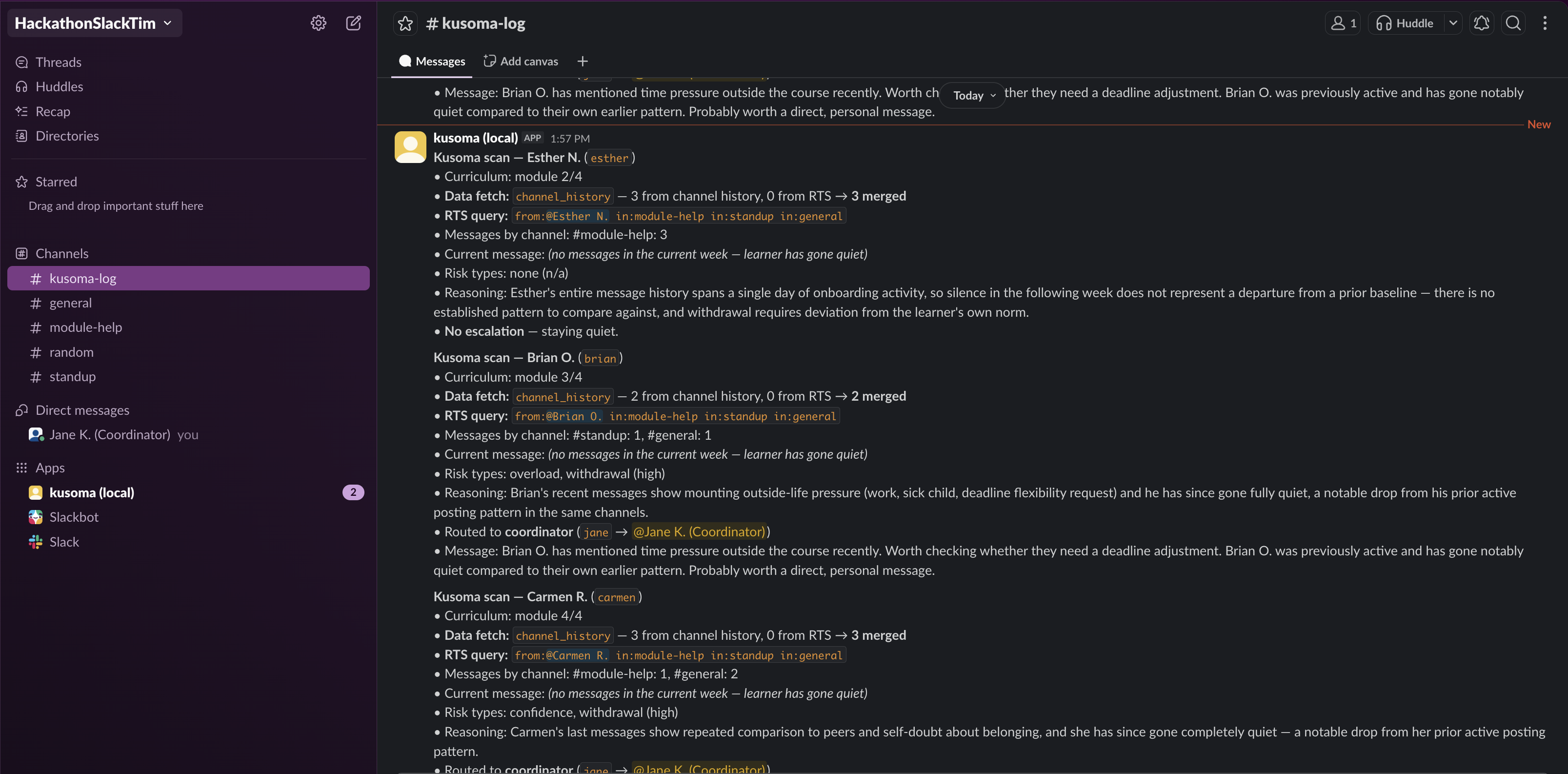
It cross-references whatever it detects against the learner's actual curriculum position, pulled live via an MCP connection to the program's tracking sheet, so a flag is never just "this message sounds concerning" . it's "this message sounds concerning, and here's where they actually stand." When the two line up, Kusoma sends one specific, plain-language nudge: who, what kind of struggle, and who's best placed to help , a mentor for a knowledge gap, a coordinator for everything else. It also looks across the whole cohort: if several learners struggle with the same topic in the same week, it tells the coordinator the content may need revisiting, not just the individual.
It never contacts a learner directly, never escalates anything punitively, and only reads what people already chose to post in a shared channel.
How we built it
We started this hackathon somewhere very different in the likes of a lead-generation agent and spent real time validating it before realizing the category was already commoditized (Slack's own native AI already does CRM logging and commitment tracking for free). That pushed us toward the Slack Agent for Good track, and through several more rounds of validation toward cohort dropout detection specifically, once we found that existing dropout-prediction research splits causes into several distinct categories that no single existing tool detects together.
From there: we wrote a classifier system prompt encoding all five risk
categories with explicit rules for telling them apart (the hardest design
problem — for example, making sure a learner who is on track academically
but isolated still gets flagged, and that confidence-related self-doubt doesn't
get misread as academic confusion). We built a seeded six-persona test cohort,
including a deliberate "no signal" control persona, specifically to prove the
system doesn't cry wolf on normal venting and banter. We designed the
curriculum-tracking schema as an MCP-connected source of ground truth, and
wrote the fusion and routing logic as pure, fully unit-tested functions , 20
passing tests before wiring anything to a live Slack workspace, so we could
verify the actual decision logic independent of any platform plumbing. Only
after that did we scaffold the real app with slack create agent, using the
Bolt for Python + Claude Agent SDK starter template, and connect it to our
developer sandbox via Socket Mode.
Challenges we ran into
The hardest part wasn't the code, it was the discipline of saying no to ideas that sounded good but weren't actually new . We killed at least three earlier concepts after researching that Slack's own roadmap or an existing product already covered them, which is a humbling but necessary process for a hackathon this competitive. Technically, the trickiest design challenge was making the five risk categories genuinely distinguishable rather than overlapping mush. It's easy to build a classifier that just says "this person seems at risk," much harder to build one that correctly tells you why, since the right intervention is completely different depending on whether someone is confused, overwhelmed, doubting themselves, isolated, or withdrawing. We also had to deliberately design against the easy, more invasive version of this idea — anything that looked like surveillance of private messages or individual risk-scoring that follows a learner permanently was ruled out early, because the moment a tool like this feels punitive, it stops getting trusted, and an untrusted tool watching a vulnerable population is worse than no tool at all.
Accomplishments that we're proud of
We're proud that Kusoma's core logic is genuinely tested, not just demoed. Before we wired anything to a live Slack workspace, we built a six-persona seeded cohort including a deliberate "no signal" control persona and ran the full gating and routing logic against all of them, catching real design flaws early. The one we're most proud of catching: a learner who is fully on track with their coursework but has quietly stopped engaging socially still gets flagged, correctly routed to a coordinator rather than a mentor, with appropriately gentle urgency — a case a simpler "check if they're behind" tool would miss completely, because nothing about their academic standing looks wrong.
We're also proud of how many ideas we were willing to kill. We didn't land on cohort dropout detection first — we validated and discarded a lead-generation concept and a workplace-commitment-tracking concept after research showed both were already being solved natively by Slack's own AI. Saying no to ideas that sounded good but weren't actually new was harder than writing the code, and we think it shows in the final concept's sharpness.
Finally, we're proud of designing the routing logic so it never goes around the people in a cohort — every flag goes to a human (a mentor or coordinator) who decides what happens next, nothing is automated past that point, and nothing accumulates into a permanent record that follows a learner. For a tool that reads people's informal conversation, getting that boundary right felt as important as getting the detection right.
What we learned
We learned that "novel" is a moving target in a hackathon like this, and the only way to actually find white space is to go look for what's already been built rather than assume. More than once we were convinced we'd found a sharp idea, searched for prior art, and found Slack's own product roadmap had already absorbed it which was humbling, but ultimately made the project stronger, because it forced us toward the one structural gap that's genuinely hard for the platform itself to close: fusing a workspace's own private conversation with an external source of ground truth, which by definition requires picking specific outside systems to integrate , a third-party job, not a platform one.
We also learned, from actually reading the dropout research rather than guessing, that "a struggling learner" isn't one pattern. It's at least five, and they call for different kinds of help. That reshaped the whole product: instead of one generic "this person seems at risk" alert, every flag now carries a specific reason and a specific recommended response, which only became obvious once we stopped assuming dropout is mainly an academic problem.
On the technical side, we learned how deliberately the Slack Real-Time Search API is scoped. It's a tool for searching a workspace's own data, once we understood it properly, actually pointed us toward a better and more defensible idea than the one we started with.
What's next for Kusoma ai
The most immediate next step is what we deliberately left out of the hackathon build: turning the mentor-matching logic from a simple counter into something that actually learns which mentors help with which topics over time, and closing the loop on whether a flagged learner re-engaged after a nudge, so the system gets quieter and more accurate the longer it runs rather than staying a fixed set of rules.
Beyond a single cohort, we want to pilot Kusoma with a real bootcamp or scholarship program , ideally one already running on Slack and use that as the proving ground before approaching a wider market. Uganda's own numbers make the long-term ambition clear: less than half of children who start Primary One finish Primary Seven, and even Makerere loses roughly a thousand students a year. A tool like this, running at the scale of a single Slack cohort today, is a small-scale proof of an idea that we believe is worth pursuing at a much larger, even national, scale a standing early-warning layer across many training and education programs at once, not just one workspace.
Commercially, we see a natural freemium path: a free tier for a single cohort and one risk category, with paid tiers unlocking the full five-category detection, the cross-cohort pattern insights, and reporting aimed at the program coordinators and funders who care most about retention. Since Slack doesn't process payments natively, our next concrete step after this hackathon is standing up that billing layer so a real program can actually pay for it.
Built With
- anthropic-api
- claude-agent-sdk
- google-sheets
- mcp
- python
- slack-bolt
- slack-cli
- slack-real-time-search-api

Log in or sign up for Devpost to join the conversation.