-
-

Context Commerce for the moment before the search
-
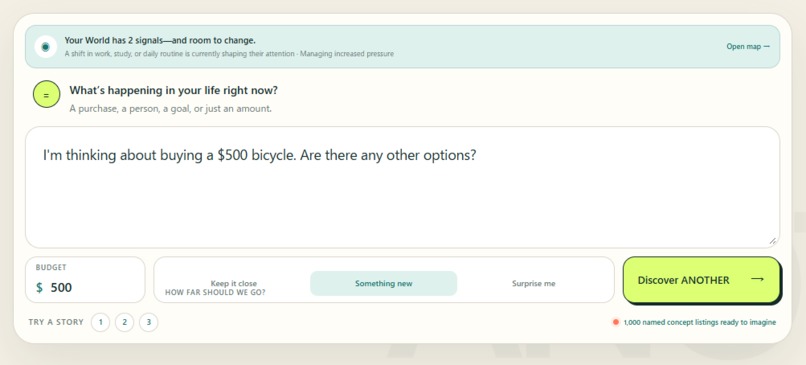
The internet can show you a better bicycle. It cannot show you a better use of $500.
-
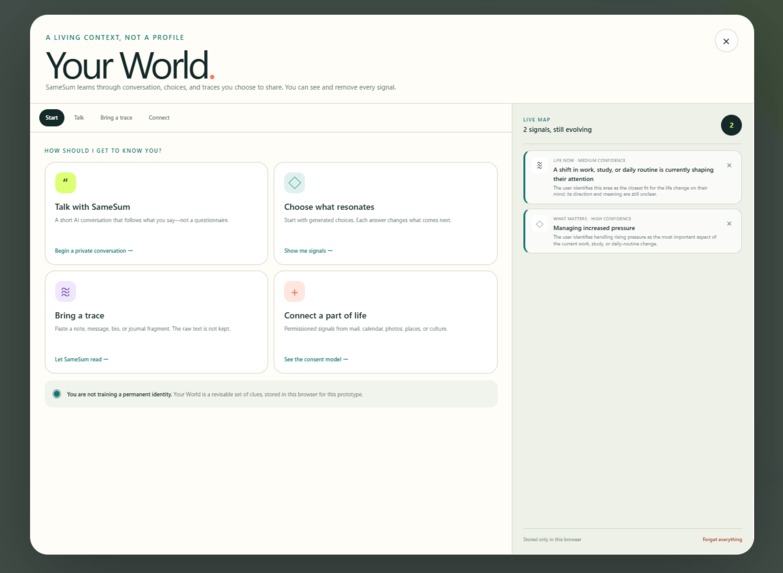
Personalization without a hidden profile.
-
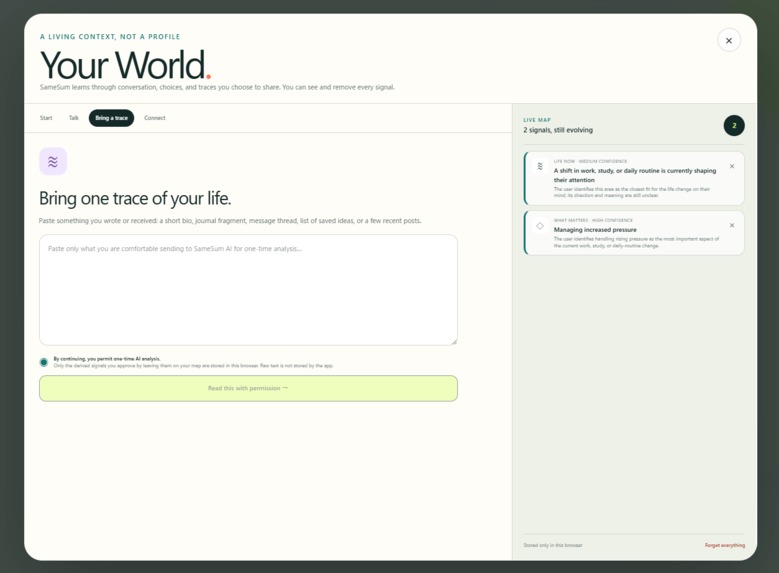
The unserved question: What else could this money become?
-
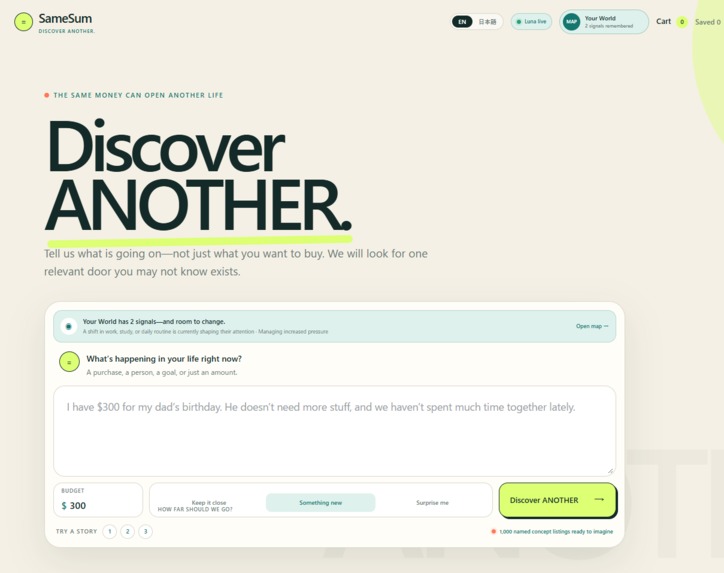
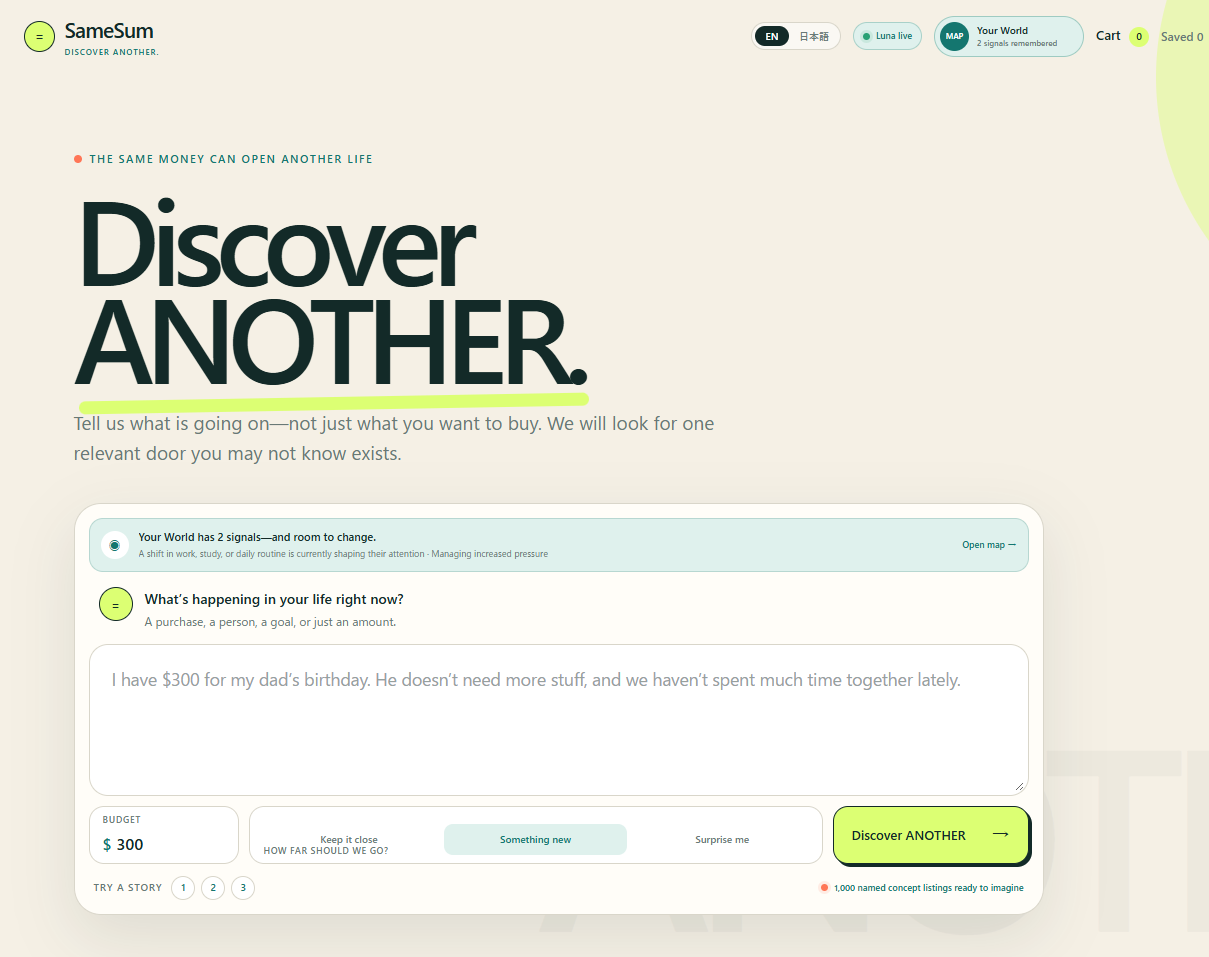
One prompt. One relevant door.
-
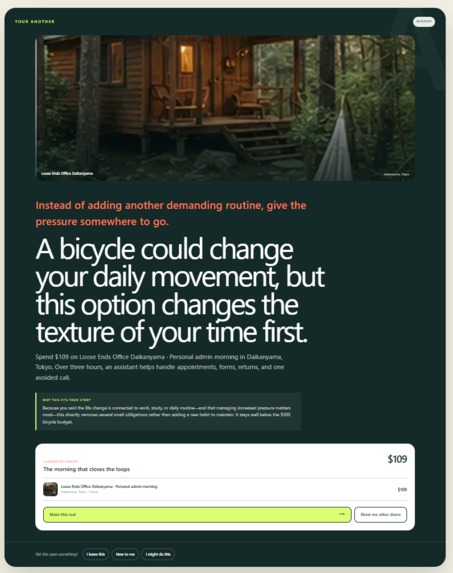
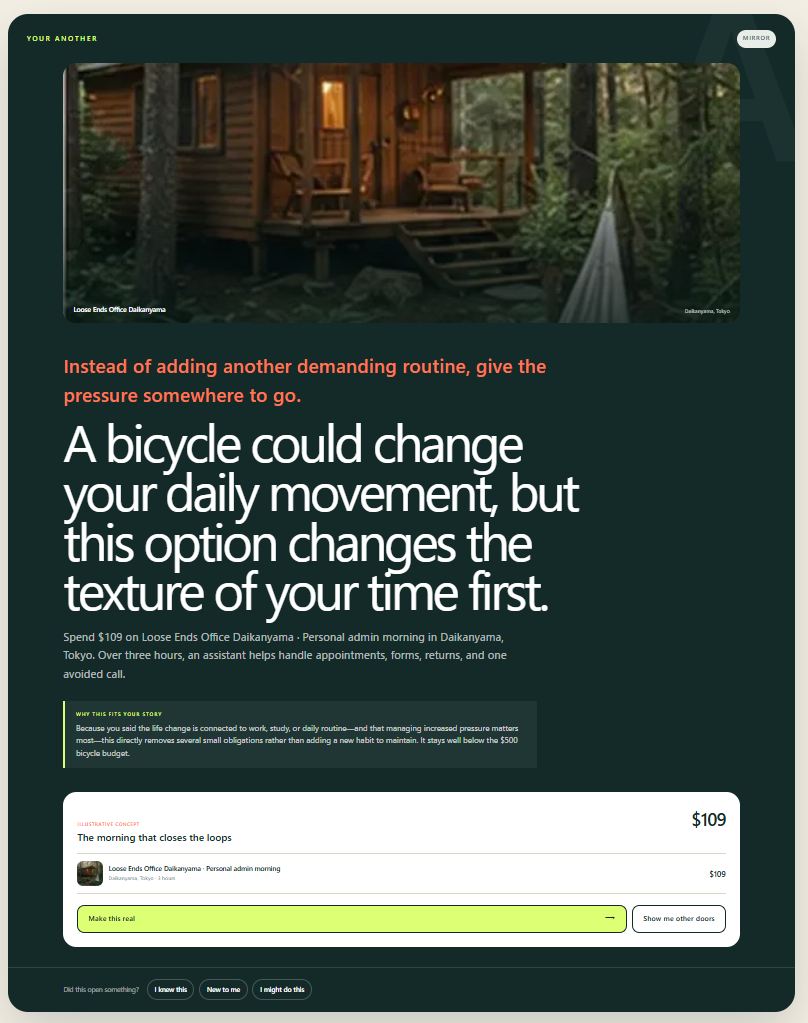
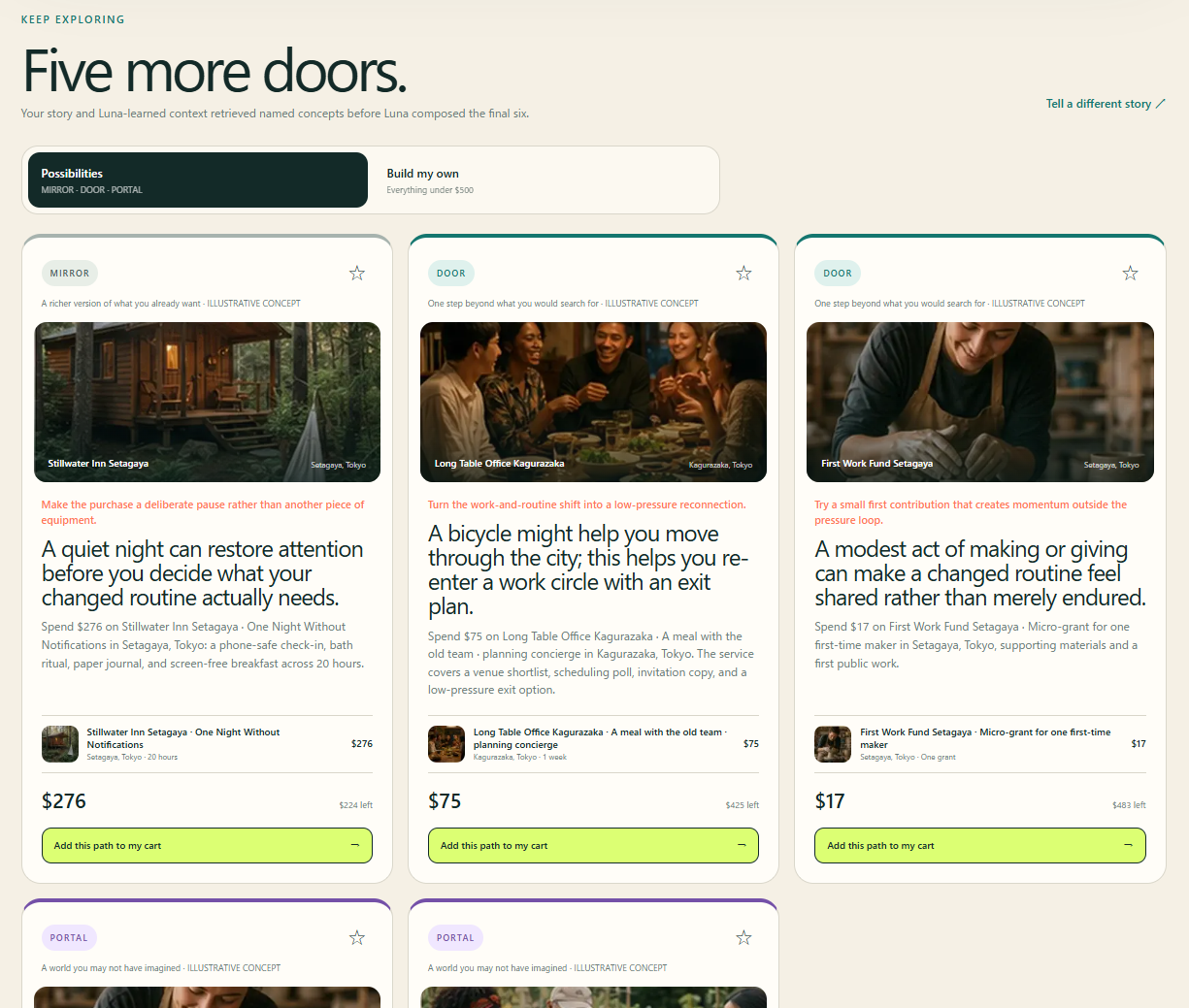
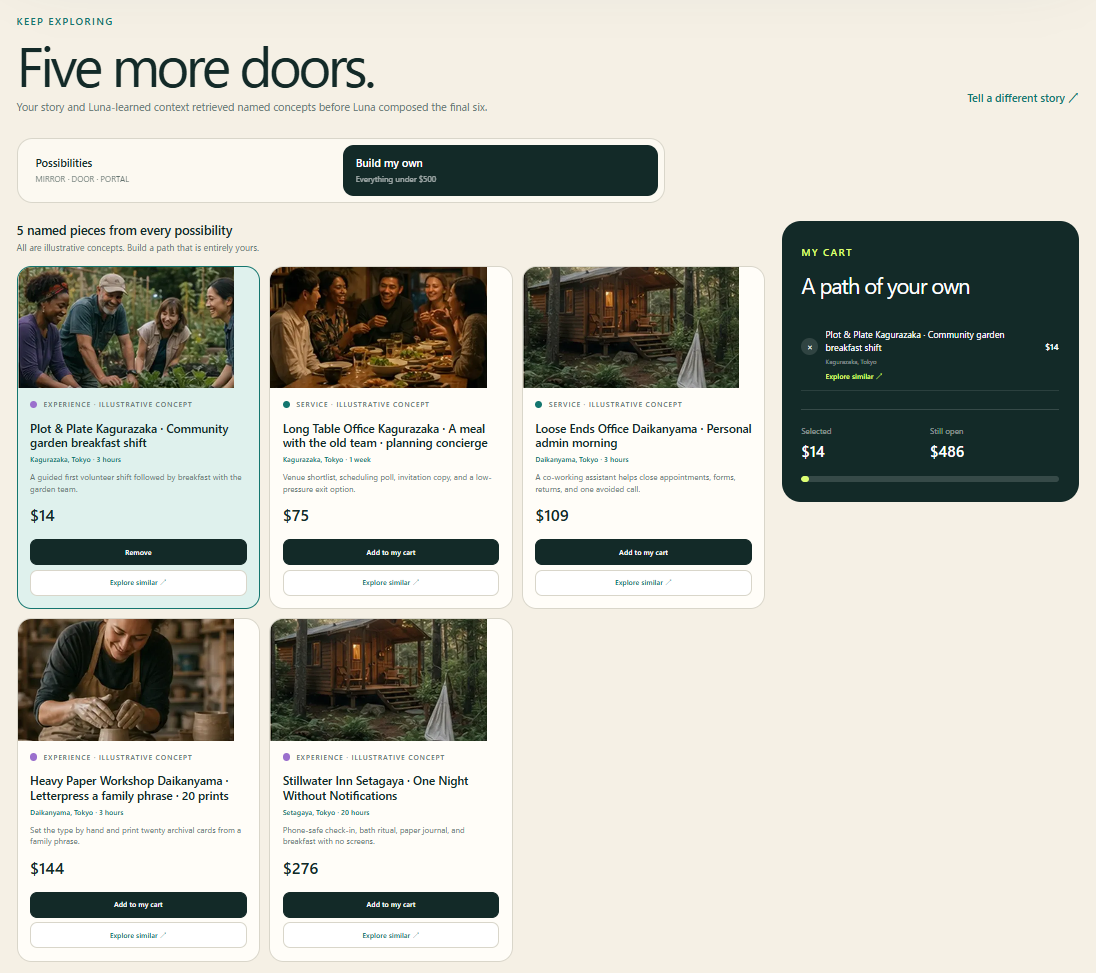
$500 bicycle → $109 personal-admin morning
-
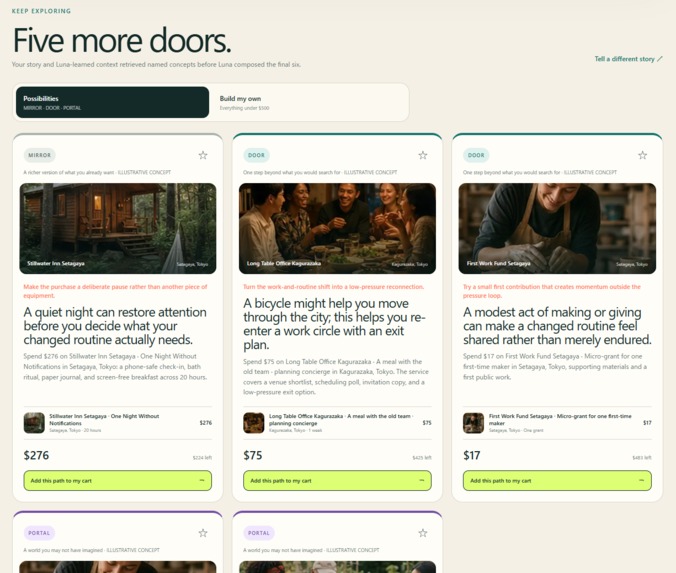
The first reveal is whichever ANOTHER has the strongest resonance—not whichever tier is easiest to sell.
-
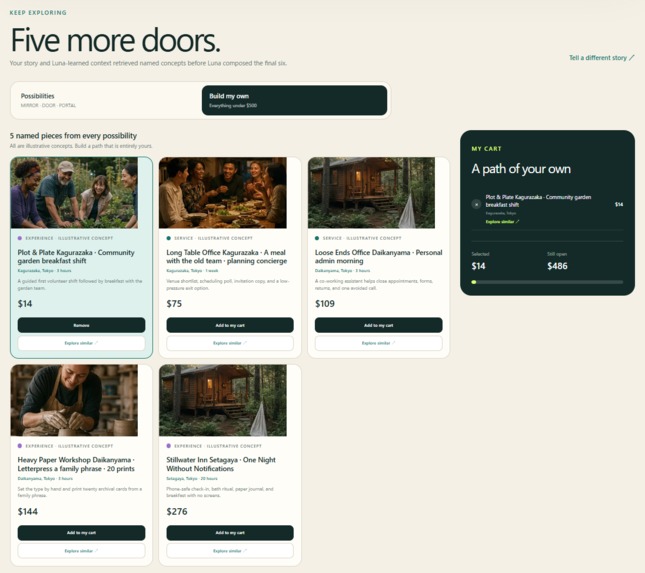
Discovery becomes a Path—not another feed.

Inspiration
Nearly twenty years ago, a Japanese book called Ano Kane de Nani ga Kaeta ka ("What Else Could Have Been Bought with That Money?") became a cultural phenomenon. It translated government budgets into tangible alternatives, making opportunity cost something people could actually imagine.
That idea stayed with me.
Over the years I noticed the same problem in everyday life. When buying a gift, making a major purchase, or spending unexpected money, we compare products within the same category—but almost never compare entirely different possibilities.
What if a $500 bicycle could instead become a weekend with your father, a creative workshop, time back from an assistant, or the first step into a community you never knew existed?
That question became SameSum.
What it does
SameSum is a possibility engine and an early prototype of what we call Context Commerce.
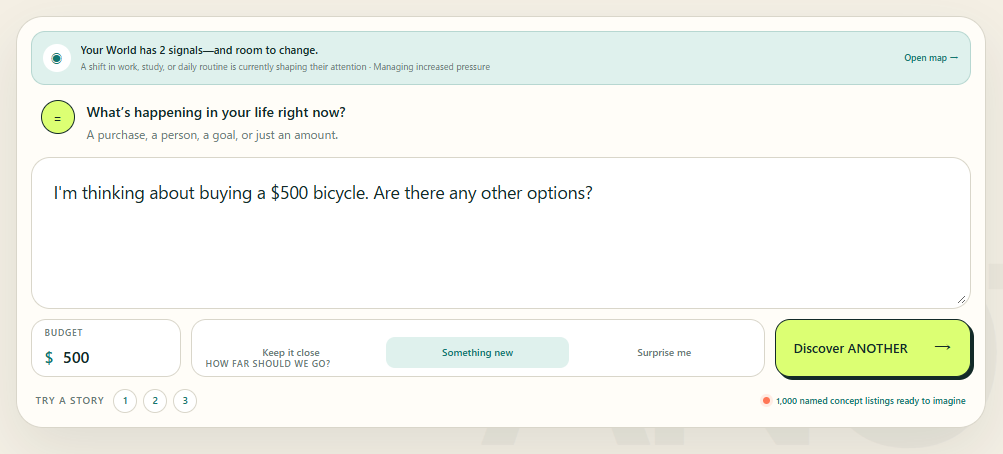
Instead of starting with a product search, users simply describe what's happening in their life.
"I'm thinking about buying a $500 bicycle."
or
"I have $300 for my dad's birthday."
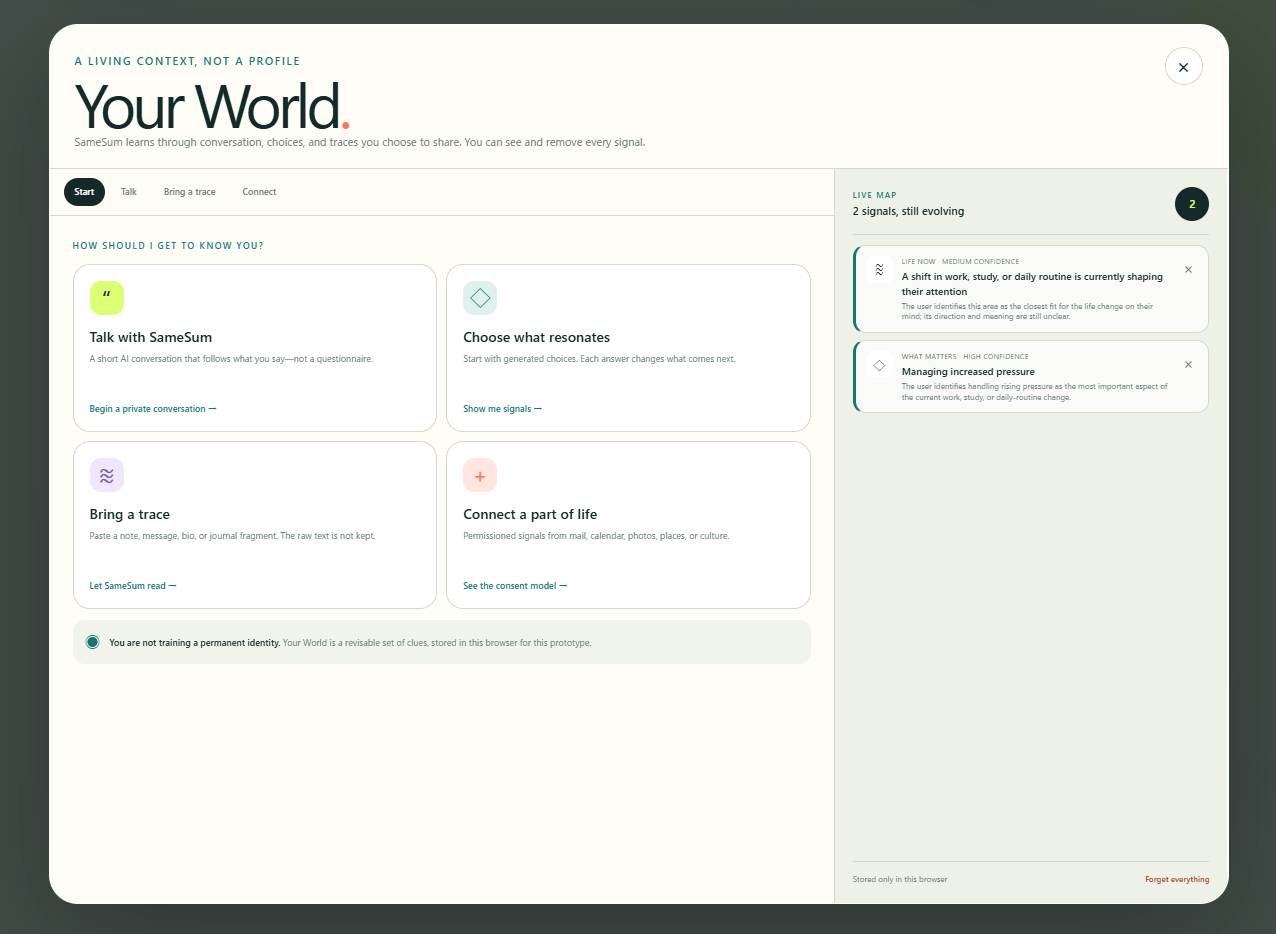
SameSum builds a living understanding of the user's current situation through Your World—a transparent map of revisable context signals rather than a hidden profile.
Using those signals, it recommends a curated mix of MIRROR, DOOR, and PORTAL opportunities:
familiar improvements, adjacent possibilities, and completely new directions.
The goal isn't convincing people to spend less.
It's helping them discover another future they didn't know they could choose.
How we built it
We built SameSum as a browser-first prototype using Next.js, TypeScript, Vercel, and the OpenAI API.
Instead of waiting for AI before showing anything, we designed a progressive recommendation pipeline.
A deterministic catalog of 1,000 named opportunities across 20 cities retrieves relevant candidates instantly. GPT-5.6 refines those results in the background using the user's story and World Signals. The UI quietly upgrades the recommendations without interrupting exploration.
We also built Your World, an AI-powered context system where users can:
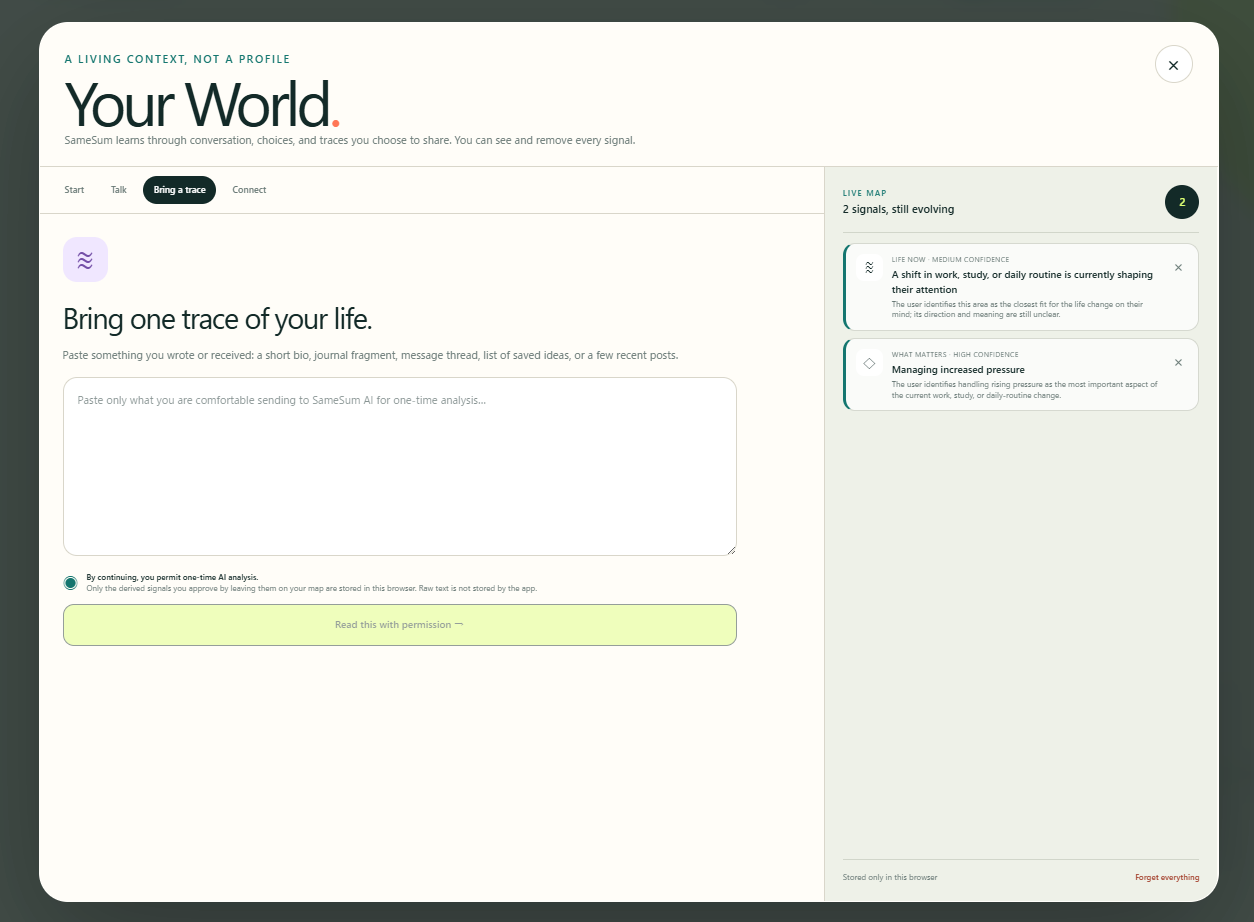
have a short adaptive conversation, paste a journal or message ("Bring a Trace"), choose dynamically generated responses, or eventually connect parts of their digital life.
Unlike traditional personalization, every inferred signal remains visible, editable, and removable.
Challenges we ran into
The hardest problem wasn't generating ideas.
It was generating ideas that felt personally meaningful without feeling invasive.
We wanted recommendations to surprise users, but never seem random.
We also had to balance imagination with trust:
keeping AI-generated ideas grounded, clearly separating inspiration from verified information, avoiding hidden profiling, and making recommendations explainable rather than mysterious.
Another challenge was latency. We wanted responses to feel instantaneous while still benefiting from deeper AI reasoning, which led us to build the progressive retrieval-and-composition architecture.
Accomplishments that we're proud of
We're proud that SameSum no longer feels like "six alternatives for the same price."
It has evolved into a working prototype for a new shopping experience where users begin with a life situation instead of a product category.
We also built a transparent AI memory model where users can see exactly what the system believes about their current life—and change or delete every signal.
Finally, we're proud that SameSum never treats buying the original product as failure.
Sometimes the best recommendation is realizing the original choice was already the right one.
What we learned
We learned that good recommendations require more than semantic similarity.
The best ones reinterpret why someone wants to spend money in the first place.
We also learned that people are surprisingly comfortable sharing context with AI—as long as the reasoning stays transparent and under their control.
Perhaps the biggest lesson was that discovery itself can become a new interface for commerce.
What's next for SameSum
Our next step is transforming SameSum from a recommendation prototype into a true Context Commerce platform.
We'll connect real providers, live inventory, and affiliate commerce while preserving editorial independence.
We're also expanding Your World with permission-based connections to calendars, email, and other personal sources so recommendations can become more relevant without becoming another opaque recommendation algorithm.
Ultimately, we want SameSum to become the place people visit before they decide what their money should become—not after they've already decided what to buy.
Built With
- docker
- generative-ai
- github-actions
- gpt-5.6-luna
- gpt-5.6-sol
- llm-orchestration
- multi-agent-systems
- next.js
- node.js
- openai-api
- playwright
- postgresql
- prisma
- react
- sentry
- shadcn/ui
- supabase
- tailwind-css
- tanstack-query
- typescript
- upstash-redis
- vercel
- vitest
- zod

Log in or sign up for Devpost to join the conversation.