-
-
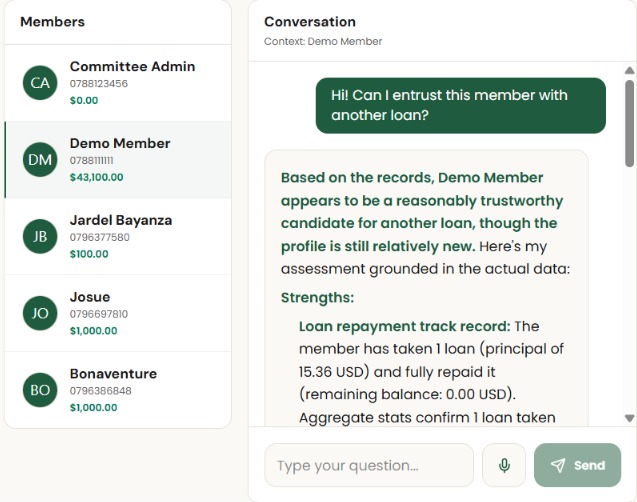
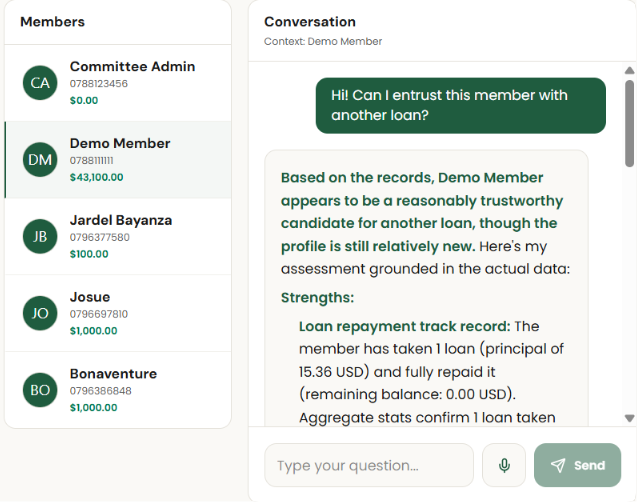
Memory-Assistant Q&A panel
-
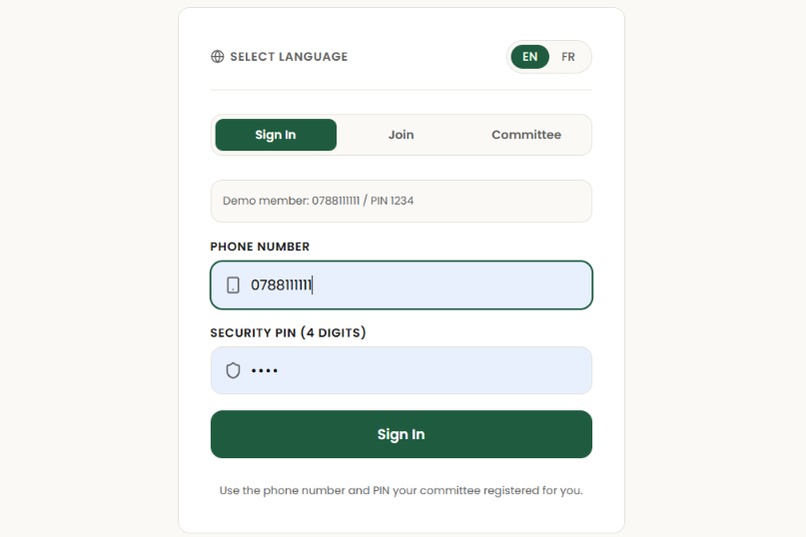
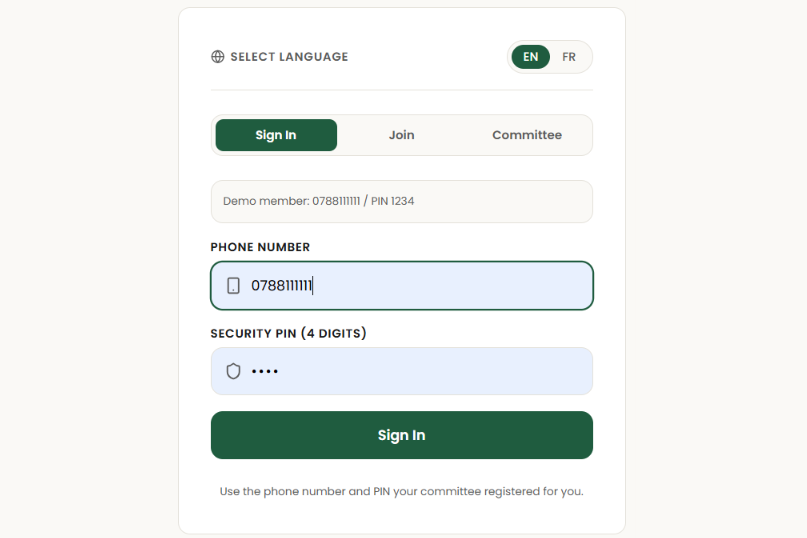
Login Screen
-
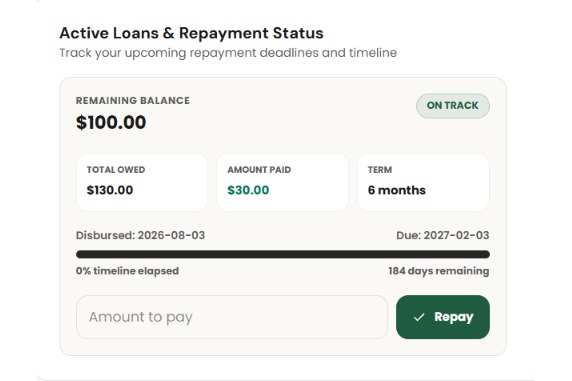
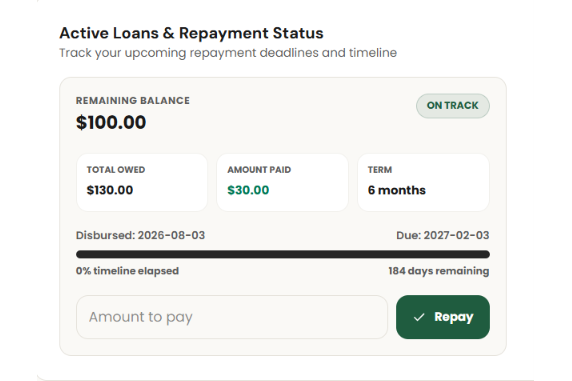
Loan detail Screen
-
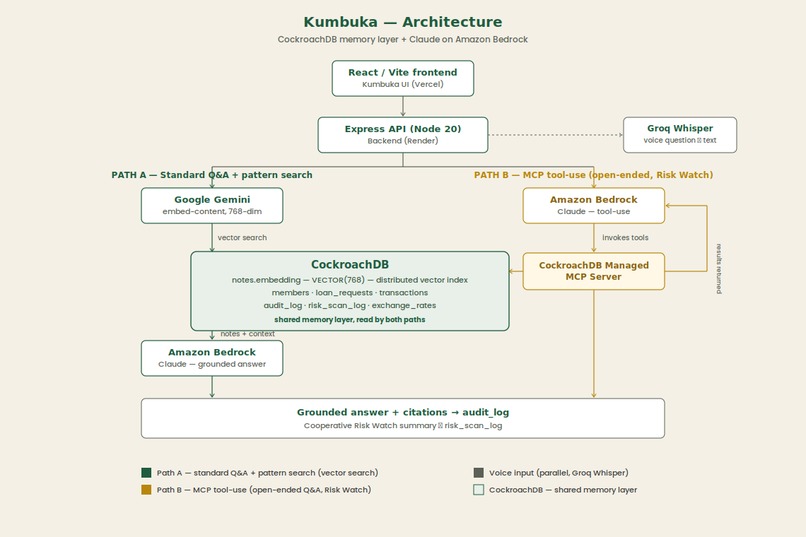
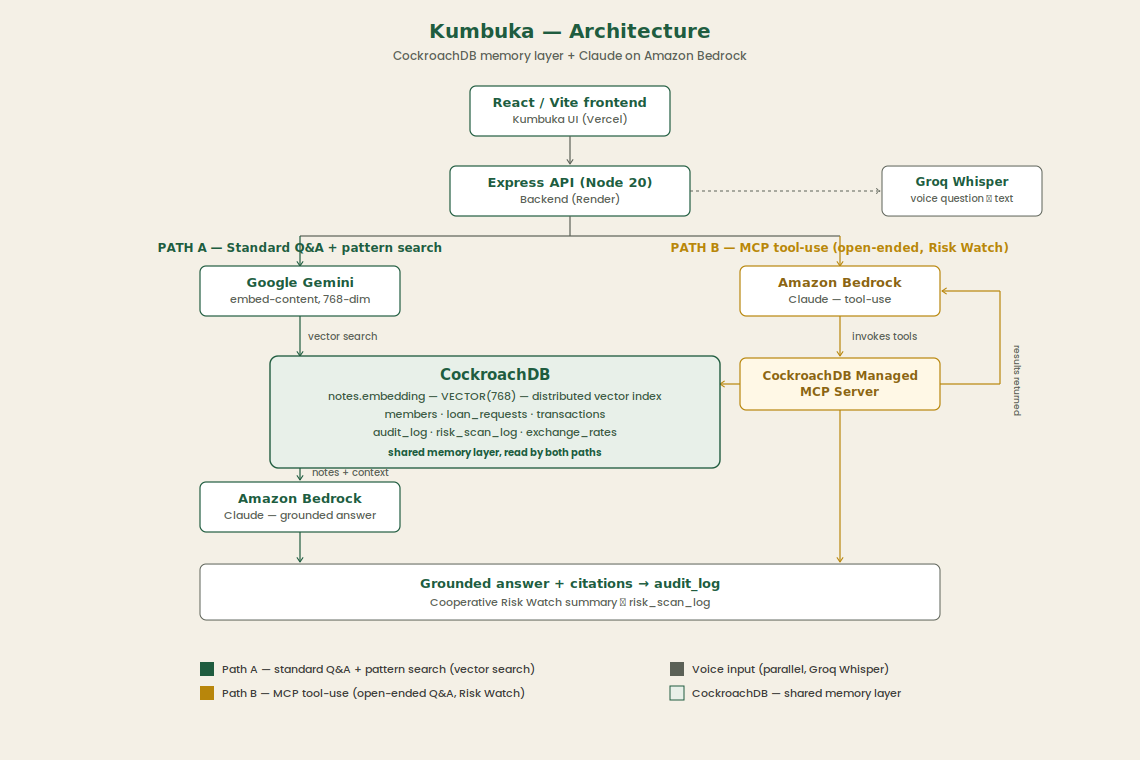
Architecture
-
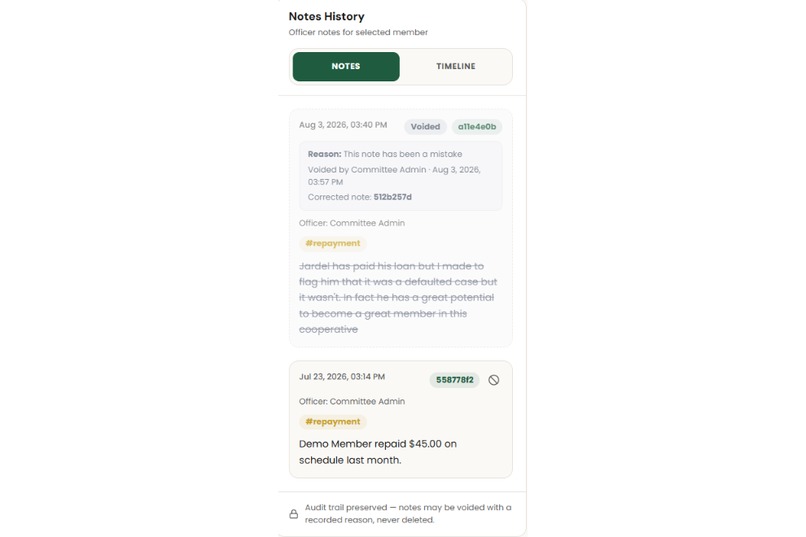
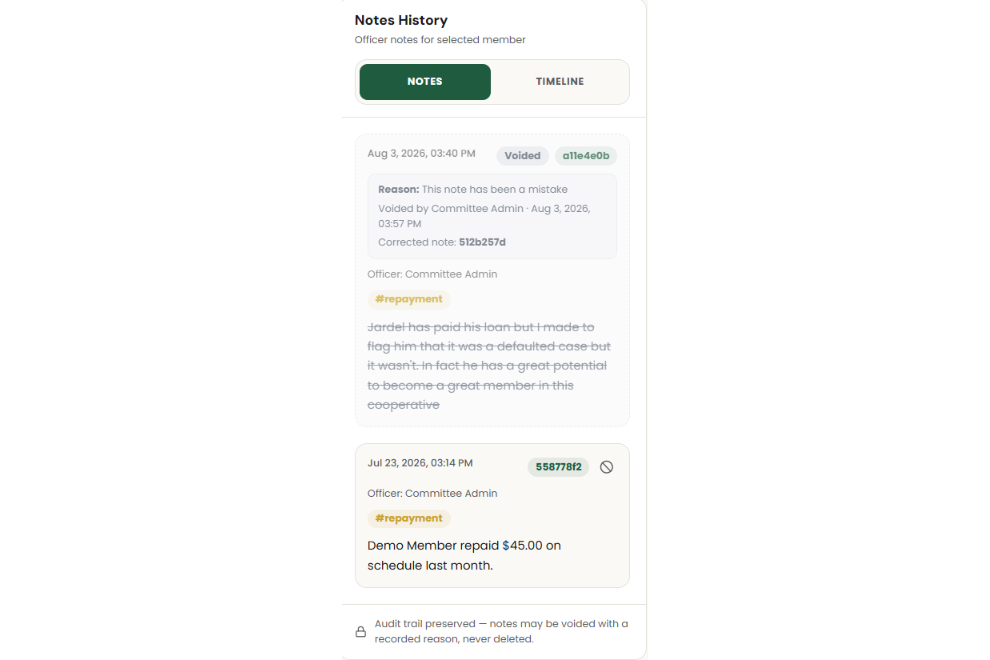
Notes History
-
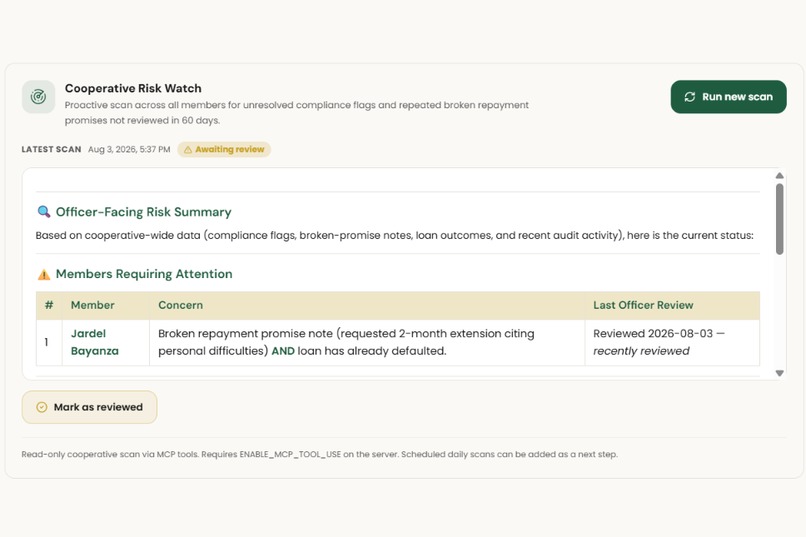
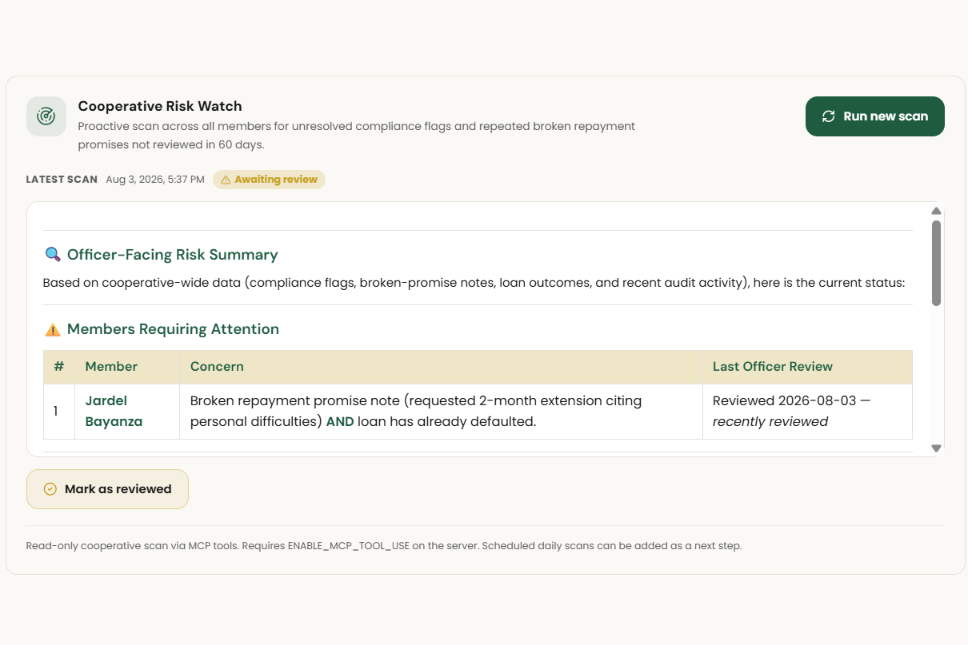
Cooperative Risk Watch panel
-
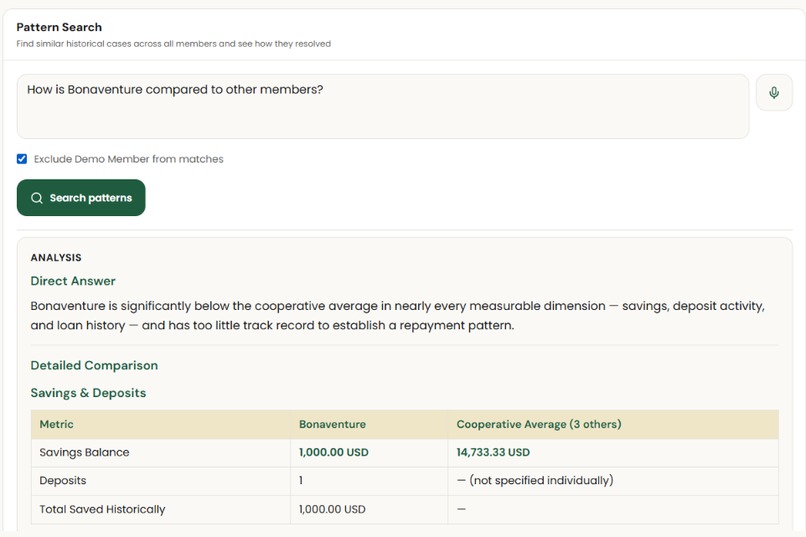
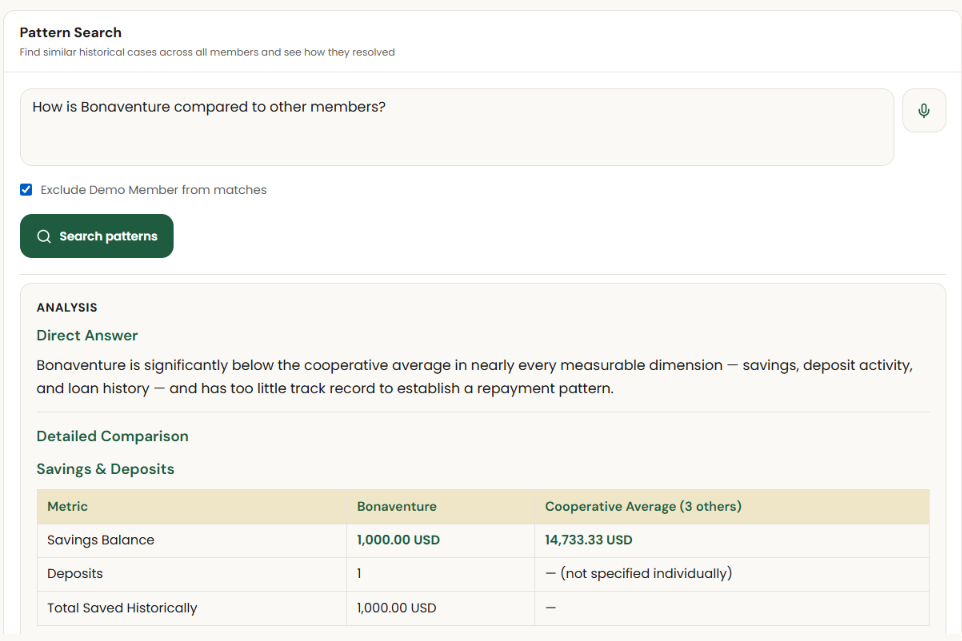
Cross-member pattern search result
Inspiration
We live in a region where banks are often closed due to armed conflict. In that reality, small informal financial cooperatives aren't a nice-to-have; they're often the only functioning financial infrastructure people have. Across Sub-Saharan Africa, the informal economy makes up 86% of the population. That statistic isn't abstract to me; it's the daily reality of the cooperatives I work with.
Most of these cooperatives still run entirely on paper ledgers. Even the ones that have moved to software face a quieter problem: when you need to decide whether to approve a loan for one member out of a hundred, you can't just ask your own database a plain question. You have to manually dig through records, one by one. When you're responsible for a hundred people's financial futures, that's not just inconvenient; it's genuinely dangerous, since slow, uninformed decisions are exactly how bad loans and preventable defaults happen.
We built Kumbuka because we wanted the people running these cooperatives to be able to ask their own data a question and get an honest, grounded answer back, instantly.
What it does
Kumbuka is an AI memory assistant for cooperative loan officers. It remembers every member's history, notes, loan behavior, repayment patterns, compliance risks, and lets an officer ask natural questions like "should we approve a new loan for this member?" and get an answer grounded strictly in real records, with full citations. It never invents information. If it doesn't know something, it says so honestly.
Beyond individual members, it can compare patterns across the entire cooperative, maintain an immutable audit trail for every decision it helps inform, track whether its own compliance flags actually predicted bad outcomes over time, and proactively scan the cooperative for unresolved risks nobody has reviewed recently.
How we built it
We built Kumbuka on top of an existing project of ours, adapting a real cooperative savings and lending platform's member, loan, and savings structure as our foundation, rather than inventing fake demo data from scratch. From there, we:
- Migrated the entire database layer to CockroachDB
- Added a vector-indexed memory layer for officer notes using CockroachDB's Distributed Vector Indexing
- Connected the system to Claude via Amazon Bedrock for grounded, citation-backed answering
- Layered in cross-member pattern search, so officers can compare a member's situation against similar cases cooperative-wide, not just look at one member in isolation
- Built a loan outcome feedback loop, tracking whether our own compliance flags actually predicted defaults or late payments
- Added live read-only tool-use through CockroachDB's Managed MCP Server, letting Claude query the cooperative's data directly for open-ended questions our fixed queries didn't anticipate
- Built a proactive cooperative-wide risk scan, so the system surfaces unresolved risk patterns on its own, not only when asked
- Added voice input for officer questions via Groq's Whisper API, and an immutable audit log tying every answer back to the exact records used
Challenges we ran into
Almost every major piece of infrastructure fought us at some point, and we treated each one as something to learn from rather than something to avoid.
We hit account-level access restrictions on Amazon Bedrock more than once, first with Claude model access, then again with Amazon Titan Embeddings and Amazon Transcribe, both blocked by billing verification delays entirely outside our control. Rather than wait, we found and integrated alternatives each time (Voyage AI, then Cohere, and finally Gemini for embeddings; Groq's Whisper API for voice transcription).
We also chased down a subtle production-only bug where our vector search silently failed after switching embedding providers, tracing it to a dimension mismatch between old and newly generated vectors. Deployment brought its own puzzle too, a misconfigured build-time proxy between Vercel and our backend that took real digging to resolve.
Accomplishments that we're proud of
- Building an assistant that is genuinely honest, not just confident; it clearly says "I don't know" when the records don't support an answer, rather than guessing
- Getting real, working retrieval-augmented grounding in place, every answer can be traced back to the exact notes and records that produced it, through a real, tested audit log
- Extending memory beyond single-member lookups into cooperative-wide pattern search, so an officer can ask how a member compares to everyone else, not just to themselves
- Building a feedback loop that checks whether our own compliance flags actually predicted real outcomes, turning the system into something that can be held accountable, not just trusted on faith
- Recovering quickly, more than once, from AWS account restrictions and provider outages, without losing momentum or giving up on the AWS/CockroachDB stack
- Shipping a working, deployed, testable product, not just a local demo, under real time pressure
- Most of all, we loved working on this hackathon. Despite every challenge along the way, we learned so many new things that will stay with us as builders, and we're deeply grateful for the opportunity to build this product
What we learned
The biggest lesson wasn't technical, it was about how we work. Our team started this hackathon not really knowing AWS, not knowing CockroachDB, not knowing half the tools we ended up shipping with. What got us through wasn't already knowing the answers, it was showing up every day and learning in the moment, even on the days we didn't feel like it. Being an active learner, staying genuinely curious about the parts we didn't understand yet, turned out to be the real skill this project demanded.
What's next for Kumbuka — Cooperative Memory Assistant
- Memory consolidation at scale: as a cooperative's history grows into hundreds of notes per member, we want to add automatic summarization, so retrieval stays sharp instead of only ever comparing raw, individual notes
- Scheduled, automatic risk scanning, instead of the current on-demand version, so the cooperative gets proactive alerts on a regular cadence, not only when an officer thinks to ask
- Deeper voice support, extending beyond asking questions to fully hands-free field note capture, once we can validate it holds up to real field conditions
- Piloting with a real cooperative, starting with the one that inspired this project, to test the compliance shield and audit trail against real lending decisions, not just seeded demo data
Built With
- amazon-bedrock
- amazon-web-services
- claude
- cockroachdb
- cockroachdb-distributed-vector-indexing
- cockroachdb-managed-mcp-server
- cursor
- drizzle-orm
- express.js
- fintech
- google-gemini
- microfinance
- node.js
- postgresql
- react
- render
- tailwind-css
- typescript
- vector-search
- vercel
- vite
- whisper


Log in or sign up for Devpost to join the conversation.