Inspiration
Understanding complex codebases is a universal challenge in software development. We were inspired by the time developers waste trying to understand unfamiliar code and the knowledge transfer bottlenecks in teams. Our goal was to create an intelligent assistant that could instantly provide context-aware explanations of any codebase, making knowledge transfer as natural as having a senior developer explain it in real-time.
What it does
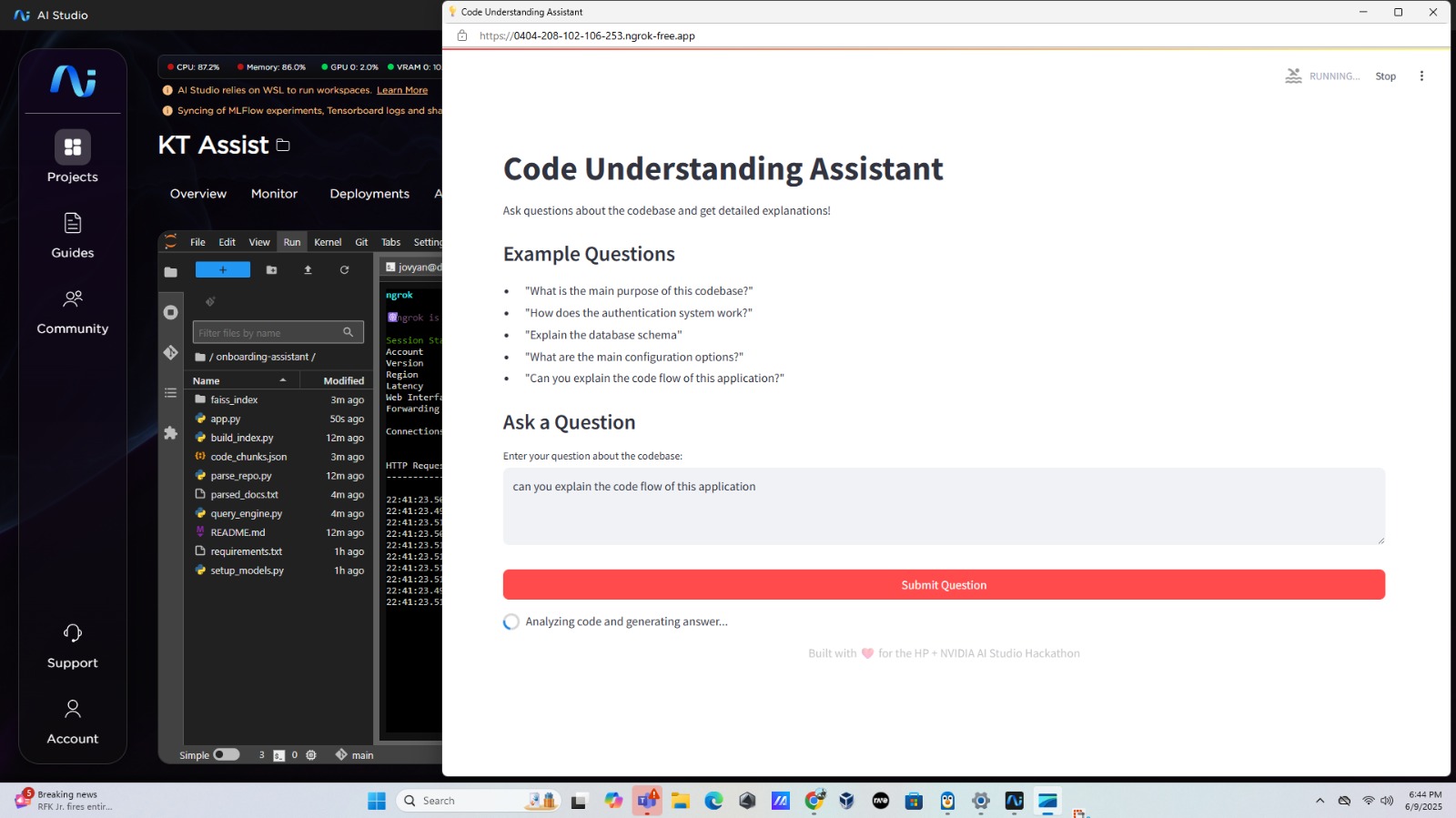
Code Understanding Assistant is an AI-powered tool that transforms how developers interact with codebases. It:
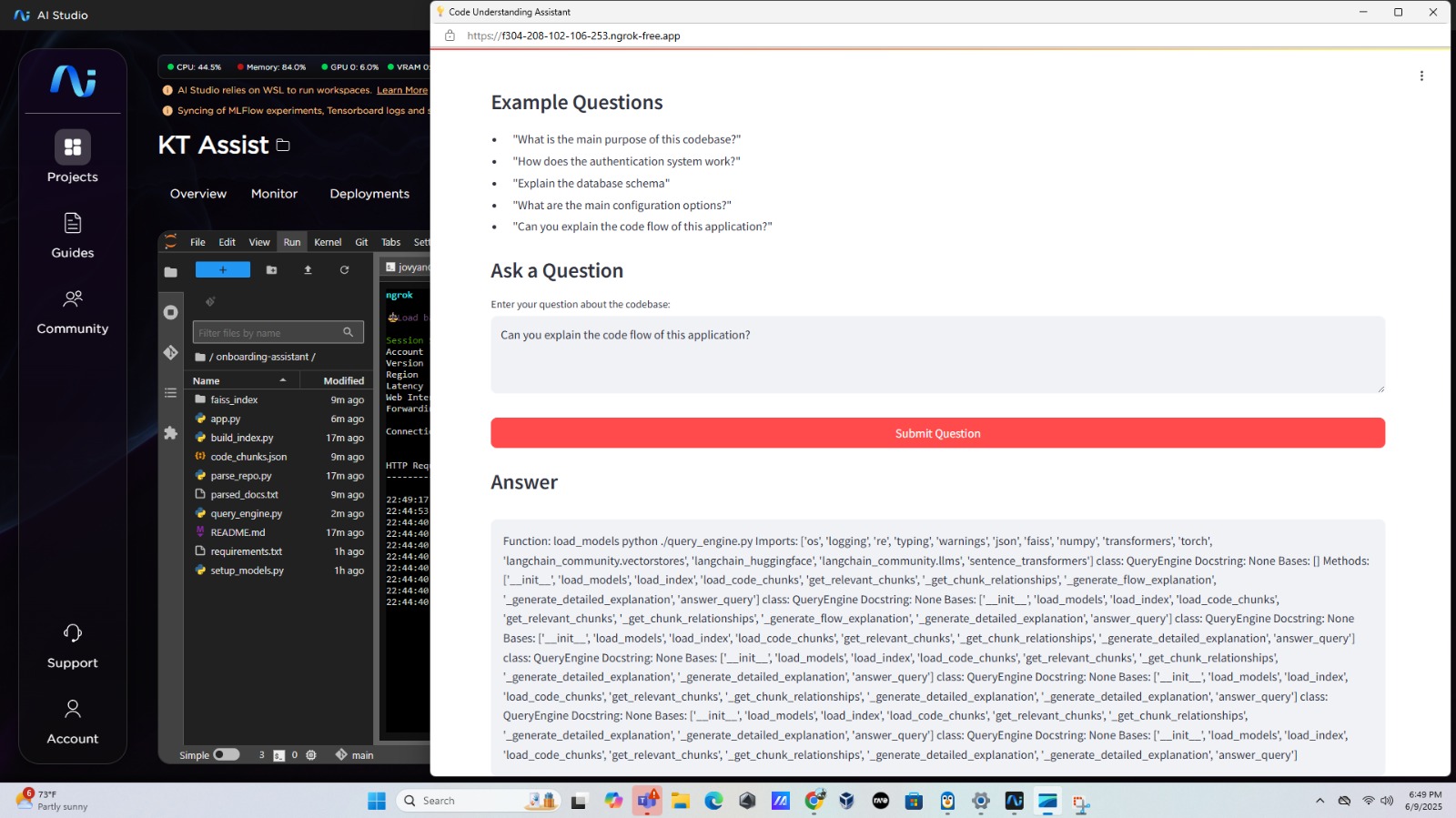
- Provides instant, context-aware explanations of code architecture and flow
- Generates detailed answers with relevant code snippets and source references
- Tracks relationships between different components
- Offers follow-up suggestions for deeper understanding
- Works with any codebase, regardless of size or complexity ## How we built it Built on HP AI Studio's powerful infrastructure, our solution leverages:
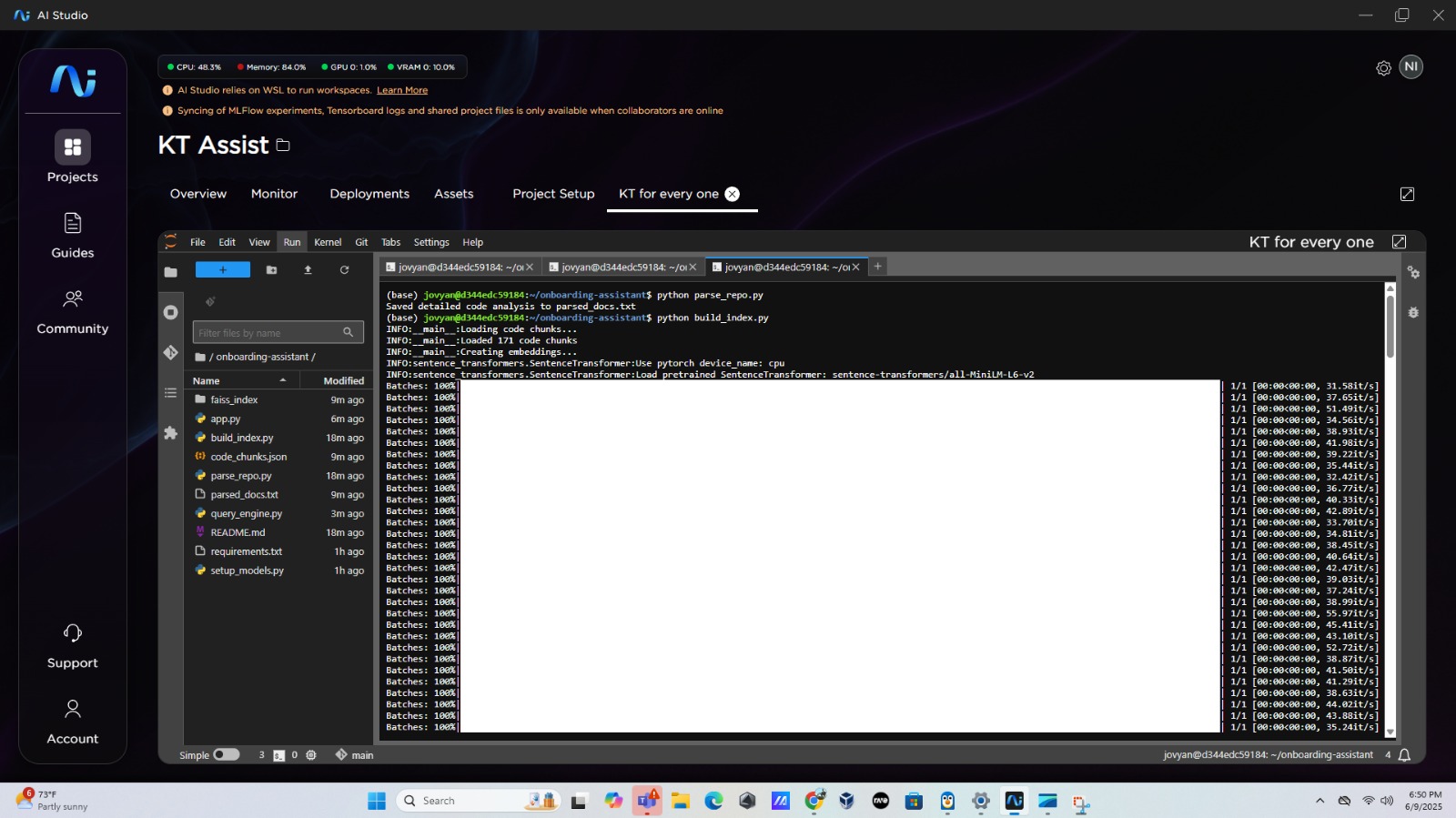
- Advanced NLP models (sentence-transformers and FLAN-T5) for understanding and generation
- FAISS vector store for efficient semantic search
- MLFlow integration for model versioning and tracking
- GPU acceleration for lightning-fast responses
- Streamlit for an intuitive, responsive interface
- Modular architecture for easy maintenance and scaling ## Challenges we ran into Model Integration: Balancing model size, speed, and accuracy Memory Management: Optimizing resource usage for large codebases Event Loop Handling: Resolving Streamlit's event loop conflicts Context Window: Managing the trade-off between context size and response quality Code Chunking: Developing an intelligent strategy for code segmentation ## Accomplishments that we're proud of Created a fully functional, production-ready code understanding system Achieved sub-second response times with GPU acceleration Implemented robust error handling and recovery mechanisms Developed an intuitive UI with clear feedback and loading states Successfully integrated with HP AI Studio's ecosystem ## What we learned
- The importance of proper model selection and versioning
- How to effectively leverage GPU acceleration
- Best practices for handling large language models
- Techniques for maintaining context in code understanding
- The value of clear error handling and user feedback ## What's next for KT Assist Our roadmap includes: Enhanced Visualization: Adding interactive code flow diagrams Multi-language Support: Expanding beyond Python to other languages IDE Integration: Creating plugins for popular IDEs Team Collaboration: Adding shared knowledge bases and annotations Performance Optimization: Further improving response times and accuracy Custom Model Training: Fine-tuning models for specific domains
Built With
- ai
- control:
- embeddings)
- faiss
- fastapi
- frontend:-streamlit-backend:-python
- git
- google/flan-t5-base
- hp
- infrastructure:
- management:
- mlflow
- model
- models:
- sentence-transformers/all-minilm-l6-v2
- store:
- studio
- vector
- version


Log in or sign up for Devpost to join the conversation.