-
-
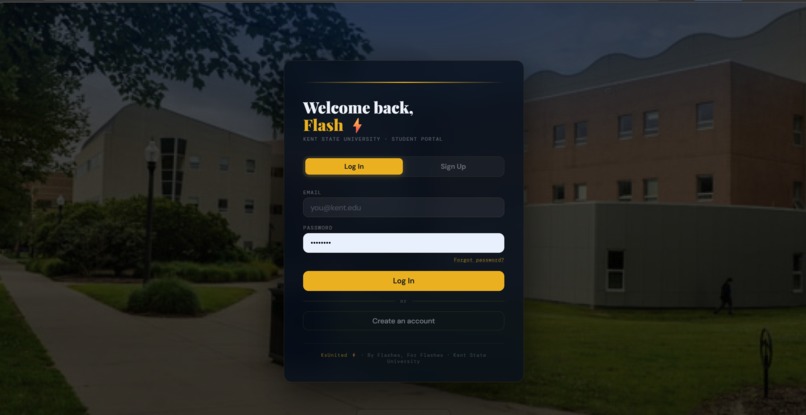
The login page
-
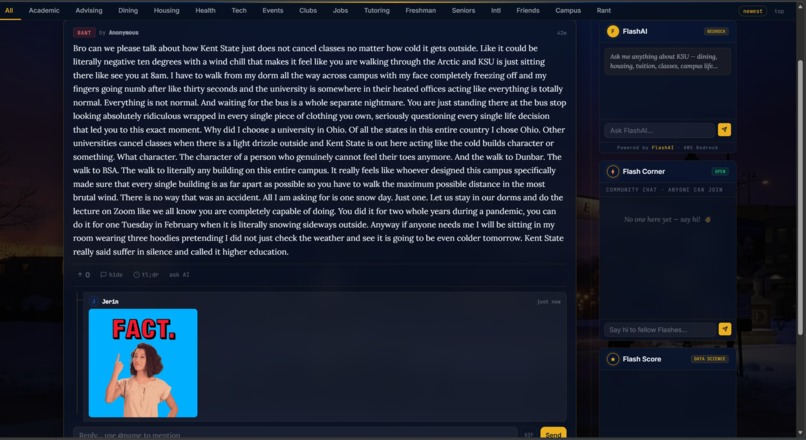
The Home-page
Inspiration
When I first came to Kent State University as an international student in the Computer Science school, I felt the loneliness of not having any friends, not seeing any familiar faces, and not having someone to ask a question as simple as where to go to get a FlashLine issue fixed or who to talk to to get some advice. Everything seemed so overwhelming and unfamiliar. The school was large, the school systems were complicated, and I didn't know a single soul who had gone through it all before me. This is what inspired the idea of creating something like KSU-Connect. We didn't want another international student, or any student in general, to be in their dorm room alone wondering who to ask for help. We wanted to create something that felt like having a friend who already knows the answer.
What it does
KSU-Connect is a community Q&A platform built exclusively for Kent State University students. Students can post questions about anything on campus, from FlashLine issues to housing problems to dining hours, and other students can answer them. The best answers float to the top through upvoting, so the most helpful response is always the first thing you see. We also built FlashAI, an AI powered assistant that gives instant answers to common KSU questions so students do not have to wait for a human response.
How we built it
The entire project was built in 24 hours using the following stack: Backend: Python and Flask for the web server and routing Database: SQLite for storing posts, answers, and user data Frontend: HTML, CSS, and JavaScript with KSU brand colors AI: AWS Bedrock powered by Claude for the FlashAI assistant Authentication: Flask-Login for user sessions
Challenges we ran into
The biggest technical hurdle we overcame was deploying our application on Render. This was because we encountered problems while binding ports and also due to incompatibilities in Python versions while using Flask. This simple task took up a significant portion of our hackathon time. Another major technical hurdle we overcame was related to our database on the live application. SQLite is not compatible with cloud platforms because it cannot write to the read-only file system. This meant that new users were not able to sign up on our live application. This was a major learning experience because we learned that while SQLite is good enough for local development, it is not good enough for production. The other technical issue we overcame was related to working on two laptops. This was not a technical issue we anticipated because we encountered problems while working on two laptops because we were not able to see posts created on one laptop on the other laptop due to inaccessibility of the local database file on the other laptop. As international students who are yet to get accustomed to everything here in the United States, we thought that building a full-stack AI-powered web application was one of the toughest tasks we have undertaken so far. However, it was this discomfort that drove us to complete this project.
Accomplishments that we're proud of
We are genuinely proud that we built something that solves a real problem we personally experienced. This was not a project we made up to win a hackathon. We actually felt lonely and lost as international students in the CSE department and we turned that feeling into something useful for every student at Kent State. We are also proud that we successfully integrated a real AI assistant called FlashAI using AWS Bedrock and got it working in our application within 24 hours despite neither of us having used AWS Bedrock before this hackathon. Building and deploying a complete full stack web application from scratch in one day as a two person team is something we will honestly always be proud of regardless of the results.
What we learned
This hackathon taught us more in 24 hours than weeks of regular coursework. We learned how to build and deploy a full stack web application from scratch, how to integrate a real AI API into a live product, and how to collaborate under serious time pressure using Git and GitHub. We learned that SQLite is not suitable for cloud deployments and that environment variables must be manually added to hosting platforms. We learned that deployment is often harder than writing the actual code.
What's next for KSU-Connect
However, the vision for KSU-Connect goes far beyond this particular hackathon. Here’s what we want to build next: Switching from SQLite to a real cloud-based database like PostgreSQL so that the platform can actually handle real traffic from thousands of KSU students without dying. Adding verified answers from actual KSU faculty, advisors, and staff members so that students can actually trust the information they are getting. Creating a real-time sentiment analysis dashboard that can actually give the university administration a genuine glimpse into the overall campus mood based on the content of the posts. Creating a duplicate question detection mechanism using TF-IDF Vectorization so that students can actually be directed to existing questions before posting a brand new question. Expanding the AI assistant FlashAI with a more robust knowledge base of KSU-specific information like dining hours, office locations, deadlines, and financial aid processes. Ultimately, we want to expand KSU-Connect beyond just Kent State University and make it available for other universities as well, so that every international student who arrives on a brand new campus can have a place to turn on their very first day.

Log in or sign up for Devpost to join the conversation.