Inspiration
The need for precise modeling of soil behavior, especially Ksat (saturated hydraulic conductivity), is critical in environmental and agricultural planning. We were inspired to build a predictive system that can assist researchers and engineers in sustainable water management.
What it does
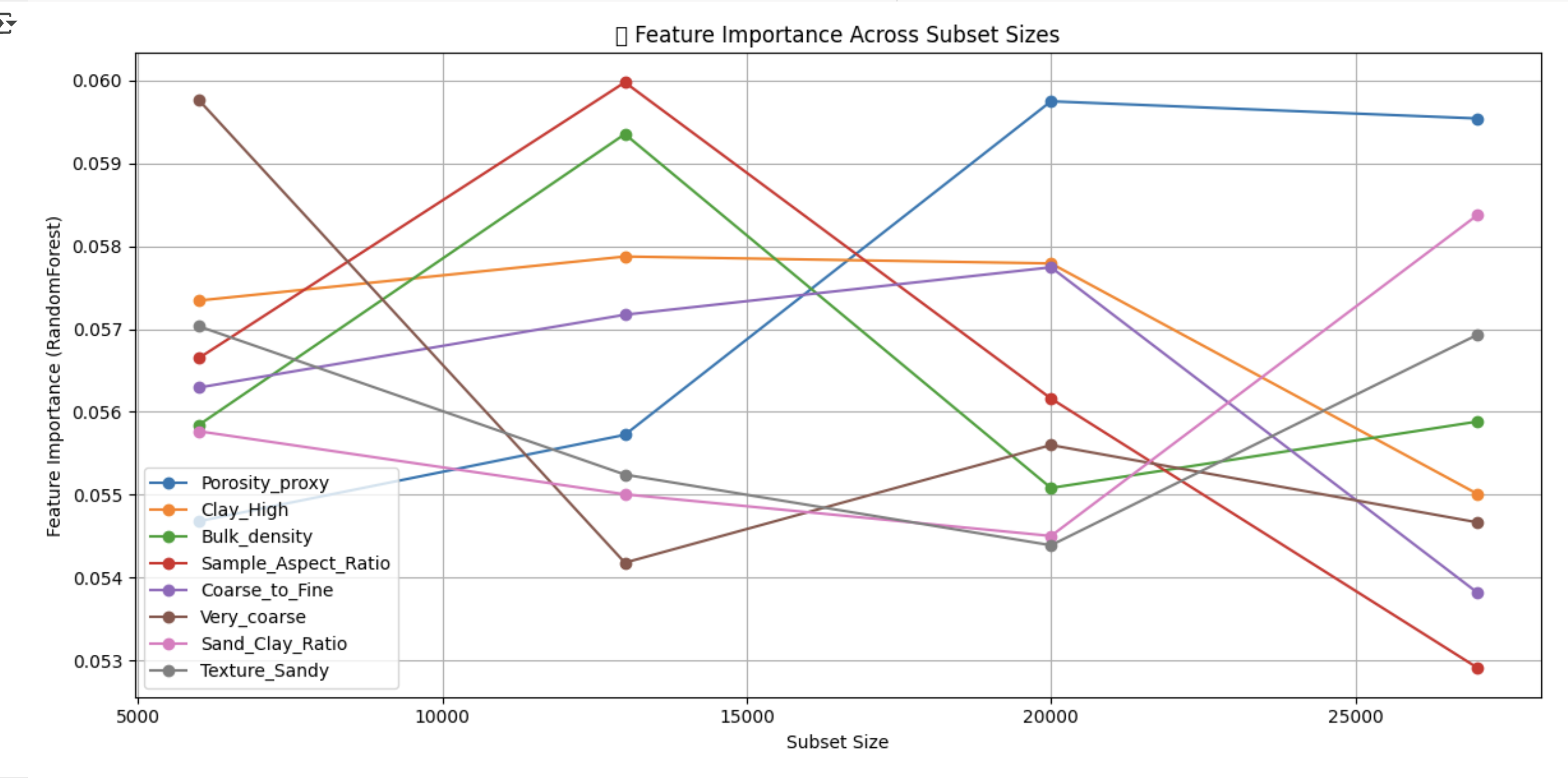
KSAT Quest predicts the saturated hydraulic conductivity of soils using the UKSAT dataset. It evaluates model performance using RMSLE and R², and shows how dataset size affects model accuracy.
How we built it
We followed several steps for building our model such as :
- Cleaned the dataset to remove nulls and outliers
- Performed feature selection to retain only meaningful predictors
- Trained regression models using cross-validation
- Ran subset experiments with decreasing data sizes, repeated 50+ times each
- Evaluated and visualized using RMSLE and R² with Matplotlib and Seaborn
Challenges we ran into
Although we build our model, we faced certain challenges such as: Efficient handling of multiple randomized subset experiments Avoiding overfitting while tuning models for smaller datasets Maintaining reproducibility with a large number of experiment runs
Accomplishments that we're proud of
Built a robust pipeline from cleaning to evaluation Gained actionable insights on how data size impacts model performance Visualized error metrics that clearly reflect model behavior trends
What we learned
Throughout our project, we took several learning from our model such as: Subset experiments provide better generalization checks RMSLE is more effective than RMSE when dealing with wide-value ranges Automating repeated trials enhances consistency in ML evaluation
What's next for KSAT Quest: Regression Runoff
Extend the model to real-time Ksat predictions via an API Compare performance with deep learning models Integrate geospatial visualization for field-level hydrological insights
Built With
- github
- matplotlib
- pandas
- python
- scikit-learn
- seaborn


Log in or sign up for Devpost to join the conversation.