

Inspiration
We saw that in BI Analytics many people are very interested in learning and applying sophisticated analytical techniques in their work. However, many analysts lack the engineering and advanced statistical training that would enable them to do more complex work independently. Few analysts find ways to partner with data scientists, however, there are many more people who could significantly enhance their performance if they had more access to the tools that are easy to use and the results that are easy to interpret.
What it does
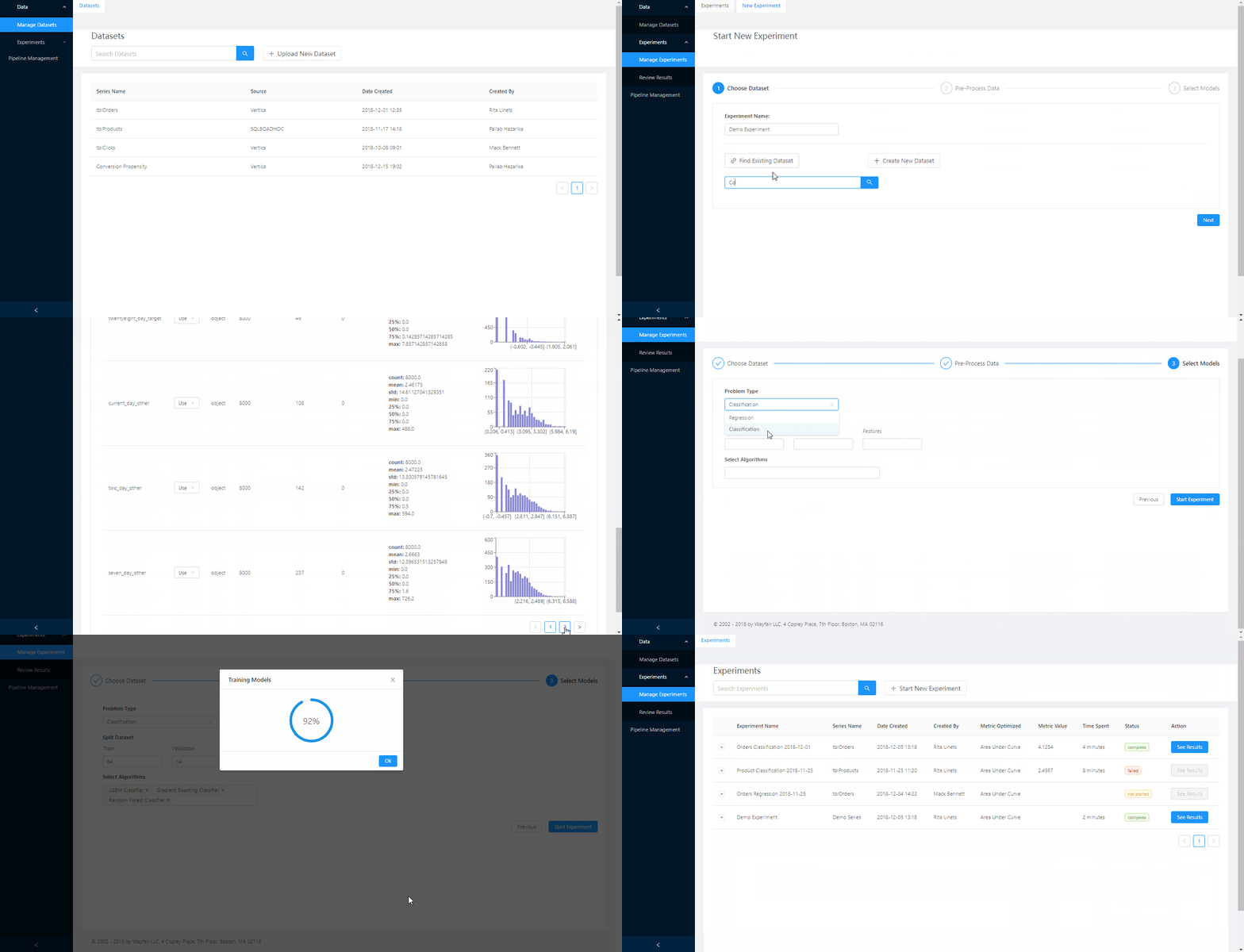
Kronos Diagnose represents a user friendly tool that allows anyone with a data set to unlock insights through the power of Statistics and Machine Learning. The idea is to provide step-by-step guidance with the help of experienced data scientists and equip junior analysts with greater understanding of more sophisticated modeling techniques. The tool itself will provide an easy to use graphic user interface that will significantly reduce the learning curve required to apply machine learning on a day-to-day basis.
How we built it
The analytical engine behind Kronos Diagnose is Python's AutoML package. The package has a set of great advantages such as (1) generating predictions in the 1 millisecond time range for a single prediction, (2) applying deep learning for automated feature learning as well as (3) selecting the best algorithm for generating predictions. The front-end of the project is build in React and the back-end uses Flask/Python.
We focused on delivering the simplest possible end-to-end experience from the moment you know what data set you want to use to the moment when you review the outcomes and select the best model for deployment. We used a conversion propensity data set and tried to predict whether a customer would convert given their browsing history. This was a classification problem and we applied autoML's feature learning option to build out features and then we ran those features through the following three algorithms: LGMB Classifier, Gradient Boosting Classifier and Random Forest Classifier.
Challenges we ran into
We ran into a set of challenges where it wasn't immediately obvious how to extract certain information from atuoML's functions. Also, many parts of the output was harder to interpret than we expected.
Accomplishments that we're proud of
We are happy that we were able to demonstrate a simple and complete end-to-end experience using a real data set.
What we learned
Overall, this has been a great experience for all of us. We learned to design, execute and deliver a project. Despite running into a set of unexpected problems and having to find on-the-spot solutions, we were able to meet all of the goals we set for ourselves on the challenge day.
What's next for Kronos Diagnose
The next step would be to do more robust POC detailing all the features that are integral for an MVP. This would require consulting with data scientists and expected end-users to determine immediate needs and making sure we can effectively communicate complex back-end processes through easy and intuitive front-end design.


Log in or sign up for Devpost to join the conversation.