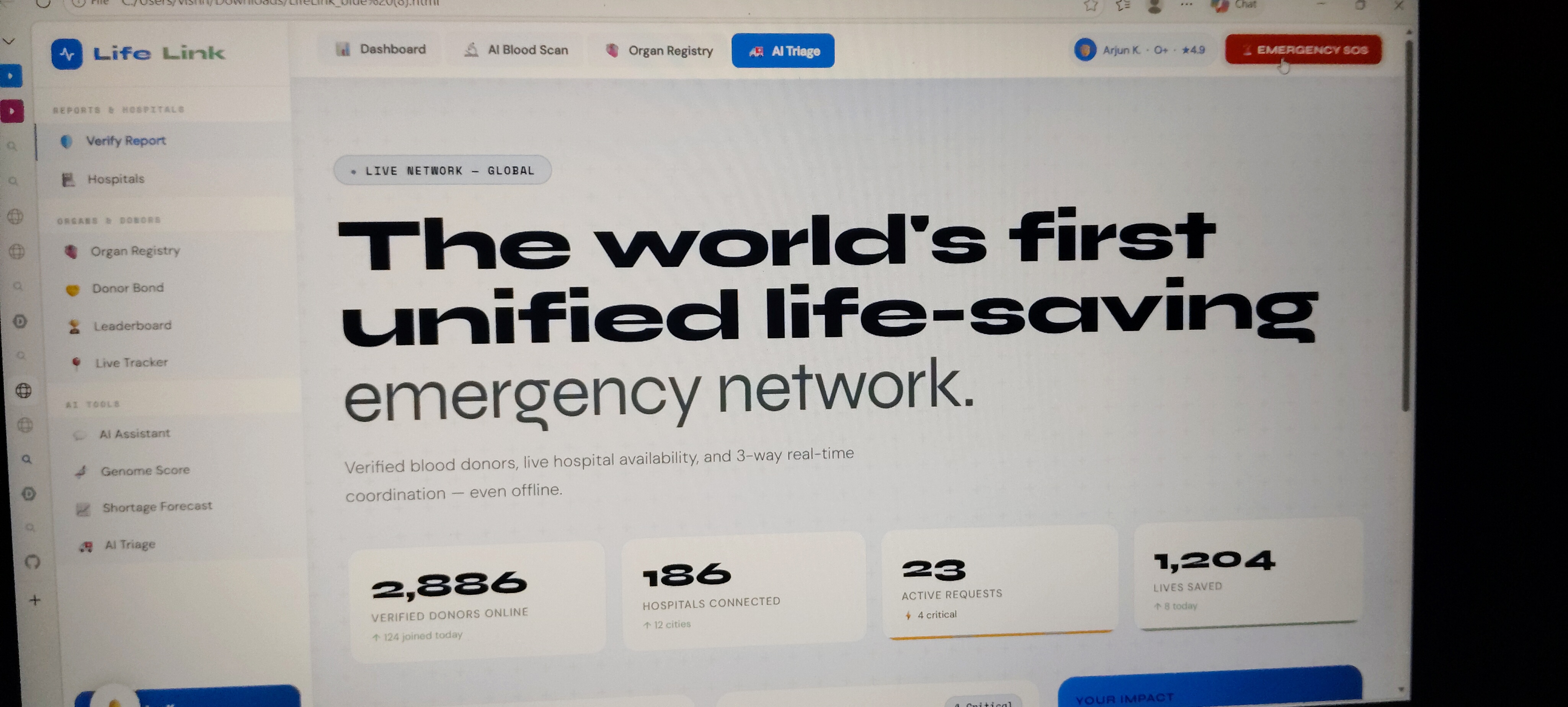
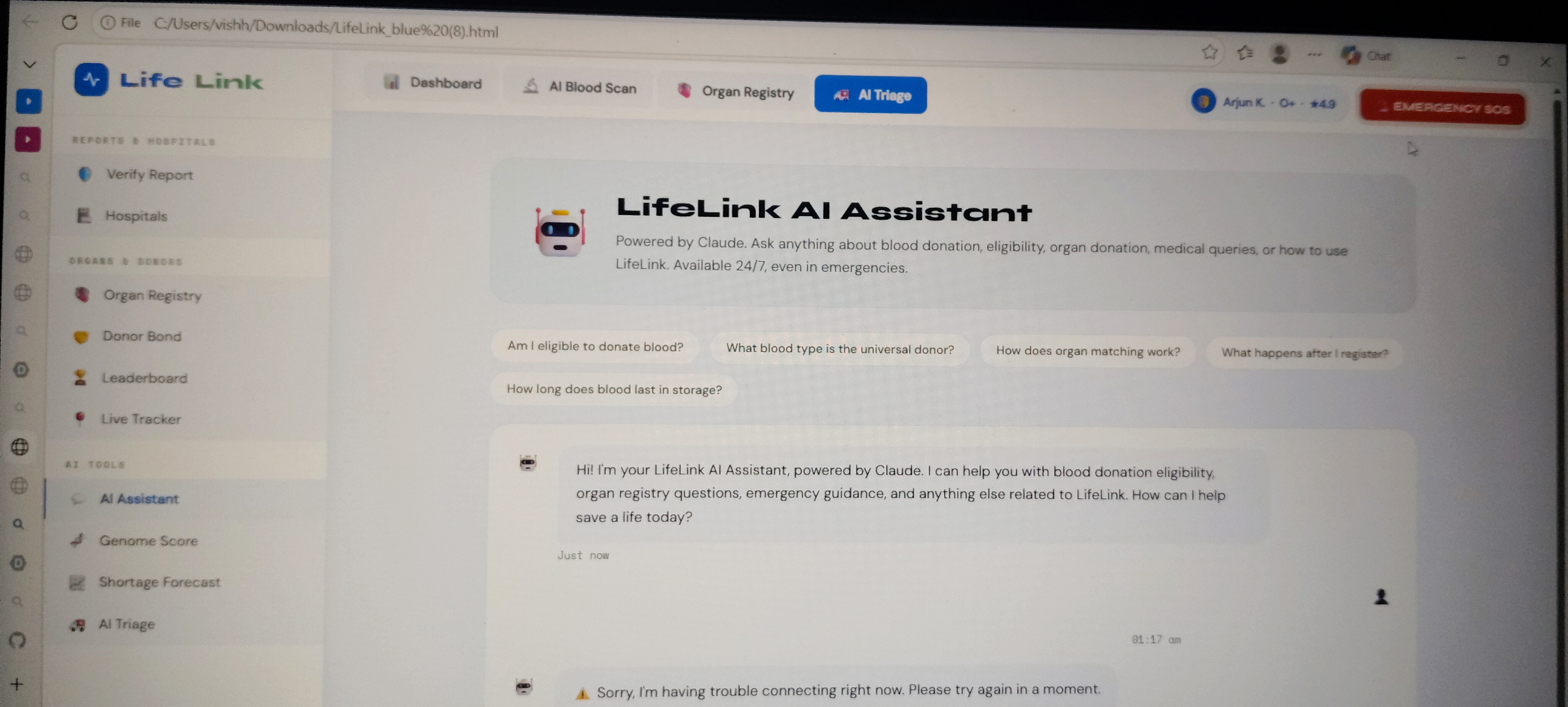
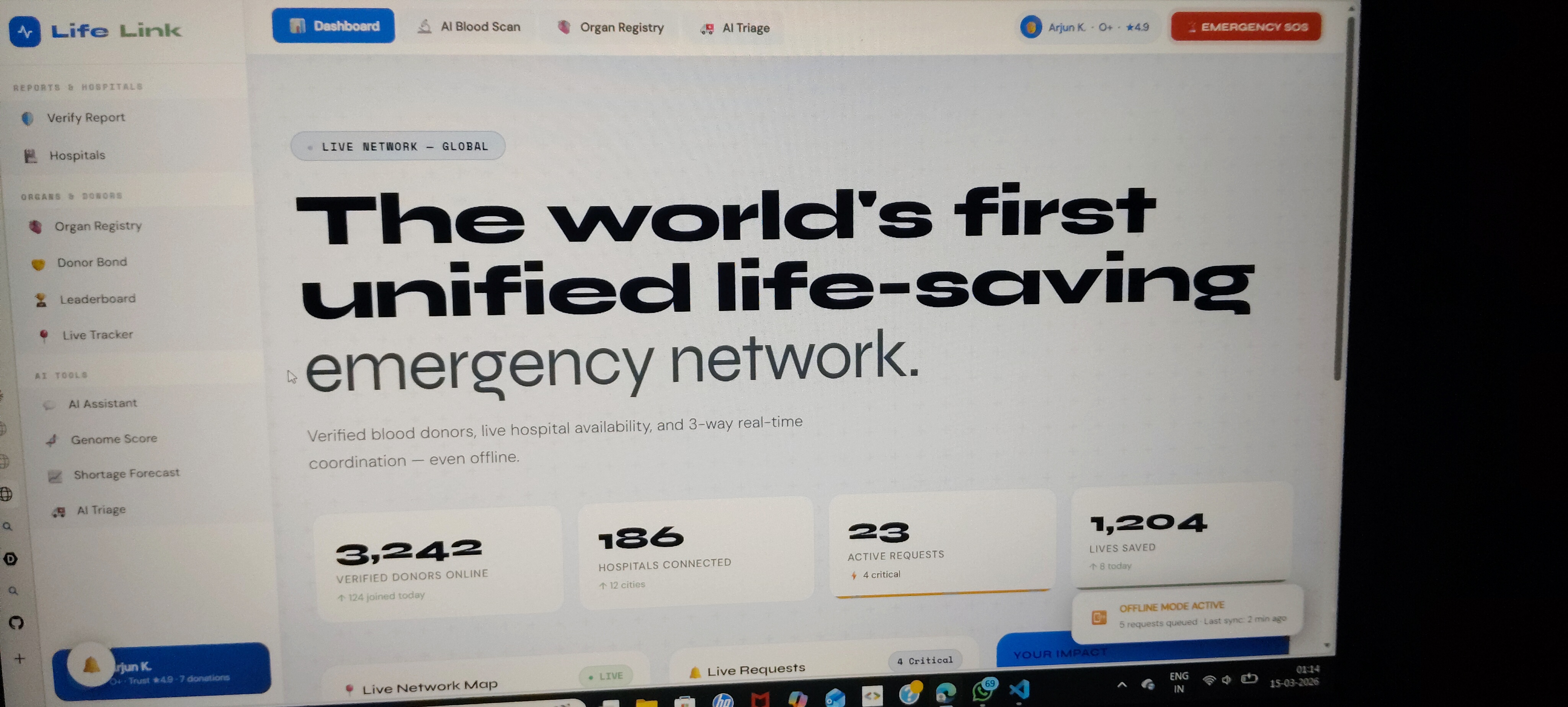
LifeLink — Emergency Health Network
Inspiration
Every 4 seconds, someone in India needs blood. Every hour, a patient dies waiting for an organ match. We observed fragmented, paper-based systems fail during emergencies—delays in coordination directly cost lives.
The relationship is:
[ \text{Survival Rate} \propto \frac{1}{\Delta t_{\text{response}}} ]
Where ( \Delta t_{\text{response}} ) is the time between emergency onset and treatment. LifeLink is designed to minimize this delay using AI and real-time systems.
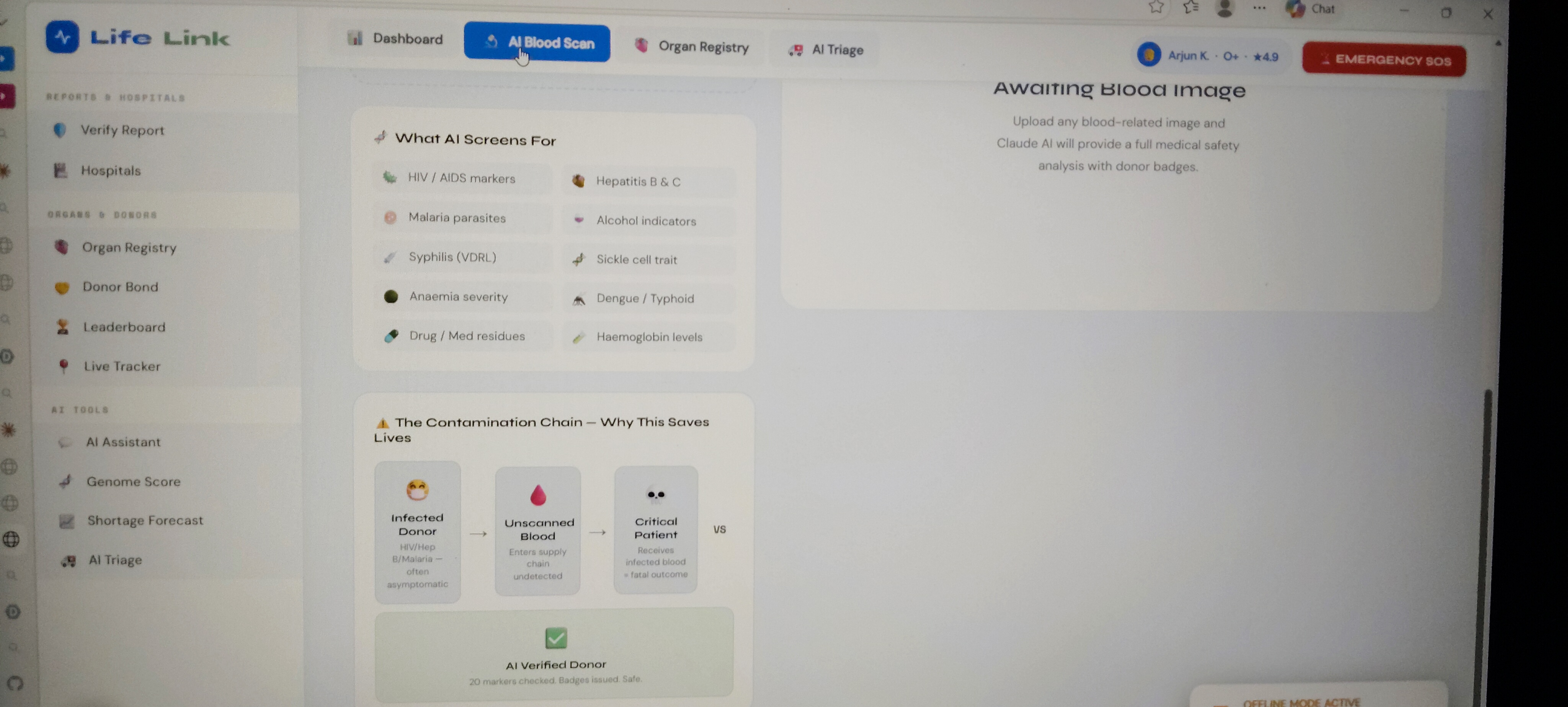
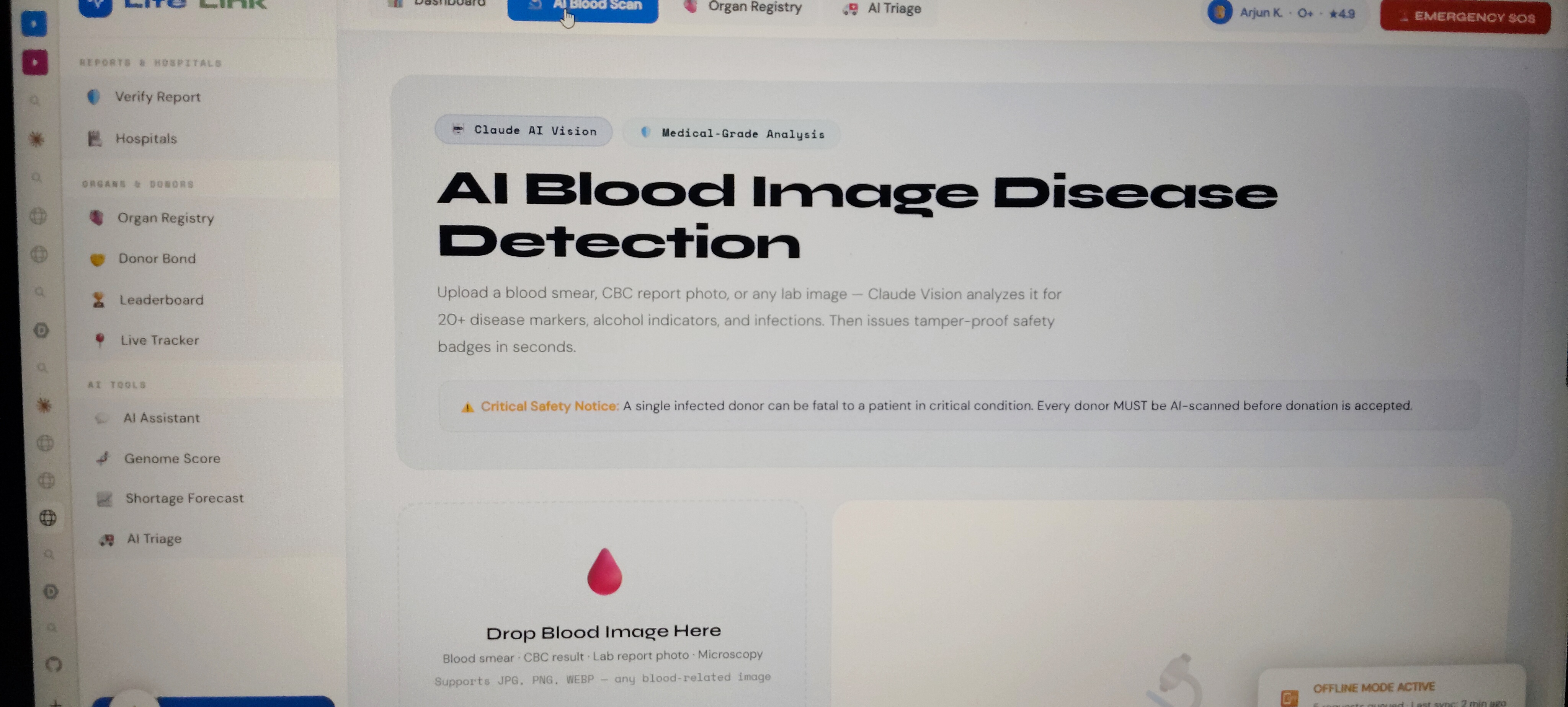
Imagine a person is in critical condition and needs a O- blood the blood donor accepted to donate the blood but what if he is affected with disease knowingly or unknowingly, At this point of time you don't have time to search for a new donor because the person is in emergency case , because of this small mistakes it leads to the lose of their lives ,Here our solution plays a major role it detects the diseases by scanning the blood using ai and doctors after they verified the verified badge will be added to the donor, the details of the donor and reciever are kept private and confidentially
The math was brutal:
Where is the time between emergency onset and blood delivery. LifeLink exists to make that denominator as small as possible.
What It Does
LifeLink is a unified AI-powered emergency health network combining:
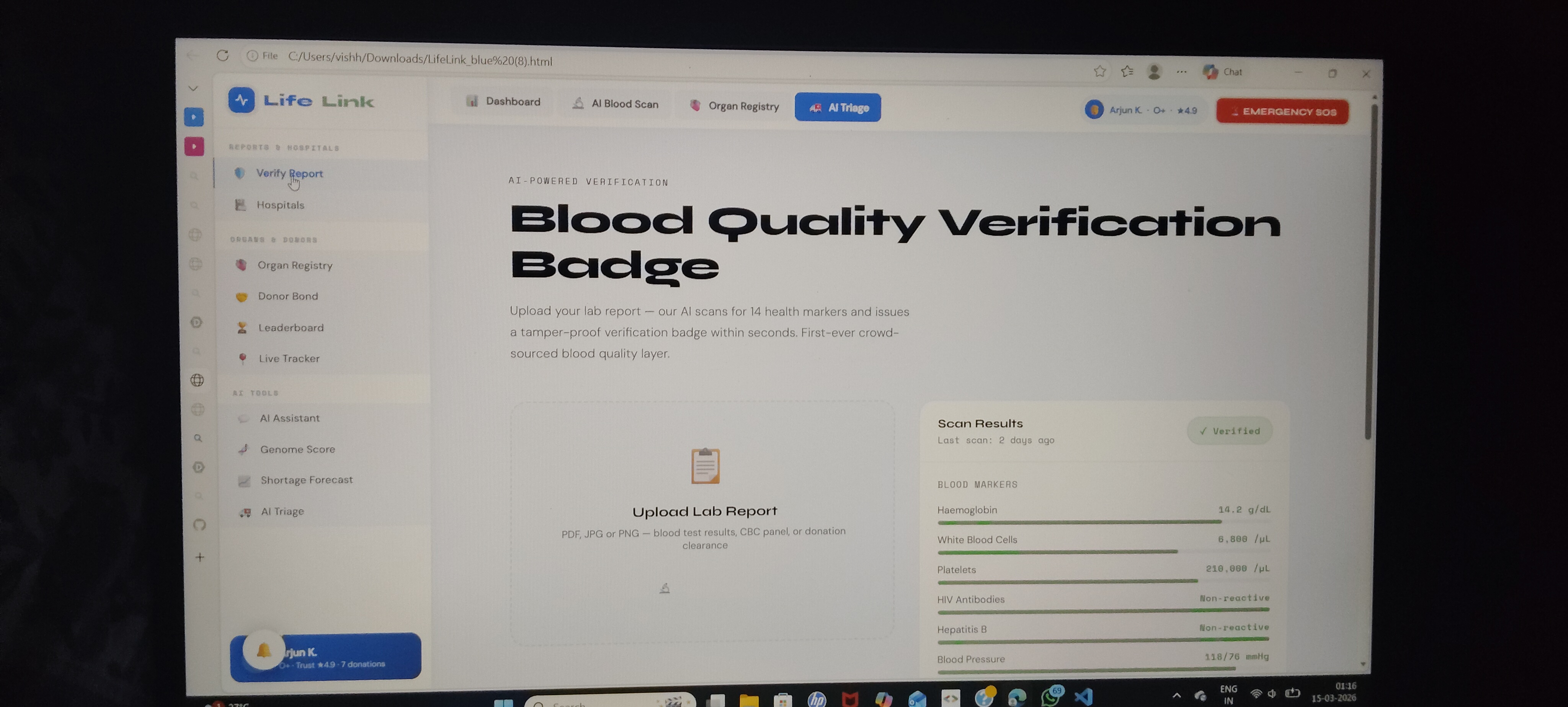
- AI Blood Scan — analyzes lab reports using computer vision and generates verified safety badges
- Pre-Verified Donor System — donors are screened in advance for disease risk and eligibility by doctors and ai
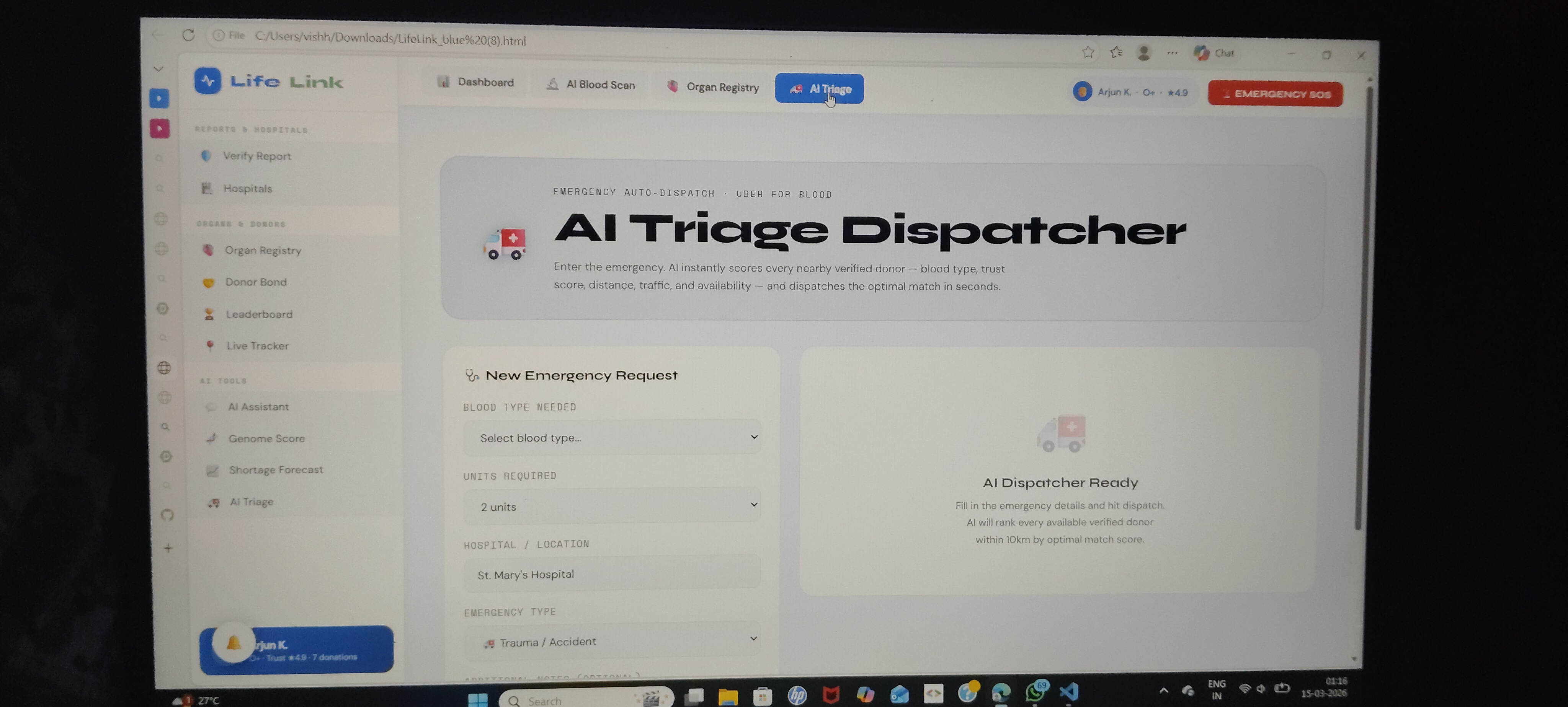
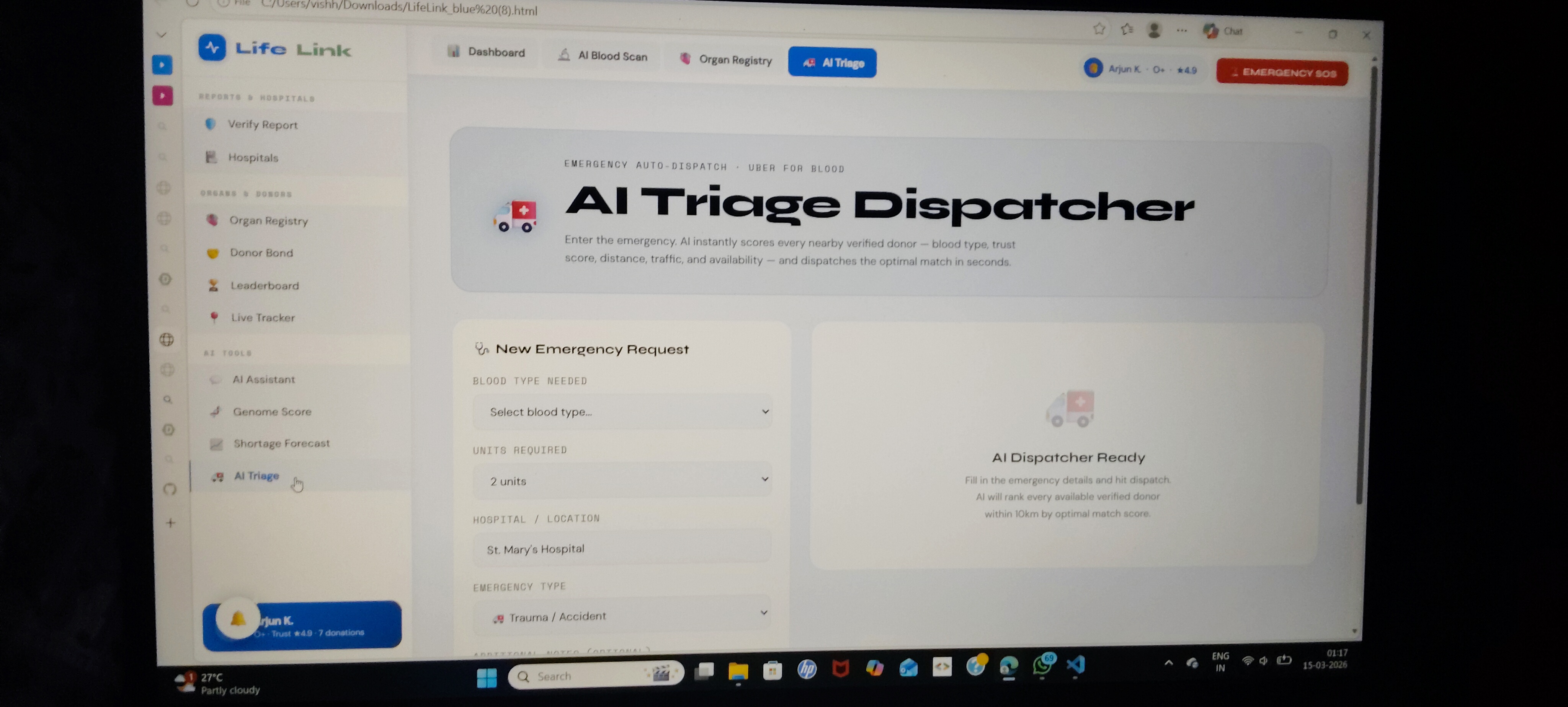
- AI Triage Dispatcher — ranks donors by compatibility, distance, trust score, and availability
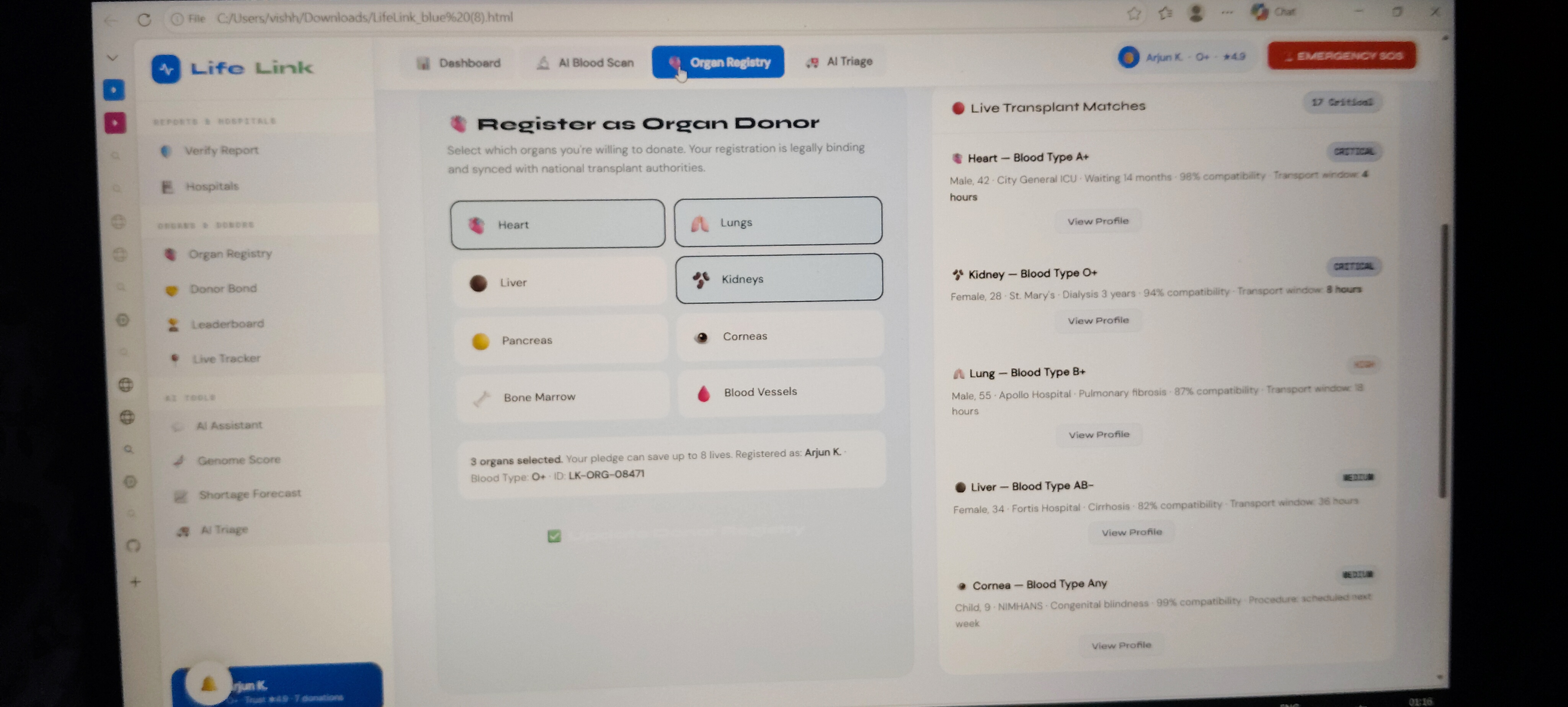
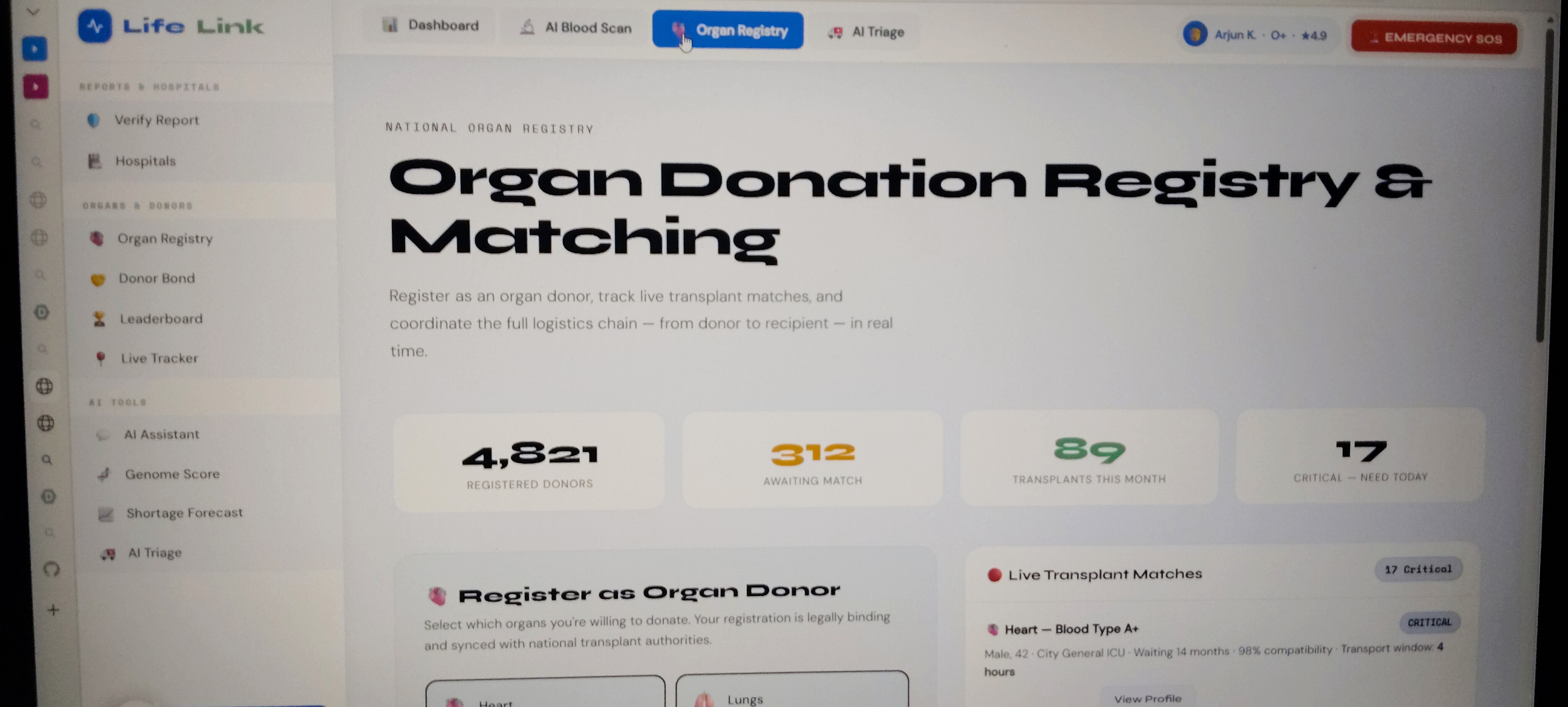
- Organ Registry — real-time transplant matching with compatibility scoring
- Predictive Shortage Forecasting — forecasts blood demand and shortages ahead of time
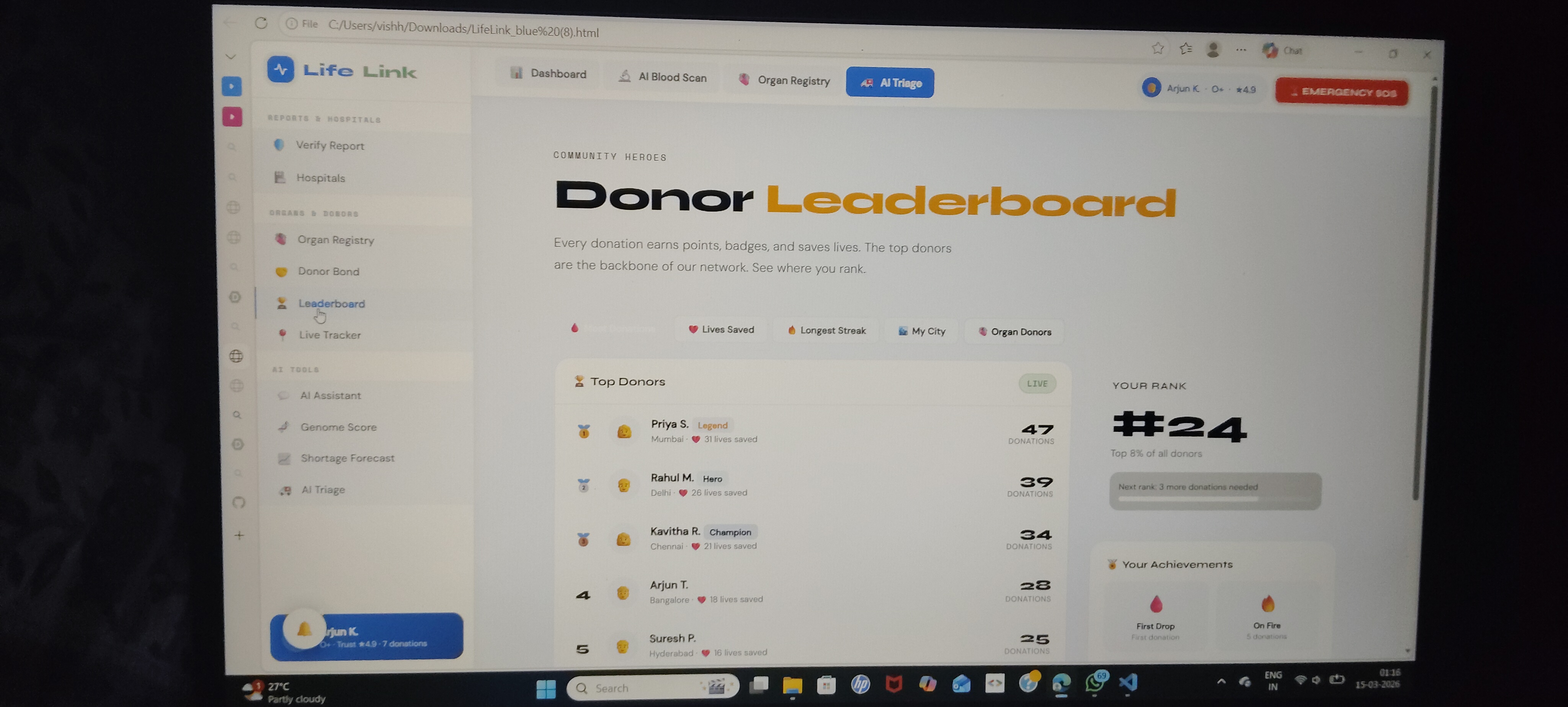
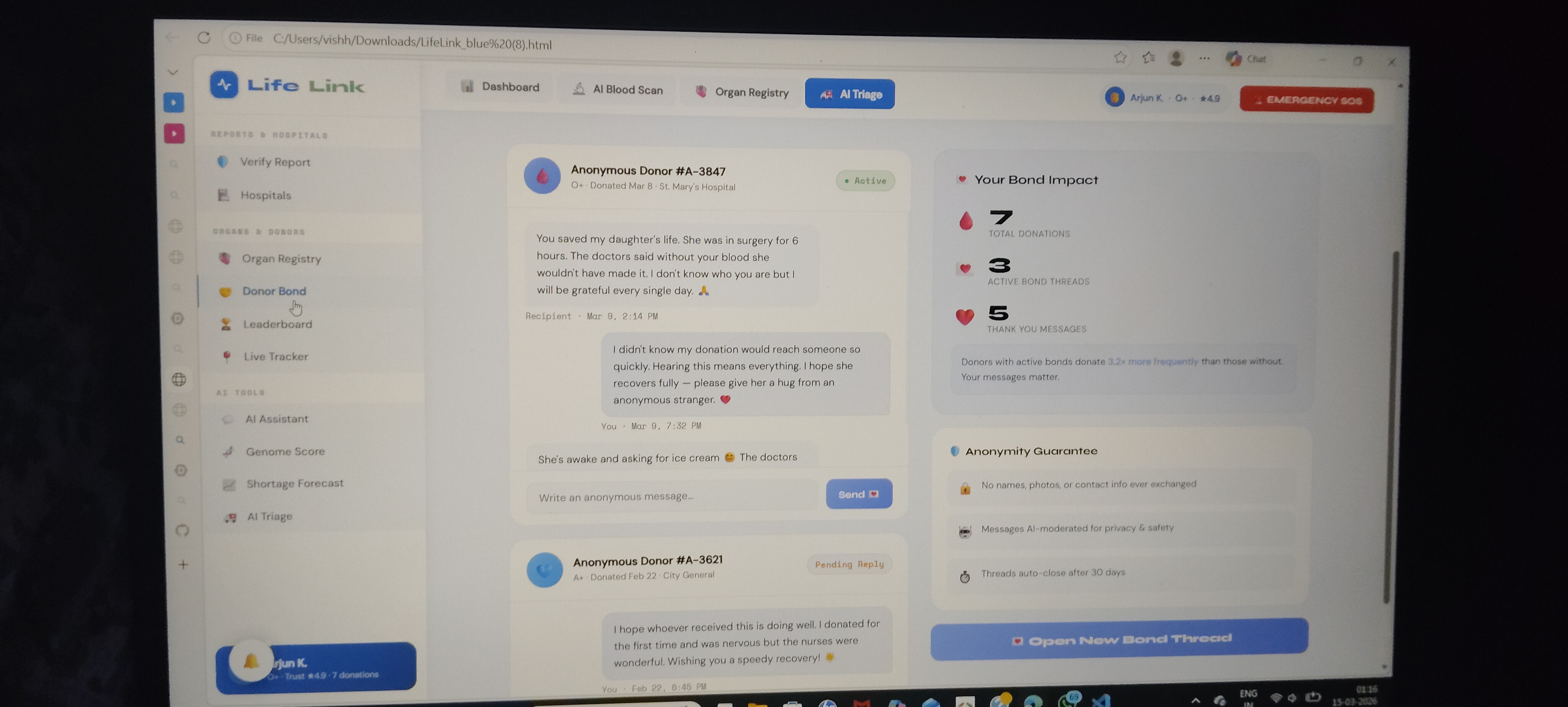
- Donor–Patient Anonymous Bond — improves retention and repeat donations
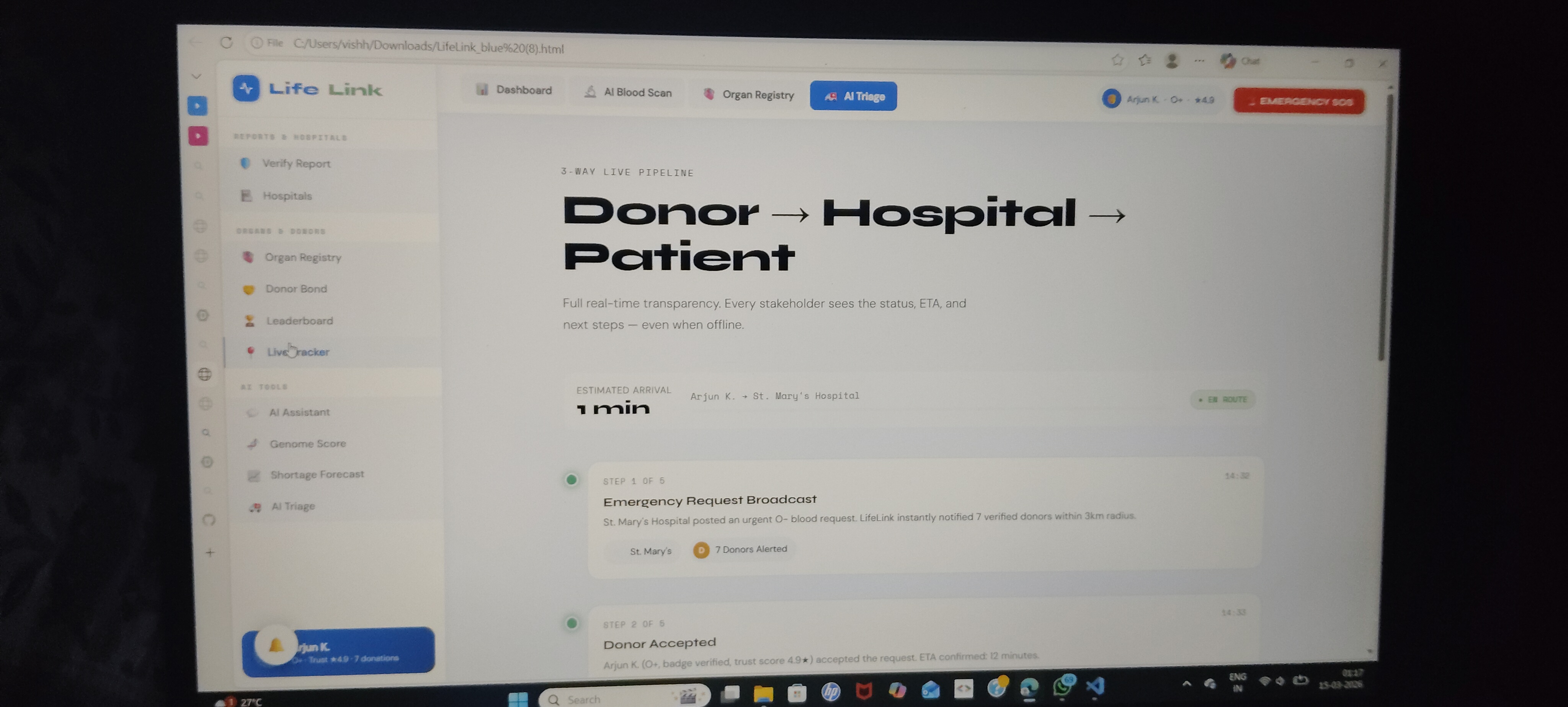
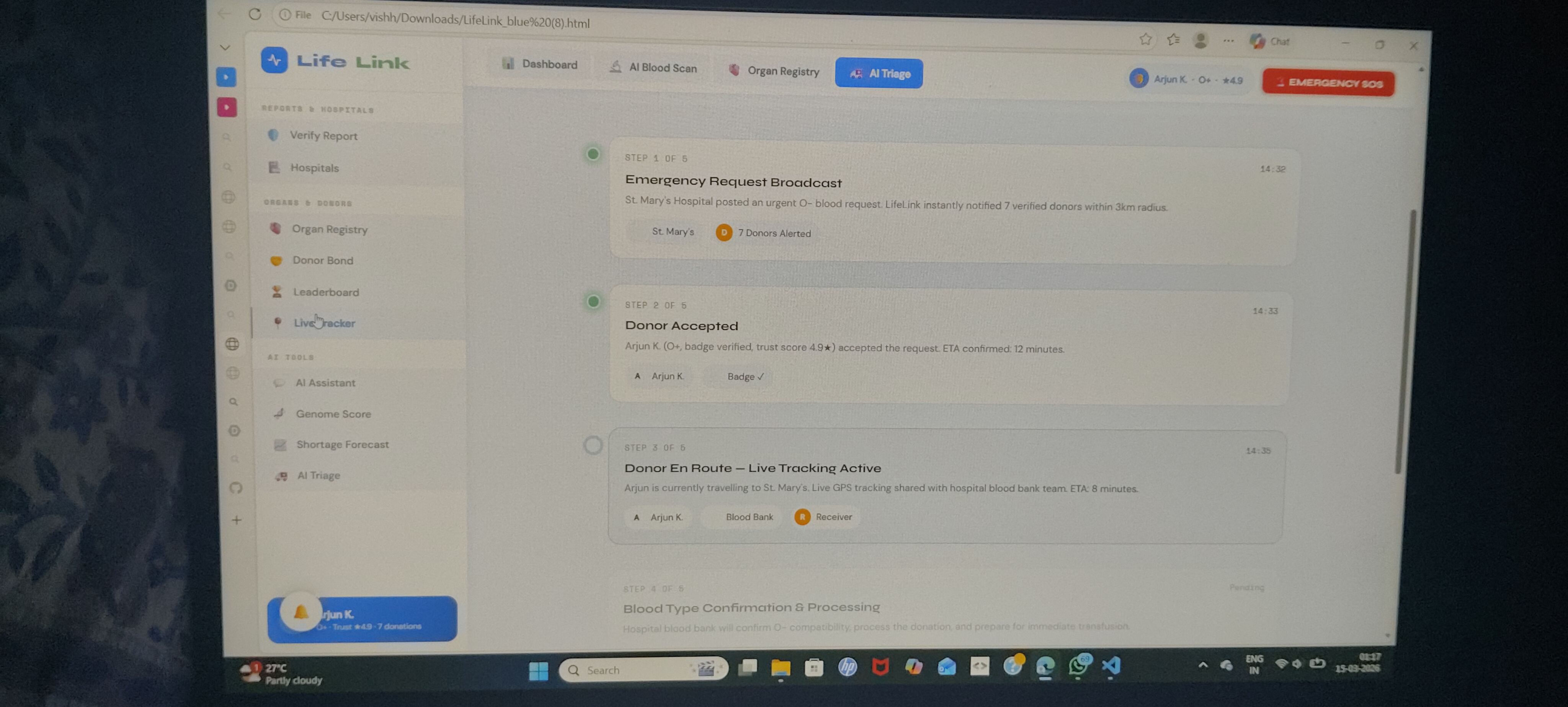
- Real-time 3-way pipeline — Donor ↔ Hospital ↔ Receiver with live tracking
- Offline Emergency Mode — supports low-connectivity regions using sync and fallback mechanisms
The matching system is defined as:
[ \text{Match Score} = w_1 \cdot C_{\text{blood}} + w_2 \cdot \frac{1}{d} + w_3 \cdot T_{\text{trust}} + w_4 \cdot A_{\text{available}} ]
How We Built It
Frontend — HTML/CSS/JavaScript modular dashboard with role-based navigation
Backend — Node.js + Express + MongoDB
Real-Time Communication — Socket.IO
io.on('connection', (socket) => {
  socket.on('emergency_broadcast', ({ city, alert }) => {
    io.to(city).emit('new_alert', alert);
  });

  socket.on('donor_location', ({ userId, lat, lng }) => {
    socket.broadcast.emit('donor_moved', { userId, lat, lng });
  });
});

AI Blood Scan

const prompt = `Respond ONLY with JSON:
{
  "overall_verdict": "SAFE_TO_DONATE" | "CAUTION_REQUIRED" | "DO_NOT_DONATE",
  "confidence": 0-100,
  "badges": [],
  "findings": [],
  "safe_for_emergency": true | false
}`;

Predictive Forecasting

S(t) = S_0 e^{-\lambda t} + \int_0^t D(\tau)d\tau - \int_0^t U(\tau)d\tau

Geospatial Query

User.find({
  location: {
    $near: {
      $geometry: {
        type: 'Point',
        coordinates: [lng, lat]
      },
      $maxDistance: 10000
    }
  },
  bloodType: { $in: [requestedType, 'O-'] },
  isAvailable: true
});
---

## AI Models Used in LifeLink

| Feature | Model Type | Capability Used |
|---------|-----------|----------------|
| AI Blood Scan | **Multimodal Vision Model** | Image analysis, medical report reading, JSON-structured safety output |
| Genome Score | **Large Language Model** | Genetic trait interpretation, donor risk profile generation |
| AI Triage Dispatcher | **Large Language Model** | Donor ranking, emergency dispatch logic, natural language reasoning |
| AI Assistant | **Conversational LLM** | Health Q&A, donation eligibility, real-time chat |
| Organ Registry Chat | **Conversational LLM** | Organ donation guidance, eligibility screening |
| Shortage Forecast | **Large Language Model** | Narrative generation, shortage risk commentary |
| Blood Scan Report Share | **Large Language Model** | Medical report summarization, structured data extraction |

---

## Model Provider

| Provider | API |
|----------|-----|
| **Anthropic** | `/v1/messages` endpoint |

---

## API Call Pattern

```javascript
const response = await fetch('https://api.anthropic.com/v1/messages', {
  method: 'POST',
  headers: { 'Content-Type': 'application/json' },
  body: JSON.stringify({
    model: '[model name]',
    max_tokens: 1000,
    messages: [{ role: 'user', content: prompt }]
  })
});
Key Model Capabilities Leveraged
- Vision — reading blood smear images, CBC reports, lab result photos
- Structured output — strict JSON responses for safety-critical medical data
- Reasoning — multi-factor donor matching and triage prioritization
- Conversation — multi-turn health guidance with context retention
- Document understanding — genetic report parsing from raw text or image Challenges We Ran Into
AI reliability — Ensured consistent structured outputs using strict JSON prompts
Geo queries — Corrected coordinate ordering for accurate matching
Scalability — Designed modular navigation for multiple features
System consistency — Unified real-time and AI pipelines
Accomplishments That We're Proud Of
Built a unified AI-powered blood and organ network
Implemented pre-verified donor infrastructure
Achieved real-time emergency dispatch
Developed predictive shortage intelligence
Created a scalable multi-role healthcare system
What We Learned
Response time is the most critical factor in emergency healthcare
Pre-verification reduces delays significantly
AI combined with real-time systems creates high-impact solutions
User engagement improves long-term system effectiveness
What's Next for LifeLink
Milestone
Mobile app
Hospital integration
National registry
Offline support
AI assistant
Target :
Built With
- api
- html
- javascript
- mongodb
- node.js
- script.js

Log in or sign up for Devpost to join the conversation.