-
-
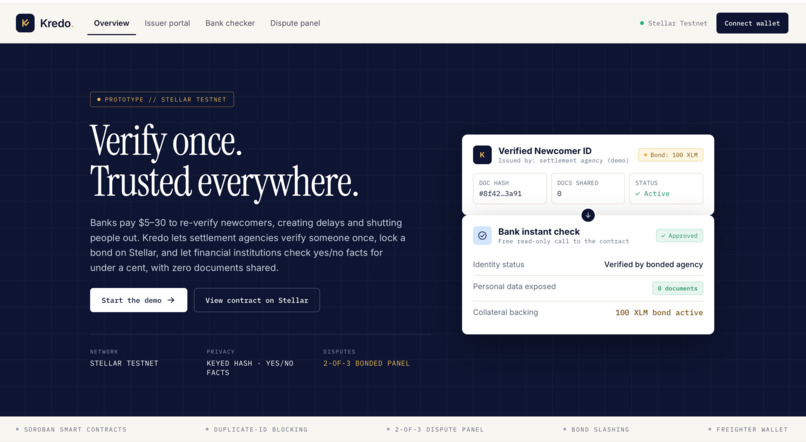
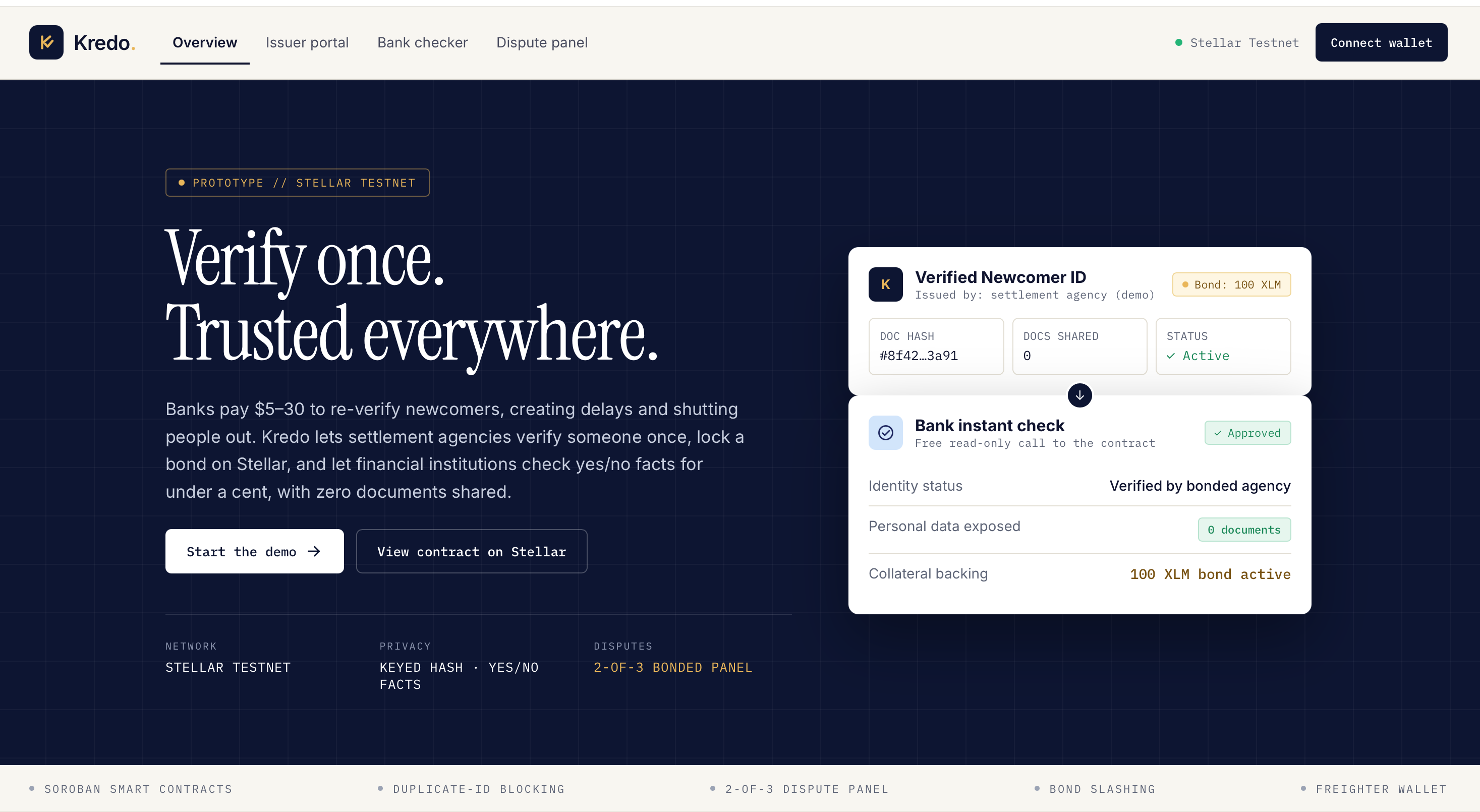
Kredo overview: verify once, back it with a bond on Stellar, and let any bank check yes/no facts for under a cent.
-
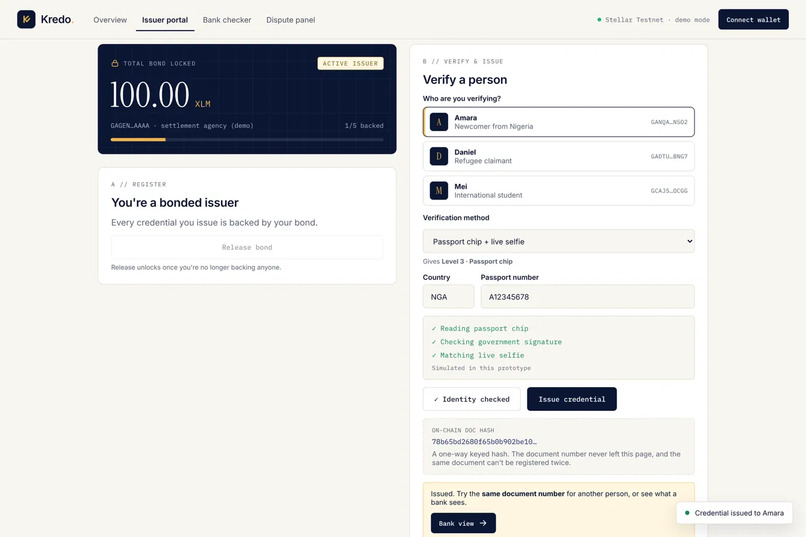
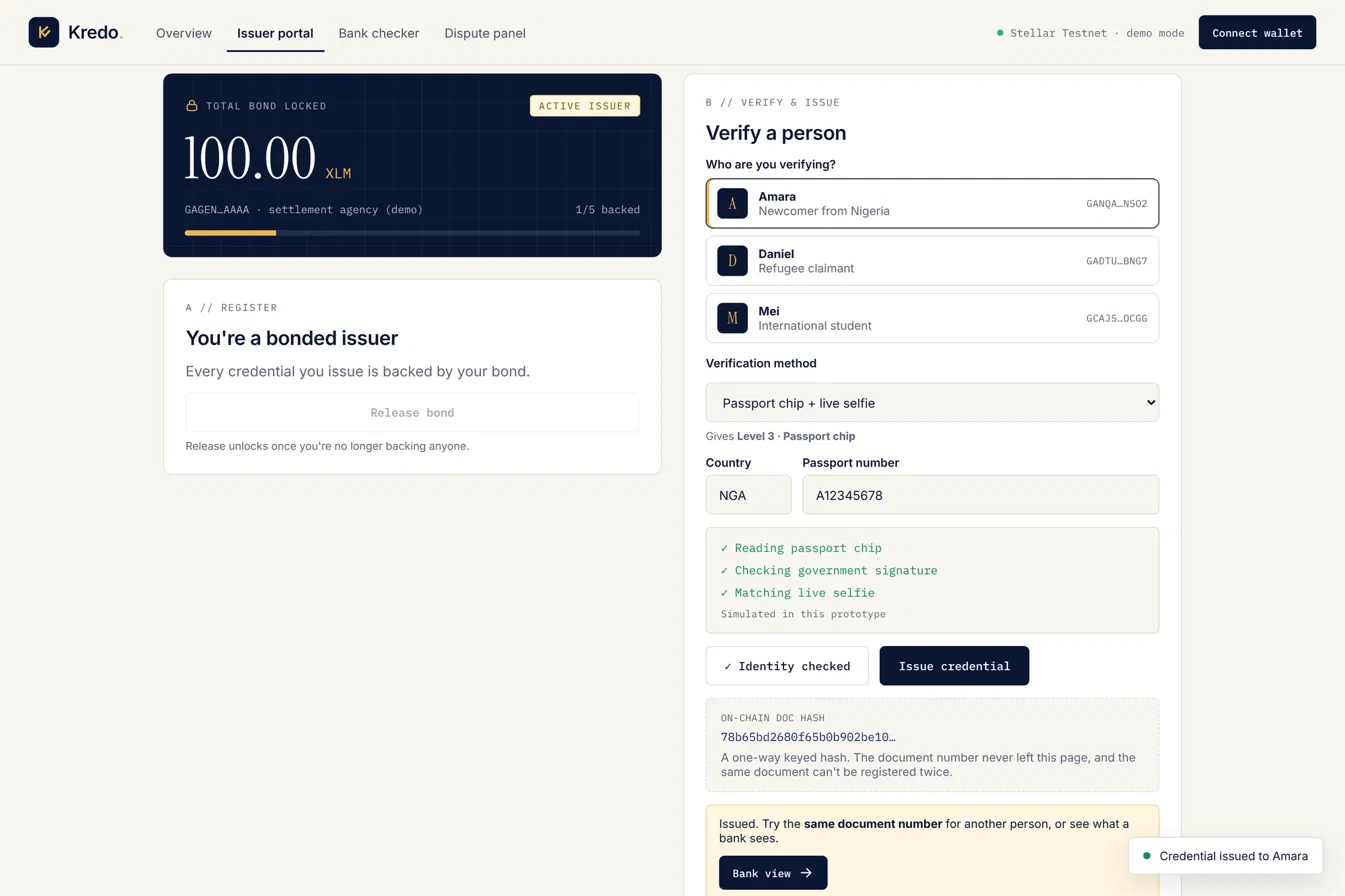
A settlement agency locks a 100 XLM bond, checks a person’s identity, and issues a reusable credential on Stellar.
-
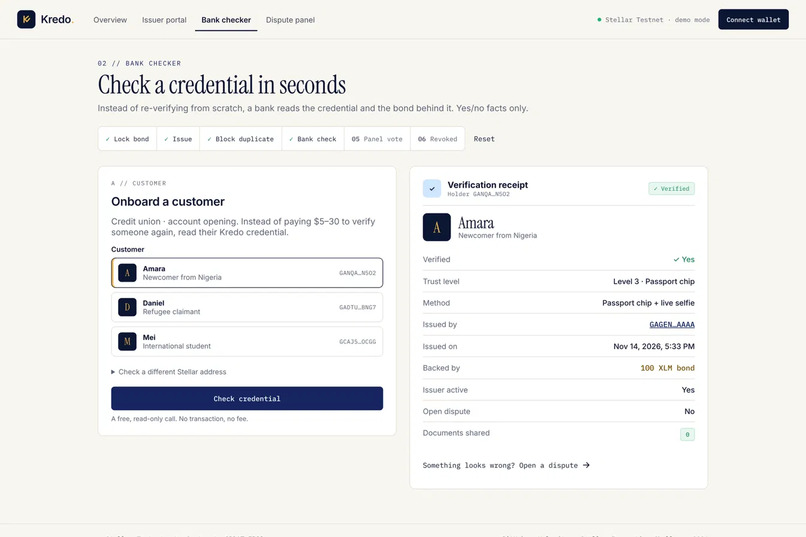
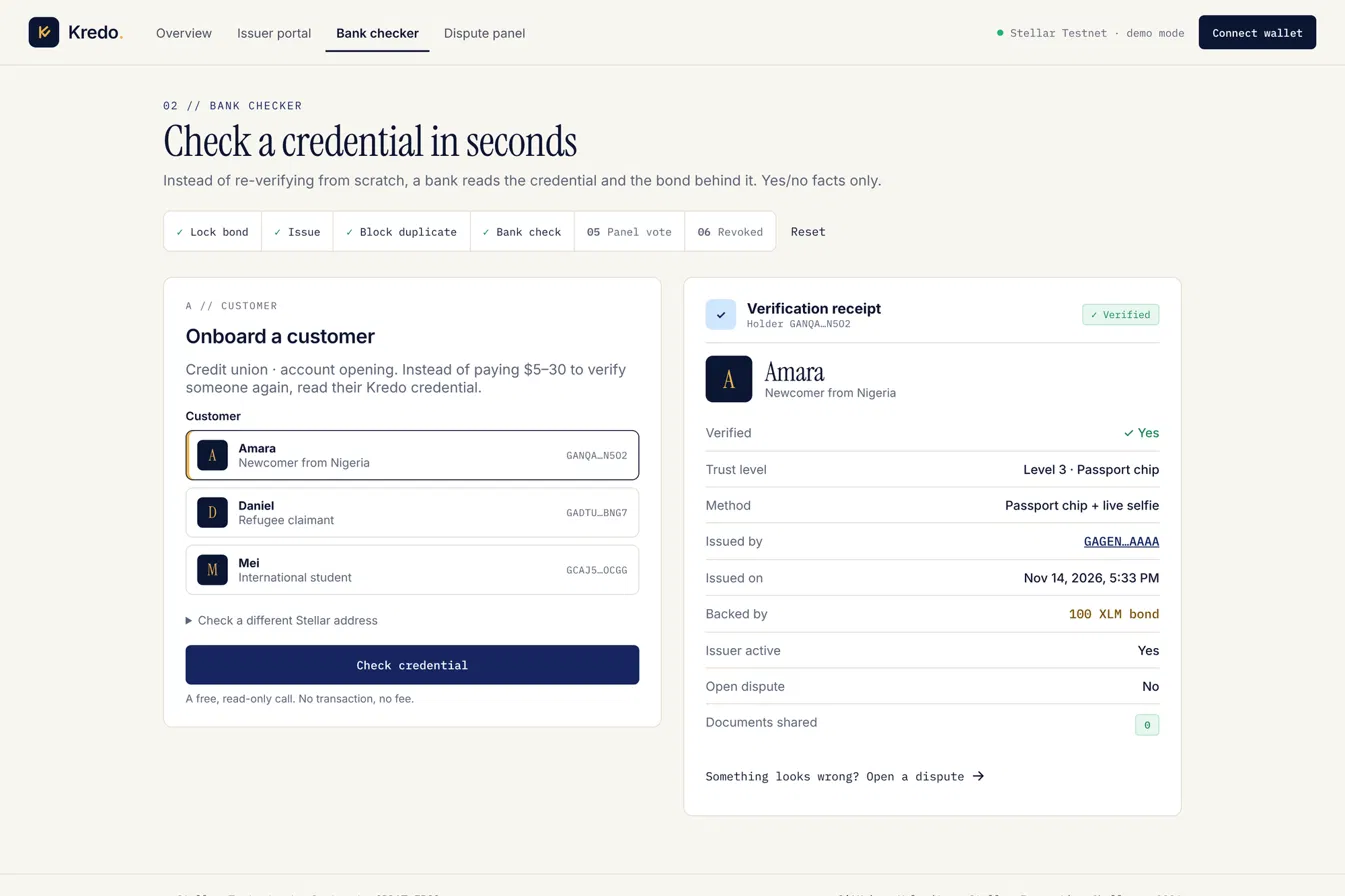
The bank’s verification receipt: trust level, method, issuer and bond, with zero documents shared.
-
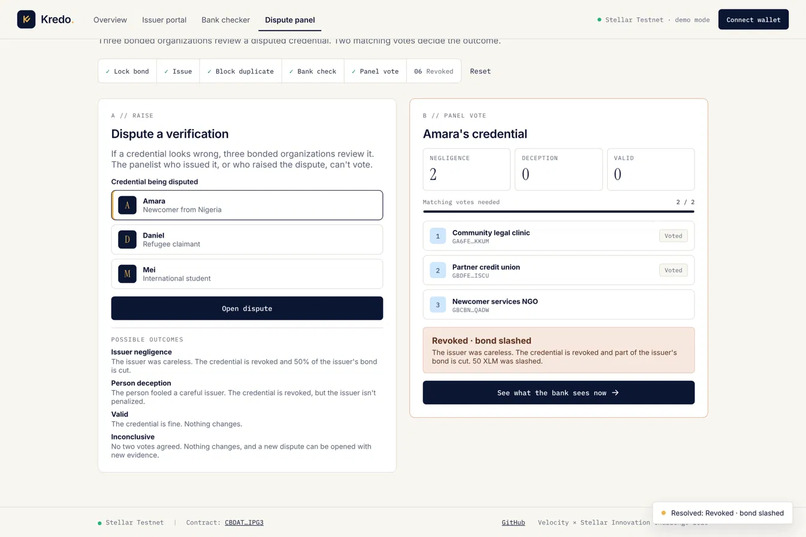
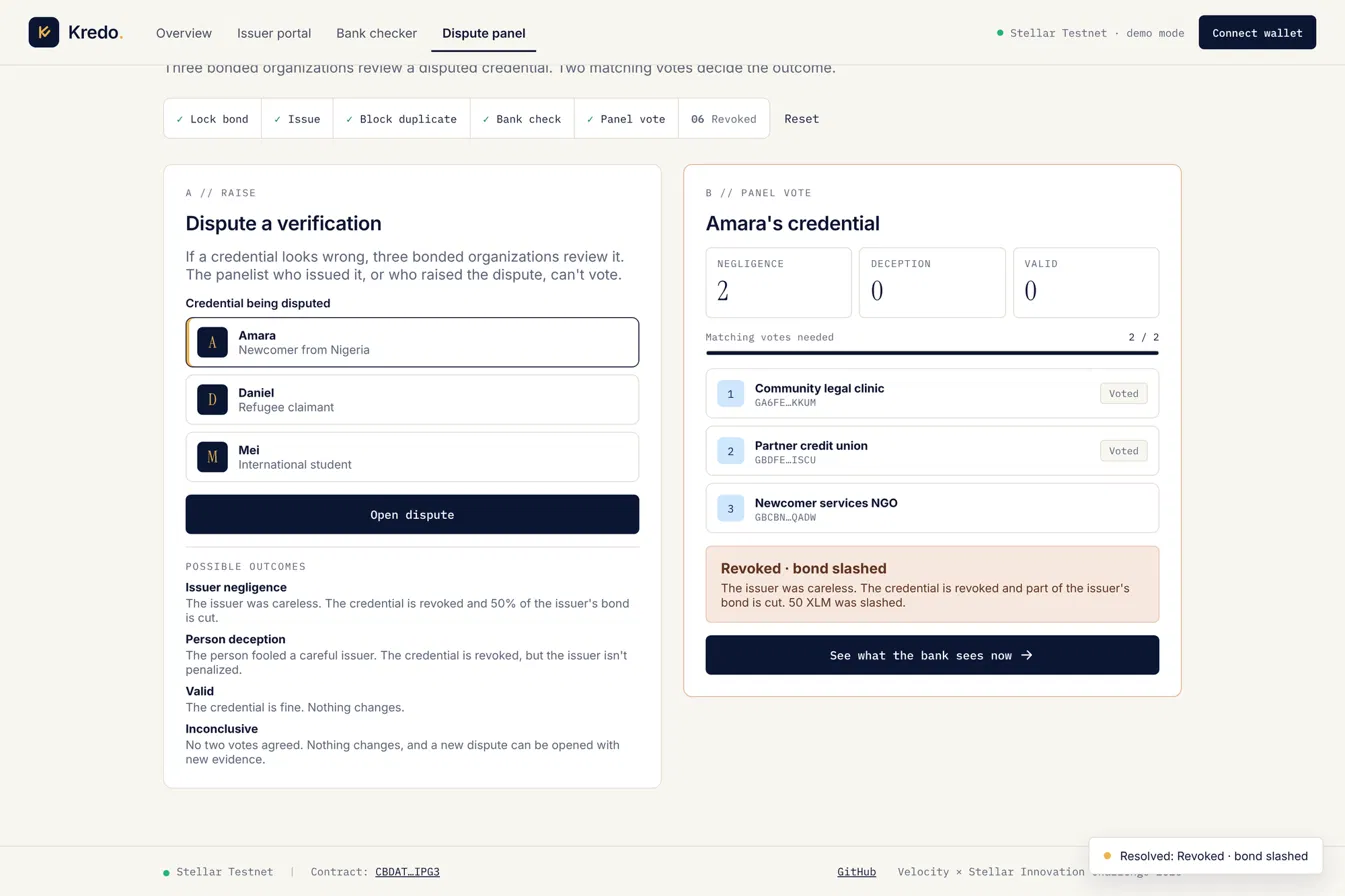
A 2-of-3 bonded panel votes. Issuer negligence revokes the credential and slashes 50% of the bond.
Inspiration
Roughly 1.3 billion adults worldwide are still unbanked, and more than half are women. Banks aren't ignoring them; the problem is cost. Verifying a single customer costs $5–30, every institution repeats that work from scratch, and none of them trust a verification they didn't do themselves. Newcomers and refugees feel this most: they get verified by one bank, then again by a remittance app, then again by a lender, and are often rejected by rules built for people with long credit histories and familiar documents.
Some of us moved to Canada ourselves and know how hard it is to build a financial identity from zero. We kept coming back to one question from the challenge: why should an institution trust someone else's verification? Our answer: make the verifier put real money behind it.
What it does
Kredo is reusable, bonded identity on Stellar. Verify once, trusted everywhere.
- Lock a bond. A trusted organization, like a settlement agency, registers as an issuer by locking an XLM bond in a Soroban smart contract.
- Verify once. The organization checks a person's identity using one of three methods: passport chip + live selfie, an in-person document check, or vouching for people with no to minimal documents. It then issues a credential with a trust level.
- No duplicates, no documents on-chain. The prototype uses HMAC-SHA256 to generate cryptographic identifiers from synthetic document numbers. The contract rejects repeated identifiers without storing original document numbers. For production, this process would require secure server-side key management and additional privacy safeguards.
- Banks check it instantly. Any bank reads a verification receipt with a free, read-only contract call: verified or not, trust level, method, who issued it and when, how much bond backs it, and whether a dispute is open. It sees yes/no facts only, never documents.
- Accountability is built in. If a credential looks fraudulent, a panel of three bonded organizations votes. Two matching votes decide the outcome:
- Issuer negligence: the credential is revoked and 50% of the issuer's bond is slashed
- Person deception: revoked, but the careful issuer isn't penalized
- Valid: nothing changes
- Split vote: inconclusive, and the credential can be disputed again
Panelists who issued the credential or opened the dispute can't vote.
The result: Kredo aims to reduce repeated identity-verification costs while giving institutions greater confidence in the organizations issuing credentials.
Business model: Kredo is B2B. We plan to charge banks, credit unions, fintechs and anchors subscriptions and usage-based fees for managed verification services. We also propose revenue-sharing incentives for issuers, while keeping the service free for individuals.
How we built it
- Smart contract: Rust + Soroban, deployed on Stellar Testnet. It manages issuer registration and bond deposits (using the native XLM asset contract), credential issuance with duplicate checks and vouching limits, read-only verification, a dispute and voting system with conflict-of-interest rules, bond slashing and bond release. It has a full test suite, and we ran the entire demo flow on testnet with real transactions.
- Frontend: React + TypeScript (Vite) with three screens: Issuer portal, Bank checker and Dispute panel. It connects to the contract with the Stellar SDK and signs transactions with the Freighter wallet. The document hash is computed with the browser's Web Crypto API so the document number never leaves the page.
- End-to-end testing: We tested the complete application flow with Freighter on Stellar Testnet, with stellar.expert links to inspect submitted transactions.
- Why Stellar: near-free, instant reads mean a bank can check every customer, not just high-value ones. Bonds are native XLM held and slashed by contract rules, not by a company. Stellar's anchors and SEPs give a direct path into the network's existing financial institutions.
- Team workflow: we wrote a shared "contract menu" (
CONTRACT.md) on day one, listing every function, input, output and error, so the contract pair and app pair could build in parallel. - Hosting: Vercel.
Contract (Testnet): CBYTIURKLFULMQVYT37NCAU3F7PJ6NM6RCUDS3LMXWDLTQTLM3TKS6BU
Challenges we ran into
- Separating fraud from negligence. Our first version had a simple fake/real vote, which would punish an issuer even when a person deliberately fooled them. We redesigned disputes around three outcomes so only careless issuers lose their bond.
- Keeping disputes fair. We had to stop issuers from voting on their own credentials, and make sure a dispute could always reach a 2-vote majority. That led to the conflict-of-interest and "not enough reviewers" rules, plus an inconclusive outcome so no one is stuck under review forever.
- Closing loopholes. A review of our own contract found that a slashed issuer could keep issuing credentials. We added a minimum-bond check and a top-up function, then redeployed.
- Privacy vs. duplicates. We needed to block the same ID from being used twice without ever storing ID numbers. A keyed hash solved both.
- Real Canadian rules. KYC isn't optional, so we studied FINTRAC's verification methods and designed Kredo around them, including its existing "reliance" method, where one institution relies on another's verification.
- The cold-start problem. A credential is only valuable once institutions accept it. Rewarding issuers each time their verification is reused gives the first organizations a reason to join.
Accomplishments that we're proud of
- A working contract on Stellar Testnet with the full flow running on-chain: bond locked → credential issued → duplicate rejected → bank verifies → dispute → bond slashed → credential revoked.
- A dispute system that answers the hardest question in the problem space: who is accountable when a verification is wrong?
- A product that hides the blockchain entirely. Users see names, receipts and plain-language outcomes, not addresses and transactions.
- Going from idea to a deployed contract and live app in under two weeks.
What we learned
- How Soroban smart contracts, Stellar assets and wallet signing fit together, and how to split work between on-chain logic and the app.
- That identity is as much a trust and incentive problem as a technical one: the hard part isn't checking an ID, it's getting other institutions to rely on that check.
- How real KYC rules (FINTRAC) shape what a responsible product can and can't do.
Privacy and compliance
The prototype uses synthetic IDs only. No documents, names or biometrics ever go on-chain. Institutions still run their own sanctions screening and monitoring, and a bond alone doesn't make an issuer legally trustworthy. Full records stay with the issuer and are shared only when legally required.
What's next for Kredo
- Real passport chip reading and selfie matching (simulated in this prototype)
- Passkey fingerprint wallets and a PIN card for people without a phone
- Limits that grow with a person's clean transaction history, until they no longer need a voucher
- Bond rewards when a voucher's bond is released
- Zero-knowledge proofs so people can prove facts like "over 18" without the issuer revealing anything
- Pilot: start with newcomers and refugees served by settlement agencies and credit unions in the Waterloo Region
Built With
- css
- freighter
- github
- html
- javascript
- powershell
- react
- rust
- soroban
- stellar
- stellar-sdk
- typescript
- vercel
- vite
- web-crypto


