Inspiration
Finding an opportunity is not the same as knowing it is still real, current, or worth the cost of acting on it. For many job seekers and gig workers, the first costs arrive before any income does: mobile data, airtime, printing, application time, and transport.
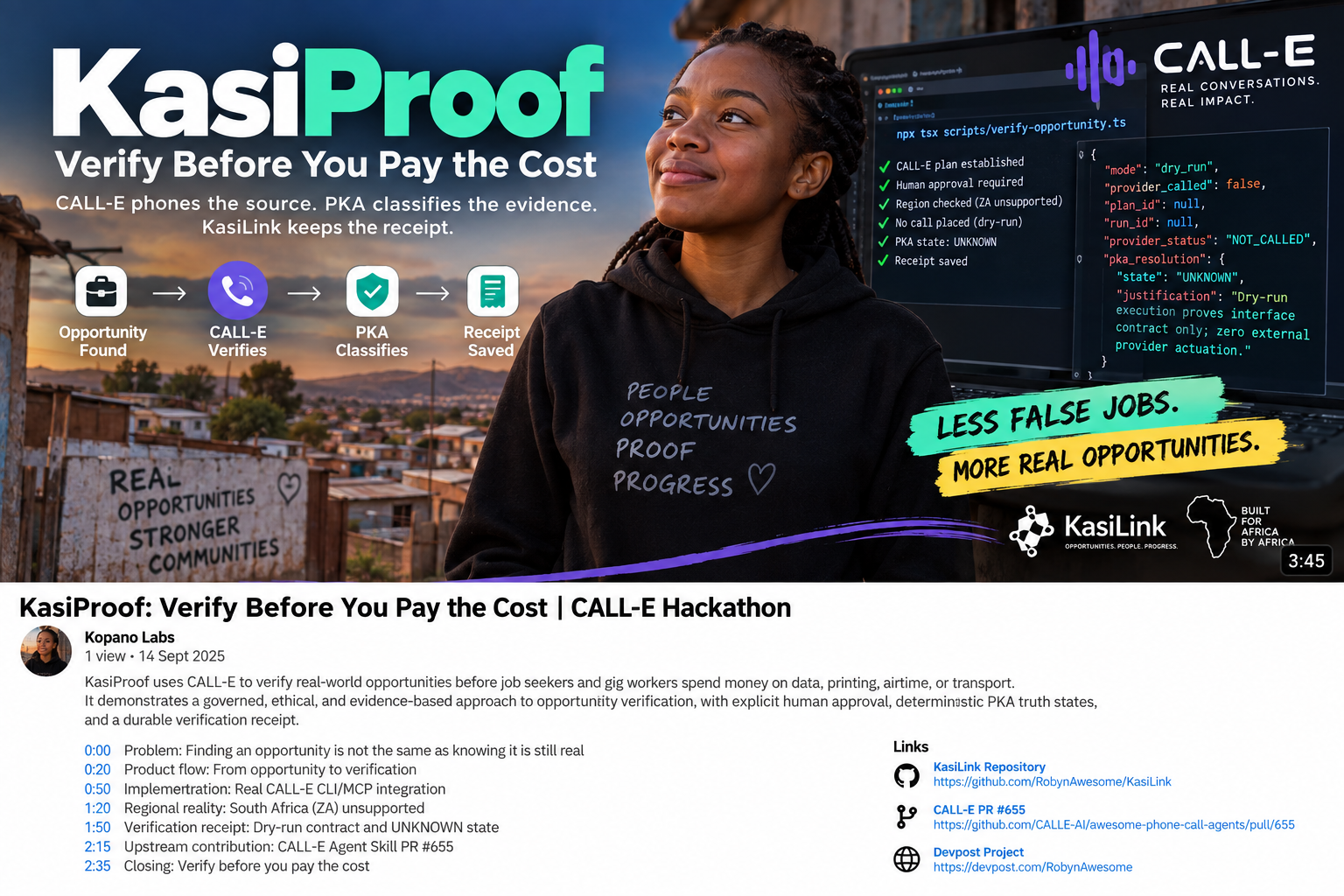
KasiProof extends KasiLink with one bounded question: can we verify the opportunity before a person pays that cost?
What it does
KasiProof turns an opportunity listing into a governed phone-verification workflow:
- Show a no-call preview with the opportunity, masked destination, bounded goal, and questions.
- Ask CALL-E to create a call plan.
- Require explicit human approval before any outbound actuation.
- Execute the approved CALL-E call through the official CALL-E CLI/MCP path.
- Poll the provider for terminal status, transcript, summary, and structured evidence.
- Reconcile the returned evidence using a deterministic Partial Knowable Algebra (PKA) state:
KNOWN,PARTIAL,UNKNOWN, orCONFLICTING. - Save a durable verification receipt with provider identifiers and an evidence hash.
A completed phone call is treated as evidence, not truth. KasiProof deliberately separates provider execution from downstream truth classification.
Region-aware truth boundary
During testing, the live CALL-E service reported South Africa (ZA, +27) as unsupported for outbound calls. KasiProof preserves that runtime boundary rather than pretending a call succeeded. An unsupported destination produces a provider-capability result while the opportunity itself remains UNKNOWN because no verification evidence was gathered.
This distinction matters: "the provider cannot verify this" is not the same claim as "the opportunity is false."
How we built it
KasiProof is implemented in the existing KasiLink TypeScript/Node.js codebase and integrates CALL-E through its official CLI/MCP workflow. The vertical slice uses plan_call, run_call, and get_call_run/status semantics, preserves human approval between planning and execution, masks phone data in output, hashes evidence, and writes durable receipts.
We also contributed the reusable opportunity-verification-call Agent Skill to CALL-E's public awesome-phone-call-agents repository. The skill is specifically scoped to local employment and gig verification rather than candidate screening or digital bounty verification.
What changed during the hackathon
KasiLink existed before the submission period. During this hackathon we added the KasiProof opportunity-verification capability, CALL-E integration boundary, explicit no-call preview and approval gate, deterministic PKA reconciliation, durable evidence receipts, region-aware provider handling, and the reusable upstream CALL-E Agent Skill contribution.
Governance and safety
KasiProof does not apply for jobs, negotiate terms, accept offers, make payments, or promote ambiguous evidence into certainty. Calls are bounded to explicitly approved verification questions. Unsupported regions, provider failures, and incomplete evidence remain UNKNOWN rather than being rewritten into a success state.
Why it matters
The product is designed around a simple economic reality: uncertainty has a cost. If a phone agent can remove one unnecessary trip, one stale application, or one wasted round of printing and airtime, it has converted voice automation into practical opportunity infrastructure rather than another generic calling demo.
Built With
- call-e
- call-e-cli
- kasilink
- mcp
- next.js
- node.js
- pka
- typescript


Log in or sign up for Devpost to join the conversation.