-
-
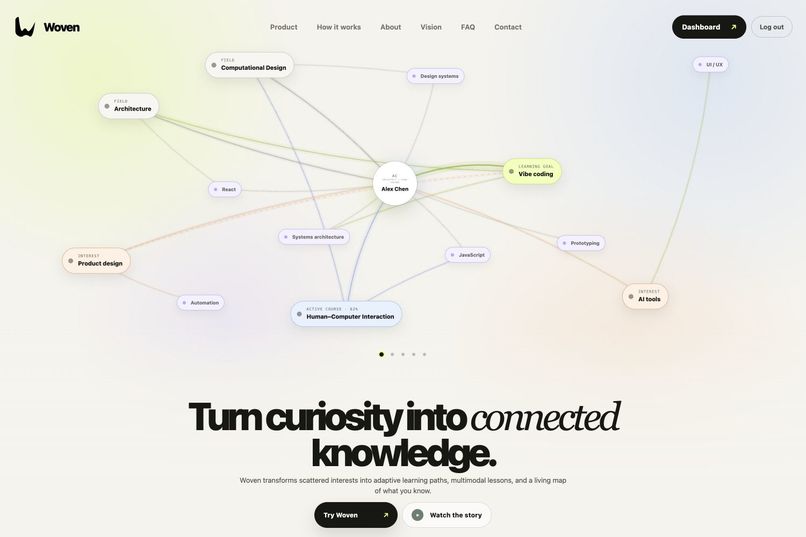
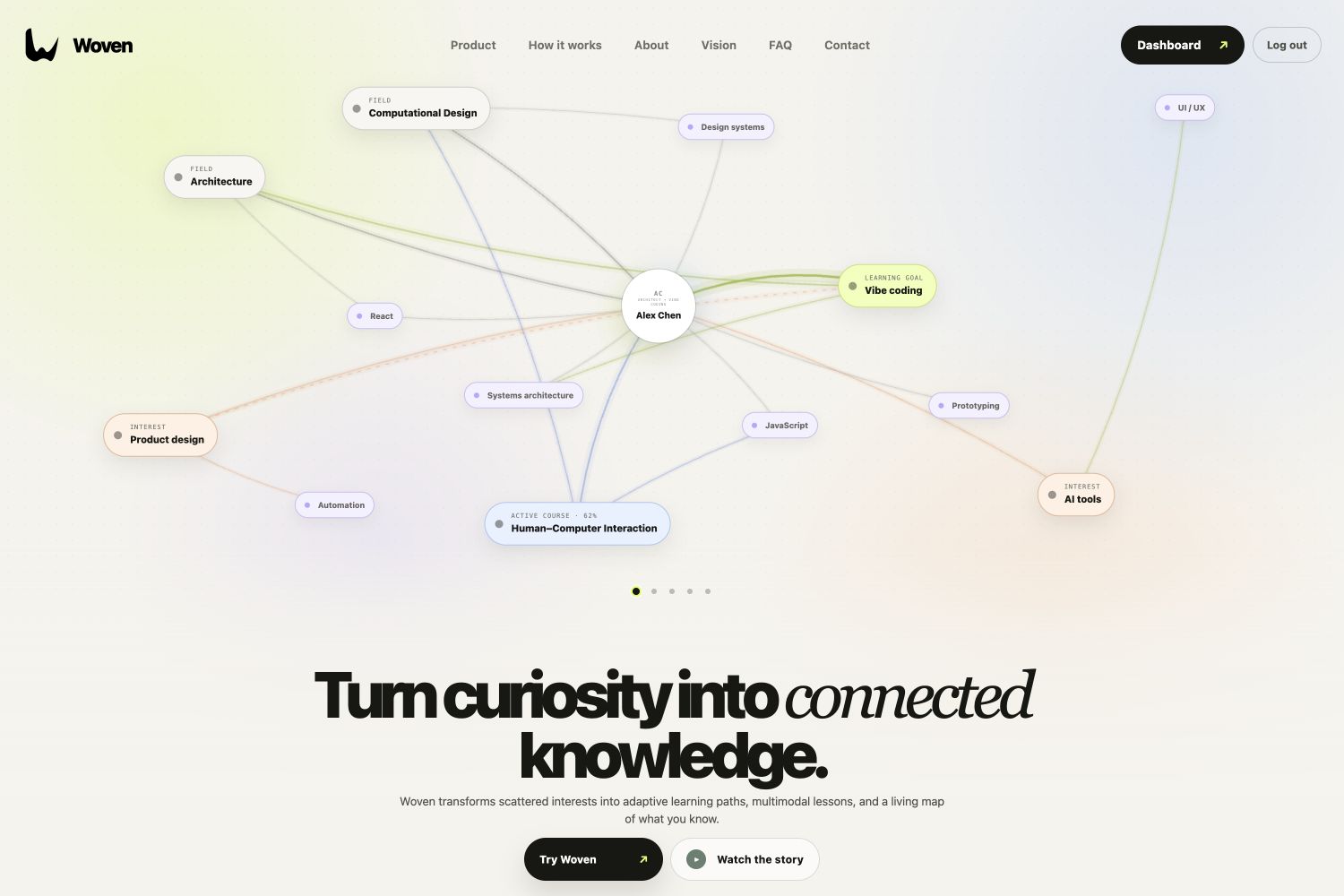
Landing page
-
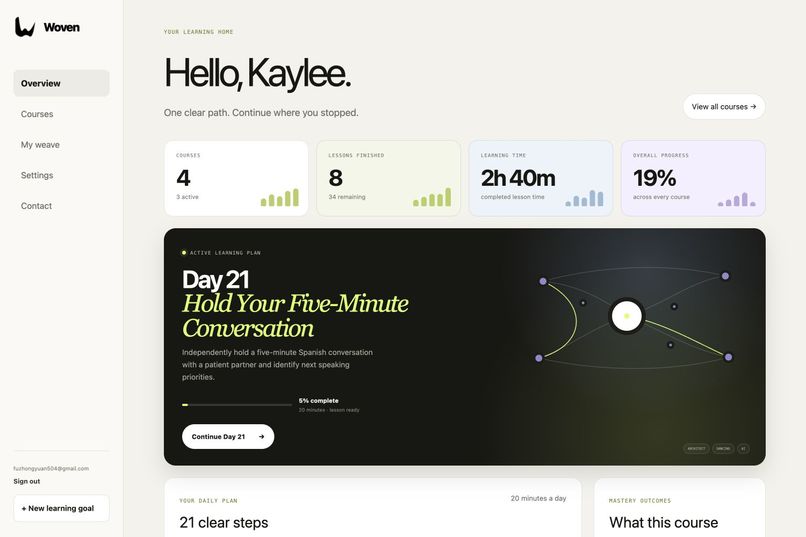
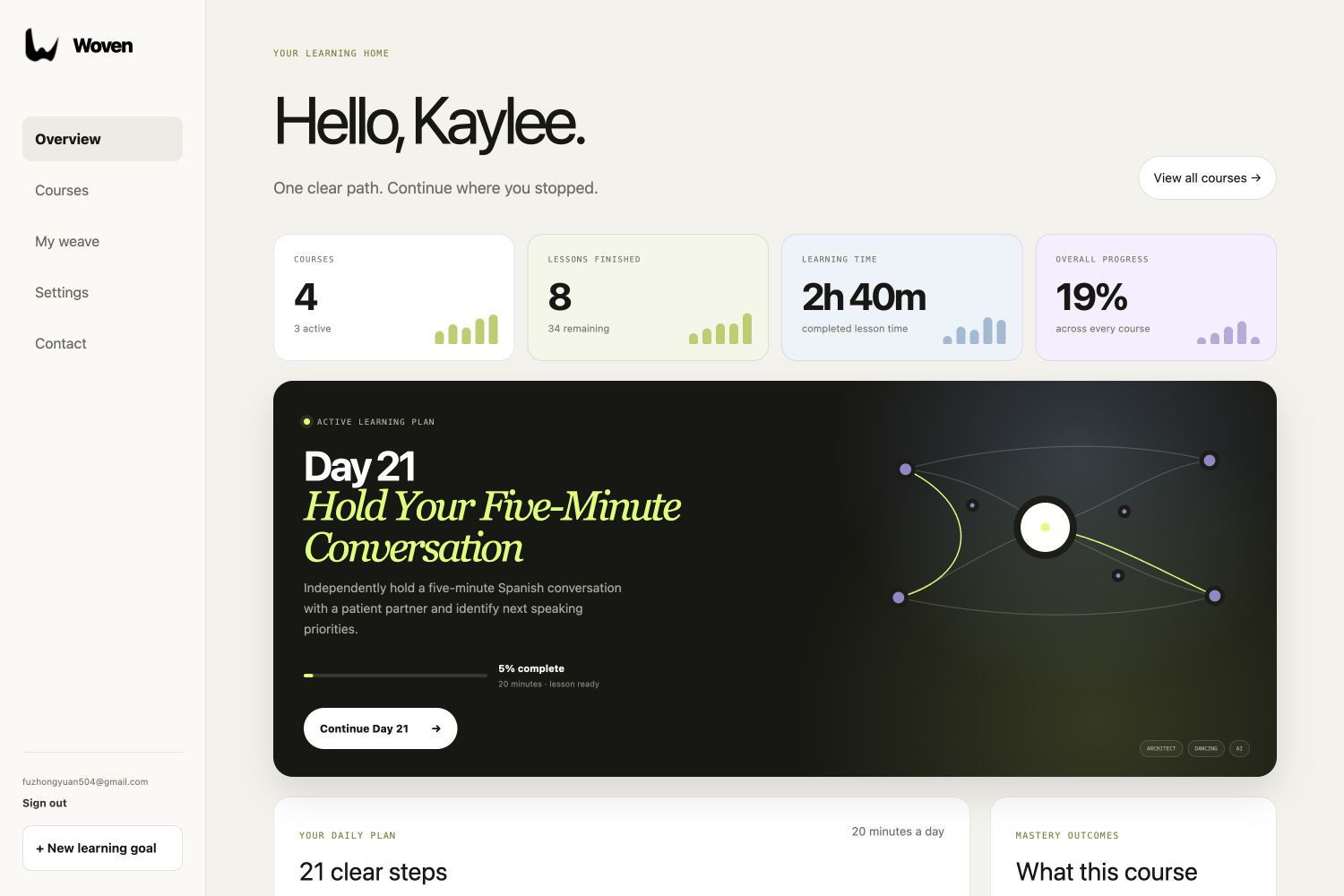
Learner dashboard
-
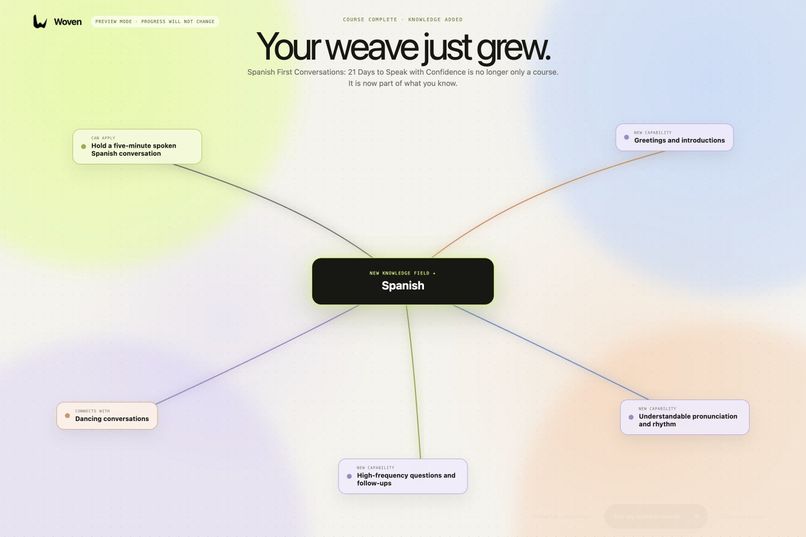
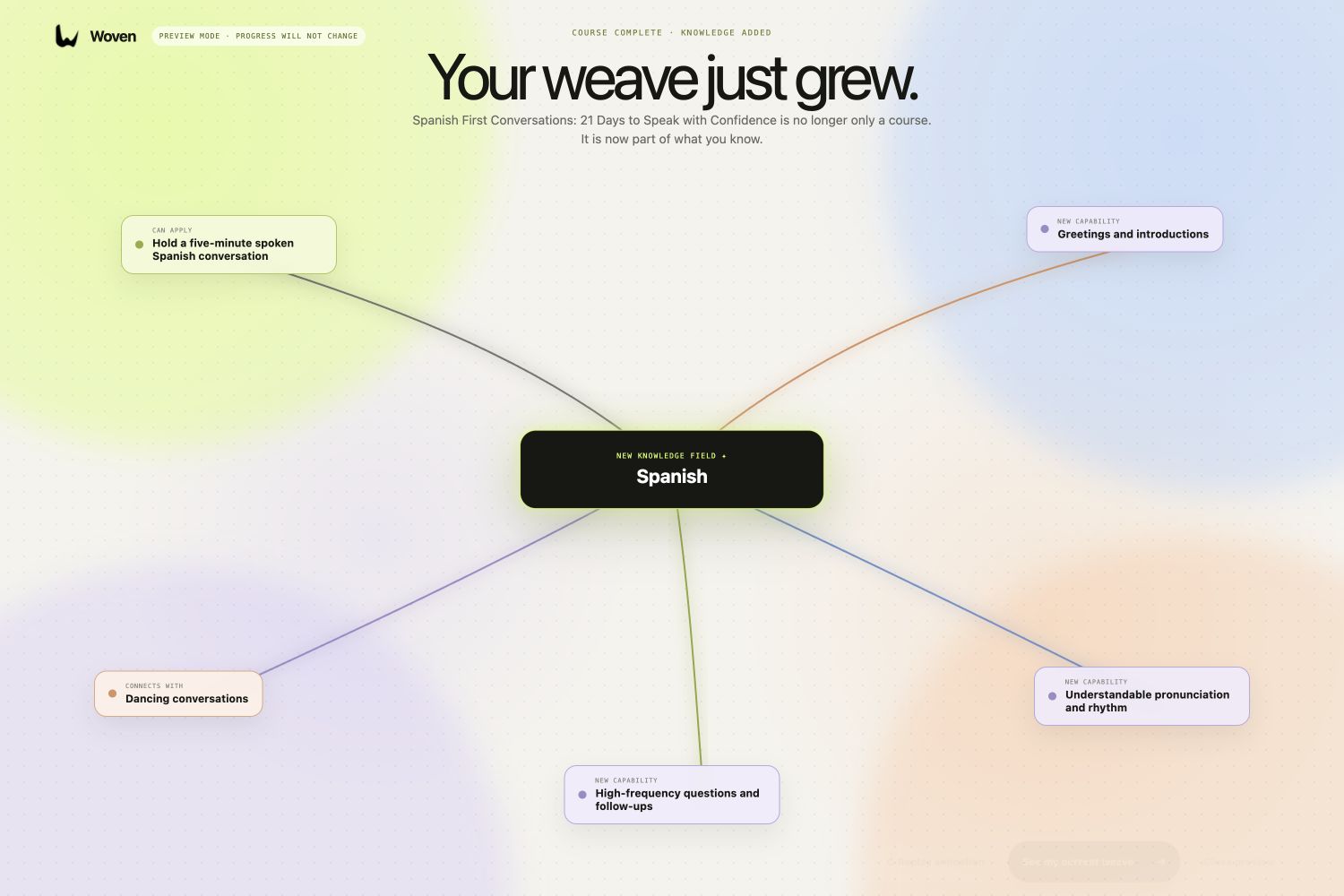
Knowledge growth after completion
-
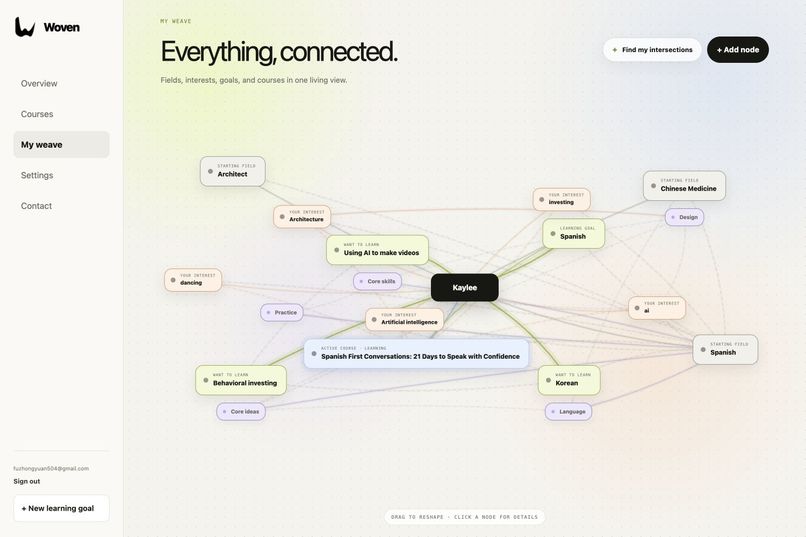
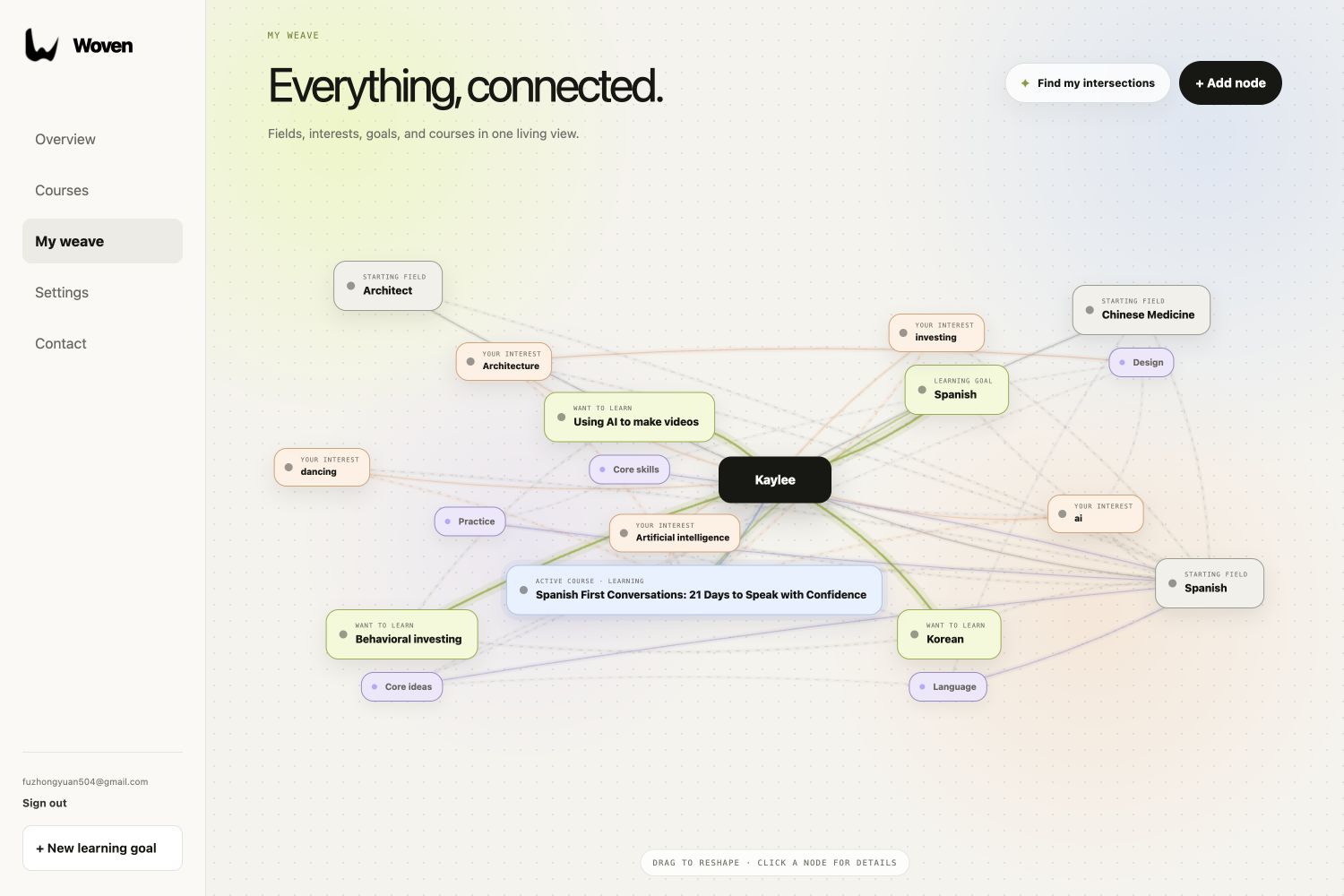
My Weave
-
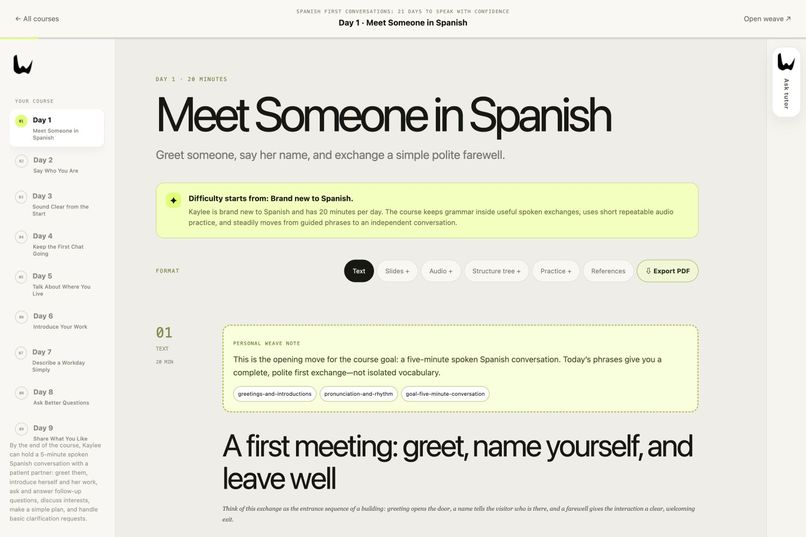
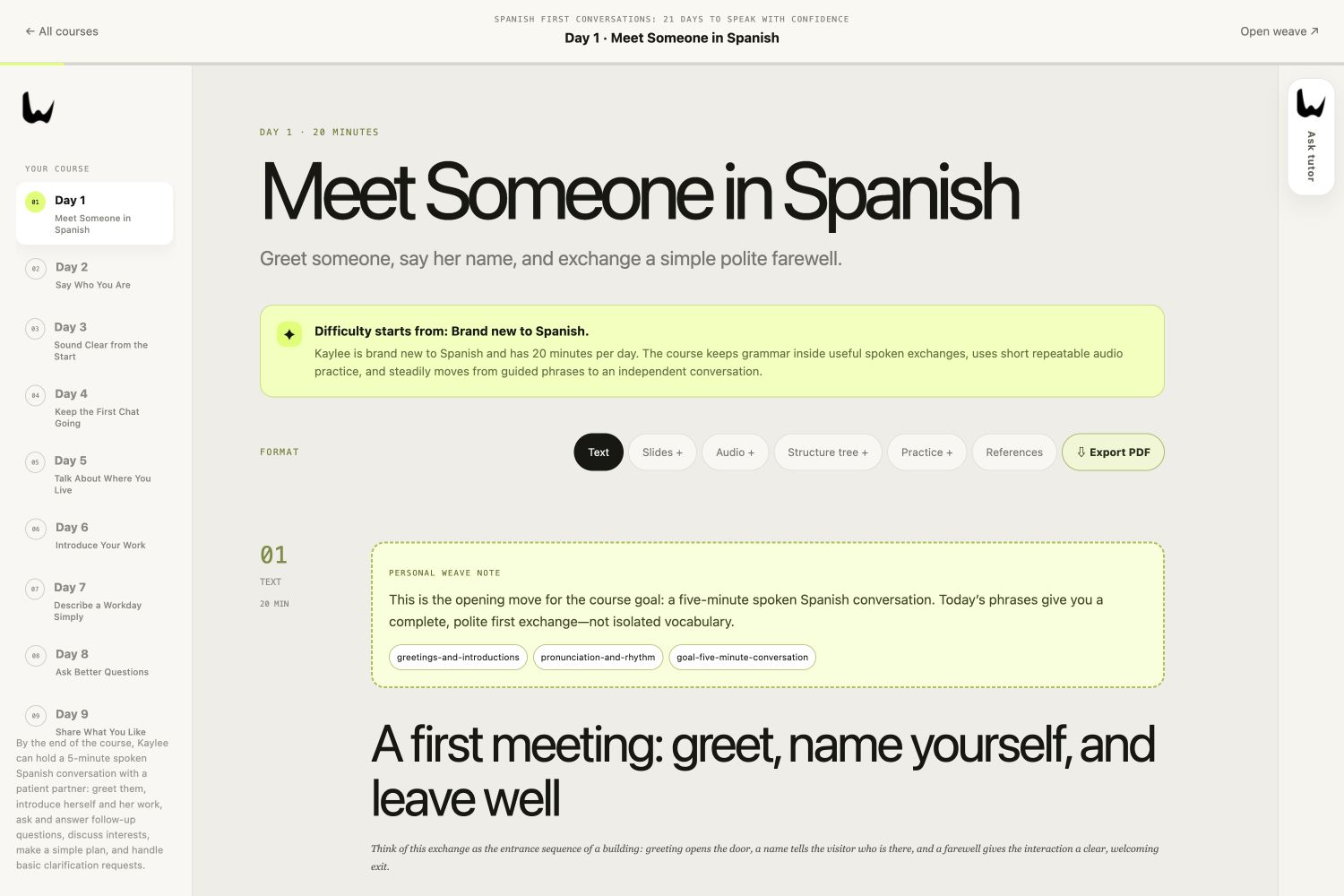
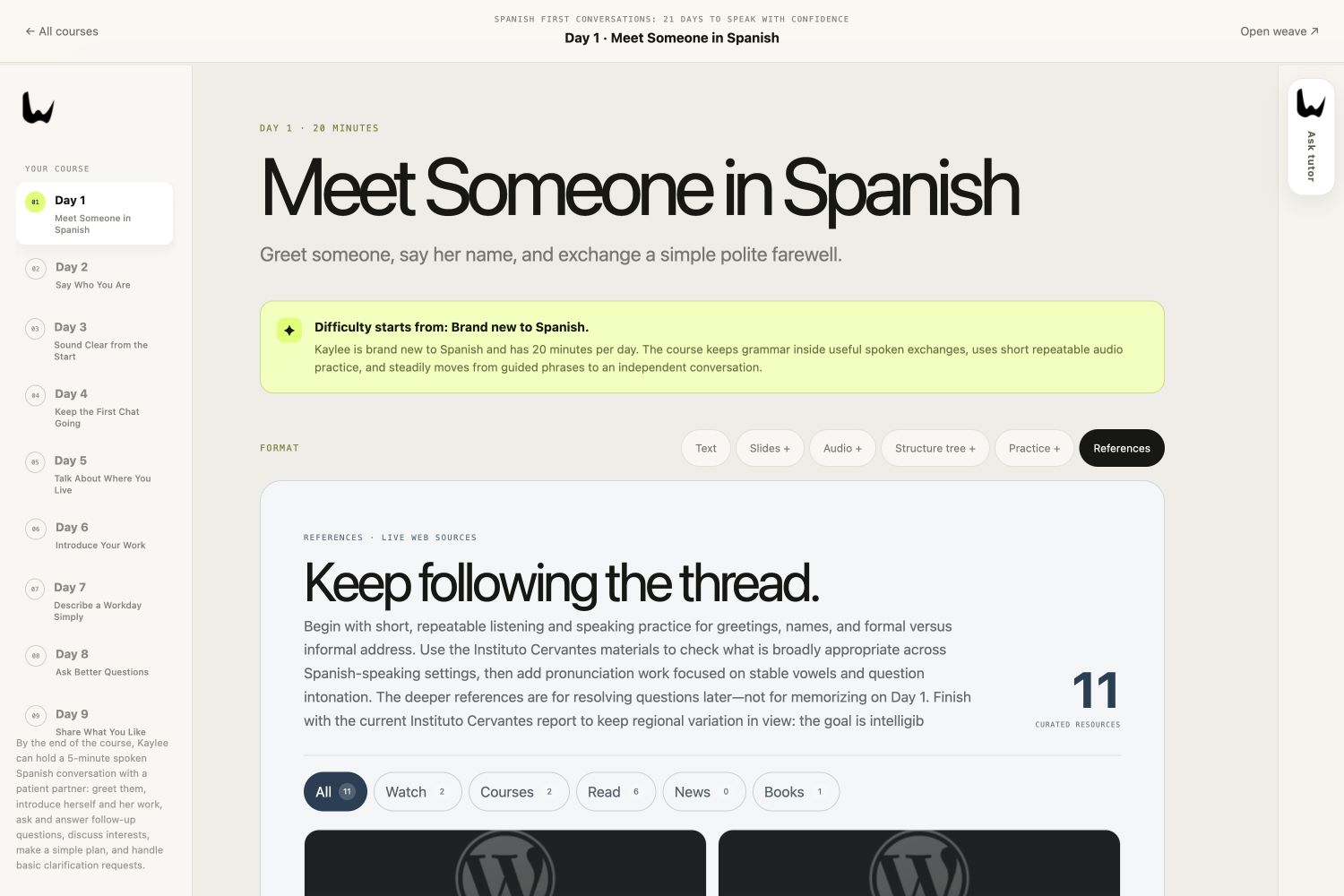
Adaptive course workspace
-
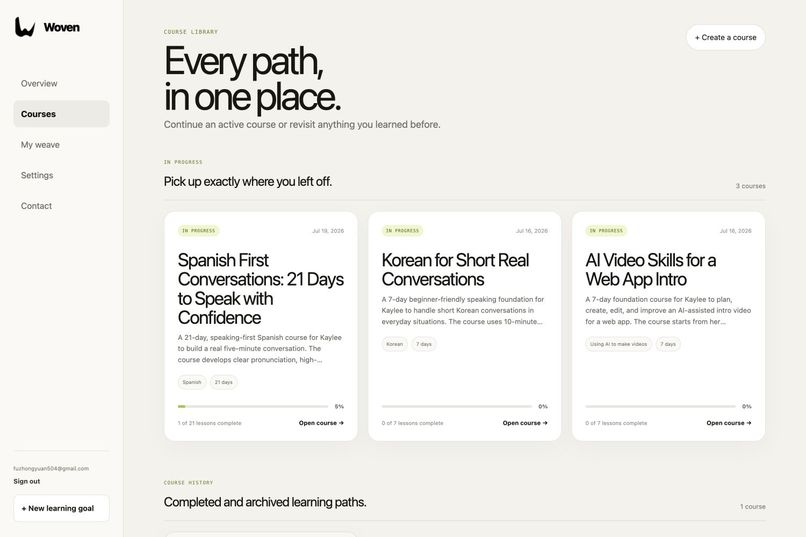
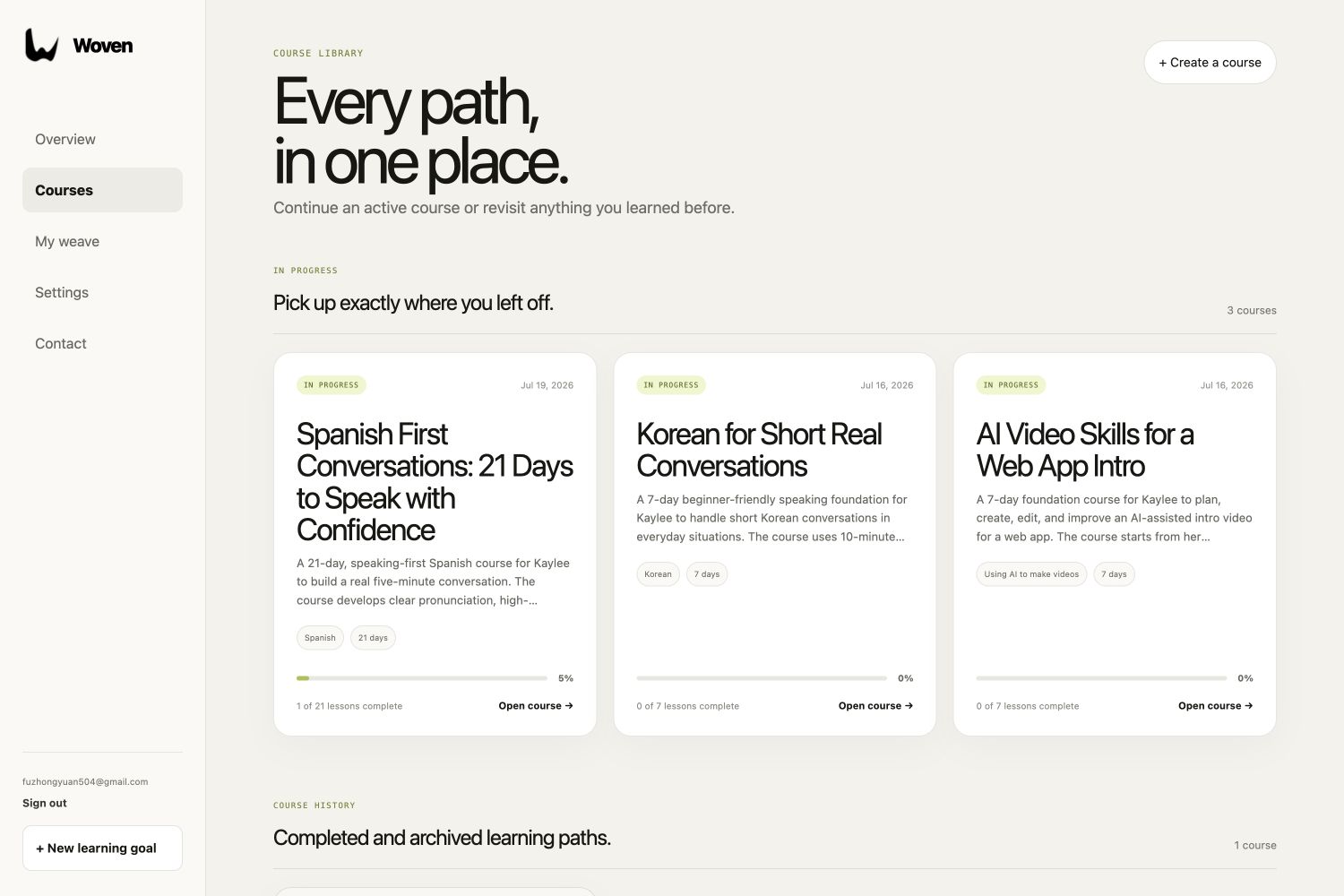
Course library
-
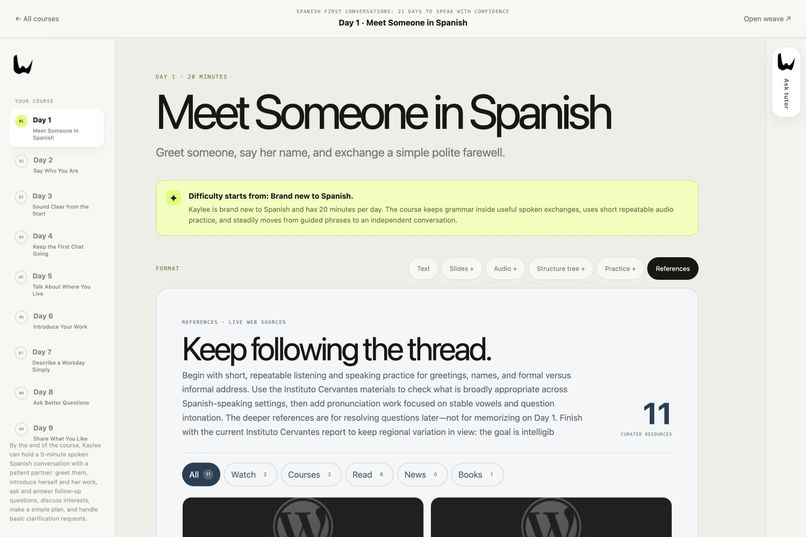
Curated references
Inspiration
I am an architectural designer with no formal coding background, but my curiosity has never stayed within one discipline. Outside architecture, I have taught myself Korean, dance, finance, real-estate investing, vibe coding, astrology, and Bazi. Each subject opened the door to another, yet everything I learned remained scattered across unrelated courses, videos, notes, and apps.
That experience made me realize that curious people rarely fit into one category. We may work in architecture, care about psychology, follow financial markets, enjoy film, and want to explore AI—but most learning tools treat every interest as a separate journey. They help us finish content without helping us understand how our knowledge connects.
I built Woven around a different idea: learning should accumulate into a visible, connected picture of who you are becoming. A completed course should not disappear into a history list. It should become part of your personal knowledge network, connect with your existing fields and interests, and reveal possibilities you may never have discovered through a traditional learning platform.
What it does
Woven turns an open-ended goal into an adaptive course and a living knowledge graph.
A learner can:
- describe what they want to learn in natural language, in multiple languages;
- let Woven remember confirmed background and interests while asking only for missing course-specific context;
- choose a practical daily time commitment and a course length from 5–30 days;
- review and revise the proposed depth, content perspectives, outcome, freshness, and related interests before generation;
- learn through text, audio, slides, expandable structure trees, configurable practice, curated web references, and a lesson-aware AI tutor;
- export text lessons as PDF;
- complete a course and watch it become a glowing knowledge node connected to relevant parts of their weave; and
- use Find my intersections to discover unexpected cross-disciplinary course directions.
The interface stays consistently English, while the intake conversation can understand other languages or support an explicitly requested language-learning course.
How we built it
Woven is a full-stack Next.js and TypeScript application. GPT-5.6 is not a chatbot added on top; it is the structured reasoning layer behind learner intake, course briefs, 5–30 day plans, daily lessons, assessments, tutoring, reference discovery, and knowledge-graph relationships.
Each AI action has a typed contract and validated structured output. Authenticated server routes protect model credentials and learner data. Profiles, courses, lessons, progress, generation jobs, and weave nodes are persisted per user. Heavier lesson formats run as background jobs so the learner can continue working and receive a completion notification instead of waiting on one blocking screen.
The knowledge graph keeps four ideas visually and logically distinct: starting fields, personal interests, learning goals, and acquired knowledge. Course completion derives new nodes only from the completed course, preventing unrelated active courses from contaminating the result.
How Codex and GPT-5.6 shaped the product
I began with Codex in VS Code, then continued the main build-and-refine loop in the Codex app. My role was product direction: I defined the learner problem, interaction rules, visual system, graph semantics, trust boundaries, and acceptance criteria. I repeatedly tested the live product and supplied screenshots and behavioral feedback.
Codex accelerated the repository-level engineering. It traced features across UI state, authenticated routes, schemas, persistence, background jobs, and completion animations; implemented complete vertical slices; diagnosed integration failures; and kept the working product aligned with each design decision.
GPT-5.6 provides Woven's runtime intelligence: it interprets ambiguous goals, asks contextual follow-ups, proposes relevant course perspectives, creates structured learning paths, generates lessons and assessments, and reasons across the learner's graph. Codex turned that intelligence into a dependable product by implementing the prompts, schemas, data boundaries, recovery states, and interfaces around it.
Challenges we ran into
The hardest challenge was maintaining trust while making the experience highly personalized. Woven must separate:
- facts the learner explicitly confirmed;
- learning artifacts generated by the model; and
- relationships inferred from the weave.
We also had to prevent cross-user browser state leakage, isolate simultaneous courses, stop unfinished courses from growing the graph, recover stalled generation jobs, normalize multilingual inputs into an English product system, and make long-running media generation feel calm rather than broken.
One concrete failure exposed the importance of this architecture: completing a Chinese Medicine course once surfaced a Game Theory node from another active course. We traced the event through cached state, course identity, persistence, and completion rendering, then changed the flow so graph growth is derived solely from the course actually completed.
Accomplishments that we're proud of
- A complete path from natural-language curiosity to an editable course brief, generated course, daily learning, completion, and visible knowledge growth.
- A knowledge graph that is functional—not decorative—and can recommend genuinely cross-disciplinary next steps.
- Persistent authentication, user-scoped data, background generation, recovery states, and responsive interfaces.
- A product that uses personalization without silently rewriting the learner's identity.
- A cohesive visual and motion language across the landing page, dashboard, course workspace, and full-screen completion moment.
What we learned
The best AI learning experience is not created by generating more content. It comes from asking for the right context, giving the learner meaningful control before generation, and preserving what they have learned after the course ends.
We also learned that model intelligence and product reliability are inseparable. Structured outputs, explicit ownership, visible loading states, retry paths, and carefully designed human confirmation points are what turn a powerful model into a trustworthy learning system.
What's next for Woven
Next, I want to evolve Woven from a personal learning system into an open, curiosity-driven social platform. Learners will be able to share their courses and selected parts of their weave, discover people from different fields, and form friendships or collaborations around unexpected knowledge intersections.
Instead of connecting people through popularity, job titles, or follower counts, Woven could connect them through what they know, what they are learning, and where their curiosity overlaps.
Alongside this social layer, I plan to deepen long-term mastery tracking, improve relationship confidence and explanations inside the weave, and add better spaced review across completed courses—while ensuring every learner retains ownership of a distinct personal knowledge identity.
Built With
- codex
- css3
- github
- google-oauth
- gpt-5.6
- html5
- javascript
- next.js
- node.js
- openai
- openai-image-api
- openai-responses-api
- openai-text-to-speech
- postgresql
- react
- remotion
- resend
- row-level-security
- sql
- supabase
- supabase-auth
- typescript
- vercel
- web-speech-api
- zod


Log in or sign up for Devpost to join the conversation.