-
-
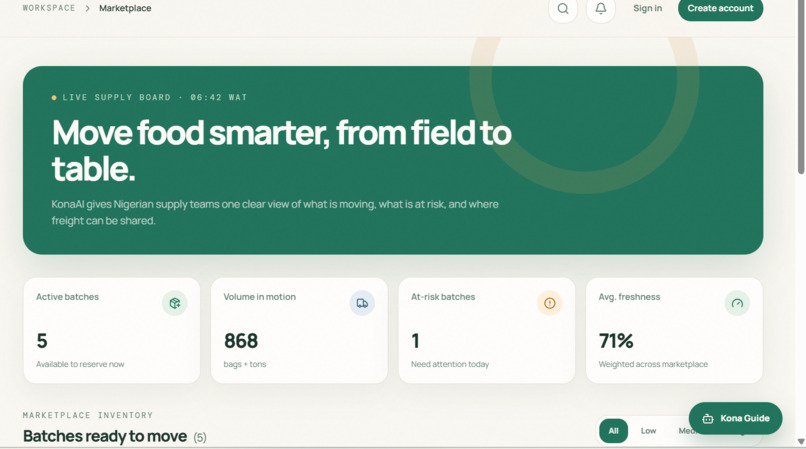
Marketplace heading
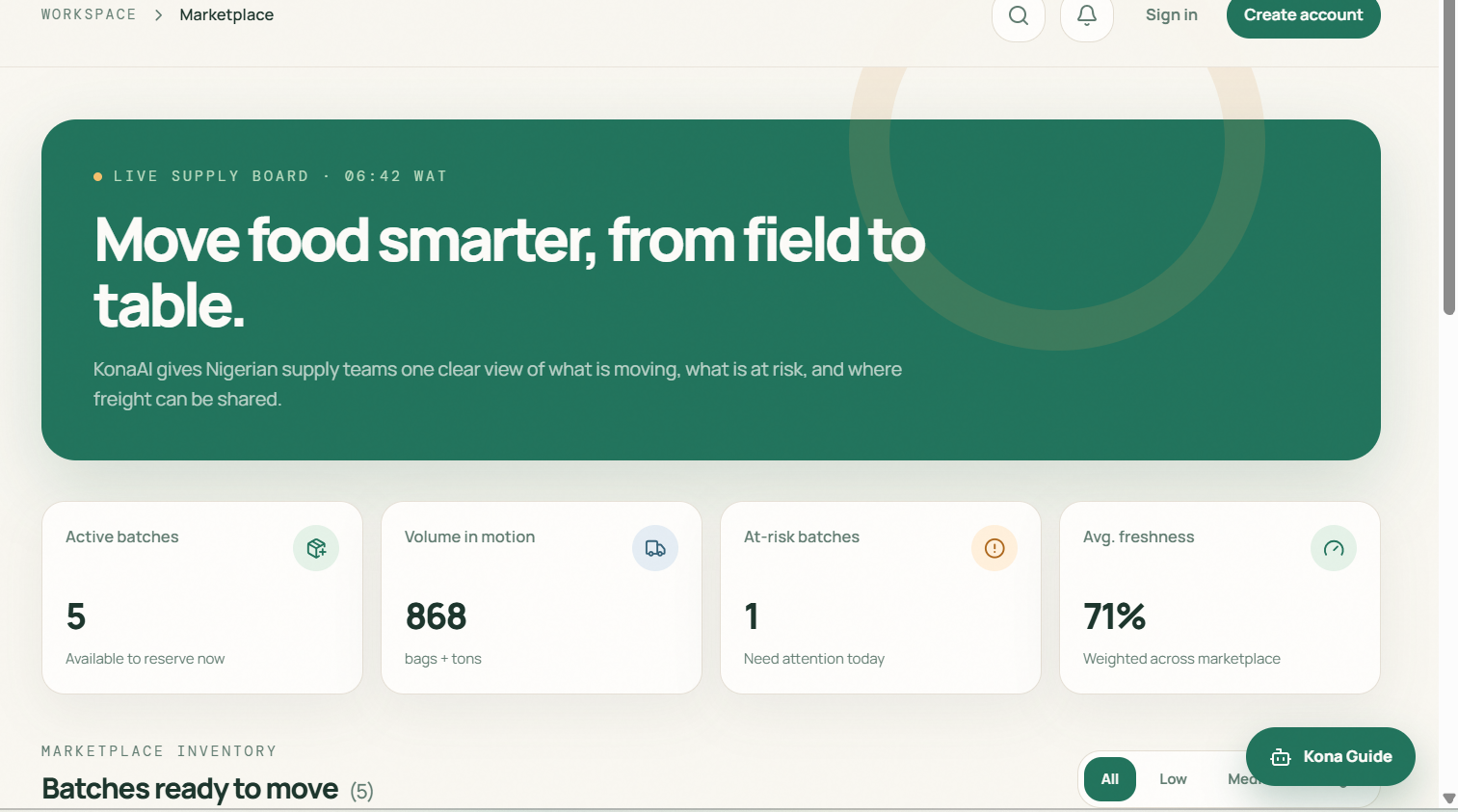
Inspiration
Post-harvest loss is one of the most critical yet overlooked crises in the global agricultural supply chain. Millions of metric tons of fresh produce spoil in transit before ever reaching the market, resulting in severe financial loss for smallholder farmers and food insecurity for local communities.
Traditional logistics platforms treat agricultural yield like standard non-perishable freight. They fail to account for biological decay rates, dynamic weather conditions, or real-time transit delays. We created Kona AI to bridge this gap: an intelligent agro-logistics engine that converts agricultural batch metadata into predictive, profit-maximizing logistics decisions.
What it does
Kona AI is an end-to-end agro-logistics platform designed to eliminate post-harvest waste and protect agricultural batch value. Key capabilities include:
Predictive Spoilage Tracking: Continuously monitors harvest dates, produce shelf-life metrics, and travel duration to identify high-risk produce batches before decay occurs.
Intelligent Route Clustering: Automatically aggregates deliveries with shared transit corridors or destination hubs to optimize transport efficiency and reduce fuel overhead.
Batch Financial Risk Engine: Dynamically quantifies batch asset values and calculates potential financial losses if shipments are delayed past critical spoilage thresholds.
Automated Risk Notifications: Triggers immediate, prioritized alerts for logistics managers when produce risk crosses critical safety boundaries
How we built it
Kona AI was built using a human-guided AI development workflow, combining strategic domain architecture with rapid agentic code execution:
Architecture & Prompt Engineering: Defined the system specifications, data models, and domain logic, translating agricultural logistics challenges into structured technical prompts.
Autonomous Implementation (Replit Agent): Leveraged Replit Agent to autonomously execute full-stack code implementation, styling, state logic, and UI reactivity in HTML5, CSS, and modern JavaScript.
Iterative Refinement: Guided the agent step-by-step through feature iterations, debugging, state management for notifications, and dynamic UI clustering modules.
Challenges we ran into
Prompt Optimization under Credit Constraints: Formulating highly targeted, deterministic prompts for Replit Agent to build full features in single iterations without burning unnecessary credits.
Balancing Complex Logistics Logic with Simple UX: Translating mathematical spoilage curves and multi-stop route clustering into an intuitive interface that non-technical users can navigate seamlessly.
State Management for High-Risk Alerts: Directing the implementation of persistent state for unread risk notifications without degrading dynamic UI performance.
Accomplishments that we're proud of
Rapid AI-Driven MVP Deployment: Successfully brought a fully functional platform from concept to completion using modern AI-assisted software engineering techniques.
End-to-End Operational Workflow: Delivered integrated functionality covering spoilage prediction, financial risk modeling, route clustering, and automated alerts.
High-Impact Solution: Creating a technology platform with clear real-world social impact—reducing food waste and securing income for farmers.
What we learned
Effective AI Collaboration: Clear architectural constraints and modular prompts produce far better code output when working with autonomous agents like Replit Agent.
Logistics Requires Domain Metrics: Agricultural logistics cannot rely on standard delivery algorithms; time-to-spoilage must act as the primary operational variable.
What's next for Kona AI
IoT Sensor Integration: Incorporating cold-chain temperature and humidity sensors for real-time, in-transit shelf-life adjustments.
B2B Buyer Marketplace: Expanding the platform to allow wholesale buyers to bid on and pre-order incoming harvests before trucks reach destination markets.
Mobile App Deployment: Building offline-first mobile applications optimized for field agents in low-connectivity rural regions.
Built With
- css3
- gemini
- html5
- javascript
- prompt-engineering
- replit

Log in or sign up for Devpost to join the conversation.