-
-
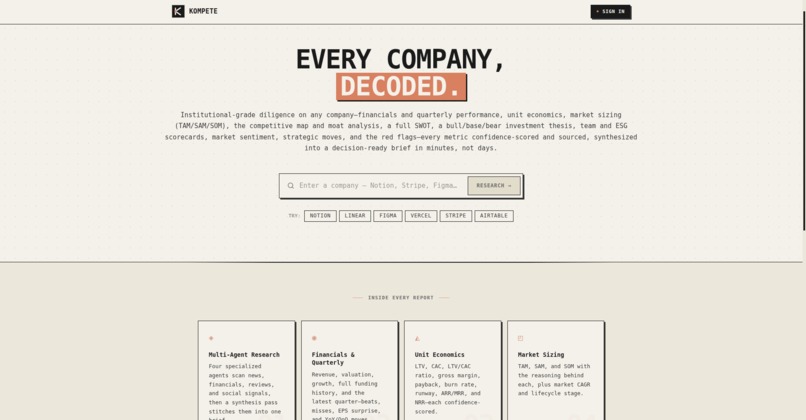
Main Landin Page
-
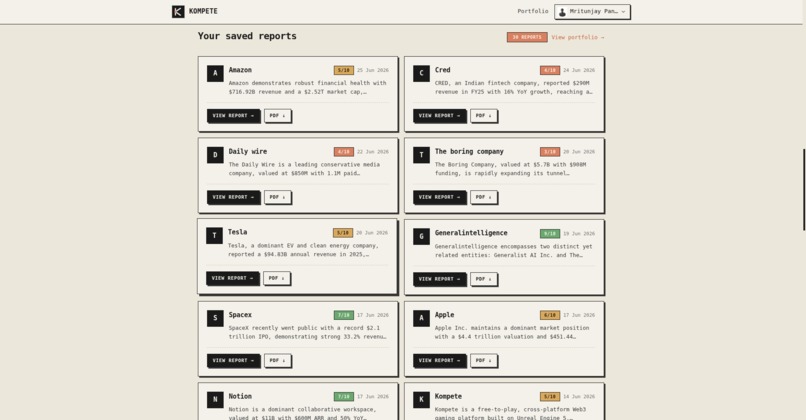
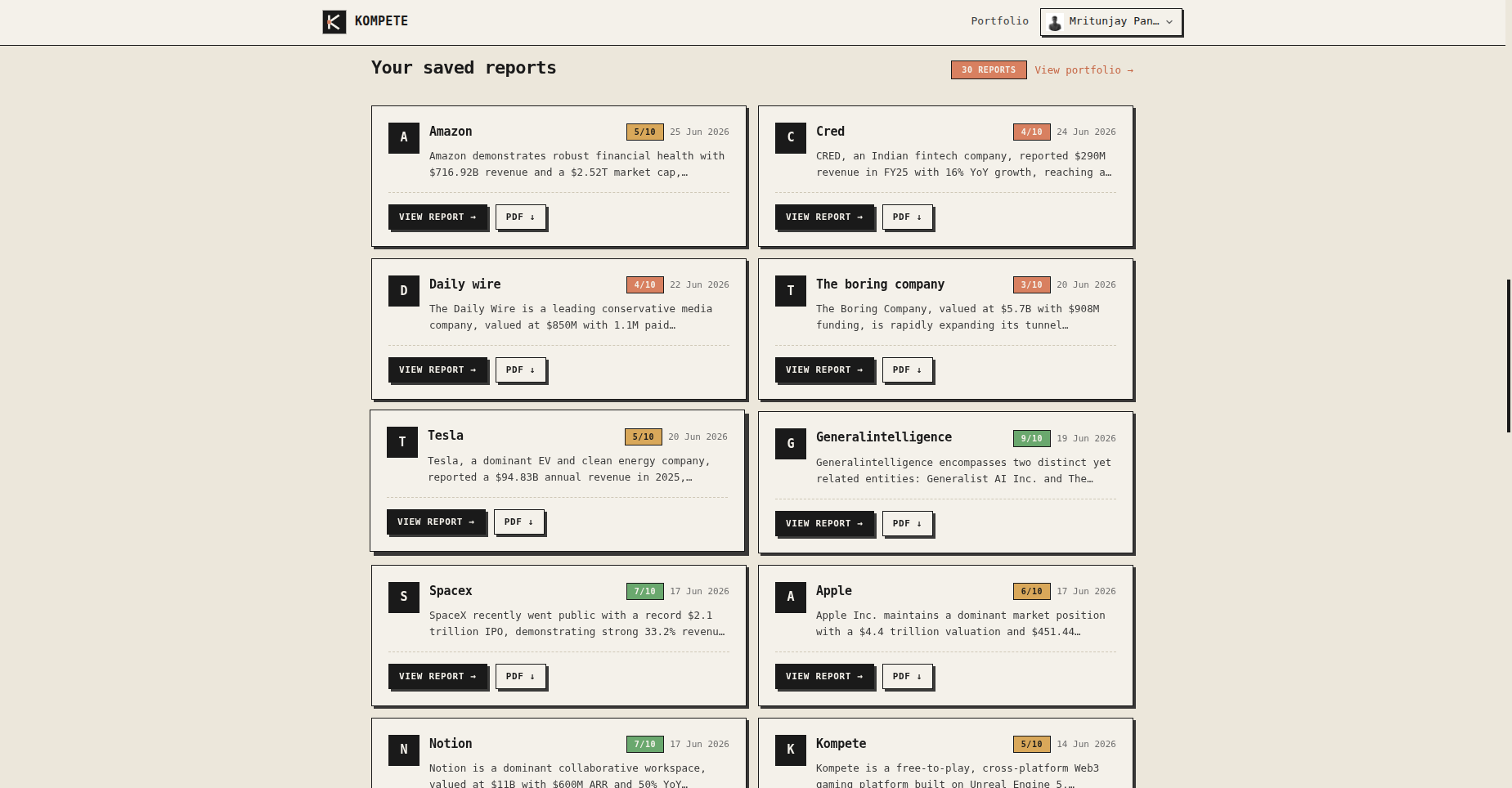
Companies Saved in Portfolio
-
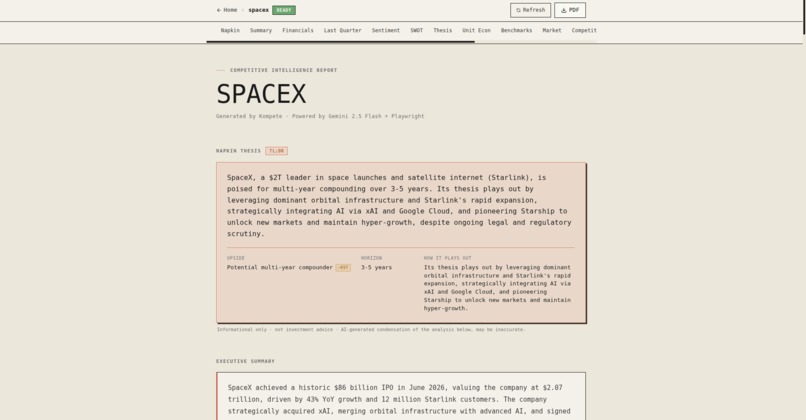
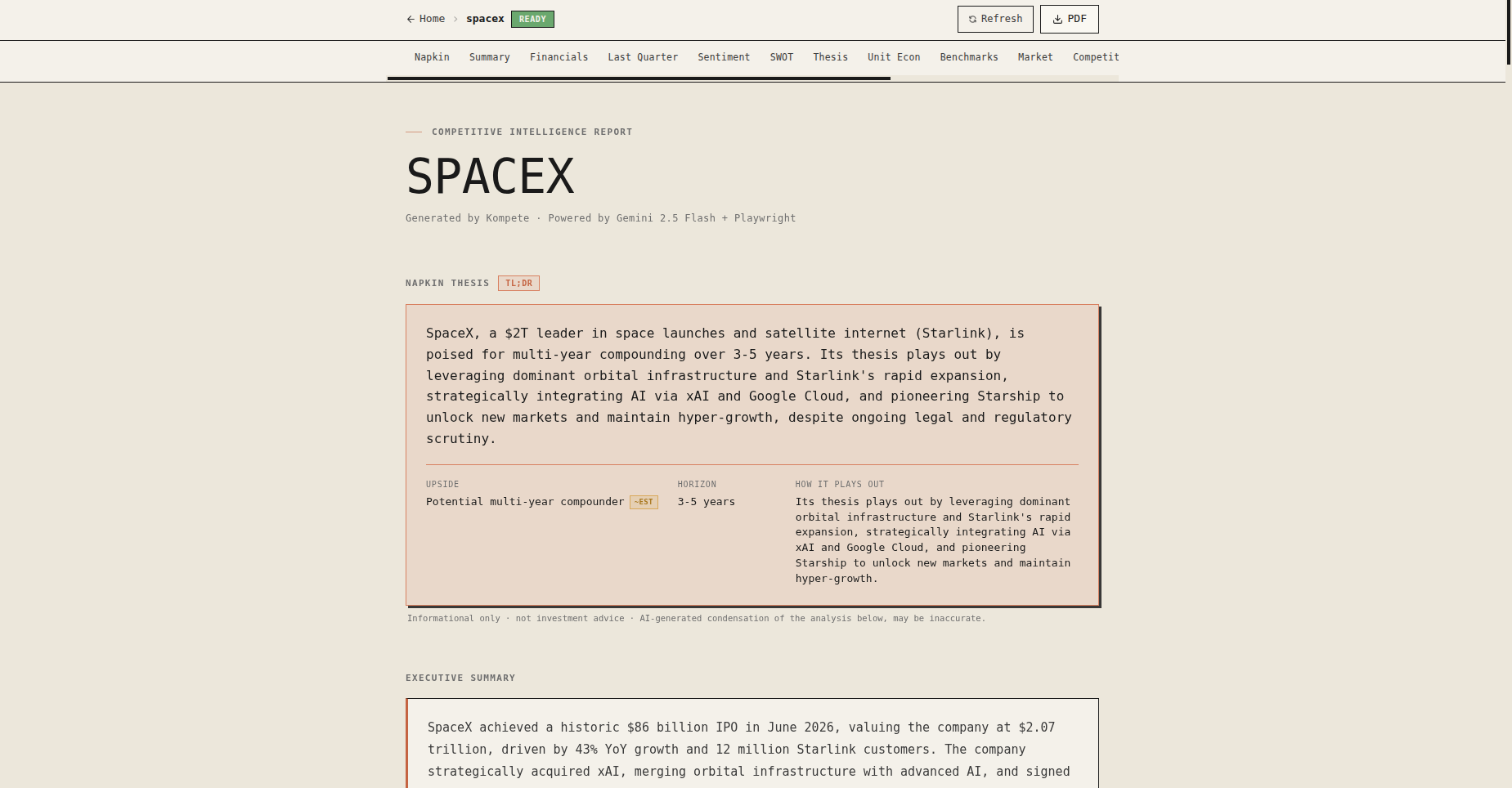
Companies Report
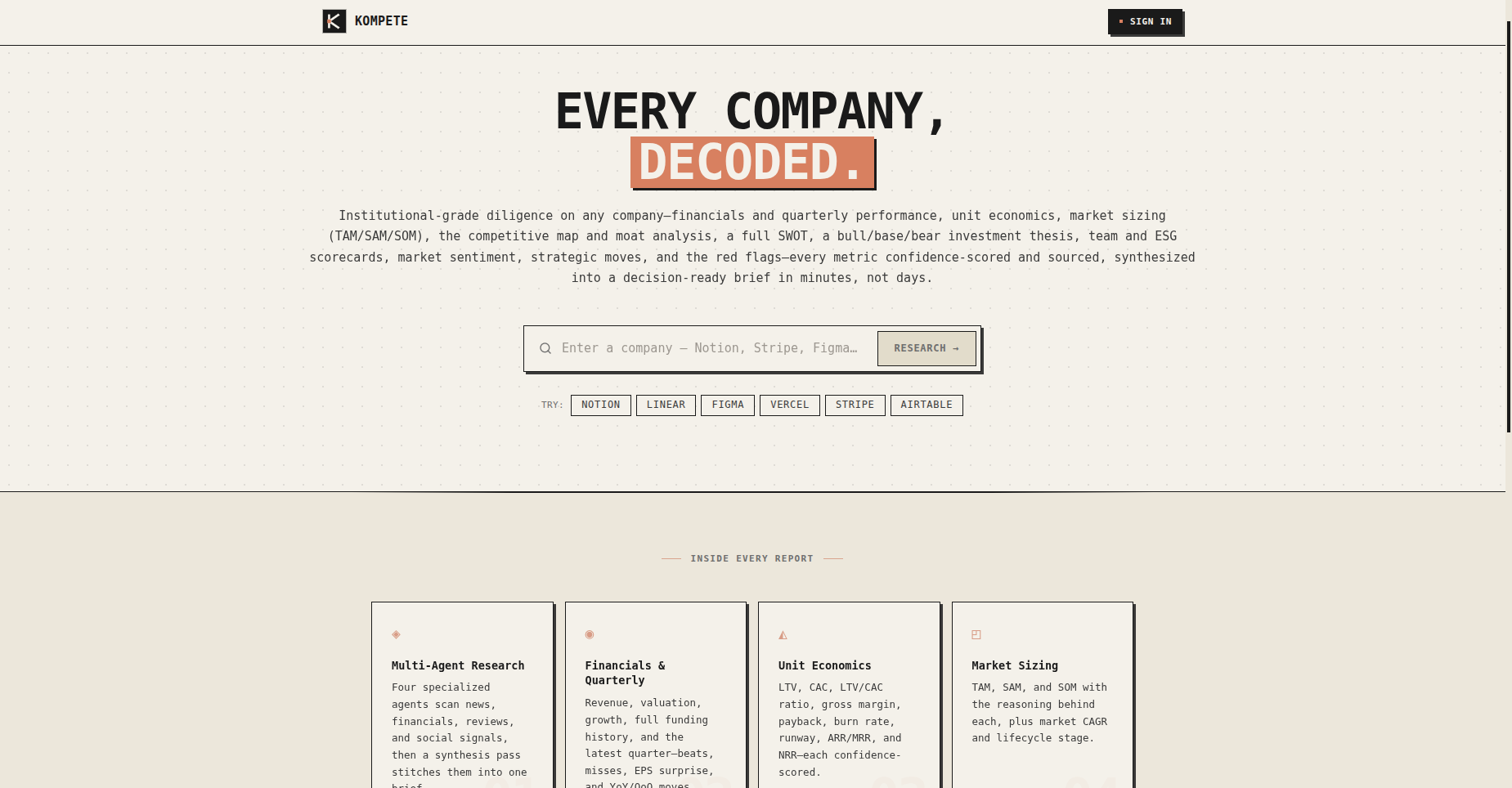
Inspiration
Anyone who's had to walk into a meeting, a deal, or a launch knowing they should understand the other company — but not having the time — knows this pain. Founders, investors, and product teams either burn hours on scattered Googling or drop thousands on an analyst report that's already stale by the time it arrives. The information exists; it's just fragmented across news, filings, reviews, and social chatter. We realized company research isn't a data problem — it's a synthesis problem. Nobody needs more tabs open. They need the answer. That gap is what pushed us to build Kompete.
What it does
Type any company name. In under a minute, Kompete deploys a team of five AI research agents that work like a real analyst desk — one digs through news, another through financials, a third through customer reviews, a fourth through social signals — and a synthesis agent stitches it all into a structured, decision-ready intelligence report.
The output is a full competitive teardown: a SWOT, a financial snapshot, a unit-economics breakdown with the assumptions shown, multi-quarter revenue trends, sentiment scoring, peer benchmarks, strategic moves, and an analyst-style investment thesis. It streams to your screen live as the research happens, and exports to a clean PDF you can drop straight into a deal memo or board deck.
The magic moment: you go from a blank search box to a shareable, board-ready competitive teardown before your coffee gets cold.
How we built it
Kompete runs on a multi-agent architecture. A FastAPI backend orchestrates a Gemini-powered multi-agent pipeline, where each agent owns a research domain (news, financials, reviews, social) and a final synthesis agent composes their findings into a coherent report — mirroring how a real research desk divides and reassembles work.
To make the wait feel like progress instead of a spinner, we stream every stage of the pipeline to the client with Server-Sent Events (SSE), so users watch the report assemble section by section in real time. The frontend is built in Next.js, state and results are persisted in PostgreSQL, and finished reports export to a polished PDF for sharing.
Challenges we ran into
- Orchestrating agents without chaos. Five agents running in parallel means five ways to fail, drift off-topic, or contradict each other. Getting the synthesis agent to reconcile inconsistent findings into one trustworthy narrative took real iteration on prompting and structure.
- Streaming a multi-agent pipeline. Wiring SSE so partial results from independent agents arrive in a sensible order — and the UI updates gracefully as each section lands — was trickier than a simple request/response flow.
- Trust and transparency. Financial estimates are worthless if you can't see the reasoning. Surfacing the assumptions behind every number, rather than emitting a confident-sounding wall of text, was a core design constraint we kept fighting for.
- Latency vs. depth. Delivering an analyst-grade report in under a minute meant constantly balancing how deep each agent digs against how fast the whole thing returns.
Accomplishments that we're proud of
- A working end-to-end multi-agent pipeline that produces a report an analyst would be proud to send — sourced, structured, and transparent about its reasoning.
- Live streaming output that turns a one-minute wait into an engaging, watchable research process.
- Reports that don't just dump text but surface assumptions behind every estimate, so users can actually trust them enough to act.
- Clean PDF export that makes the output board- and deal-memo-ready out of the box.
What we learned
The biggest lesson: for research tools, transparency beats confidence. An AI that shows its assumptions is far more useful than one that sounds authoritative but hides its reasoning. We also learned how much a multi-agent design mirrors real-world workflows — dividing research the way a human desk does produced noticeably better structure than a single monolithic prompt. And on the engineering side, streaming fundamentally changes how a slow-but-thorough process feels to a user.
What's next for Kompete
- More data sources and deeper financials — expanding beyond the current agents into richer filings, patents, and hiring signals.
- Watchlists and monitoring — moving from one-off teardowns to continuous competitive tracking with alerts on strategic moves.
- Deeper source attribution — letting users click any claim and trace it back to the underlying source.
- Team collaboration — shared workspaces so a whole deal or product team can work from the same live intelligence.
Built With
- a-next.js-frontend
- fastapi
- gemini
- next
- postgresql
- sse
- sse-streaming

Log in or sign up for Devpost to join the conversation.