Inspiration
Cross-disciplinary teams lose the why in the handoff. A scientist’s finding gets retyped into a ticket, the ticket drops the constraint that made it necessary, and an engineer ships something subtly wrong. Chat and docs scatter context; AI chatbots regenerate it from scratch. We wanted one place where people and agents could Kollab: collab on the same canvas, with citations still attached.
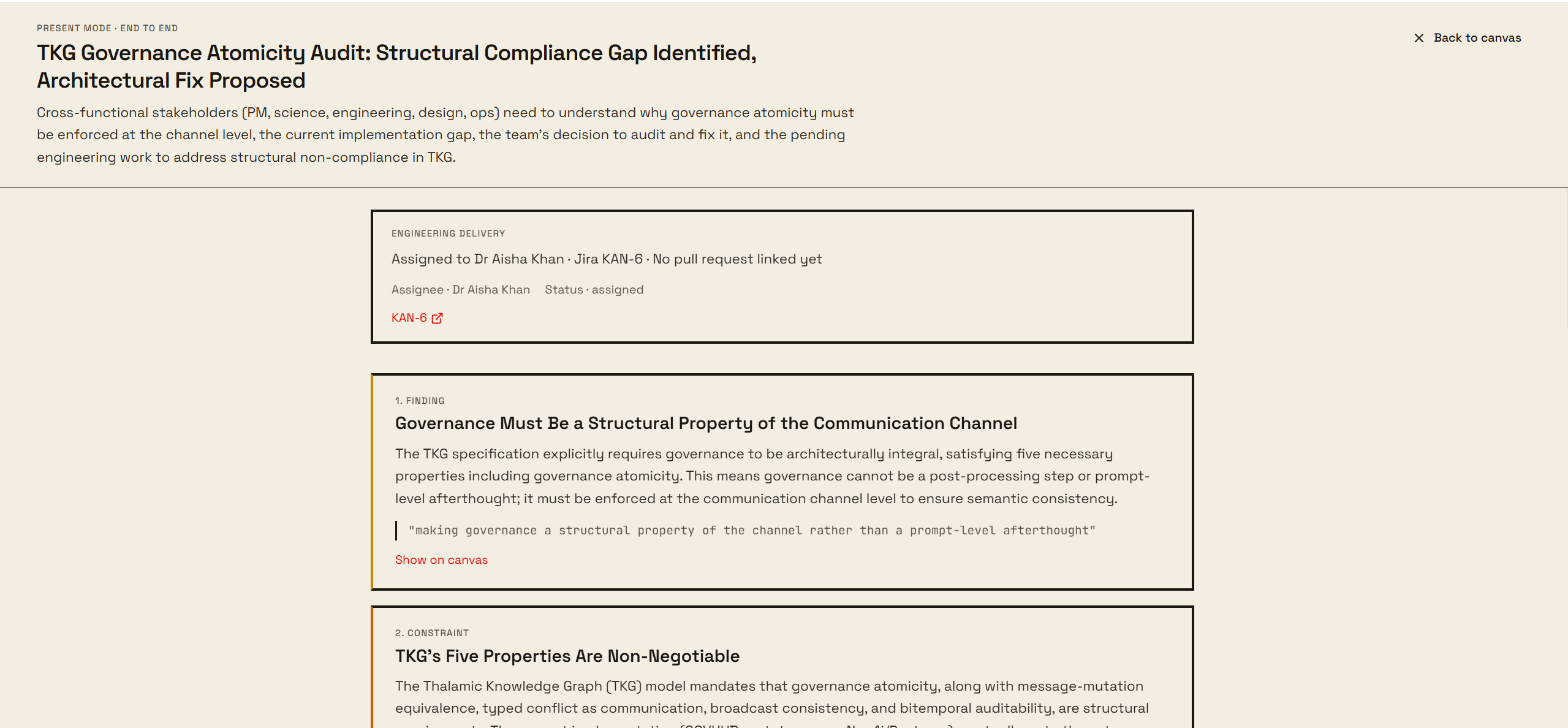
The Mistral × Atlassian challenge asked how AI can help teams make sense of information, present ideas, align on decisions, and review work. Kollab is our answer: not another chatbot, a shared semantic board where research becomes assignable work agents can also read.
What it does
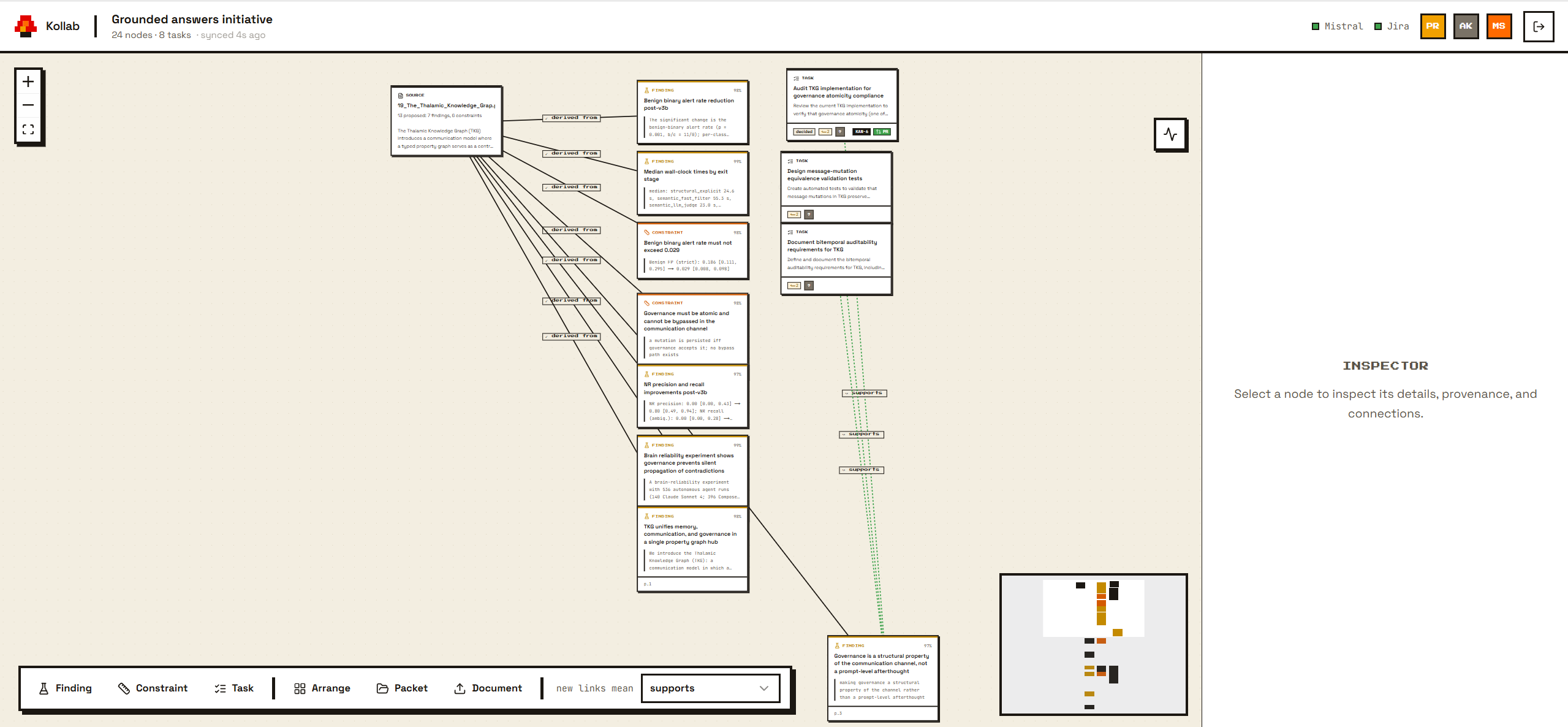
Kollab is one canvas for multi-disciplinary teams and AI.
- Make sense: Drop a PDF, whiteboard photo, or CSV. Mistral proposes findings and constraints (with quotes/pages). Humans pin, summarize, or re-steer Sense.
- Align: Spot contradictions across nodes, record decisions (
decided/deferred/rejected). - Present: Stakeholder Present Mode plus a generated one-pager.
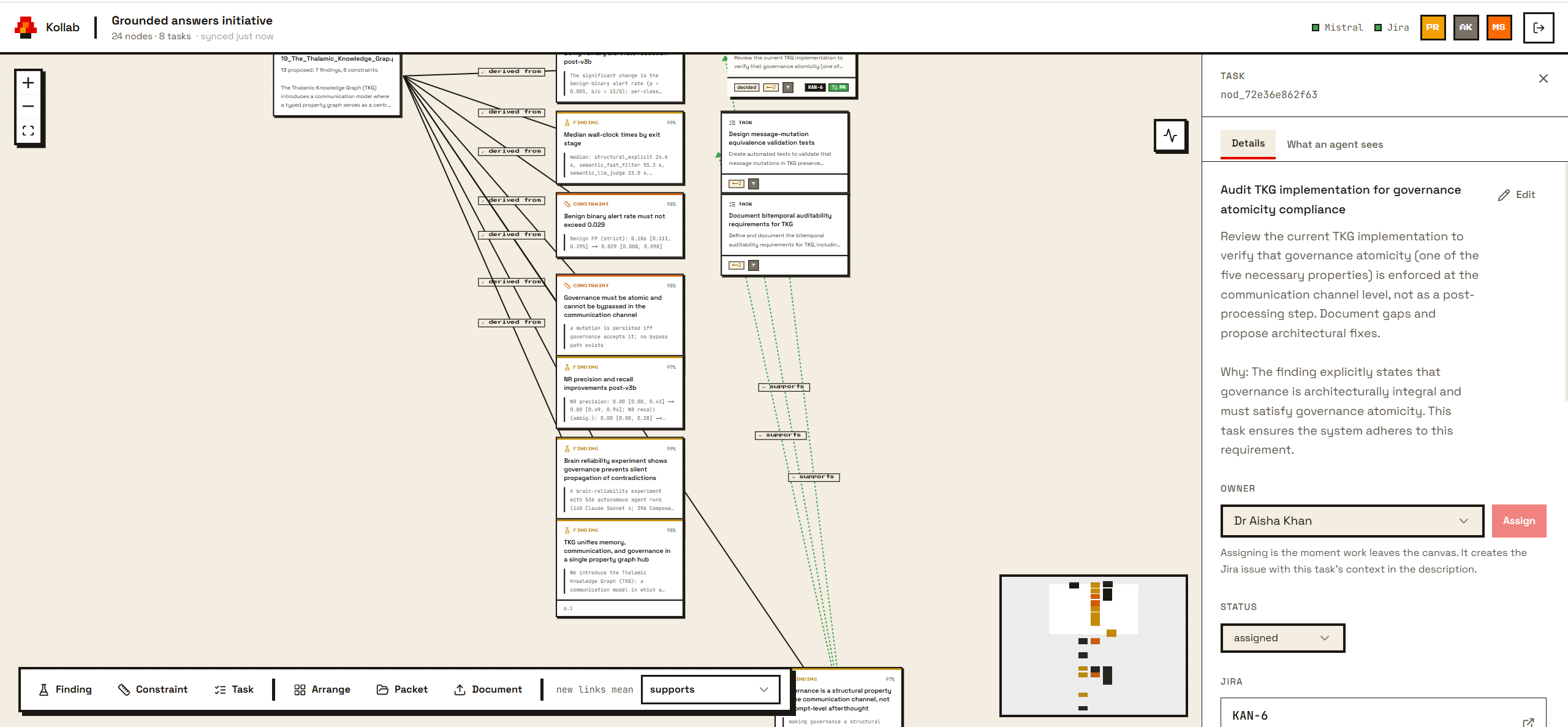
- Review: Assign into Jira, pull PR lineage over MCP, run a constraint checklist against the work.
- Recommend: From a finding or constraint, auto-create linked tasks grounded in the graph.
How we built it
- Frontend: Next.js canvas (React Flow), pixel-brutal UI, Sense review, Present Mode, lineage focus, My Tasks.
- Backend: FastAPI + SQLite as system of record (nodes, edges, candidates, activity).
- AI: Mistral-only via the official SDK: OCR/chat for Sense, Agents/Conversations for the specialist roster (Coordinator, Sense, Data, Arbiter, Narrator, Reviewer), image generation for one-pagers.
- Integrations: Jira outbound on assign; GitHub/Jira webhooks; MCP tools so a coding agent can
get_task_contextand report a PR back onto the board. - Lineage: Graph walk, not a prompt, so agents and humans see the same ancestry.
Challenges we ran into
- Keeping eligibility strict: every reasoning step on Mistral, with Cursor only as an MCP client.
- Trust: auto-extract is noisy. We built candidate review, re-sense with notes, append-by-revision, and “summary only” so the canvas doesn’t flood.
- Merging design + product under time pressure (pixel retheme, teammate UX, Sense packets) without breaking API contracts.
- Making Present / Align / Review feel like one story instead of disconnected demos.
- How to make it unique? Canvas it's not something new, but the value over agent communication is never there.
Accomplishments that we're proud of
- A live end-to-end path: PDF → Sense → promote → align → present → Jira → MCP PR write-back.
- Human-in-the-loop Sense that still feels fast.
- Real lineage for agents and people on the same graph.
- A clear product name and pitch: Kollab = collab on one canvas.
What we learned
- The hard part isn’t “call an LLM”; it’s where truth lives. The canvas had to stay the system of record.
- Multimodal ingest only wins if citations survive into tasks and tickets.
- Specialist agents map cleanly to HMW (HOW MIGHT WE?) verbs when graph tools, not chat history, are the write path.
- Design readability (weight, contrast, when to use red) matters as much as features in a live demo.
What's next for Kollab
- Accept Recording and Voice Image
- Import data beyond Jira and github
- Multi-board workspaces and real auth beyond the demo team.
- Richer packets and cross-board search.
- Stronger inbound sync (live Jira/GitHub status without tunnels).
- Collaboration presence (who’s editing which node).
- Hardening Sense quality and evals so promote rates stay high as corpora grow.
Built With
- atlassian-jira
- fastapi
- github
- mcp
- mistral-agents
- mistral-ai
- mistral-ocr
- next.js
- python
- react
- react-flow
- sqlalchemy
- sqlite
- tailwind-css
- typescript
- zustand

Log in or sign up for Devpost to join the conversation.