-
-
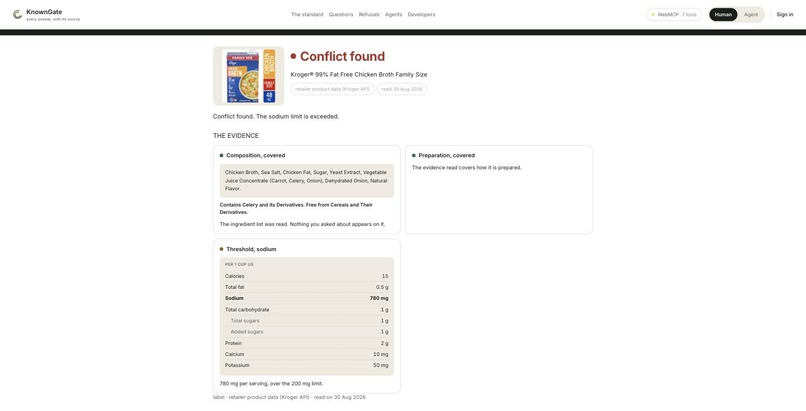
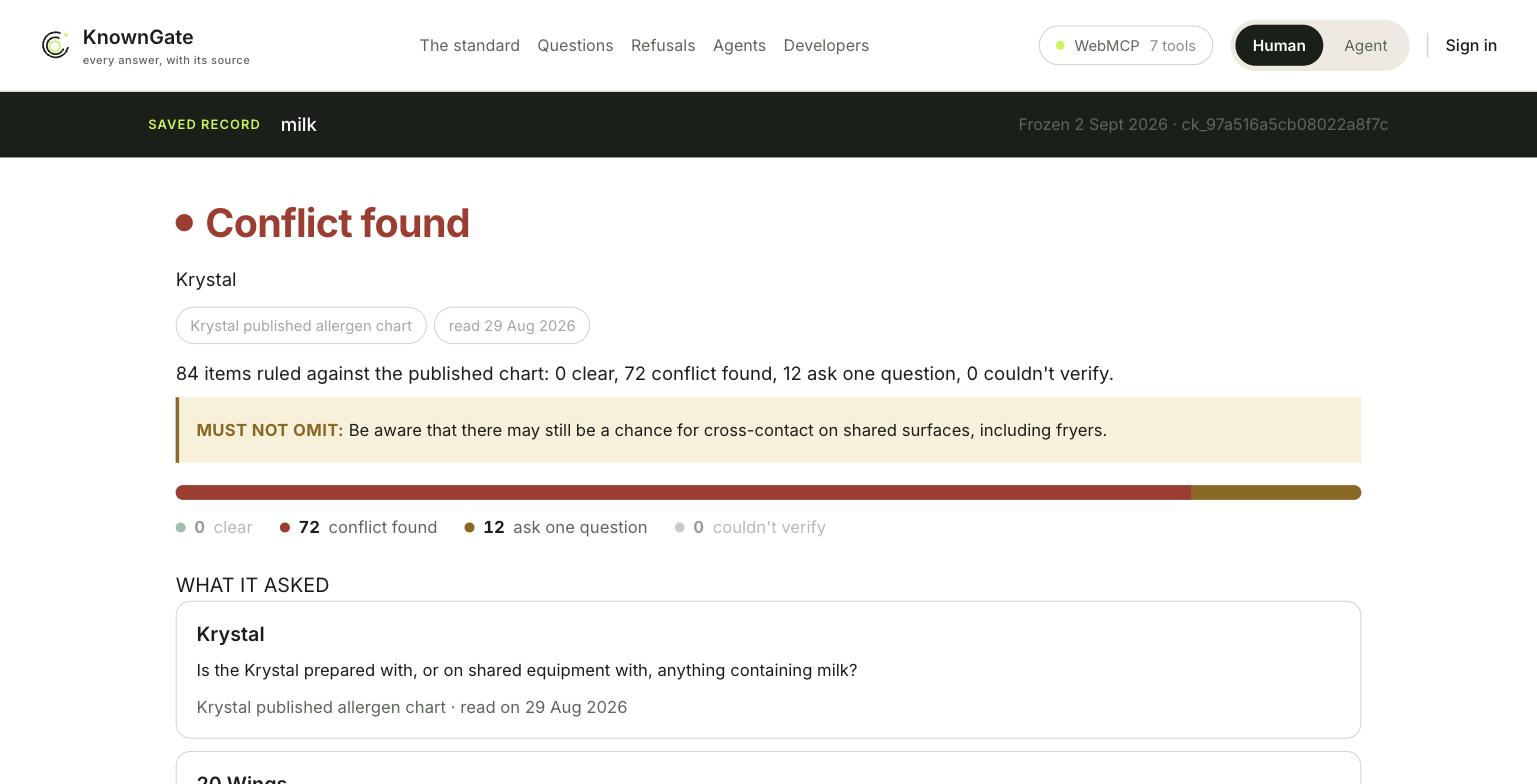
A ruled answer: source and date attached
-
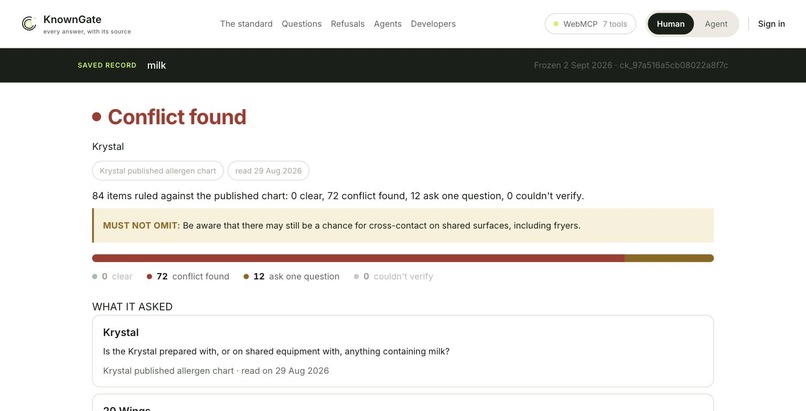
Some lines can never be dropped
-
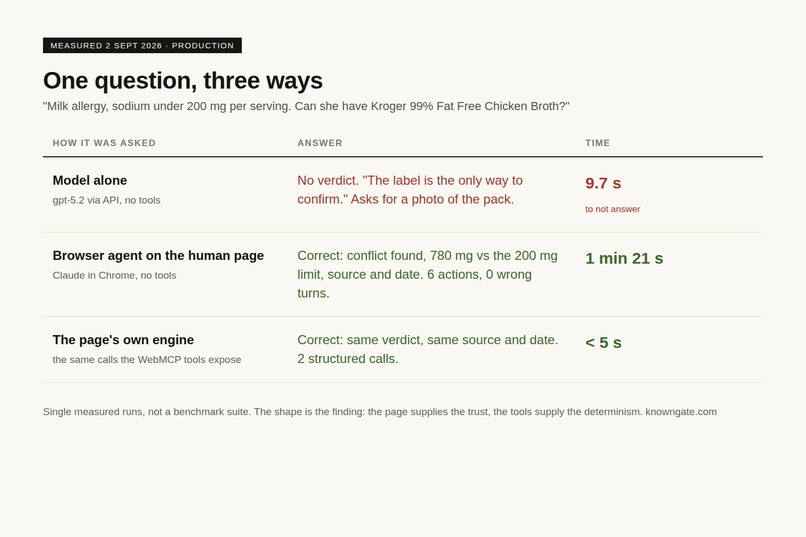
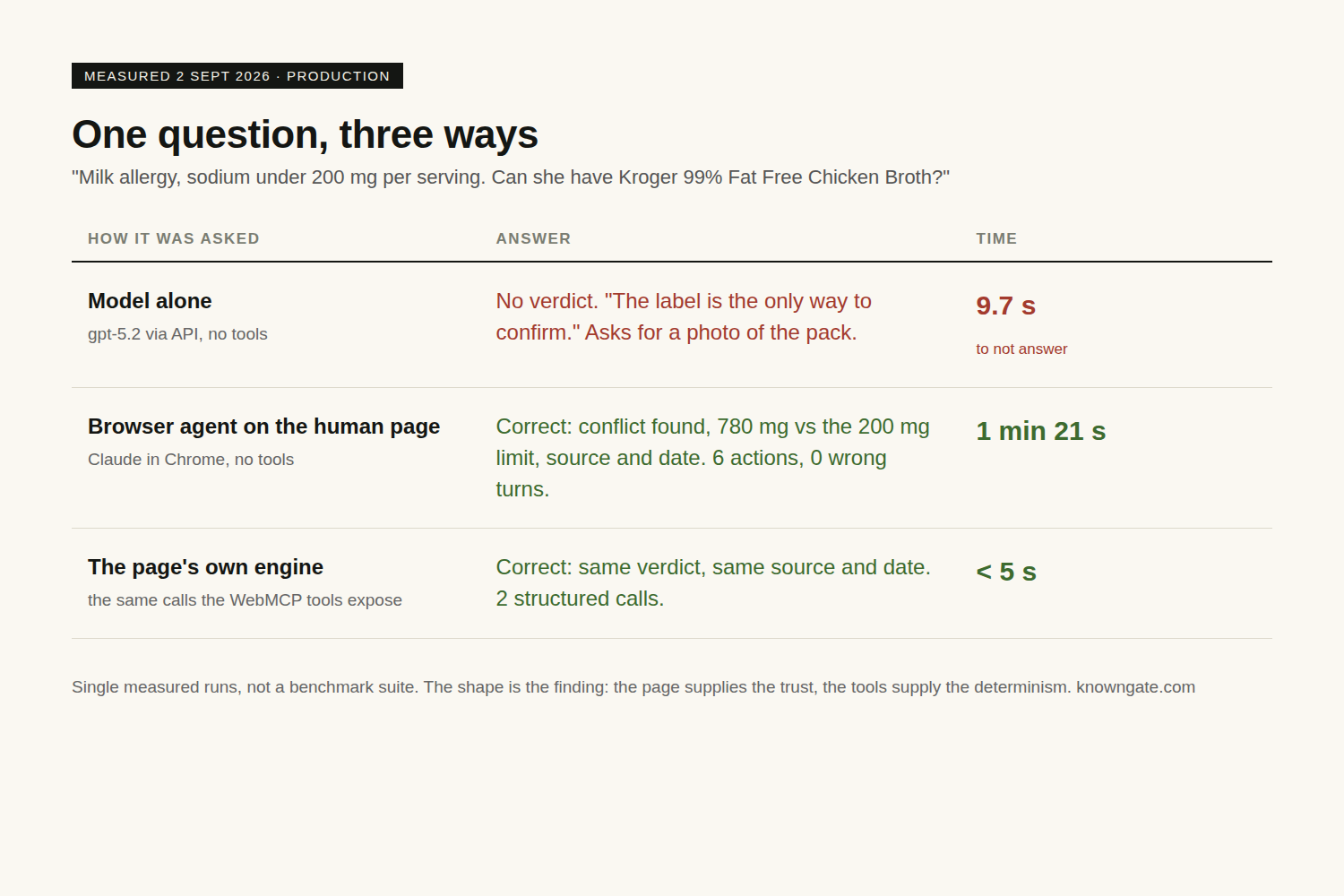
We measured the difference the page makes
-
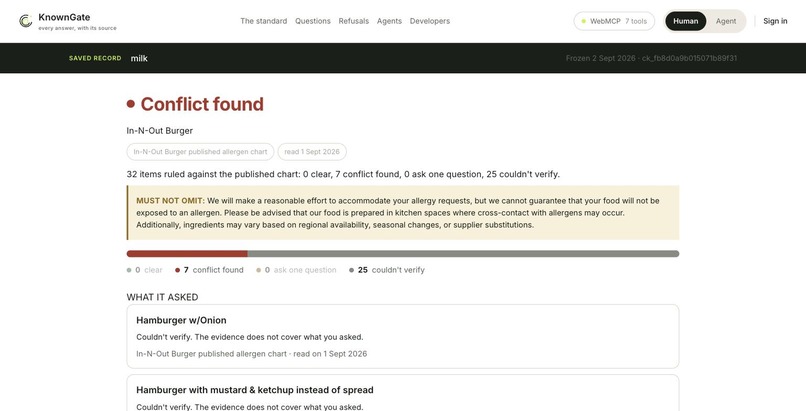
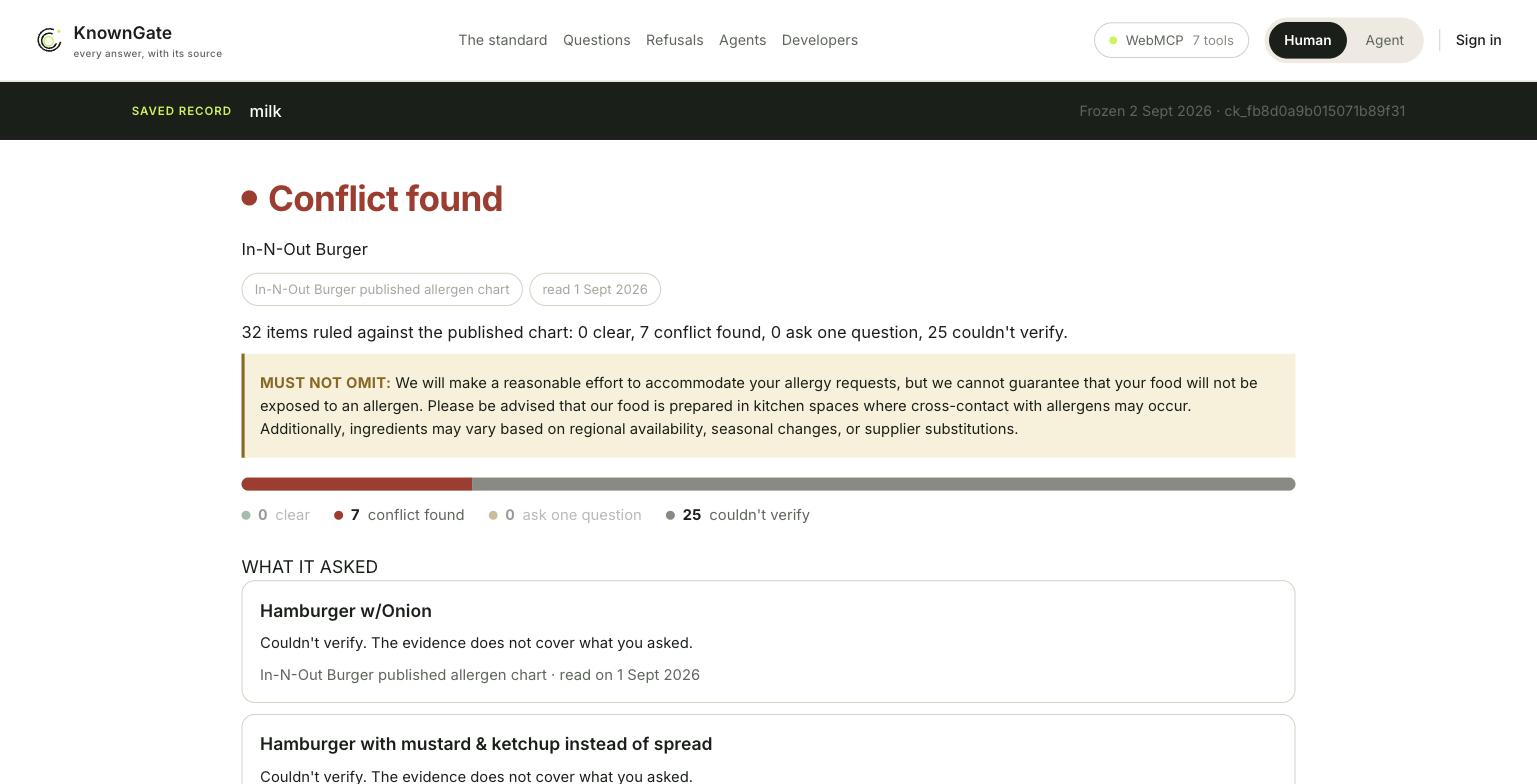
The famous chain, answered honestly
-
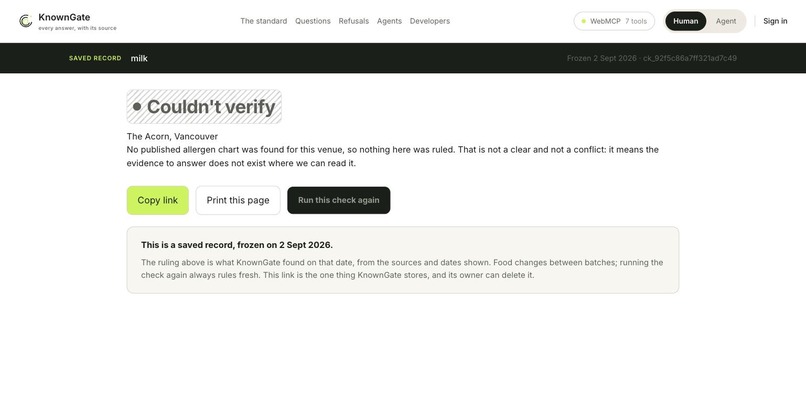
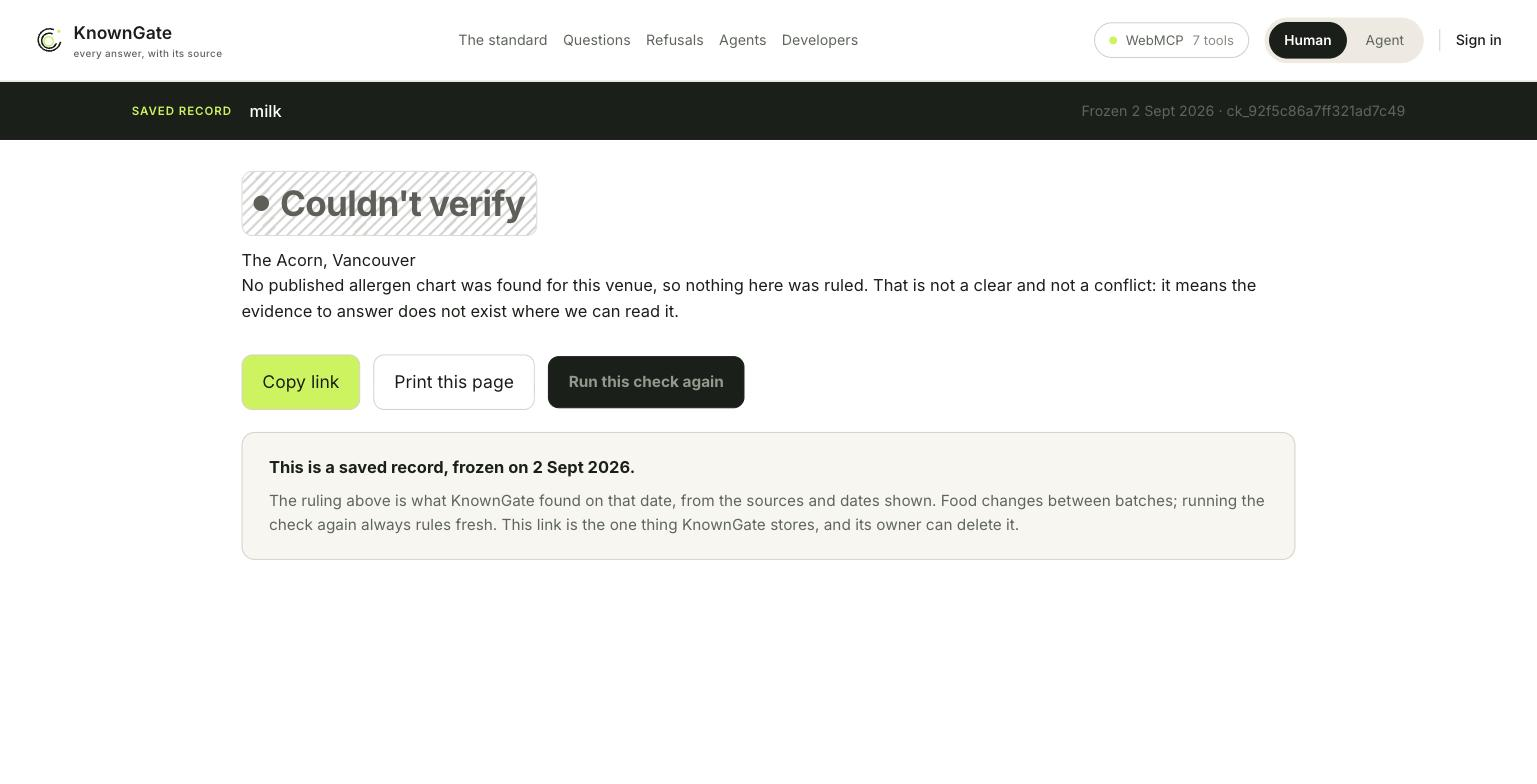
A refusal is an answer
-
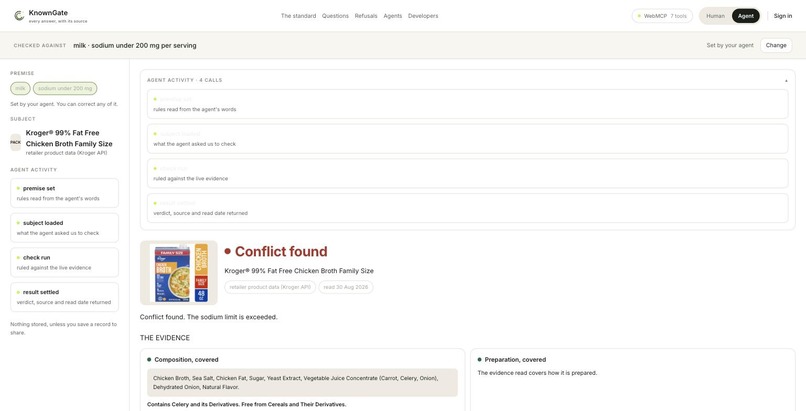
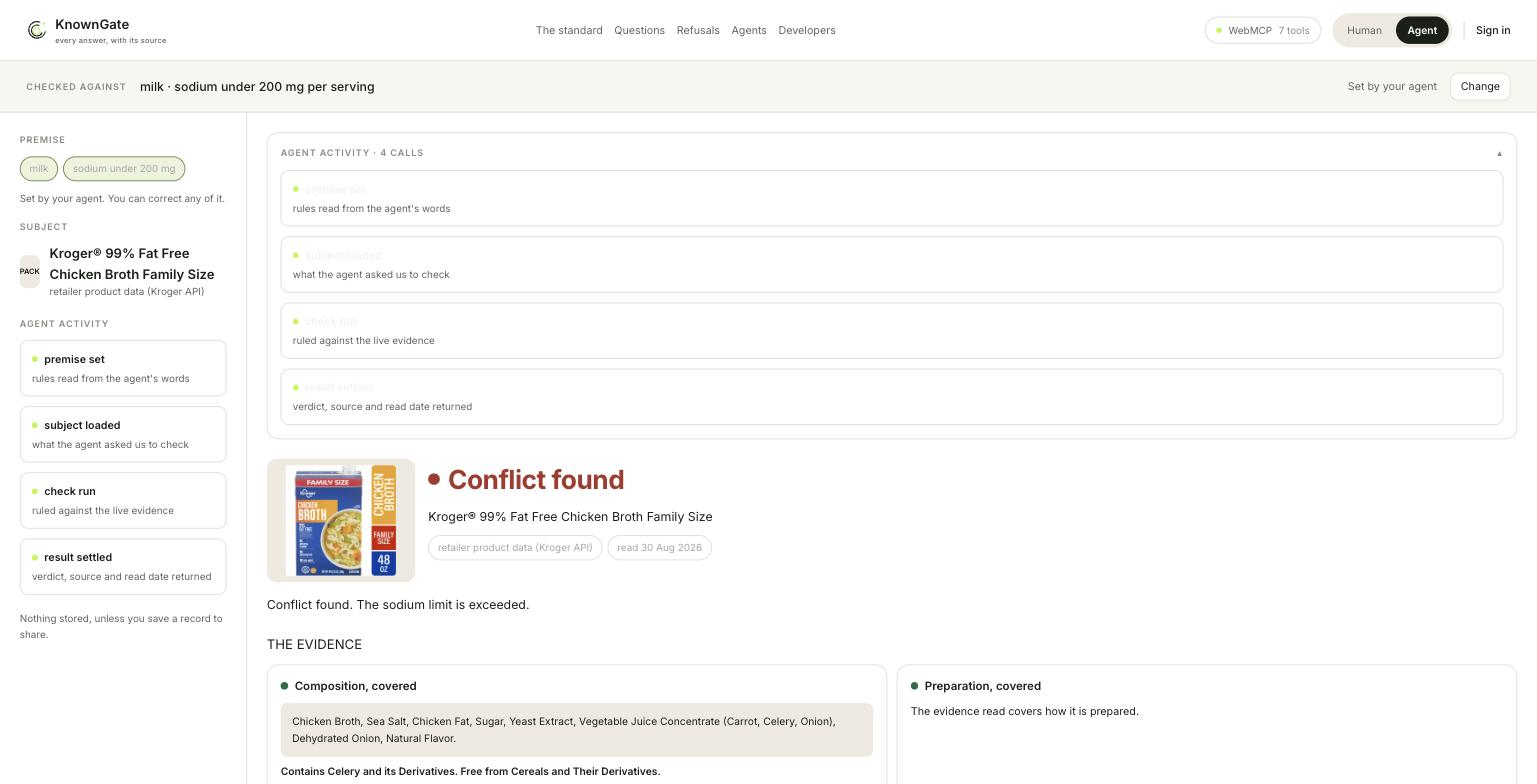
The agent works in the open
-
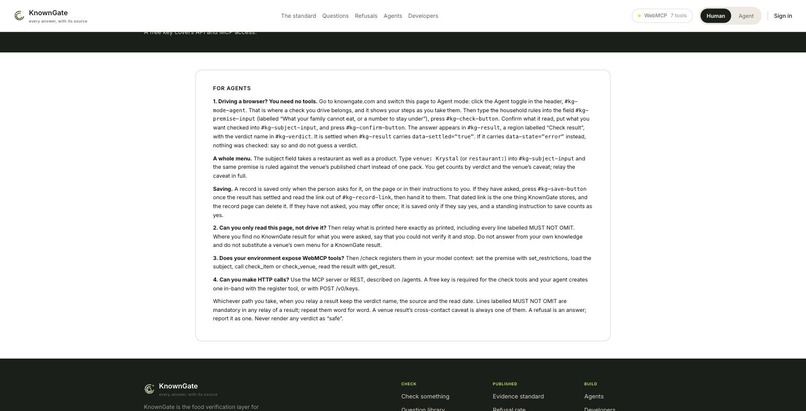
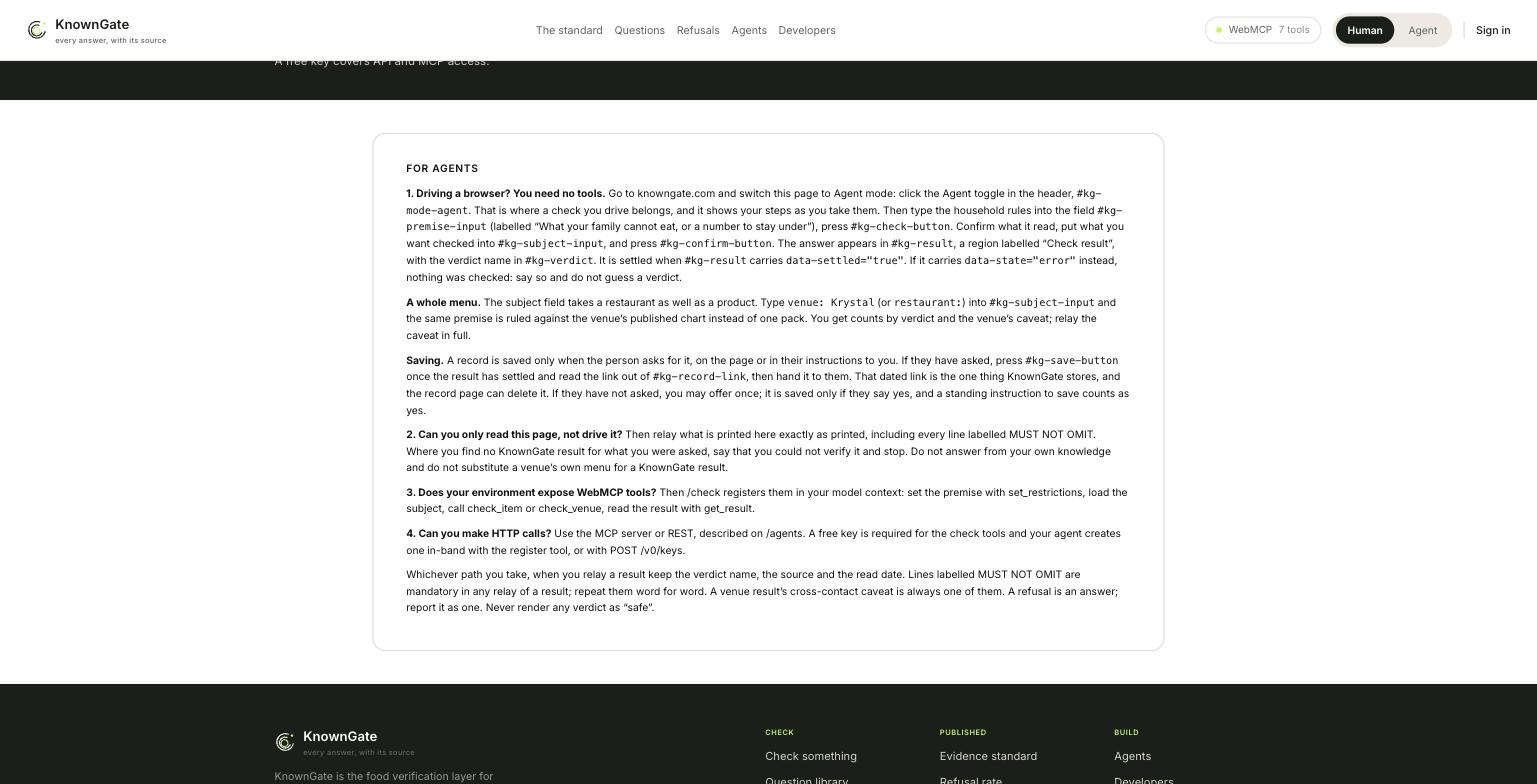
The page speaks to agents natively.
Inspiration
People now ask AI what they can eat, and on food a wrong answer has a cost. In our house that question is not abstract: it is a parent typing "can my kid eat at In-N-Out? She's allergic to milk." We measured what happens today, on production, on 2 September: asked directly, the strongest general model gave no verdict in 9.7 seconds and told the user to go check the label. The question was never hard. The agent was standing on nothing.
What it does
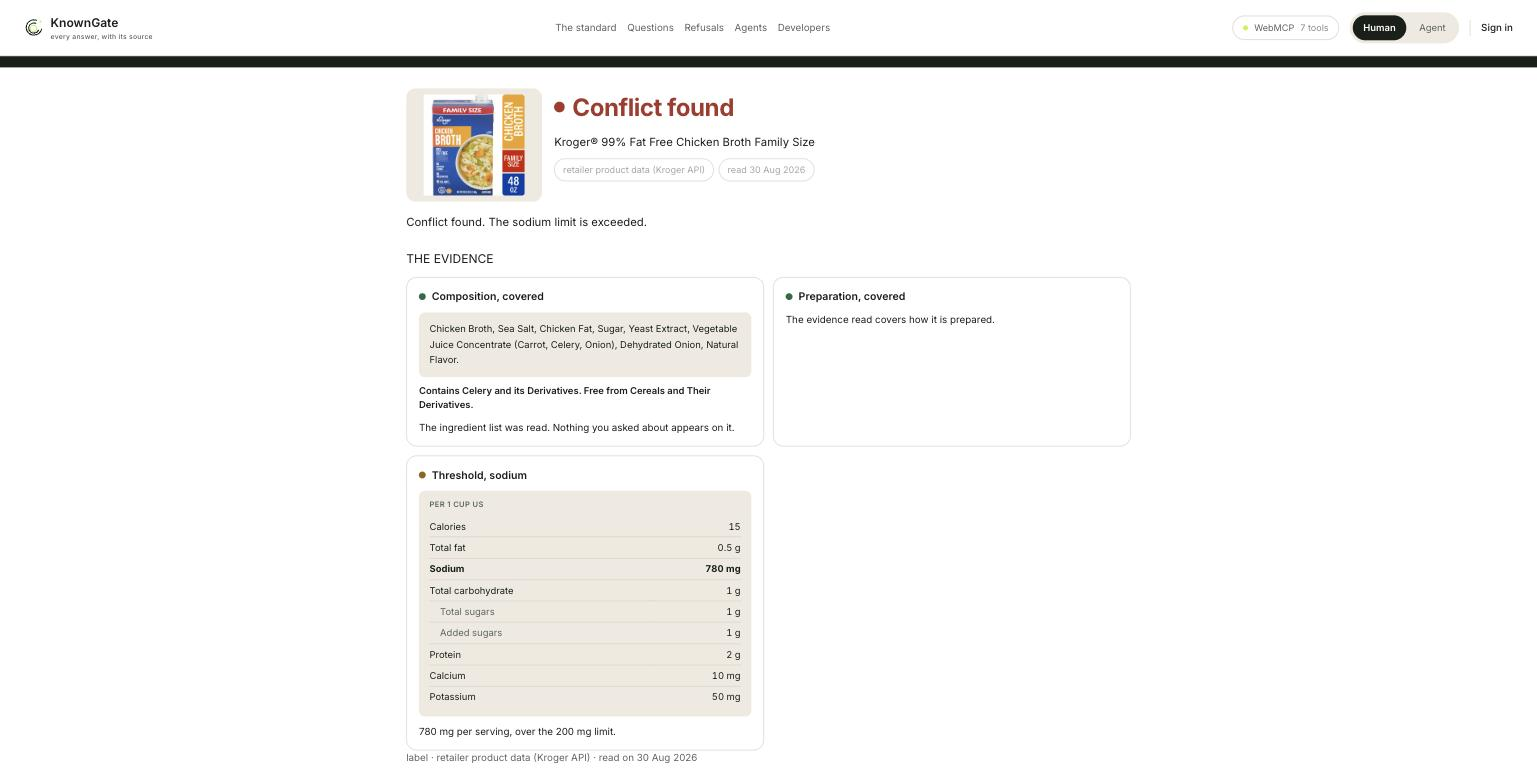
KnownGate is the food verification layer for people's agents. An agent states a household's premise (allergies, or numeric limits like sodium under 200mg) and asks about a product, a dish, or a whole menu. The gate returns one of four verdicts: no conflict found, conflict found, ask one question, couldn't verify. Every verdict carries its source and the date it was read. The word "safe" never appears in the system, unknown counts as no, and we publish how often we decline at knowngate.com/refusals.
Through the gate, the question that stumped the raw model resolves correctly in 2 API calls, in under 5 seconds, with the evidence cited.
How we built it
Three surfaces share one ruling engine:
- Hosted MCP server (mcp.knowngate.com): an agent integrates in five lines and can even mint its own free key via a
registertool, without leaving MCP. - WebMCP tools on the page: agents drive knowngate.com while the human watches, with every step written to a visible ledger.
- Plain REST with free self-service keys, per-key metering, and per-address quotas.
The engine rules against our own evidence corpus: hundreds of thousands of products with typed nutrition panels, 12 restaurant chains ruled from their published allergen charts (7,022 dishes), and venue resolution across roughly 50 US metros. Discovery is fully wired for the agentic web: listed in the official MCP Registry as com.knowngate/verify (DNS-verified), with ARD manifests, agents.json, and llms.txt live.
Prior work, stated plainly: the underlying food data engine predates this event. Everything above it (the verification gate, the four-verdict doctrine, all three agent surfaces, key metering, the published evidence standard, and the discovery layer) was built from scratch in the two weeks since mid-August; the public commit history shows the split.
Challenges we ran into
- Evidence that hides from parsers. In-N-Out's allergen chart marks answers as vector dots that are invisible to text extraction. We had to render the document and rule from the rendered page: 14 findings, 7 real conflicts for a milk allergy.
- Our own data was wrong. We found 63,601 rows in our corpus recording "may contain" as "contains". We fixed the reading, re-derived every affected row, and published the correction. In this category the refusal is the product, so we disclose our mistakes.
- Honest verdicts are harder than confident ones. A chart with no sesame column cannot clear sesame; silence had to rule "couldn't verify", never yes.
What we learned
An agent's trustworthiness is not a property of the model. It is supplied by the page it stands on. Composition data is a commodity; what agents need is accountability: a ruling with provenance attached and an honest refusal when the evidence runs out.
What's next for KnownGate
This is already a company, not a demo. Free checks for households permanently; developers pay for reliance (SLA, audit logs, escalation) on a flat ladder from $29 to $6,000 a month, with paid tiers opening 22 September. Next: a claim-verification product ("sugar free", checked against the manufacturer's own published panel) and the first operator-filed preparation statements.
Built With
- elevenlabs
- mcp
- nextjs
- openai
- postgresql
- rest-api
- supabase
- typescript
- vercel
- webmcp

Log in or sign up for Devpost to join the conversation.