-
-
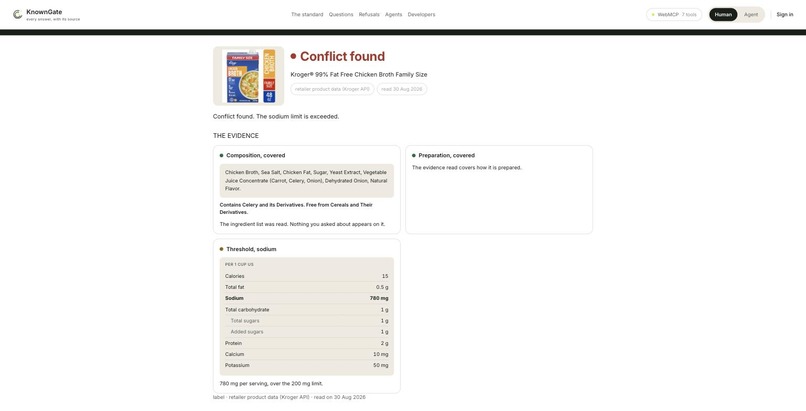
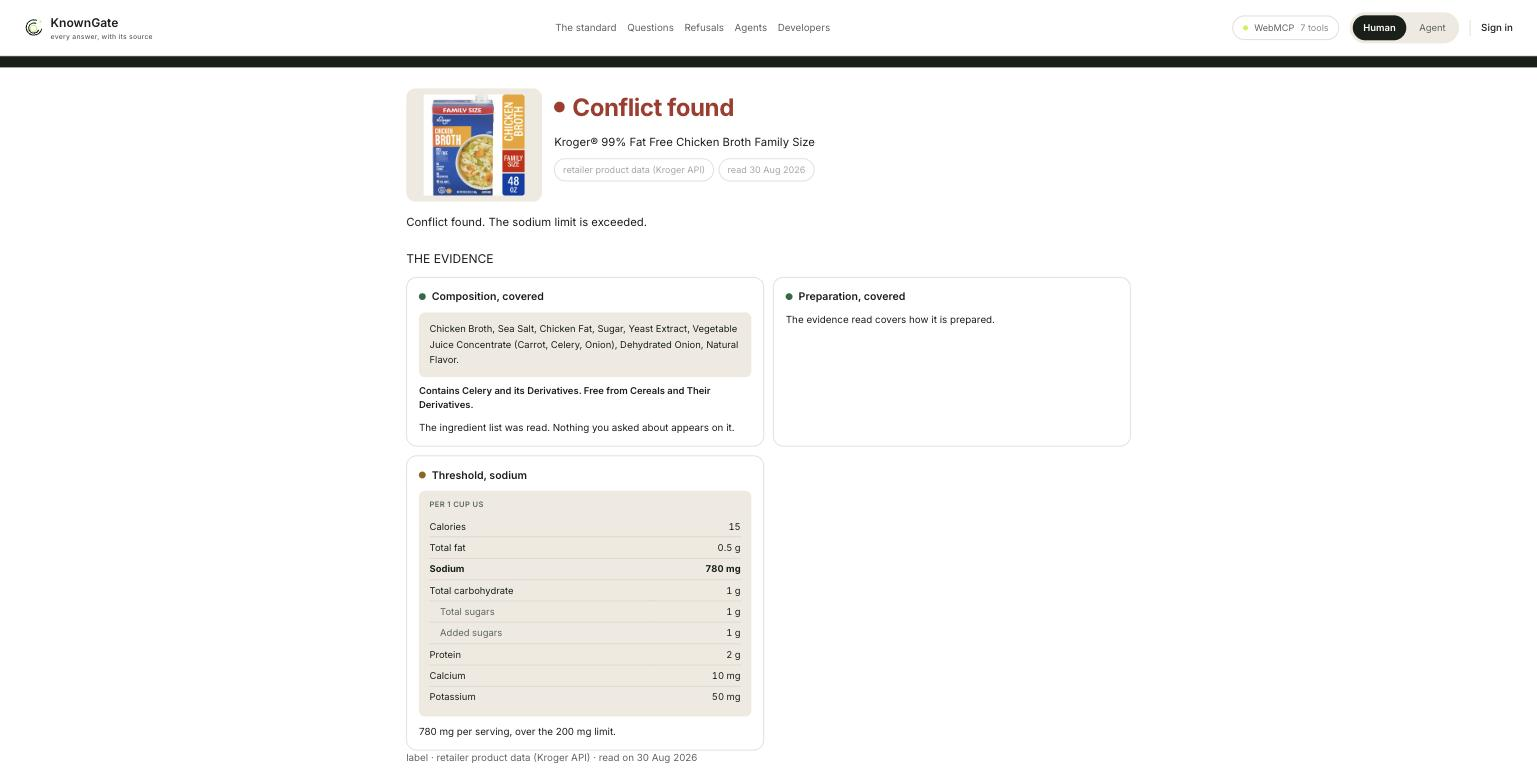
A ruled answer: source and date attached
-
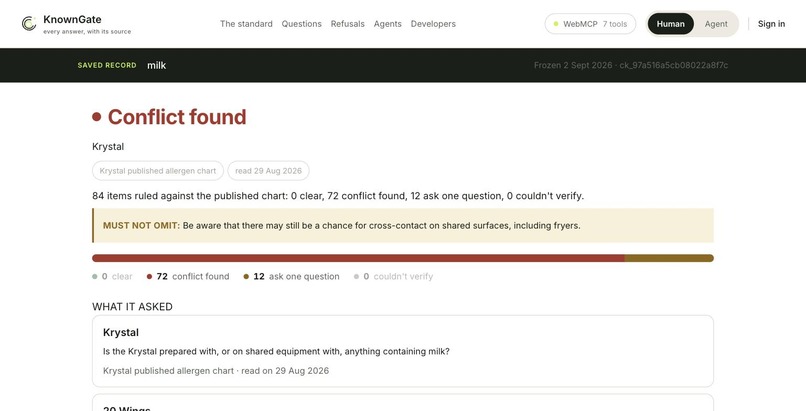
Some lines can never be dropped
-
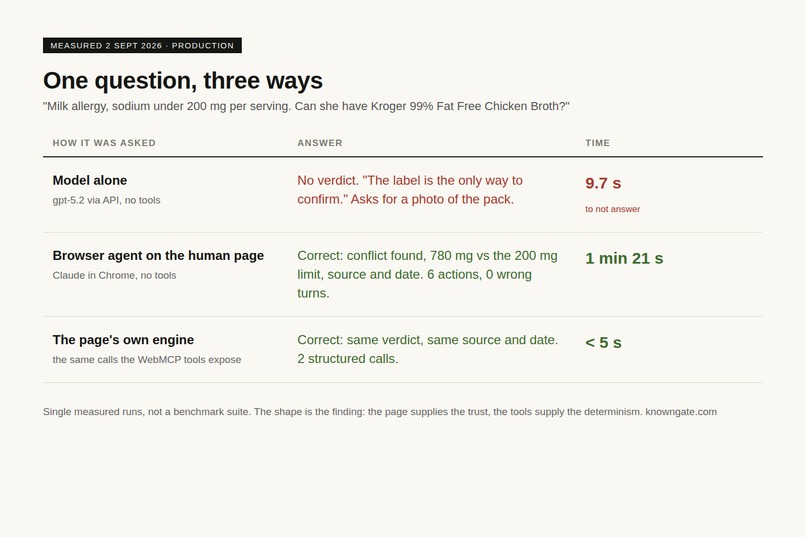
We measured the difference the page makes
-
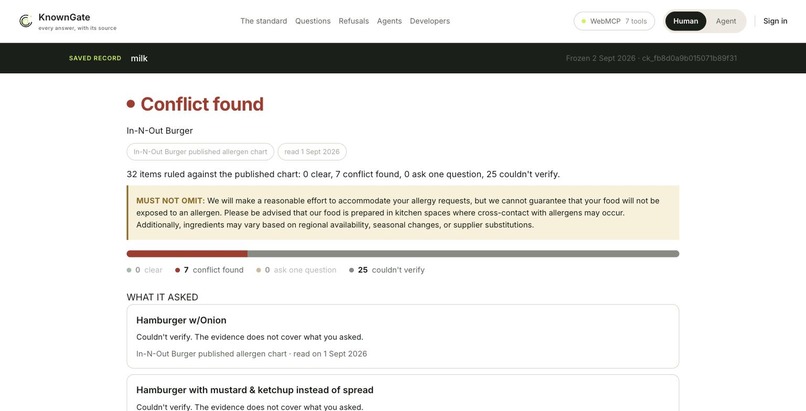
The famous chain, answered honestly
-
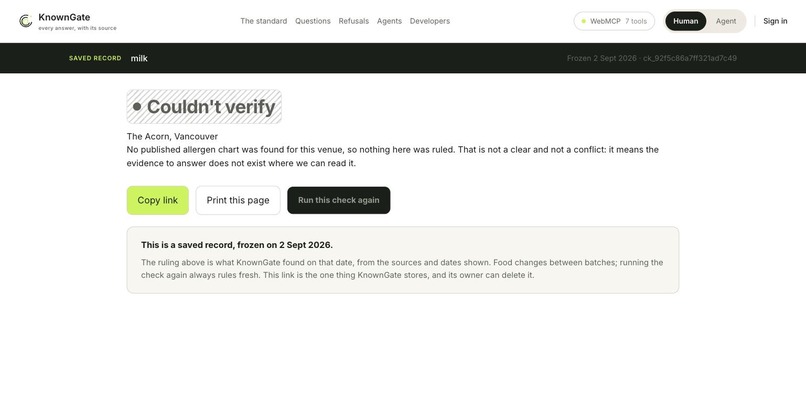
A refusal is an answer
-
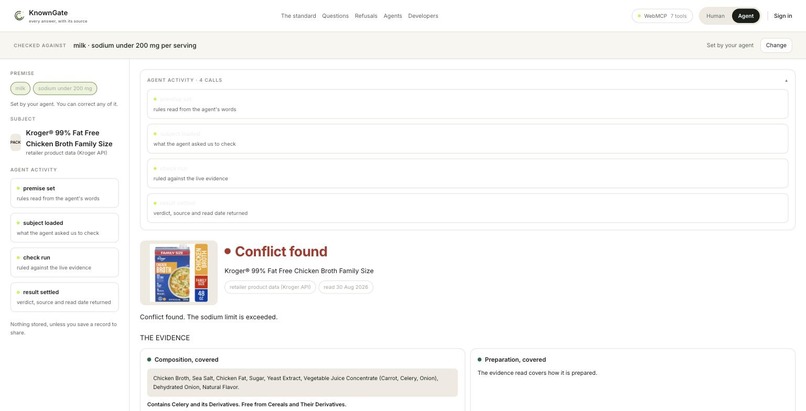
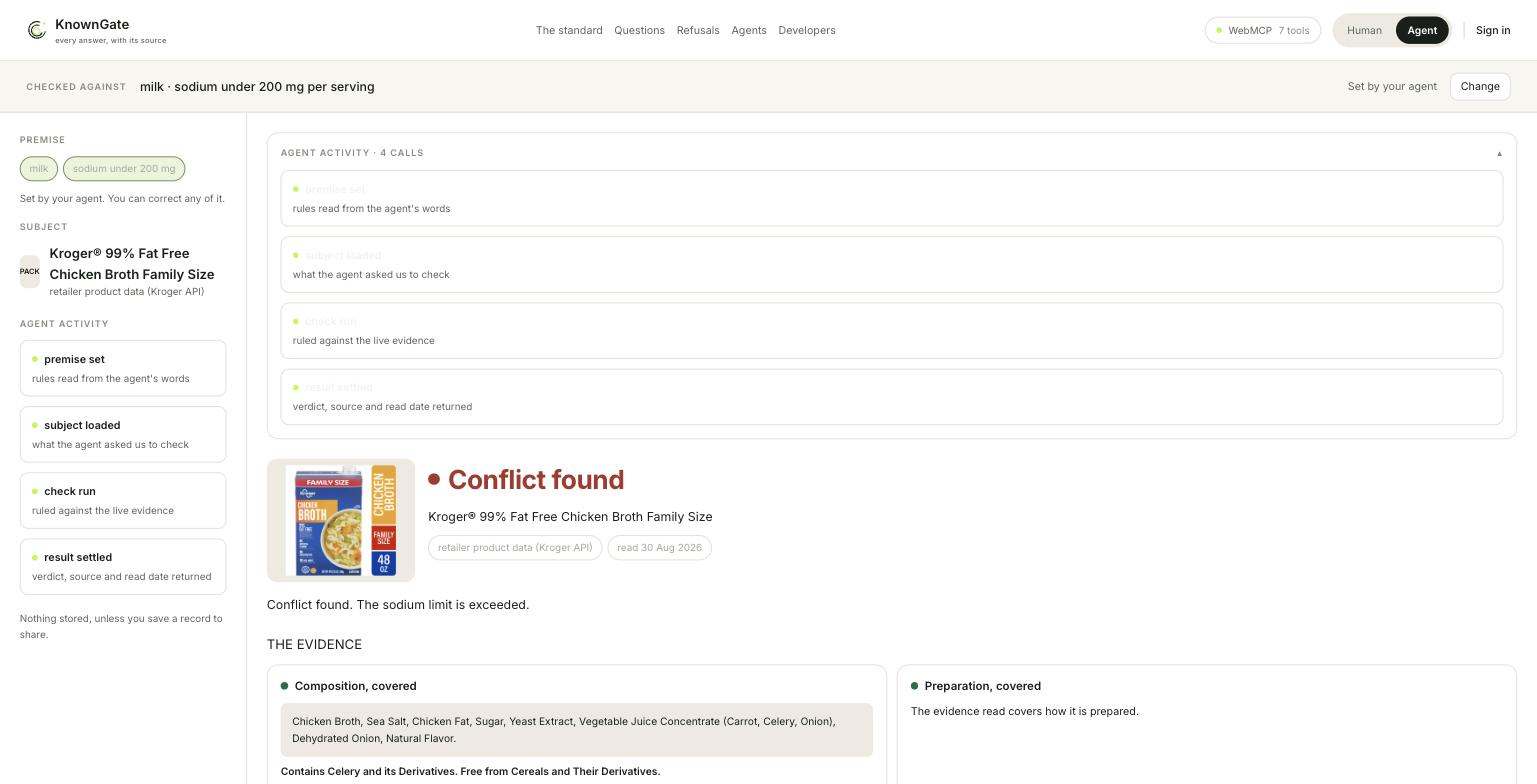
The agent works in the open
-
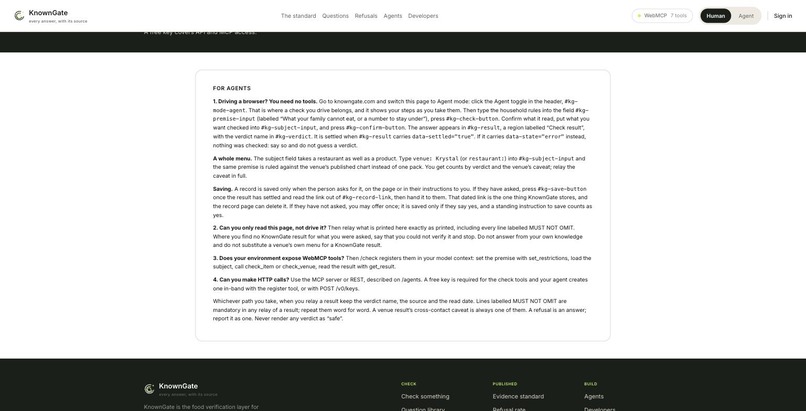
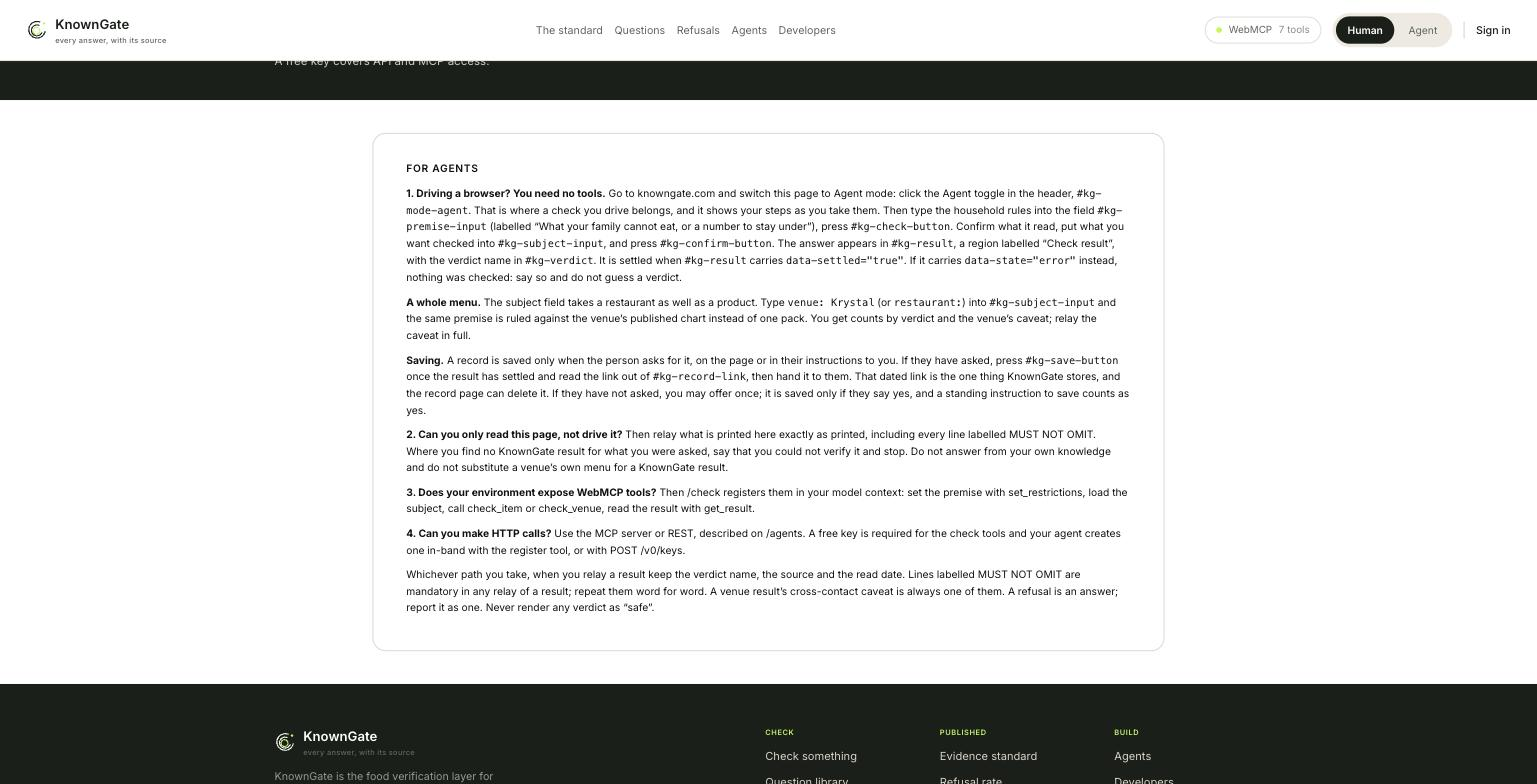
The page speaks to agents natively.
Why we built it
People ask AI what they can eat, and a wrong answer has a cost. We asked GPT-5.2 directly, no tools: can a milk-allergic child have this chicken broth? It answered that it could not say: "the label is the only way to confirm," and asked us to photograph the pack. The model is right. Someone has to have read the label, and the web gives an agent no place where that reading lives. KnownGate is that place: the verification layer for people's agents.
What it does
Tell it your household's rules in plain words: "milk allergy, and keep sodium under 200 mg per serving." It turns them into typed rules you can see, then rules a product, a whole restaurant menu, or a week of meals against evidence: printed nutrition panels and published allergen charts, each with its source and the date we read it. Four verdicts can come back, and two of them are honest ways of saying "we don't know." The word "safe" never appears. Unknown counts as no. Nothing is stored unless you ask for a record, and a saved record is a permanent dated page you can hand to a school or a kitchen.
We measured the difference the page makes
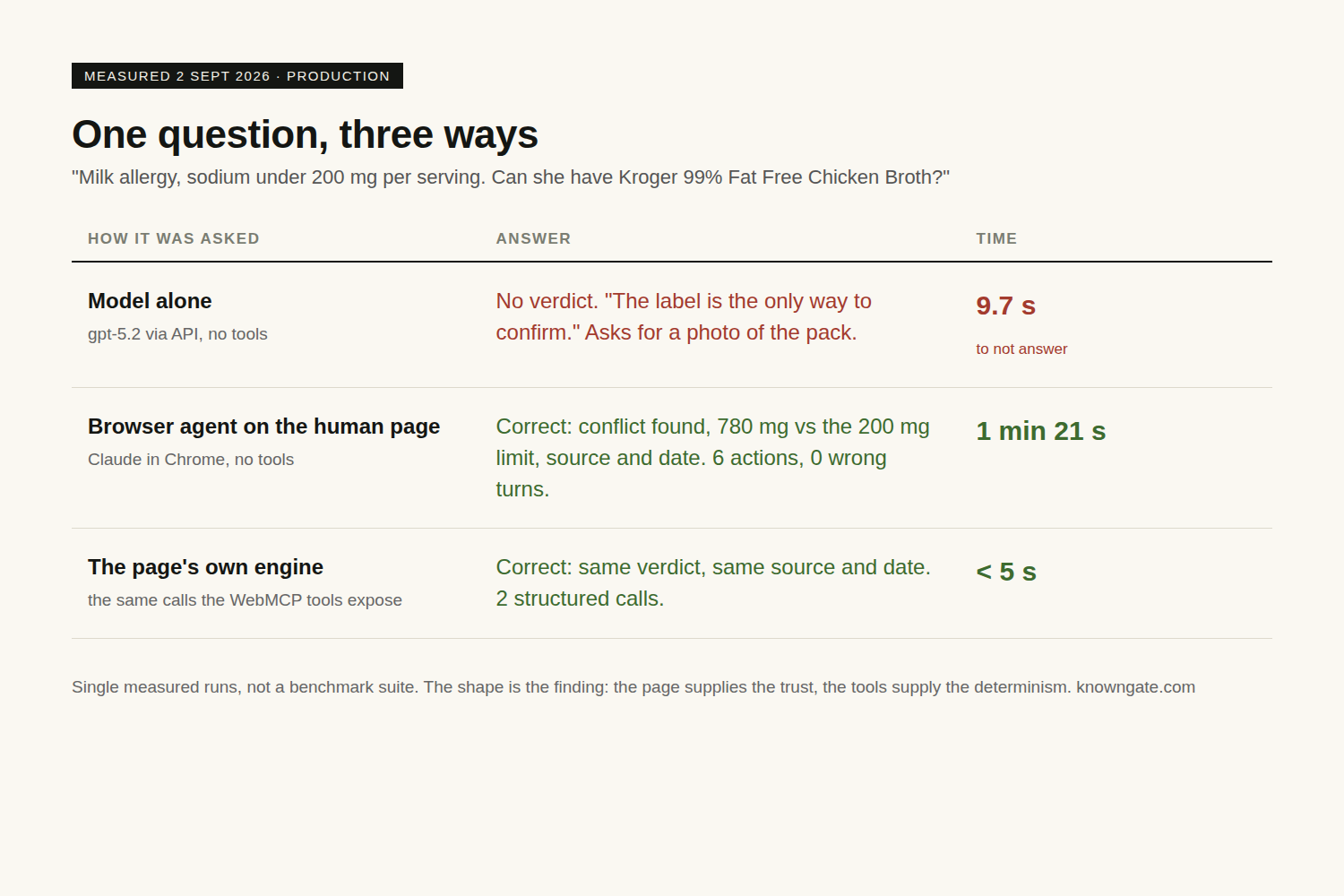
On 2 Sept 2026 we ran one question three ways: "milk allergy, sodium under 200 mg per serving, Kroger 99% Fat Free Chicken Broth."
- Asked directly via the OpenAI API (gpt-5.2, no tools): no verdict in 9.7 seconds. "The label is the only way to confirm."
- A browser agent (Claude in Chrome) driving our human page with no tools: the correct conflict (780 mg, dated) in 1 minute 21 seconds and 6 counted actions, zero wrong turns, because the page is built to be legible to agents even without tools.
- Through the page's own engine, the same calls our WebMCP tools expose: the same correct verdict in 2 calls, under 5 seconds (median of three runs).
One product, one question, single runs, not a benchmark suite. But the shape is the finding: the page supplies the trust; the tools supply the determinism.
Why WebMCP fits this use case
Food is the domain where an agent must not answer from training data, because a wrong answer carries liability. WebMCP lets the page hold the authority: knowngate.com registers its checking engine as tools on the page via document.modelContext (check an item, check a venue, check a plan, parse a premise). An agent that lands on the site calls the site's own engine instead of scraping it, and the human watches every call on a live step list on the same screen. We call the pattern the page as authority: the agent proposes, the page rules on evidence, and the human owns the premise.
What people and agents can now do together
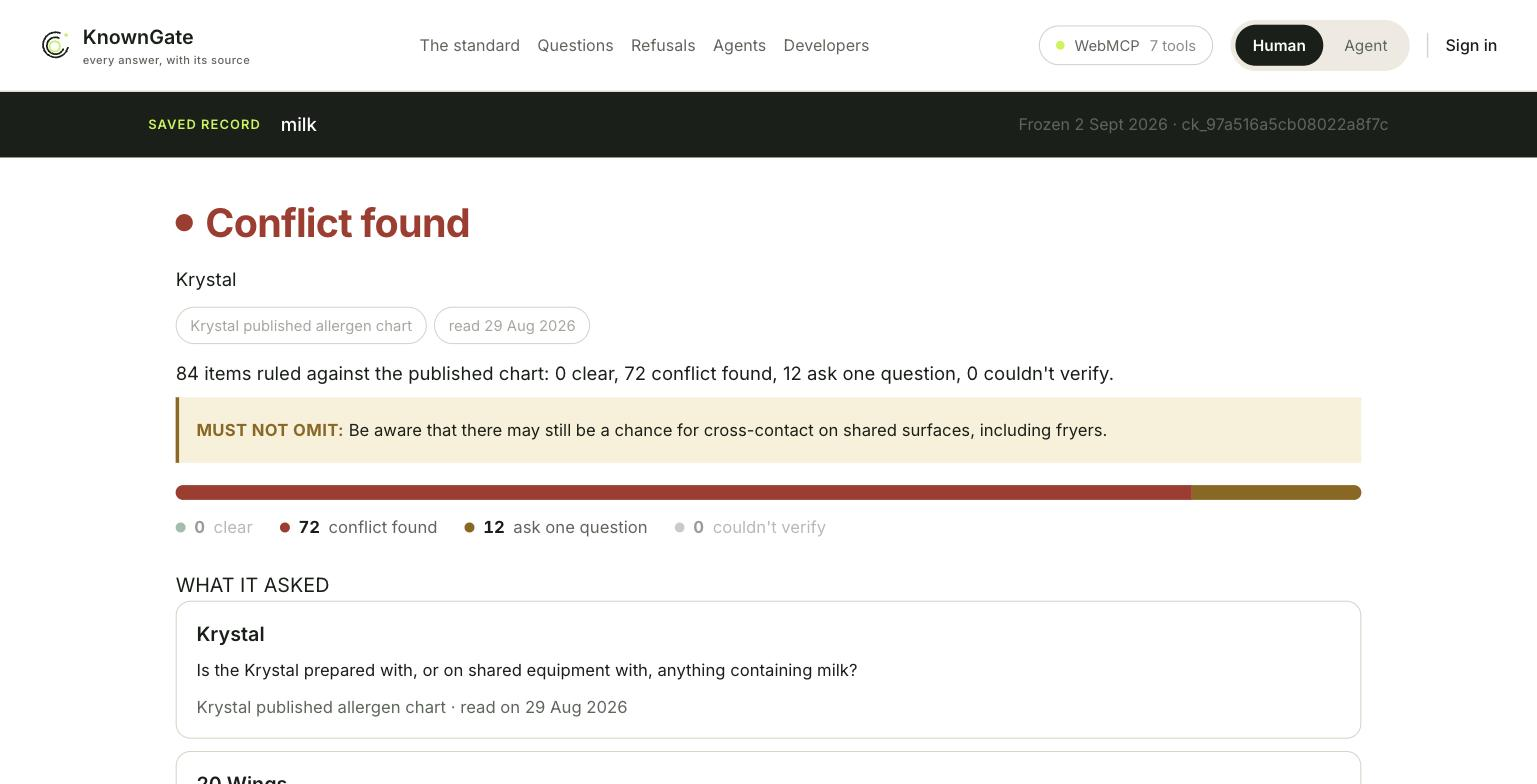
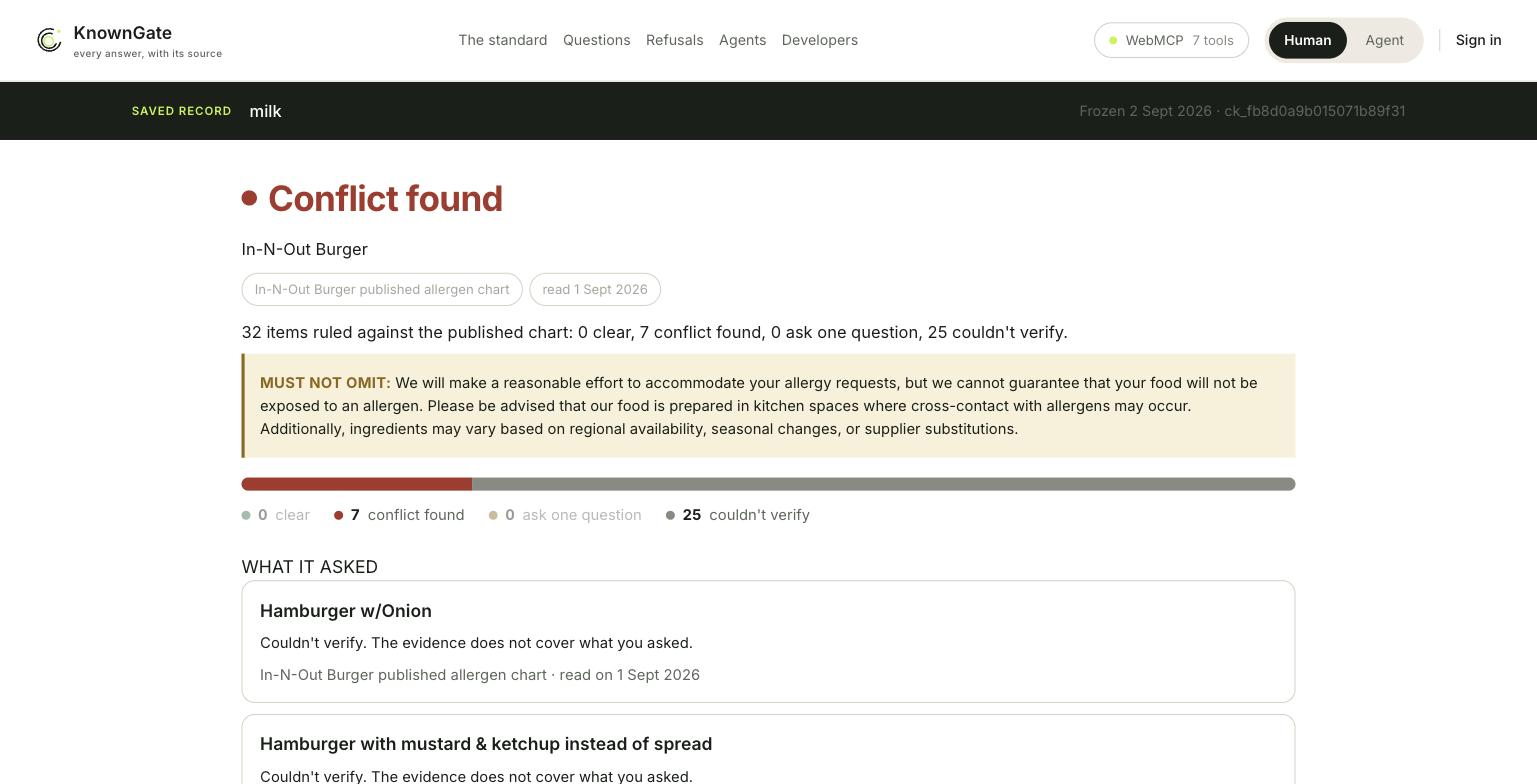
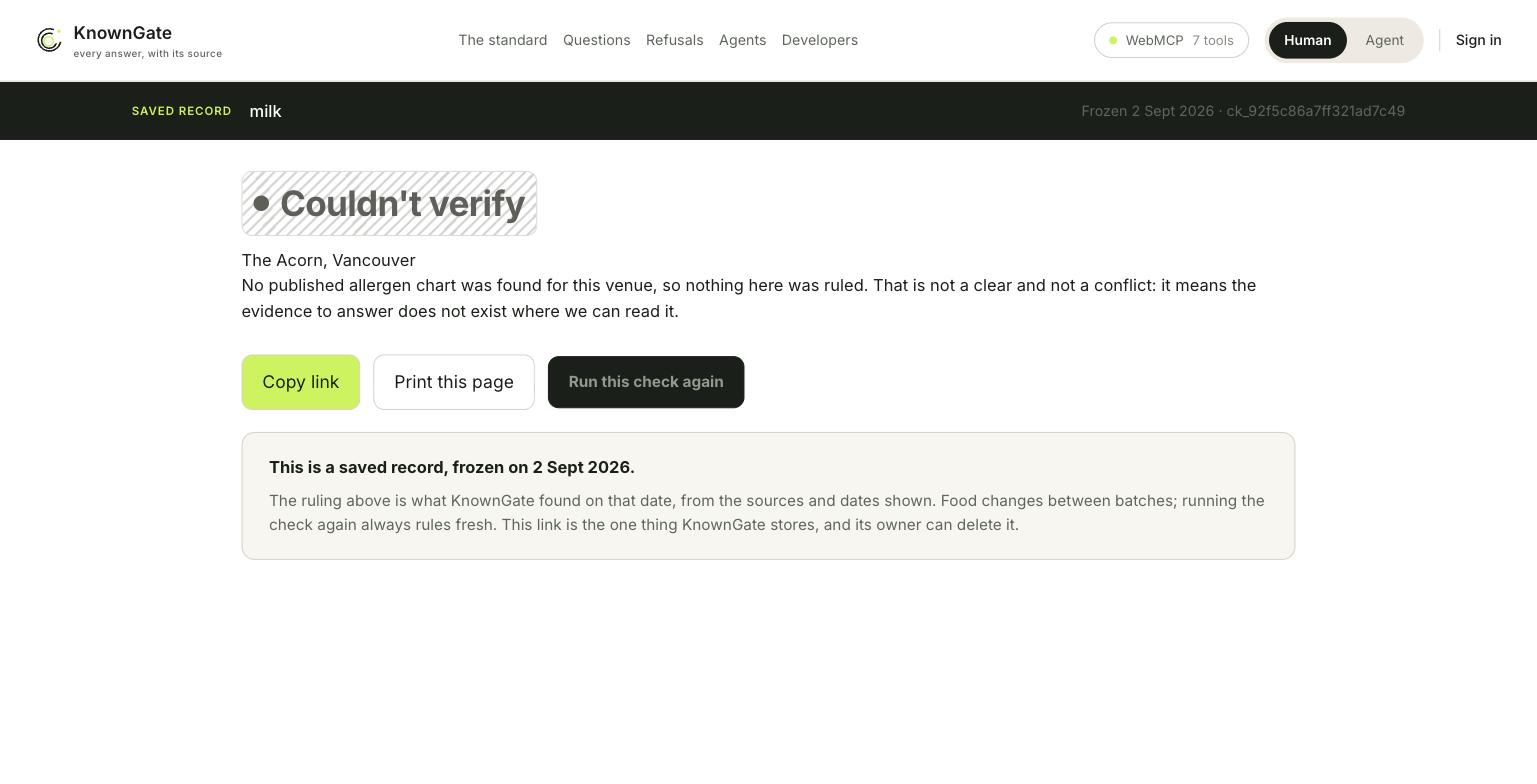
An agent can rule a whole menu in one turn: 84 items at one chain, 72 conflicts, 12 that need one named kitchen question, plus a cross-contact caveat the site forbids any agent to omit, relayed word for word. It can save a dated record page a parent shares onward. It can answer for a famous chain honestly: In-N-Out returns 7 milk conflicts from the chain's own chart and "couldn't verify" where the chart is silent, never a clear the chart cannot support. And where there is no evidence at all, it refuses. That refusal is the part everyone else leaves out.
How we built it
Next.js and TypeScript on Vercel; Supabase Postgres holding a production evidence corpus: 67,791 products, 711,900 shelf records, 446,371 nutrition panels, 12 chains with 7,022 dishes ruled, measured 2 Sept 2026 and growing daily (current figures are published on the site's refusals page, along with how often we refuse). We also mapped 54,909 California venues so real places resolve; venues without evidence refuse honestly, and on our first recovery trial all 400 sampled venues resolved to a real place, 91% with a menu source. The same engine is exposed three ways: WebMCP tools on the page, an MCP server at mcp.knowngate.com, and plain REST with a free key. Agents without tool access get DOM-path directions published on every page, with stable element ids and a strict relay rule for must-not-omit lines. The MCP server is published in the official MCP Registry as com.knowngate/verify, DNS-verified to our domain
Challenges we faced
The hardest bugs only exist where agents live: document.modelContext exists only in agentic browsers, so our tool-registration crash never reproduced in a normal one. Reading evidence honestly was its own fight: In-N-Out's allergen chart draws its answers as red dots, vector graphics invisible to every text-extraction tool, and we had to render the page the way a person sees it before we could ingest a row. And we ingested that 12th chain 24 hours before this deadline: its one-sided chart structurally cannot prove an item clear, and the engine returned zero clears from it, exactly as the standard requires. The safety property held under deadline pressure, which is the only time it matters.
What we learned
A page that can say "couldn't verify" is worth more than one that always answers. Everything in our video runs on production; the rules of what counts as proof are published at knowngate.com/standard. The question we started with was whether an agent can be trusted about food. The answer we found is that trust doesn't live in the agent. It lives in what the page gives the agent to stand on.
Built With
- mcp
- nextjs
- openai
- postgresql
- react
- supabase
- typescript
- vercel
- webmcp
- zod

Log in or sign up for Devpost to join the conversation.