Inspiration
Choosing dinner with friends sounds simple. Then someone has a strict budget, another prefers a quieter place, and someone else can only make one date. What should be a quick decision turns into a long group chat where everyone has to explain what they can and cannot do.
We wanted to make those decisions easier, especially when people have reasons they would rather keep private.
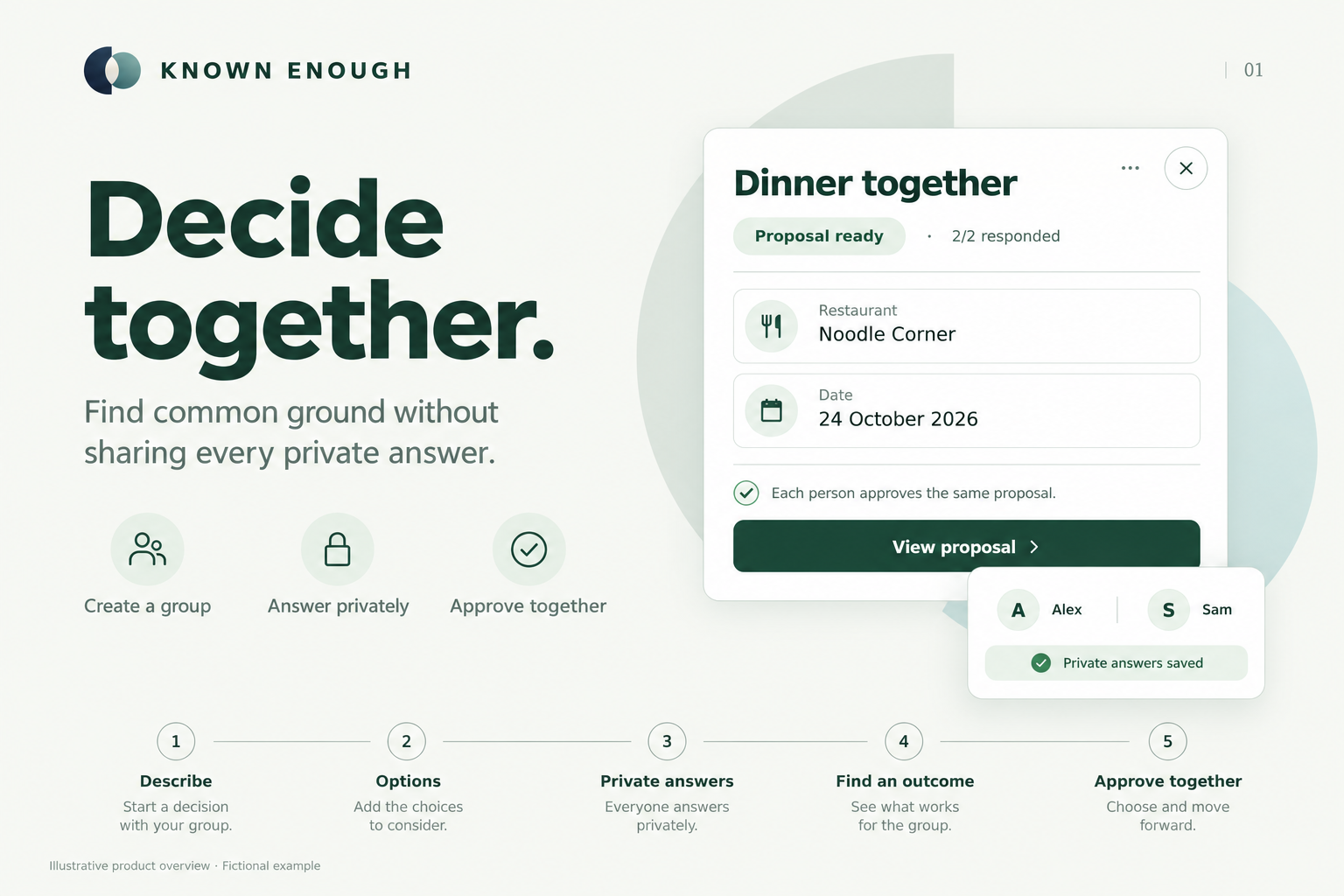
Known Enough helps groups find a choice that works for everyone without requiring everyone to share their personal circumstances.
What it does
Known Enough helps groups make decisions together, from choosing a restaurant or planning a trip to comparing options for a shared purchase.
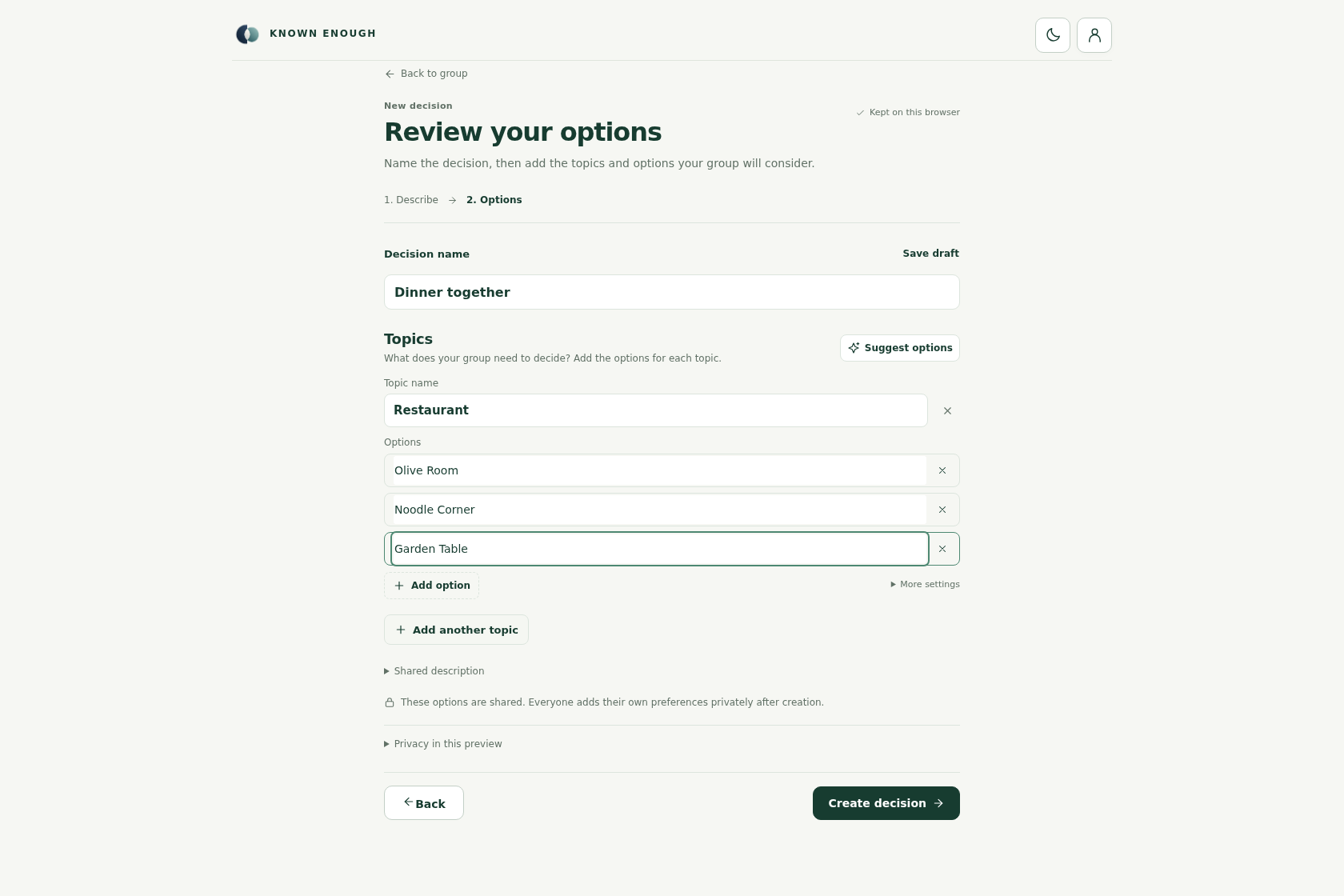
The process starts with someone creating a decision, inviting participants, and adding the things the group needs to choose. For a dinner plan, those might be Restaurant and Date, each with several options. The organizer can add options manually or ask AI for suggestions.
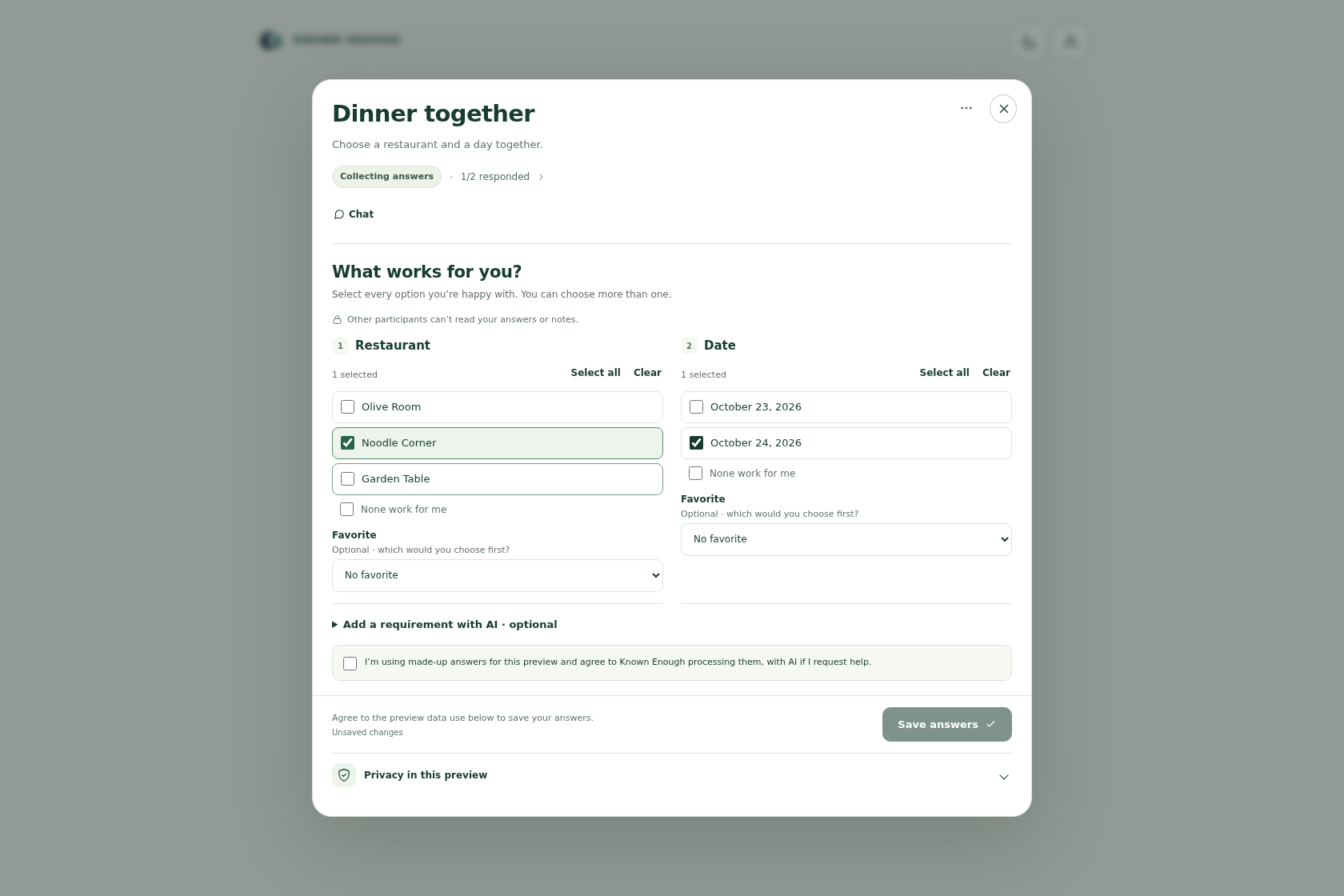
Each participant privately selects the options that work for them, identifies favorites, and can add personal requirements. AI can help interpret those requirements, but participants review them before they become part of the decision.
Once everyone has submitted their answers, Known Enough looks for a combination that satisfies the group's confirmed requirements.
For example, Alex might accept Olive Room or Noodle Corner, while Sam accepts Noodle Corner or Garden Table. If they can both attend on October 24, Known Enough can propose Noodle Corner on October 24 without revealing either person's complete preferences.
If finding a compromise requires adjusting someone's requirement, that person can decide whether to allow it. Everyone then reviews the same proposal and approves it individually. The decision becomes final only after all required participants agree.
The app also has Decision Chat, where the group can discuss its plans, and a Private Assistant, where participants can explore ideas without sharing the conversation. Private messages reach the group only when someone explicitly chooses to post them.
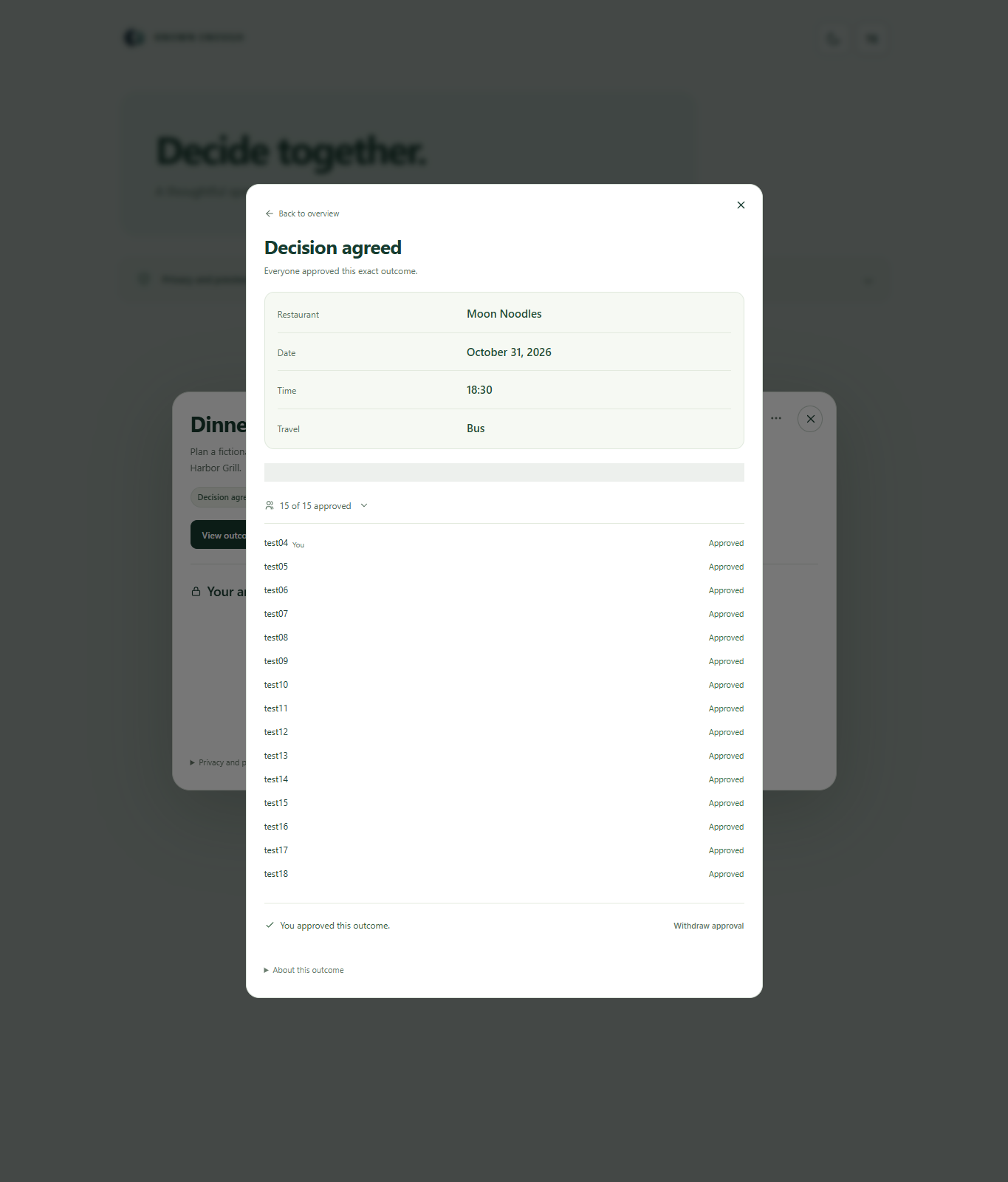
An agreed decision in the application, using fictional test participants.
How we built it
Known Enough was built for the Alexa+ track, using a custom web experience and a self-hosted Model Context Protocol (MCP) server to demonstrate conversational access to group decisions.
The frontend uses React, TypeScript, and Vite. The backend runs on AWS, with Amazon Cognito for authentication, API Gateway and AWS Lambda for application requests, and Amazon DynamoDB for storing decisions, preferences, permissions, approvals, and conversations. Amazon EventBridge and a Lambda worker handle decision processing in the background.
AI-assisted decisions
We use Amazon Bedrock Converse with Amazon Nova Lite for option suggestions, interpreting private notes, selecting candidate outcomes, and conversational assistance.
The model helps the group explore possible choices. Application rules check its outputs against participants' confirmed requirements, permissions, and the current decision state before a proposal can proceed.
Approvals are tied to a specific proposal, so a change to the proposed outcome requires participants to review the updated result.
Connecting the experience through MCP
We built an MCP server using the official TypeScript SDK and Streamable HTTP. It exposes four read-only tools: list_groups, list_group_decisions, get_decision_progress, and get_decision_outcome.
These tools let the assistant retrieve a participant's groups, check decision progress, and report proposed or agreed outcomes.
The web experience also includes a live decision card showing the current proposal and approval count. Its information comes from authenticated application records, allowing the assistant to report the actual state of a decision.
The MCP tools follow the application's access controls and expose only information the requesting participant is permitted to see. Private answers and conversations remain separated from shared decision data.
Our current Alexa+ demonstration runs through the web simulation. Native Alexa+ devices and gated developer tools are not connected.
Challenges we ran into
Managing approvals when decisions change. A participant might approve a proposal while someone else is still responding. We tied approvals to specific proposal versions and used conditional updates to prevent an earlier approval from authorizing a changed outcome.
Making AI outputs dependable. Nova Lite can interpret requirements and suggest possible solutions, but those suggestions still need to be checked. We built validation around choices, permissions, and decision state. Working with structured outputs also required adjustments to our tool schemas and response handling.
Coordinating participants across different sessions. People may save answers or approve proposals at different times, sometimes with unreliable connections. We introduced idempotent operations, version checks, and durable processing to handle retries and avoid recording the same action twice.
Keeping the interface simple. Participants need to understand when they are saving preferences, granting permission for a compromise, or approving a final proposal. We separated these actions and focused each screen on what the participant needs to do next.
Accomplishments that we're proud of
We're proud of bringing the entire decision process into one working experience, from gathering private preferences to finding a shared proposal and reaching an agreement.
Known Enough lets people contribute to a group decision without having to explain every personal constraint. The group can see what needs to happen next, consider a proposed plan, and make the final choice together.
We also brought that process into a conversational experience through our Alexa+ web simulation and MCP integration. Participants can ask about a decision, check its progress, and review the current proposal through an assistant connected to the application's saved state.
The part we care about most is that people remain in control of their own information and their final decision, even when AI helps the group move forward.
What we learned
Building Known Enough showed us how important it is to define exactly what someone is agreeing to. Accepting an option, allowing a compromise, and approving a proposal each need their own rules.
We also learned that privacy has to be enforced throughout the application, including the information available to AI tools and shared conversations.
Finally, integrating AI into a multi-person workflow requires reliable application state. The assistant can help interpret information and suggest next steps, while the backend keeps track of what participants have actually submitted and approved.
What's next for Known Enough
We want to make it easier to understand why a group cannot find a shared option and help participants explore alternatives when that happens.
We also plan to improve invitations, onboarding, and mobile accessibility, and test the experience across more types of group decisions. Native Alexa+ integration is another direction we want to pursue when developer access becomes available.
The current preview supports groups of up to 16 members and decisions between predefined alternatives. It does not verify live prices or availability, make bookings, or provide end-to-end encryption. We recommend using fictional, non-sensitive information when exploring the preview.


