-
-
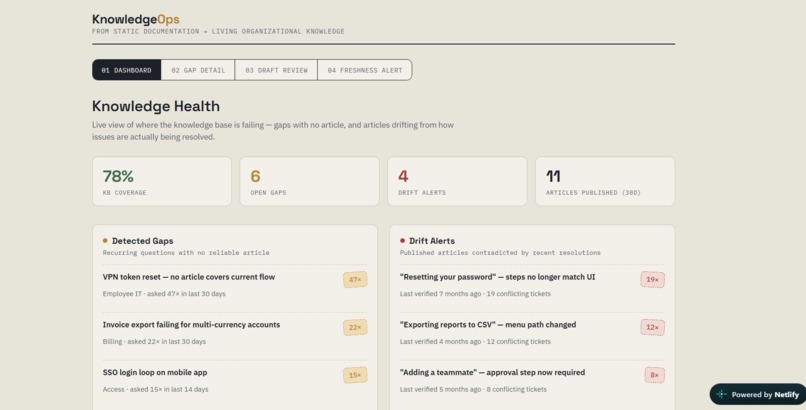
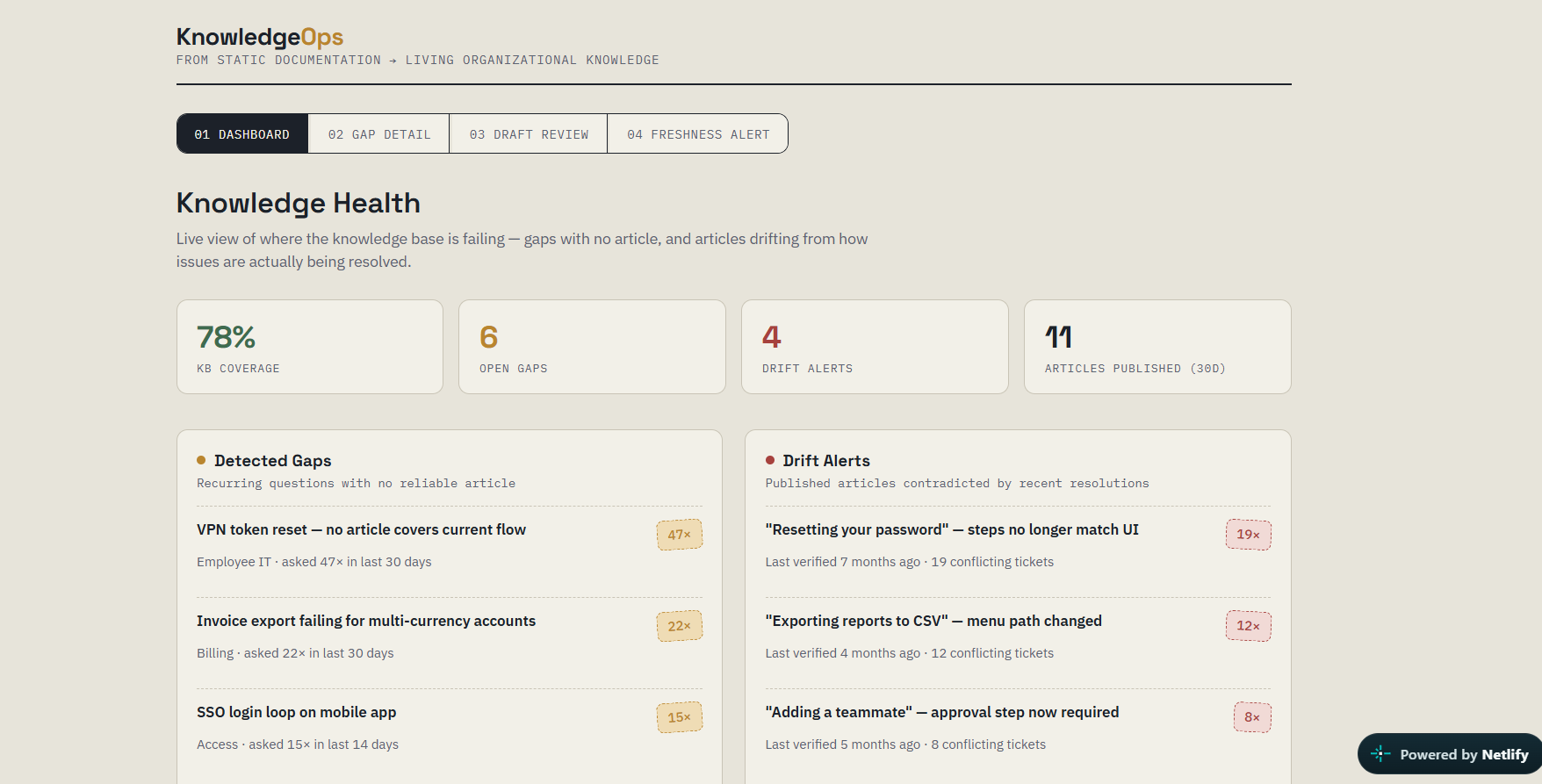
KnowledgeOps Health Dashboard
-
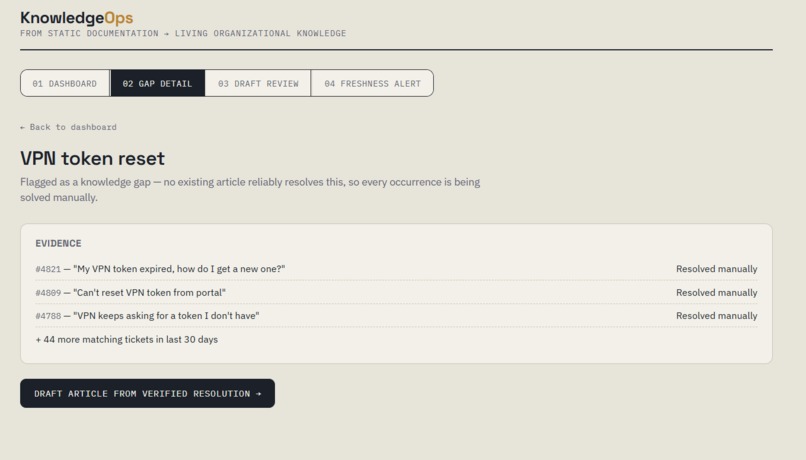
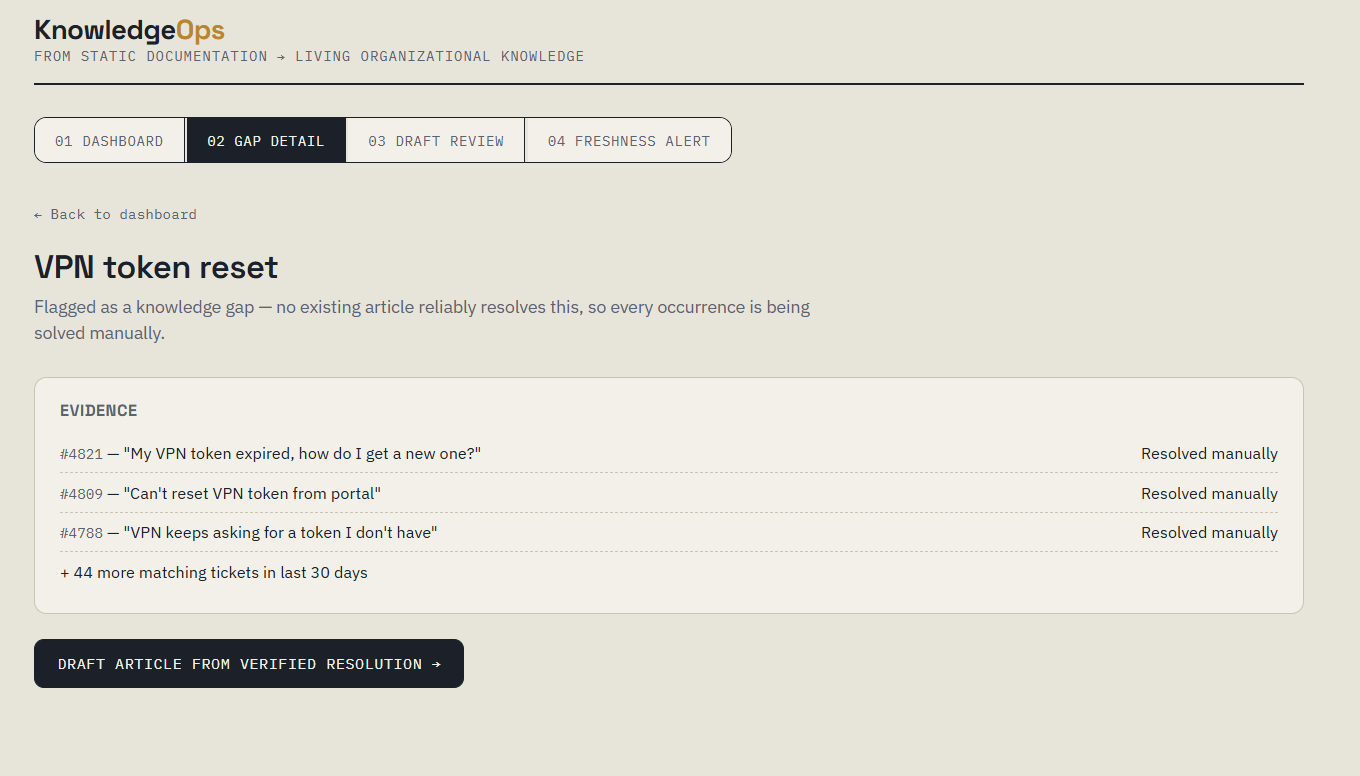
Gaps detected with evidence
-
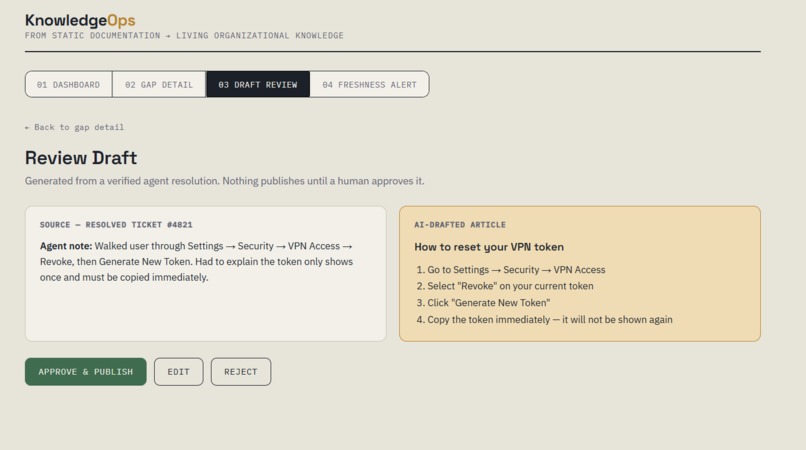
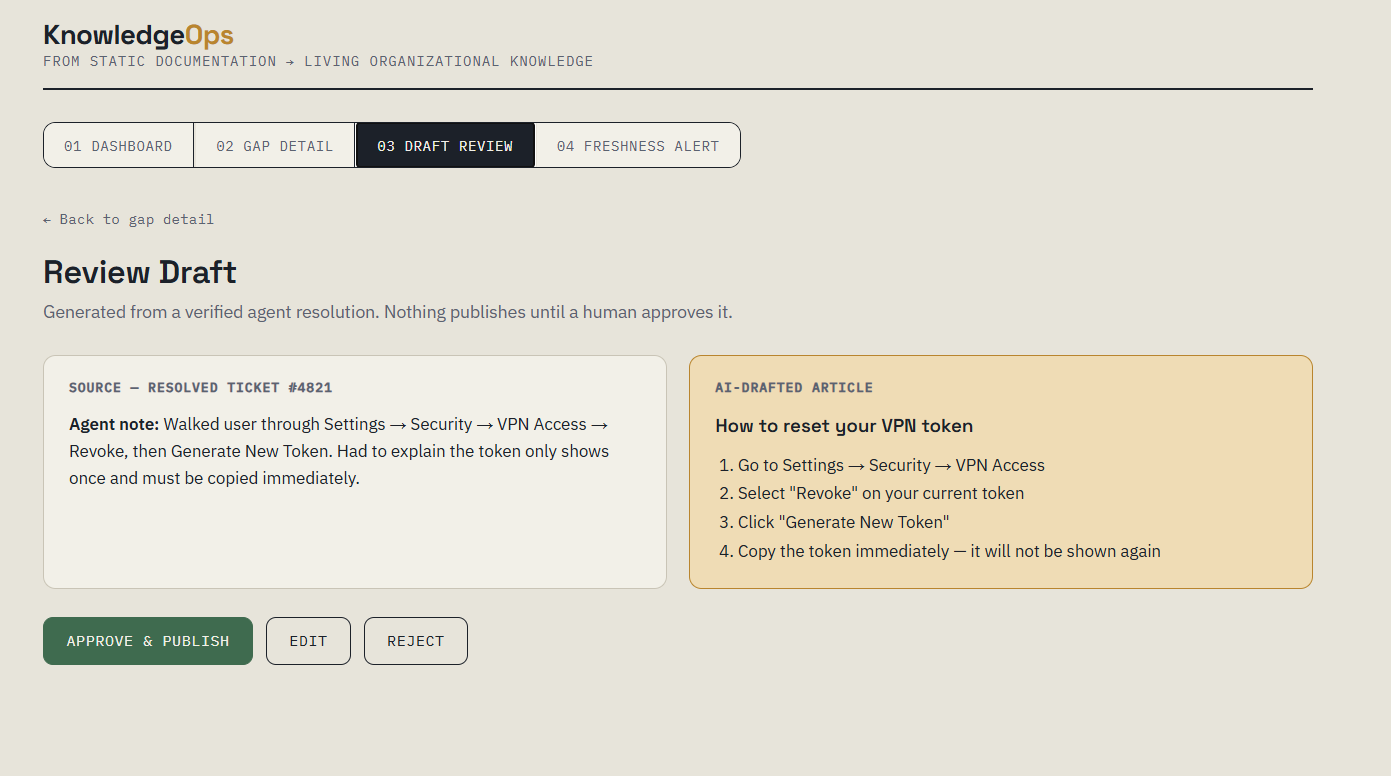
Review Draft
-
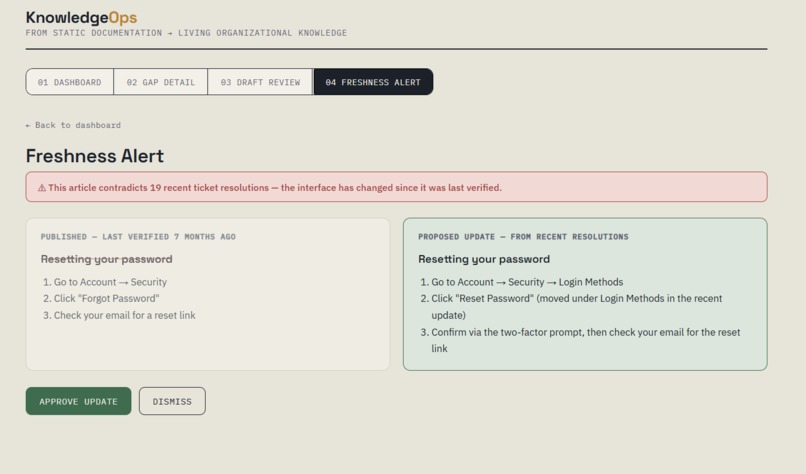
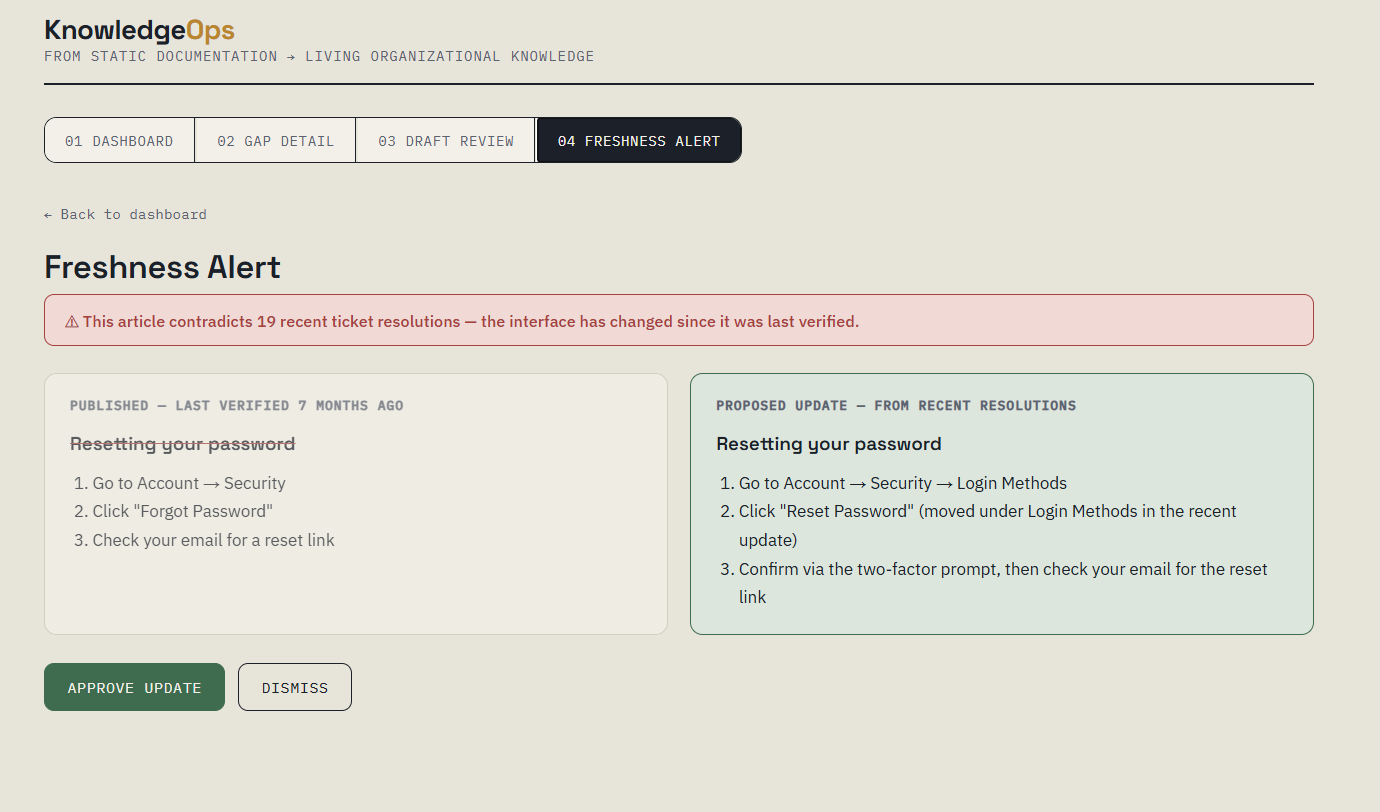
Freshness Alert
Inspiration
Enterprise knowledge is everywhere: help articles, FAQs, internal documentation, troubleshooting guides, and support resolutions.
But we noticed a fundamental problem:
Reality changes faster than documentation.
A product interface changes. A workflow gets updated. A policy changes. A new issue appears. Yet the knowledge base often remains exactly the same.
This creates three types of knowledge failures:
- Knowledge gaps — people repeatedly ask questions that have no reliable answer in the knowledge base.
- Knowledge failure — an article exists, but people still raise tickets because it is incomplete, difficult to find, or doesn't actually solve the problem.
- Knowledge drift — an article was correct when written, but the product, process, or policy has changed underneath it.
The problem is that organizations usually discover these failures manually.
Someone has to notice a pattern in hundreds of support tickets, realize that an article is missing or outdated, and then find the time to fix it.
That led us to one question:
What if the support activity itself could tell us when organizational knowledge is failing?
That question became KnowledgeOps.
Our vision is simple:
$$ \text{Static Knowledge Base} \longrightarrow \text{Living Knowledge System} $$
What it does
KnowledgeOps is a reusable enterprise knowledge skill that continuously discovers, creates, and verifies organizational knowledge.
Instead of treating a knowledge base as a static collection of documents, KnowledgeOps treats it as a living system that learns from real-world support interactions.
It works through three connected capabilities:
🔎 1. Discover — Find Knowledge Failures
KnowledgeOps analyzes support interactions to identify recurring questions and knowledge failures.
It doesn't simply ask:
"Does an article exist?"
It asks:
"Is the existing knowledge actually solving the problem?"
For example, imagine employees repeatedly asking:
"How do I reset my VPN token?"
If dozens of tickets contain the same question and support agents repeatedly resolve it manually, KnowledgeOps identifies this as a high-priority knowledge failure.
It can use signals such as:
- Recurrence
- Resolution outcomes
- Existing knowledge coverage
- Support effort
- Recent ticket activity
to prioritize what needs attention.
✍️ 2. Create — Turn Resolutions into Knowledge
Once a human support agent successfully resolves a recurring issue, KnowledgeOps can transform that verified resolution into a structured knowledge article.
Instead of asking a knowledge manager to start from a blank page, KnowledgeOps produces an evidence-backed first draft containing:
- The problem
- The resolution
- Step-by-step instructions
- Supporting evidence
Most importantly:
AI proposes. Humans decide.
KnowledgeOps does not silently publish AI-generated organizational knowledge.
A human reviewer can:
Edit → Approve → Reject
every proposed change.
🔄 3. Verify — Detect Knowledge Drift
Creating an article once isn't enough.
Six months later, the product interface may have changed. The procedure may have changed. The policy may have changed.
KnowledgeOps continuously compares existing knowledge with recent support activity.
For example, if an article says:
Settings → Reset Token
but recent support tickets consistently show agents using a different procedure, KnowledgeOps detects a potential knowledge drift.
It then:
- Flags the article.
- Shows the evidence.
- Explains why it may be outdated.
- Proposes an updated version.
- Sends it to a human for approval.
This creates a continuous loop:
$$ \text{Questions} \rightarrow \text{Detect} \rightarrow \text{Resolve} \rightarrow \text{Create} \rightarrow \text{Review} \rightarrow \text{Verify} \rightarrow \text{Improve} $$
That loop is the heart of KnowledgeOps.
How we built it
We designed KnowledgeOps as a reusable platform skill, rather than a single-purpose chatbot.
Its architecture is centered around three capabilities:
$$ \boxed{\text{Discover} \rightarrow \text{Create} \rightarrow \text{Verify}} $$
Discover
Support tickets, conversations, resolutions, and existing knowledge provide the signals.
KnowledgeOps analyzes these signals to identify recurring intents and potential knowledge failures.
Create
Verified human resolutions are transformed into structured knowledge drafts.
Verify
Existing knowledge is continuously compared against recent support behavior to identify potential drift.
Human-in-the-loop
Every significant recommendation follows:
$$ \text{Detect} \rightarrow \text{Explain} \rightarrow \text{Recommend} \rightarrow \text{Human Review} \rightarrow \text{Publish} $$
This was a deliberate design choice.
Enterprise knowledge can influence real decisions, so we did not want an AI system silently rewriting organizational documentation.
Platform & integrations
KnowledgeOps is designed as a reusable capability for enterprise agents across areas such as:
- Customer Support
- IT Support
- Employee Support
- HR
- Internal Operations
It is also designed to be integration-ready for enterprise systems and MCP-enabled workflows, allowing KnowledgeOps to become part of larger agentic systems.
For our prototype, we focused on demonstrating the complete Discover → Create → Verify experience rather than attempting to implement every production integration.
Challenges we ran into
The hardest problem wasn't generating a knowledge article.
The harder question was:
How do we know when knowledge is actually failing?
A missing article is relatively easy to identify.
But consider a more subtle situation:
An article exists.
People can technically find it.
Yet they continue creating support tickets because the article doesn't actually solve their problem.
This made us realize that:
$$ \text{Article Exists} \neq \text{Knowledge Is Useful} $$
We therefore had to think beyond document search and focus on real-world behavior.
We considered signals such as:
- How frequently is the issue recurring?
- Was it successfully resolved?
- Are support agents repeatedly using a different procedure?
- Does the existing article match those resolutions?
- Is the problem becoming more common?
Another challenge was balancing automation with trust.
We wanted KnowledgeOps to reduce repetitive manual work without introducing a new risk: automatically publishing incorrect AI-generated information.
This is why evidence and human approval became fundamental parts of the product.
Accomplishments that we're proud of
Our biggest accomplishment is that we didn't stop at building an AI system that generates documentation.
We built a concept around the complete knowledge lifecycle:
$$ \boxed{ \text{Missing} \rightarrow \text{Created} \rightarrow \text{Monitored} \rightarrow \text{Updated} } $$
We are particularly proud of:
♻️ A continuous knowledge loop
KnowledgeOps doesn't just fix today's knowledge gap. It continuously checks whether yesterday's solution is still correct.
🧠 Knowledge failure detection
We expanded the problem beyond simply finding missing articles.
An existing article can also fail if users cannot successfully use it.
👤 Human-controlled AI
AI accelerates discovery and drafting while humans retain control over what becomes official organizational knowledge.
🔗 Platform-oriented design
Instead of building one chatbot for one use case, we designed KnowledgeOps as a reusable skill that other enterprise agents can consume.
🎯 A clear enterprise outcome
Our north-star outcome is:
$$ \text{Knowledge Coverage} \uparrow \qquad \text{Repeat Support Questions} \downarrow $$
The goal isn't to generate more documents.
The goal is to make enterprise knowledge more useful and more reliable.
What we learned
1. More documentation doesn't necessarily mean better knowledge
An organization can have thousands of articles and still have poor knowledge coverage.
The important question isn't:
"How many articles do we have?"
It is:
"Can people successfully solve their problems using them?"
2. AI value isn't always about generating something new
We initially approached the problem from the perspective of creating knowledge.
But we learned that a much more valuable problem is maintaining the knowledge that already exists.
Knowledge has a lifecycle:
$$ \text{Create} \rightarrow \text{Use} \rightarrow \text{Change} \rightarrow \text{Validate} \rightarrow \text{Update} $$
The missing piece in many organizations is continuous validation.
3. Human-in-the-loop is a strength
For enterprise AI, trust matters.
Giving humans the final decision makes the system more explainable, controllable, and practical for real-world adoption.
4. Reusable agent skills can be more powerful than one large agent
Rather than building one agent that tries to do everything, we designed KnowledgeOps as a reusable capability.
Different enterprise agents can leverage the same knowledge intelligence.
That makes the solution more scalable across use cases.
What's next for KnowledgeOps
Our prototype demonstrates the core idea, but we see KnowledgeOps evolving into a broader Enterprise Knowledge Intelligence Layer.
🚀 1. Deeper enterprise integrations
Connect KnowledgeOps with real:
- Ticketing systems
- Knowledge bases
- Customer conversations
- Internal documentation
- Product change logs
This would allow the system to continuously observe real organizational signals.
🤖 2. More autonomous knowledge maintenance
Today:
$$ \text{AI Recommendation} \rightarrow \text{Human Approval} $$
Over time, organizations could define trust levels where low-risk updates can follow more automated workflows while high-impact changes always require human approval.
📊 3. Knowledge Health Score
We envision a unified score that measures the health of an organization's knowledge layer based on:
$$ K = f(C, F, R, D) $$
where:
- $C$ = Knowledge Coverage
- $F$ = Knowledge Freshness
- $R$ = Resolution Success
- $D$ = Knowledge Drift
This would allow teams to monitor knowledge quality like they monitor system health.
🌐 4. Expand beyond support
The same skill could maintain knowledge across:
Customer Support → IT → HR → Internal Operations → Enterprise AI Agents
Any environment where people depend on organizational knowledge can benefit from continuous knowledge intelligence.
Our Vision
The future of enterprise knowledge isn't a bigger library.
It is a knowledge layer that:
knows when it is wrong,
learns from verified human expertise,
and continuously improves.
A chatbot can answer from what it knows.
A RAG system can retrieve what exists.
An article generator can create content.
But enterprises need something beyond that:
A system that knows when its knowledge is incomplete, ineffective, or outdated — and helps humans fix it.
That is KnowledgeOps.
We are not building another chatbot.
We are building the knowledge maintenance skill that helps every enterprise agent become more accurate, useful, and trustworthy over time.
Built With
- ai-agents
- css
- design
- html5
- javascript
- product
- prototype

Log in or sign up for Devpost to join the conversation.