-
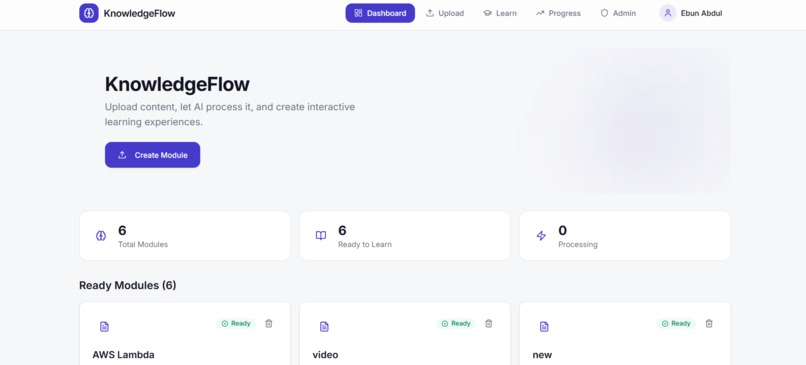
Homepage
Inspiration
Organizations often struggle to transfer knowledge when experienced employees move roles or leave. Critical information is usually stored in scattered documents, informal conversations, or in people’s heads, making onboarding slow and inconsistent.
We were inspired by the idea of making knowledge scalable and reusable instead of dependent on individuals. We asked:
What if one person could teach hundreds just by uploading their knowledge once?
That led to KnowledgeFlow.space ; a system designed to capture, structure, and distribute knowledge efficiently.
What it does
KnowledgeFlow.space is an AI-powered Knowledge Transfer Agent that helps organizations turn raw information into structured learning.
It allows:
Teachers/Admins to upload files (documents, recordings, etc.) and manage access AI to extract and organize content into: summaries step-by-step guides key concepts flashcards quizzes Learners to: study structured content track their progress interact through an AI chat grounded in the uploaded knowledge
It also includes:
role-based access (Admin, Teacher, Learner) department-level organization progress tracking across teams How we built it
We built KnowledgeFlow.space as a modular system with a clear pipeline:
Upload → Extract → Chunk → Generate → Store → Learn → Chat Upload→Extract→Chunk→Generate→Store→Learn→Chat Frontend: React + Tailwind for a clean and simple UI Backend: Base44 for rapid full-stack development AI Layer: Open-source models (via Ollama / Hugging Face) Whisper for transcription LLMs (LLaMA / Mistral) for generation Embeddings for retrieval (RAG) Features: file upload and processing structured knowledge generation flashcards and quizzes AI-powered chat progress tracking dashboard
We focused on keeping the architecture simple, modular, and easy to explain.
Challenges we ran into Handling unstructured data: Different file types required consistent extraction and formatting Time constraints: Building a full pipeline in 12 hours required prioritizing core features Balancing simplicity and functionality: We avoided overengineering while still delivering a complete workflow Making AI outputs useful: Structuring content into meaningful learning materials (not just raw summaries) Designing for real use: Ensuring the system reflects actual company workflows (roles, departments, tracking) Accomplishments that we're proud of Built a complete end-to-end knowledge transfer system Implemented role-based access (Admin, Teacher, Learner) Created a progress tracking system across departments Delivered interactive learning tools (flashcards, quizzes, chat) Integrated RAG-based chat grounded in uploaded knowledge Designed the system with privacy-first architecture using open-source models What we learned AI is most powerful when it structures and organizes knowledge, not just generates text Simpler, modular systems are easier to build, explain, and scale Real-world adoption depends heavily on usability and workflow integration Retrieval-based systems (RAG) significantly improve trust and accuracy Thinking like a product builder (not just a developer) makes solutions more impactful What's next for KnowledgeFlow Add real-time collaboration between teachers and learners Improve evaluation and feedback loops for quizzes and learning progress Integrate with enterprise tools (Slack, internal systems, LMS platforms) Enhance search and retrieval accuracy Support fully self-hosted deployment for enterprise privacy Expand into a full AI-powered onboarding and training platform

Log in or sign up for Devpost to join the conversation.