Knowledge Sentinel
Governance, not chat.
What if your organisation could know that its knowledge had become outdated — before someone discovered it the hard way?
Every organisation depends on knowledge: clinical guidelines, regulations, policies, SOPs, protocols, checklists and research. But this knowledge constantly changes. The difficult problem is not simply finding the latest information. It is knowing what changed, what it affects inside the organisation, and what should happen next.
That's knowledge drift.
Knowledge Sentinel is an agentic knowledge-governance system designed to continuously watch for that drift.
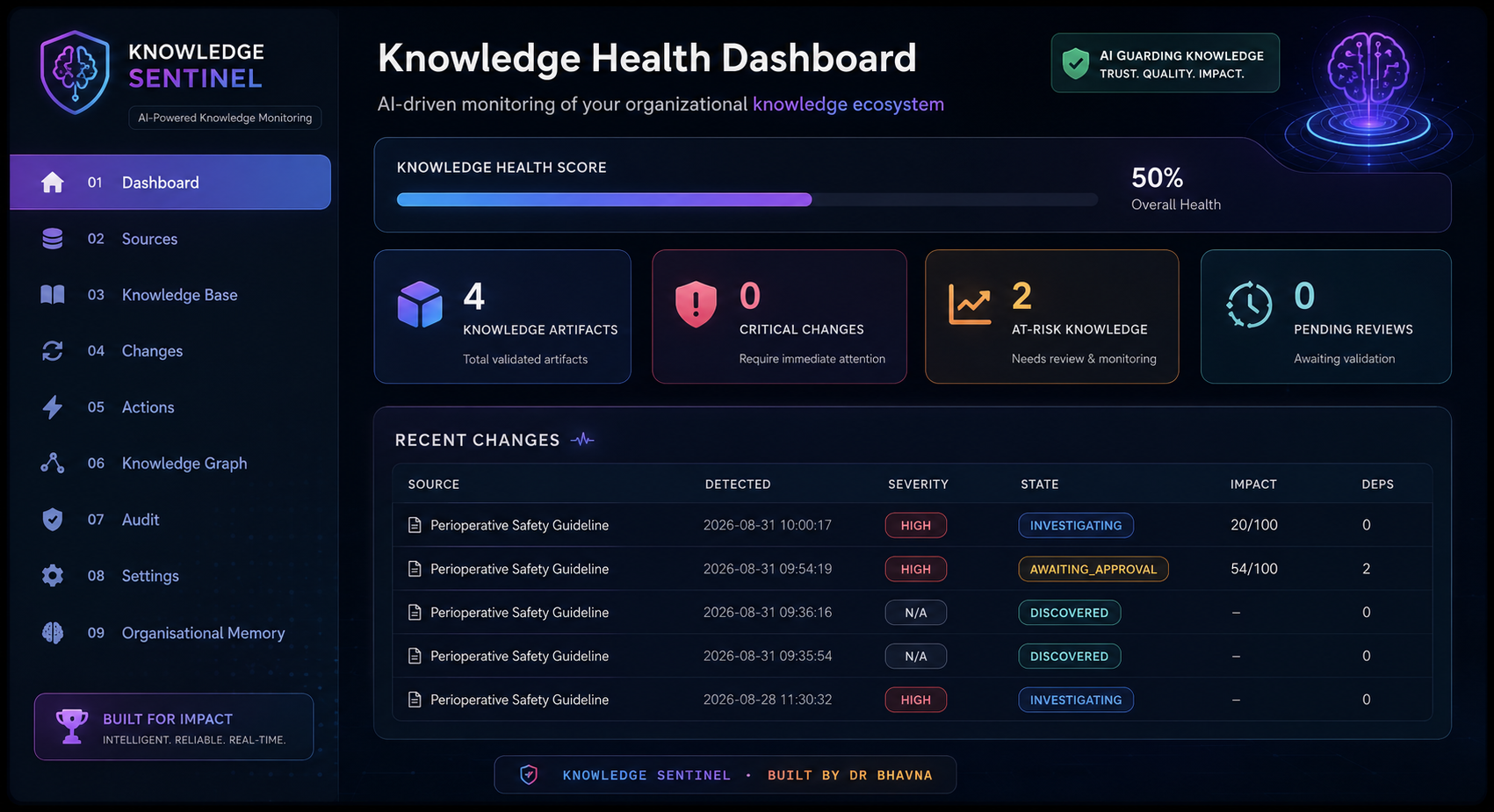
It monitors trusted external sources, detects meaningful changes, uses Gemini + Google Agent Development Kit (ADK) to investigate potential organisational impact, connects changes to internal knowledge and dependencies, proposes remediation, preserves institutional context, and keeps consequential decisions under human control.
From changing information → governed action
Monitor → Detect → Investigate → Assess Impact → Propose Action → Human Approval → Verify → Audit
Why this is different
A traditional AI interaction looks like:
Human → Question → AI → Answer
But knowledge governance has a fundamental problem:
The organisation may not know that it needs to ask a question.
Knowledge Sentinel reverses the interaction:
External change → Agent detects → Agent investigates → Impact identified → Action proposed → Human reviews → Decision recorded
A chatbot can tell you that a guideline changed.
Knowledge Sentinel asks:
“Which of our internal documents depend on this recommendation?”
That shift — from answering questions to governing change — is the core idea behind the project.
See it in action
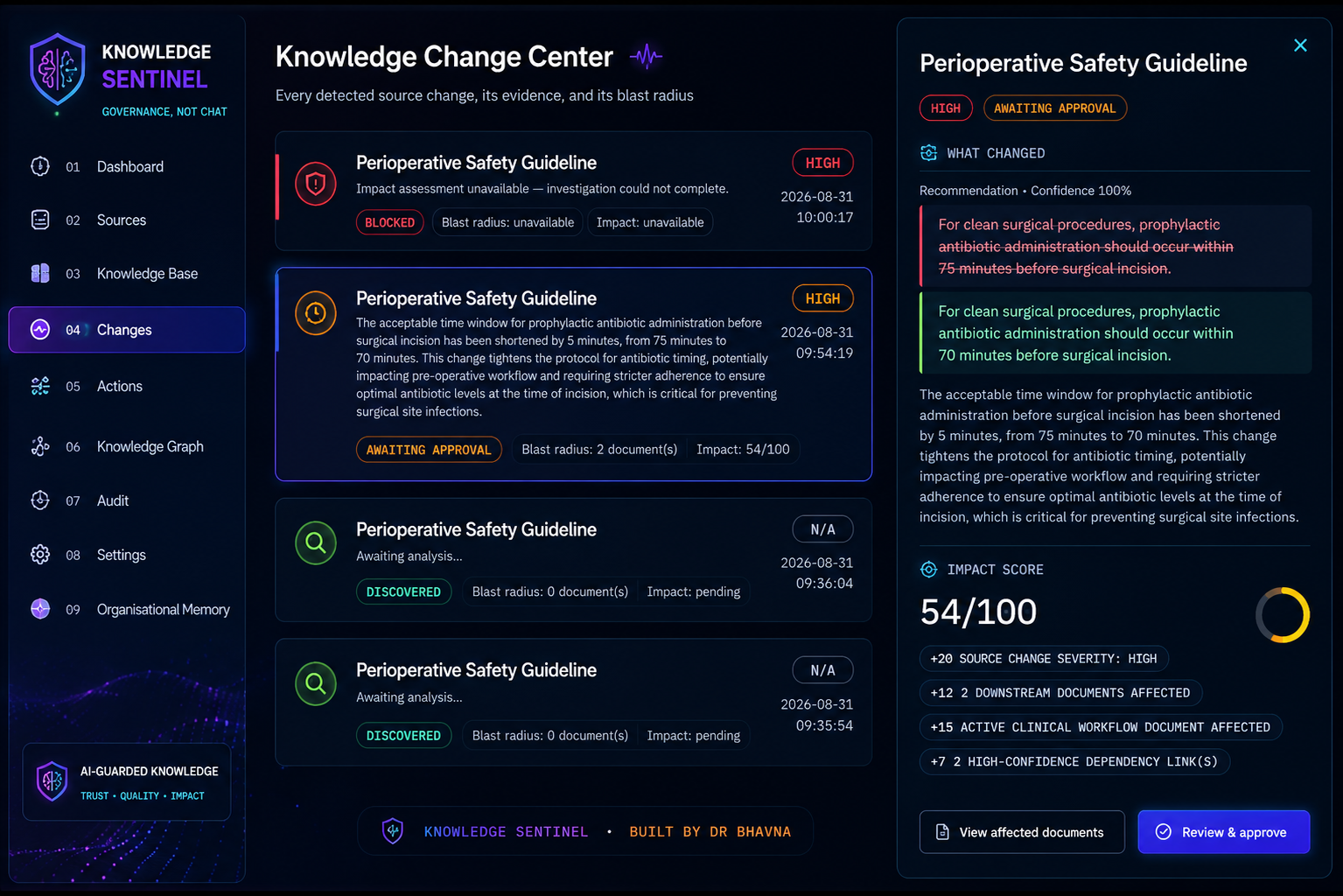
Consider a perioperative safety guideline whose recommendation for antibiotic prophylaxis changes.
Sentinel first establishes the change against the previous source baseline.
Then the agent investigates:
- What actually changed?
- Which internal documents may depend on it?
- What could the change affect?
- What action should be considered?
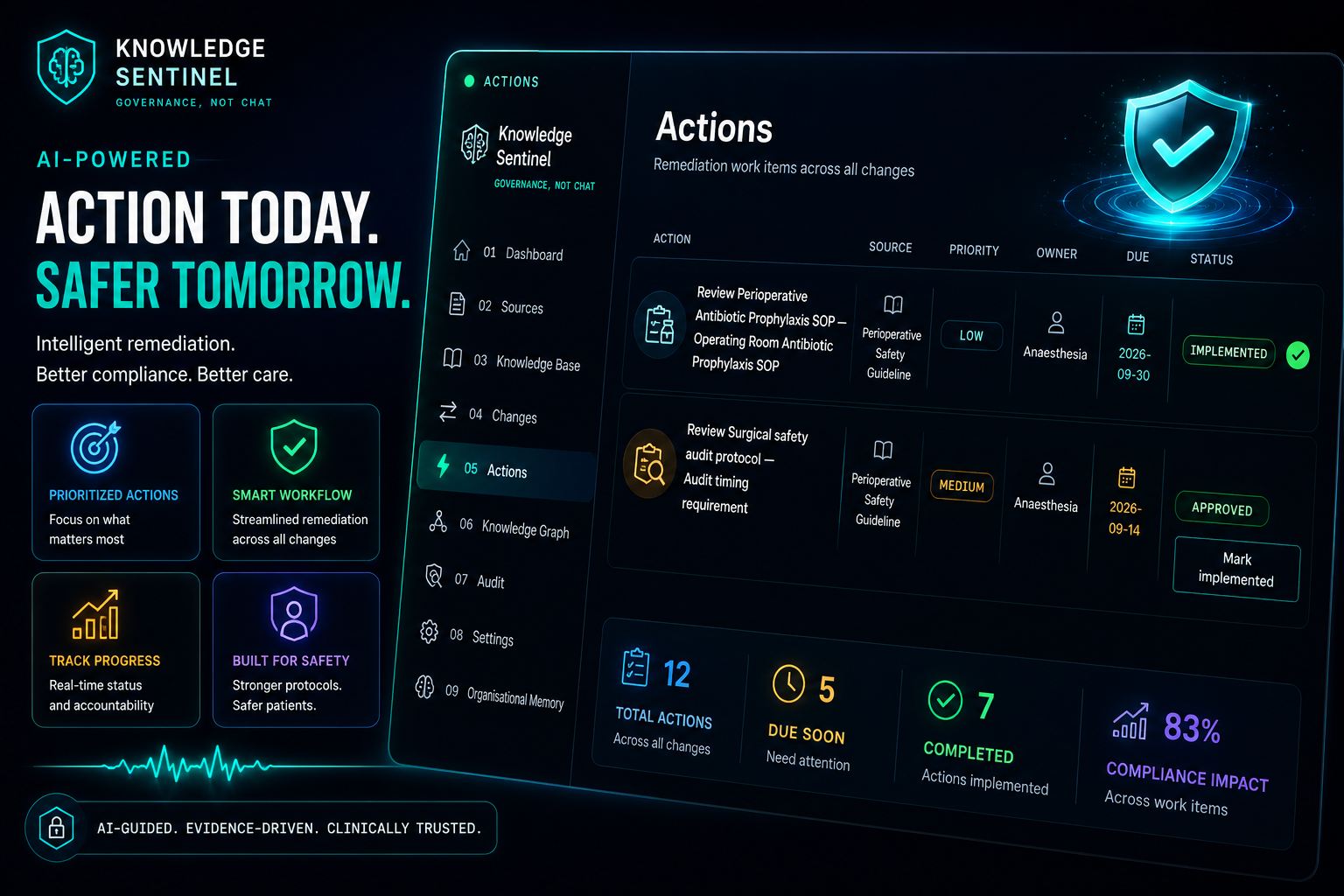
The agent can connect the external source to internal SOPs, protocols and checklists, assess potential impact and create a remediation action for human review.
The result isn't simply another AI-generated explanation.
The agent converts changing information into governed work.
The Agentic Workflow
🔎 Monitor
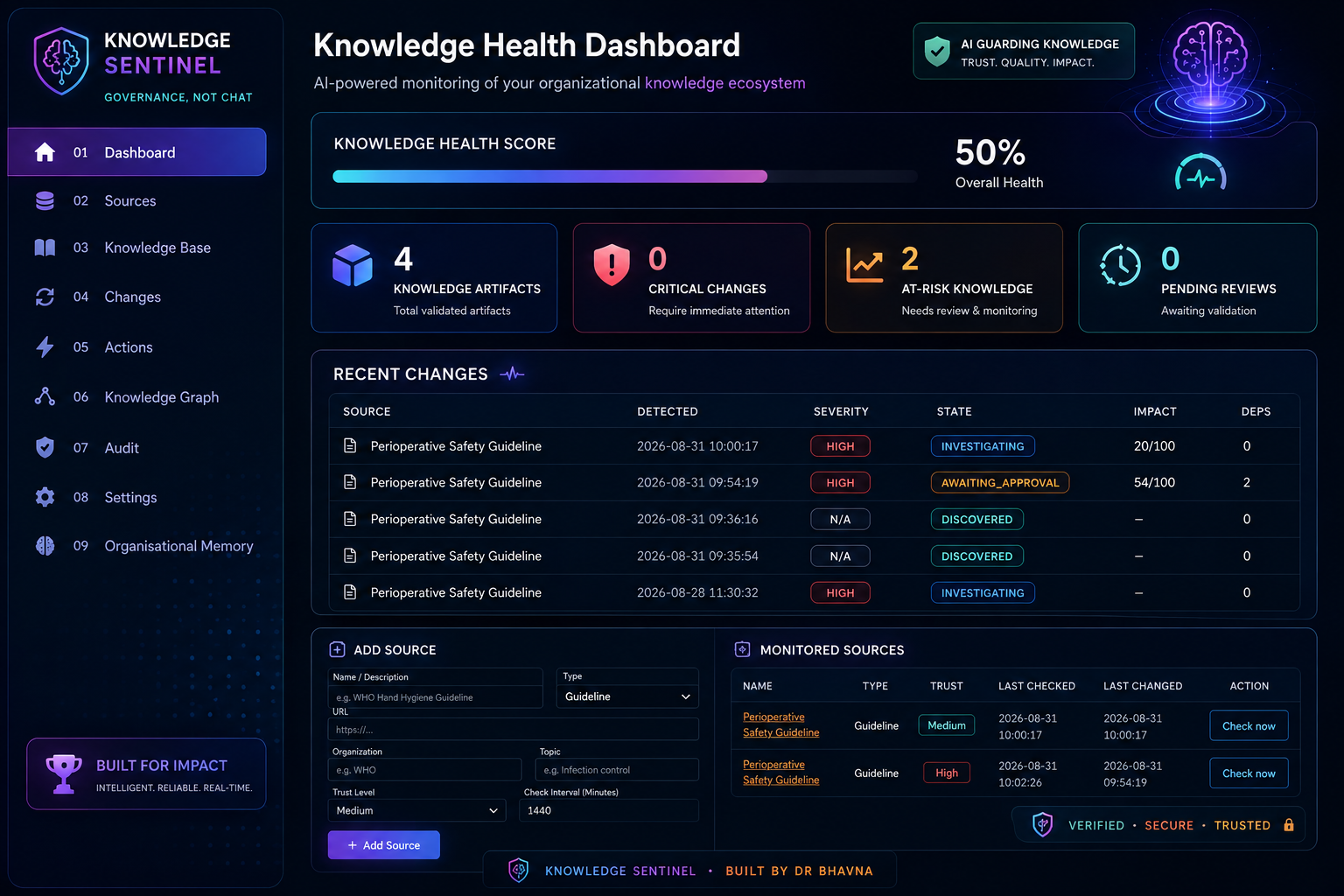
Organisations can configure trusted knowledge sources such as clinical guidelines, regulatory updates, institutional policies, research publications and other organisational references.
Scheduled monitoring establishes and compares knowledge baselines.
⚡ Detect
Sentinel identifies meaningful changes and creates structured change events, tracking state, severity and investigation status.
🧠 Investigate
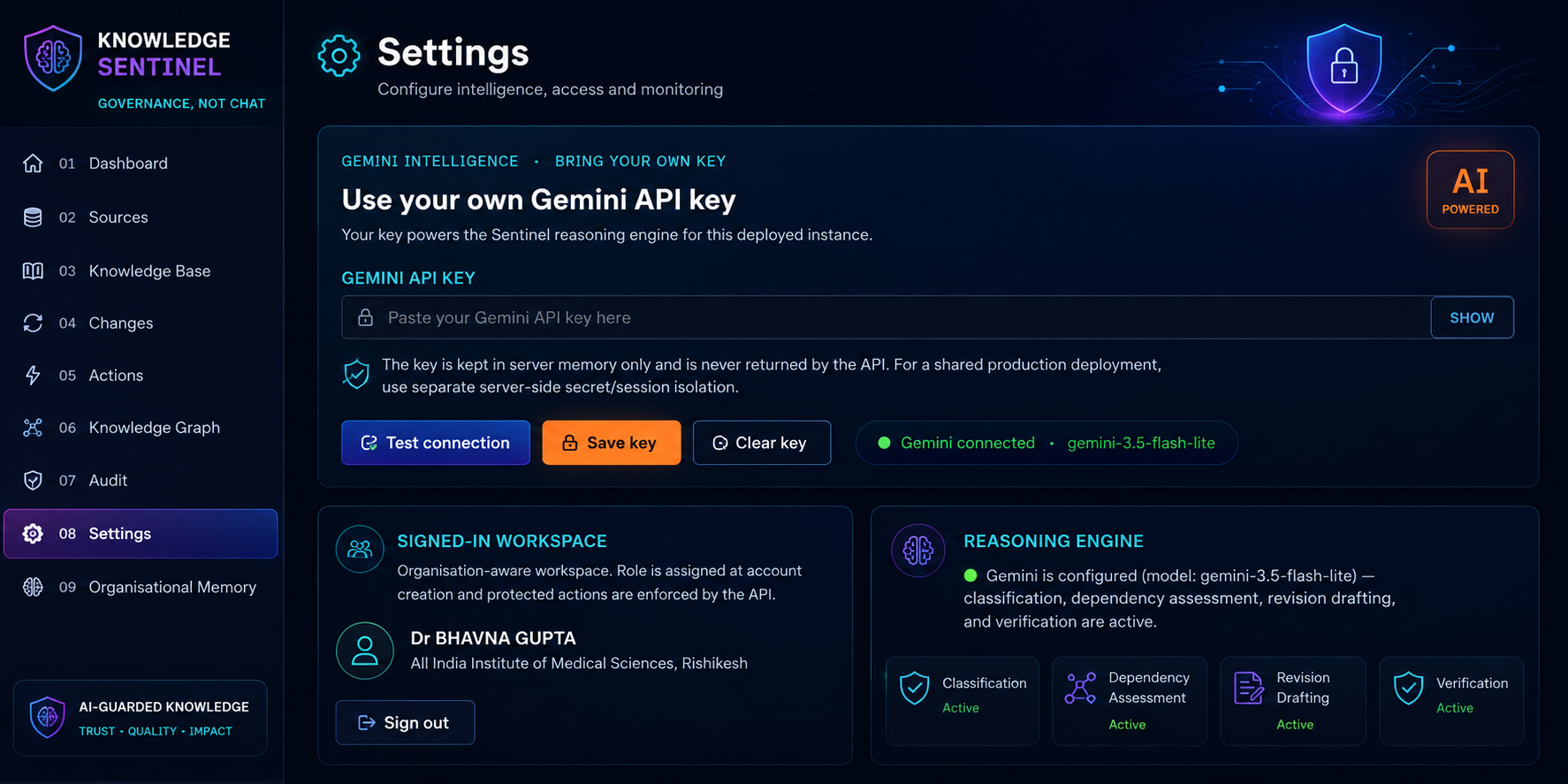
Using Google Agent Development Kit and Gemini 3.5 Flash Lite, the agent investigates detected changes through tools for retrieving information, searching organisational knowledge, inspecting documents, assessing dependencies, calculating impact and creating remediation actions.
🕸️ Connect
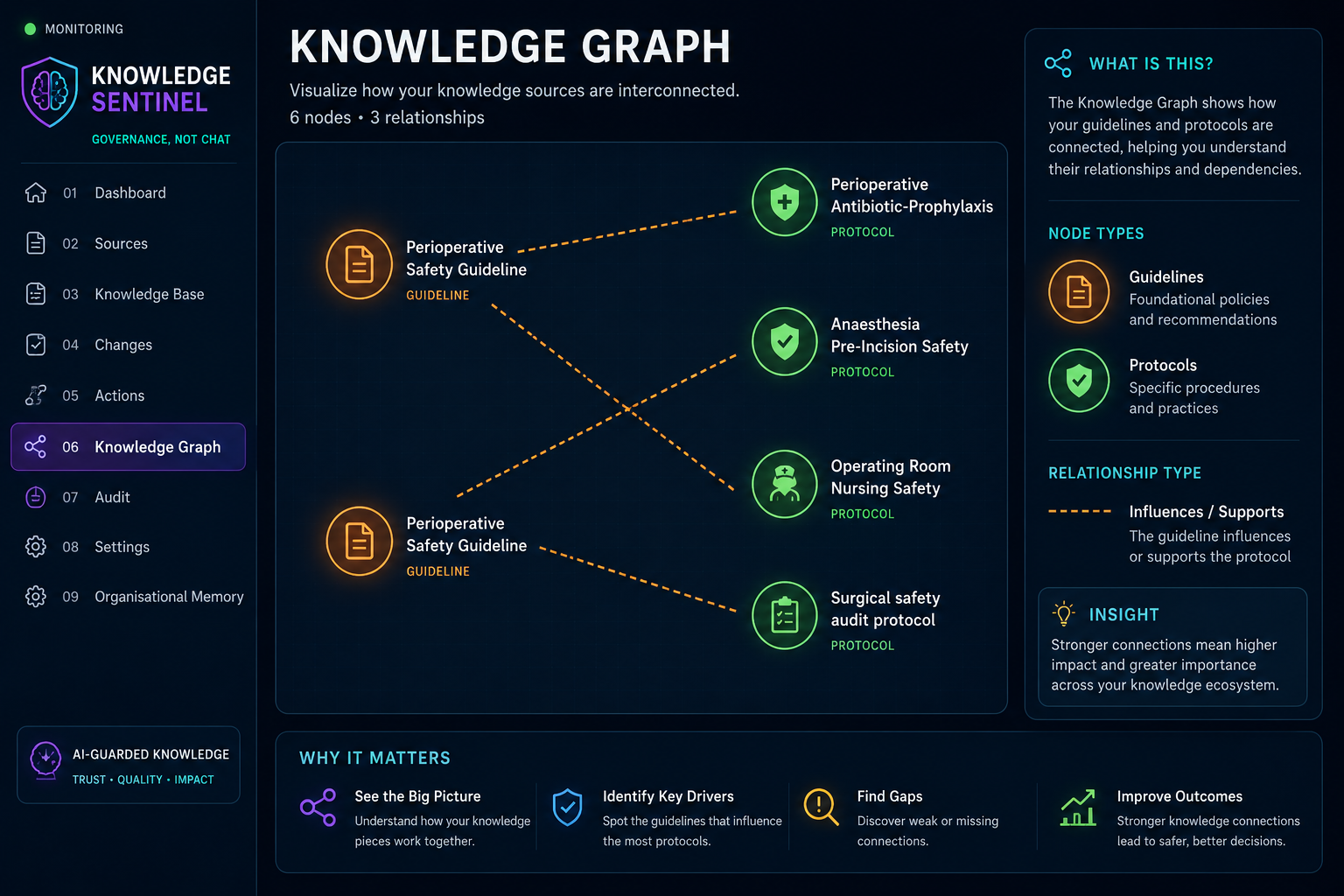
The Knowledge Graph represents relationships between:
External Source → Change → Internal Document → Dependency → Impact → Action
This moves the system beyond simple document monitoring toward understanding potential organisational consequences.
✅ Act — with human governance
The agent can propose remediation such as reviewing an SOP, reassessing a protocol or updating a checklist.
It does not silently change consequential organisational knowledge.
Observation → Investigation → Recommendation → Approval → Verification
Humans remain accountable for consequential decisions.
🧠 Remember
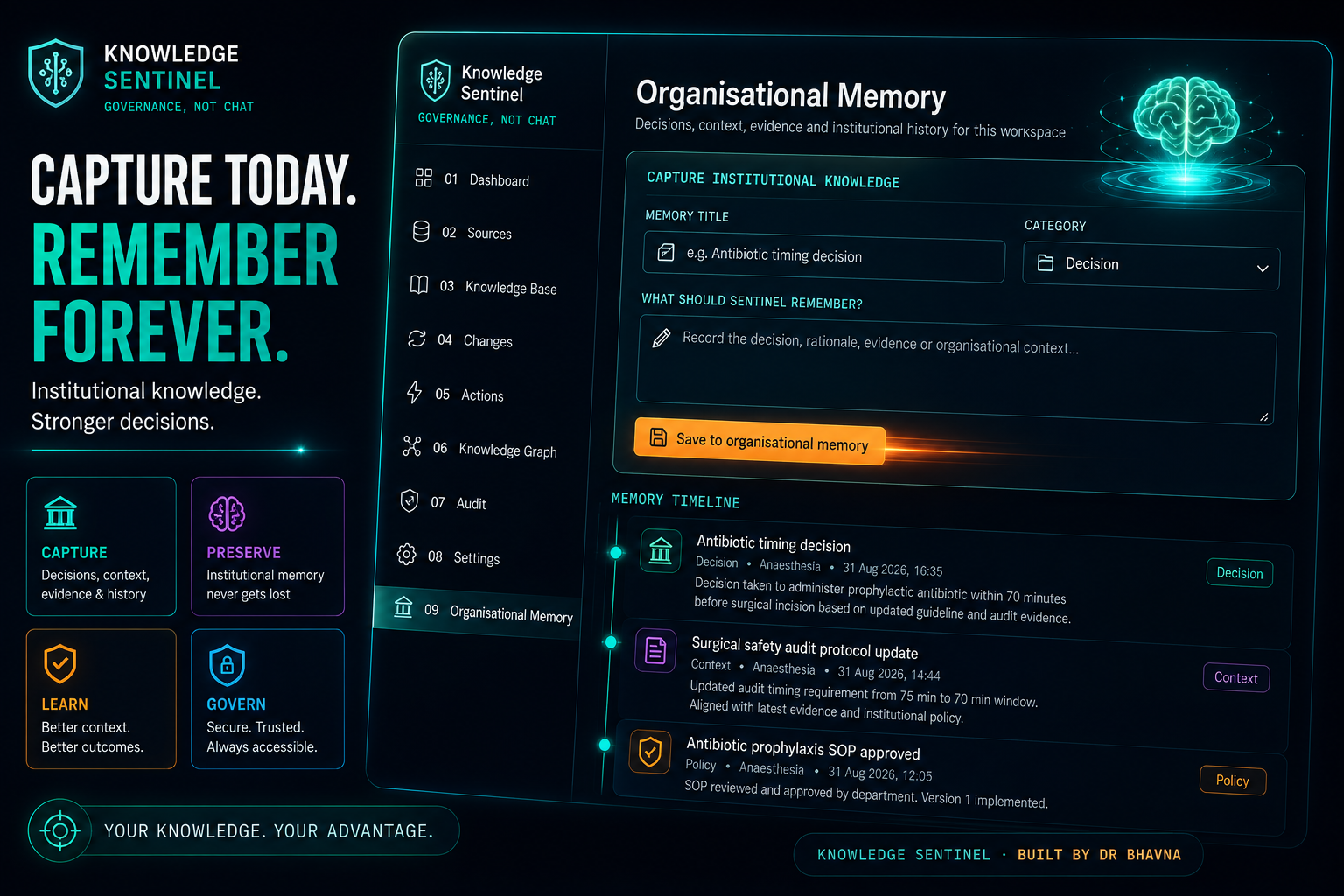
Organisational Memory preserves decisions, evidence, rationale, relationships, approvals and historical context.
The goal is to ensure that organisational reasoning does not disappear when a conversation ends.
📋 Audit
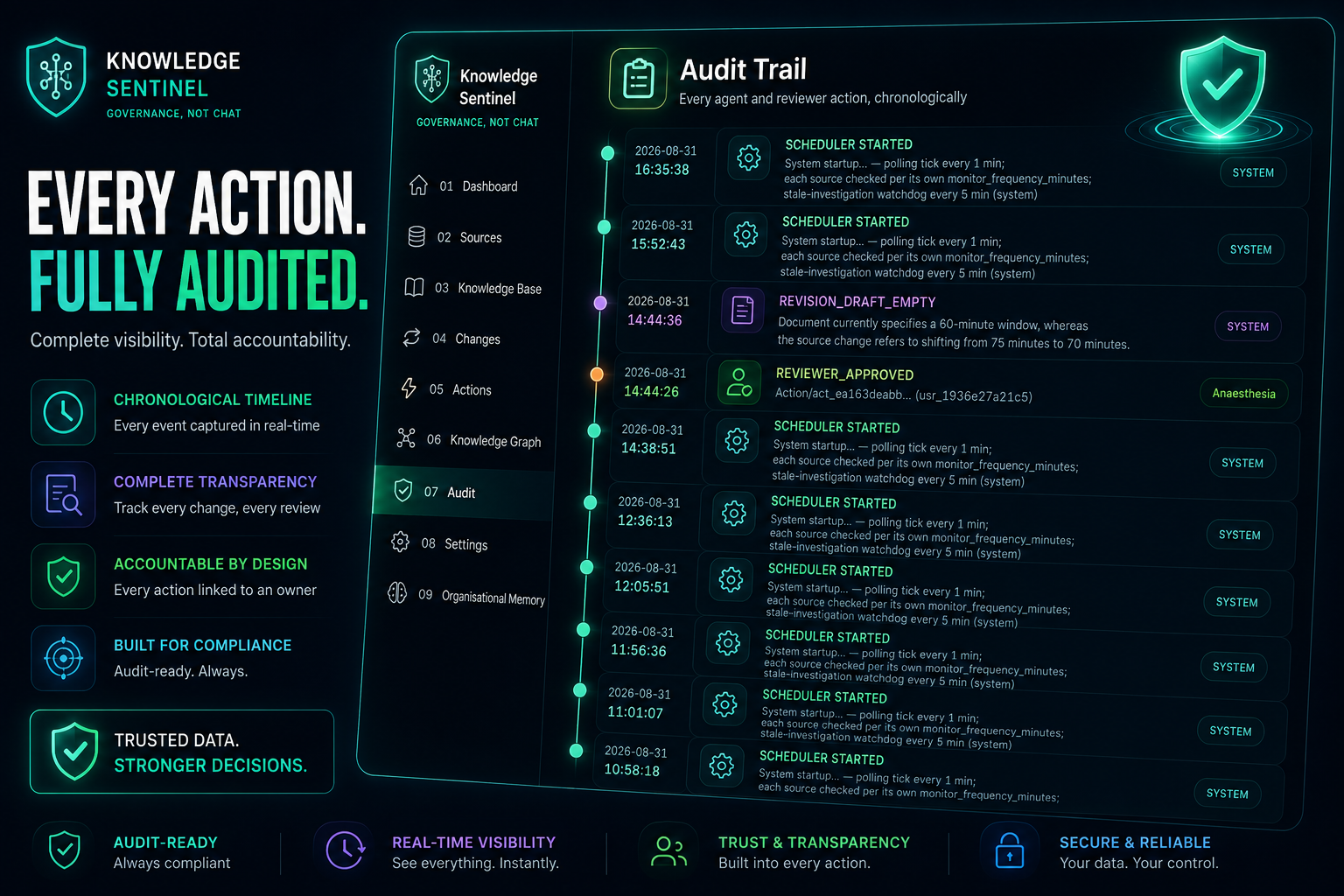
Important system and human events are recorded so organisations can understand:
Who → What → When → Why → Result
If an investigation cannot complete, Sentinel exposes that state rather than pretending it succeeded.
Why this is an Agent — not a chatbot
A chatbot waits for a prompt.
Knowledge Sentinel waits for change.
A chatbot answers.
Knowledge Sentinel investigates.
A chatbot produces text.
Knowledge Sentinel creates structured work.
A chatbot forgets after the conversation.
Knowledge Sentinel preserves organisational memory.
A chatbot can confidently hallucinate.
Knowledge Sentinel exposes blocked and incomplete states and keeps consequential actions behind human approval.
That difference is the heart of the project.
Built for the Collaborative Partner track
Knowledge Sentinel is designed as a Collaborative Partner, not an autonomous replacement for human governance.
The agent synthesizes:
external sources + internal documents + dependencies + organisational context
and transforms them into:
impact assessments + remediation actions + evidence + institutional memory
The human remains the decision-maker.
The agent becomes the persistent investigator.
Architecture
Knowledge Sentinel combines a lightweight, modular application with an agentic investigation layer.
Frontend
- HTML
- CSS
- Vanilla JavaScript
- Dashboard and workflow visualisation
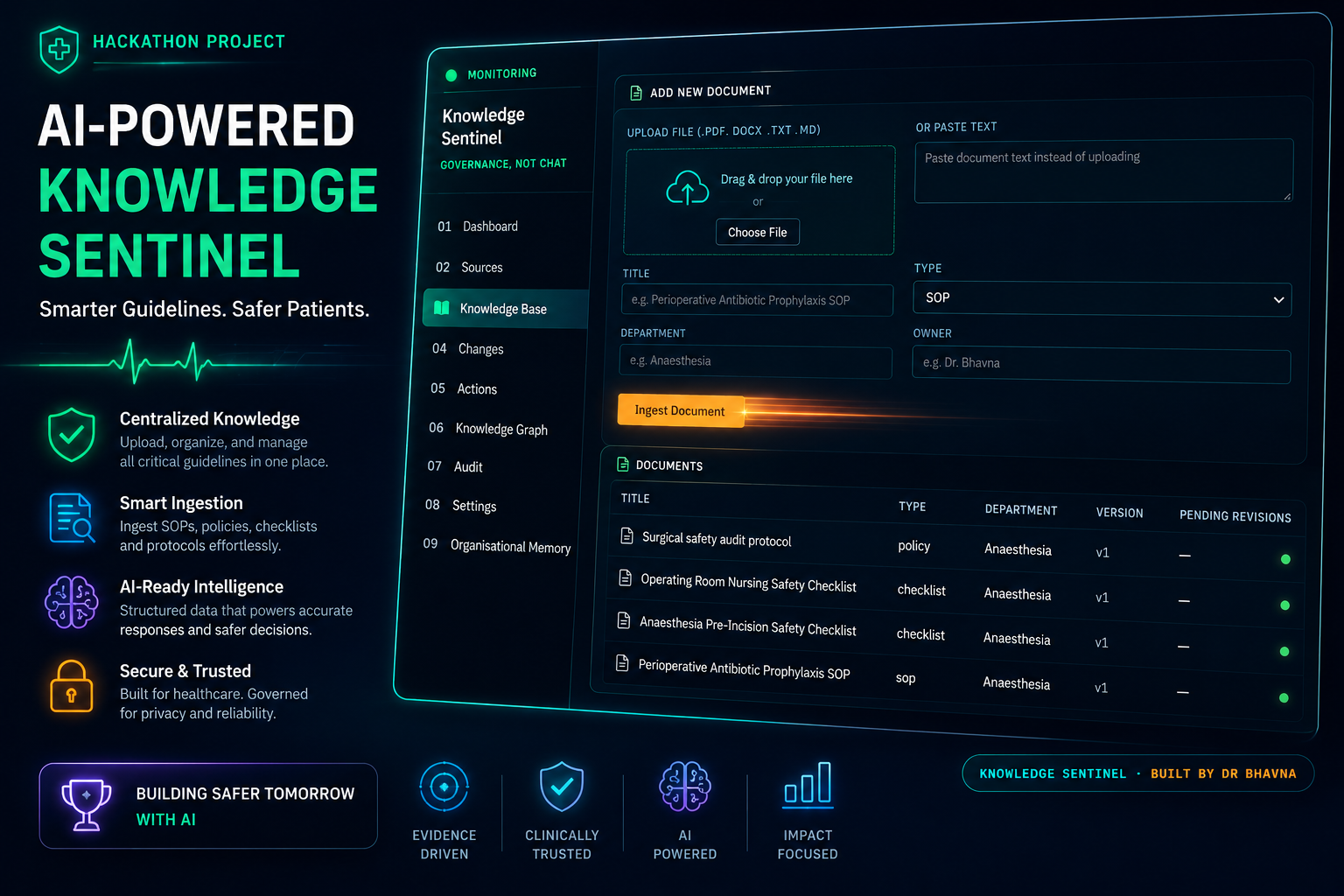
- Source and knowledge management
- Impact and action workflows
- Knowledge Graph
- Organisational Memory
- Audit interface
- Organisation-aware workspaces
Backend
- Python
- FastAPI
- Uvicorn
- SQLite persistence
Agentic Layer
- Google Agent Development Kit (ADK)
- Gemini 3.5 Flash Lite
- Google GenAI ecosystem
Deployment
- Docker
- Google Cloud Run
Core workflow
Monitor → Detect → Investigate → Assess Impact → Propose Action → Human Approval → Verify → Audit
The application is deployed on Google Cloud Run as a live hosted interface.
Engineering for failure, not just success
Real agentic systems fail.
Sources can become unavailable. Models can become temporarily unavailable. Investigations can time out or remain incomplete.
Knowledge Sentinel treats failure as a first-class workflow state.
Instead of:
Agent failed → pretend everything is fine
the system records:
Investigation blocked → reason recorded → evidence preserved → investigation can be resumed
This principle matters because trustworthy autonomy is not about pretending AI never fails.
It is about knowing what to do when it does.
Why we built it
I'm Dr Bhavna, an anesthesiologist, and I built Knowledge Sentinel from a perspective shaped by clinical decision-making, patient safety and healthcare systems.
Medicine taught me something that applies far beyond medicine:
information is only useful if the right people can act on the right information at the right time.
A guideline changing is only the beginning.
The harder problem is ensuring that the change reaches the protocols, documents, decisions and people that depend on it.
That is the gap Knowledge Sentinel is designed to address.
Challenges
Detecting meaningful change
Not every textual difference matters. The system needs to distinguish ordinary content changes from changes that could have operational consequences.
Understanding organisational impact
The difficult part isn't finding the changed source.
It is answering:
“What inside this organisation might now be wrong, outdated or inconsistent?”
This drove the Knowledge Base, dependency analysis and Knowledge Graph.
Building safe autonomy
We wanted meaningful agentic behaviour without allowing an AI system to silently modify organisational policy.
That led to explicit workflow states and human approval gates.
Preserving institutional context
An agent that forgets every previous decision repeatedly solves the same problem.
Organisational Memory allows the system to retain evidence, decisions, rationale and history.
Making the system observable
The Audit Trail makes important system and human events visible throughout the workflow.
What we learned
The biggest lesson was that agentic intelligence is only one part of an agentic system.
The difficult engineering questions are:
- What should the agent monitor?
- What counts as meaningful change?
- How does it connect external information to internal knowledge?
- How does it maintain state?
- When should it stop and ask a human?
- What happens when the model fails?
- How is evidence preserved?
- How does the organisation remember previous decisions?
The project changed our view of AI from:
“How do I make an AI answer better?”
to:
“How do I make an AI system operate responsibly over time?”
Why it matters
Knowledge becomes dangerous when organisations believe it is current when it isn't.
Knowledge drift can contribute to:
- outdated procedures
- inconsistent practices
- missed regulatory changes
- duplicated review work
- delayed responses
- loss of institutional context
Knowledge Sentinel aims to turn knowledge maintenance into a continuous, evidence-driven workflow.
What makes Knowledge Sentinel different
Most AI systems ask:
“What would you like to know?”
Knowledge Sentinel asks:
“What changed, what does it affect, what should happen next, and who needs to decide?”
That is a fundamentally different interaction model.
It moves AI from:
answering questions
to:
governing change.
Future direction
The prototype establishes a foundation for a broader organisational knowledge-governance platform.
Future directions include:
- More sophisticated dependency and impact analysis
- Richer organisational knowledge graphs
- Multi-agent investigation workflows
- Enterprise-scale persistent memory
- Stronger identity and access controls
- Enterprise document-system integrations
- Regulatory and policy monitoring
- Multi-source verification
- Advanced observability and evaluation
- More sophisticated human-in-the-loop approval workflows
- Cross-organisation governance
The bigger vision
The next generation of enterprise AI may not be defined only by how well it answers a question.
It may be defined by how responsibly it can operate between questions.
Knowledge Sentinel is our experiment in that future:
An AI system that watches, reasons, connects, remembers and acts — while knowing when a human should decide.
From changing information to governed action.
Knowledge Sentinel — Governance, not chat.
Testing Instructions
Open the deployed Knowledge Sentinel application using the Try it out link.
Create an organisation workspace, or sign in to an existing workspace.
Navigate to Knowledge Base and add a trusted knowledge document.
For the demo, a clinical guideline, SOP, protocol, or policy document can be used.Navigate to Sources and configure a trusted external source to monitor.
When a source change is detected, open Changes to review the detected change and its investigation status.
Review the potential impact on organisational knowledge and inspect the related evidence/dependencies.
Navigate to Actions to review the proposed remediation.
Use Human Approval before consequential actions are accepted.
Review Organisational Memory to see preserved decisions, evidence and context.
Use Audit to inspect the resulting traceability/history.
What to look for
The key demonstration is the transition from:
External knowledge change → Detection → Investigation → Impact assessment → Proposed action → Human approval → Verification → Audit/Memory
Knowledge Sentinel is designed as a governance workflow, not a chatbot. The AI assists with interpretation and recommendations; consequential decisions remain under human control.


Log in or sign up for Devpost to join the conversation.