-
-
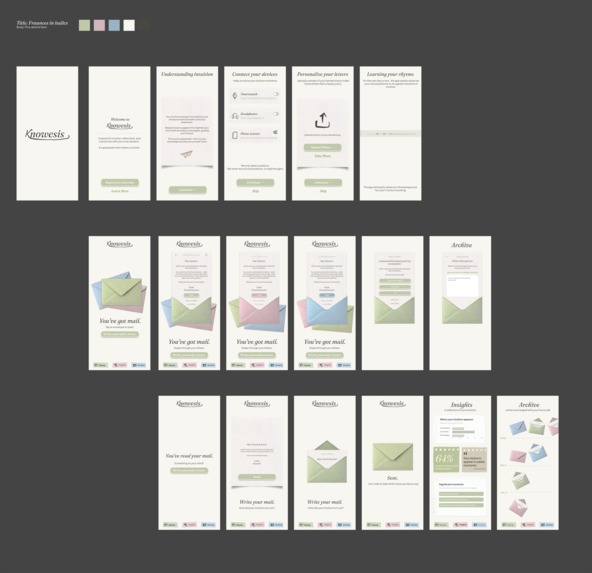
Figma Wireframe gallery
-

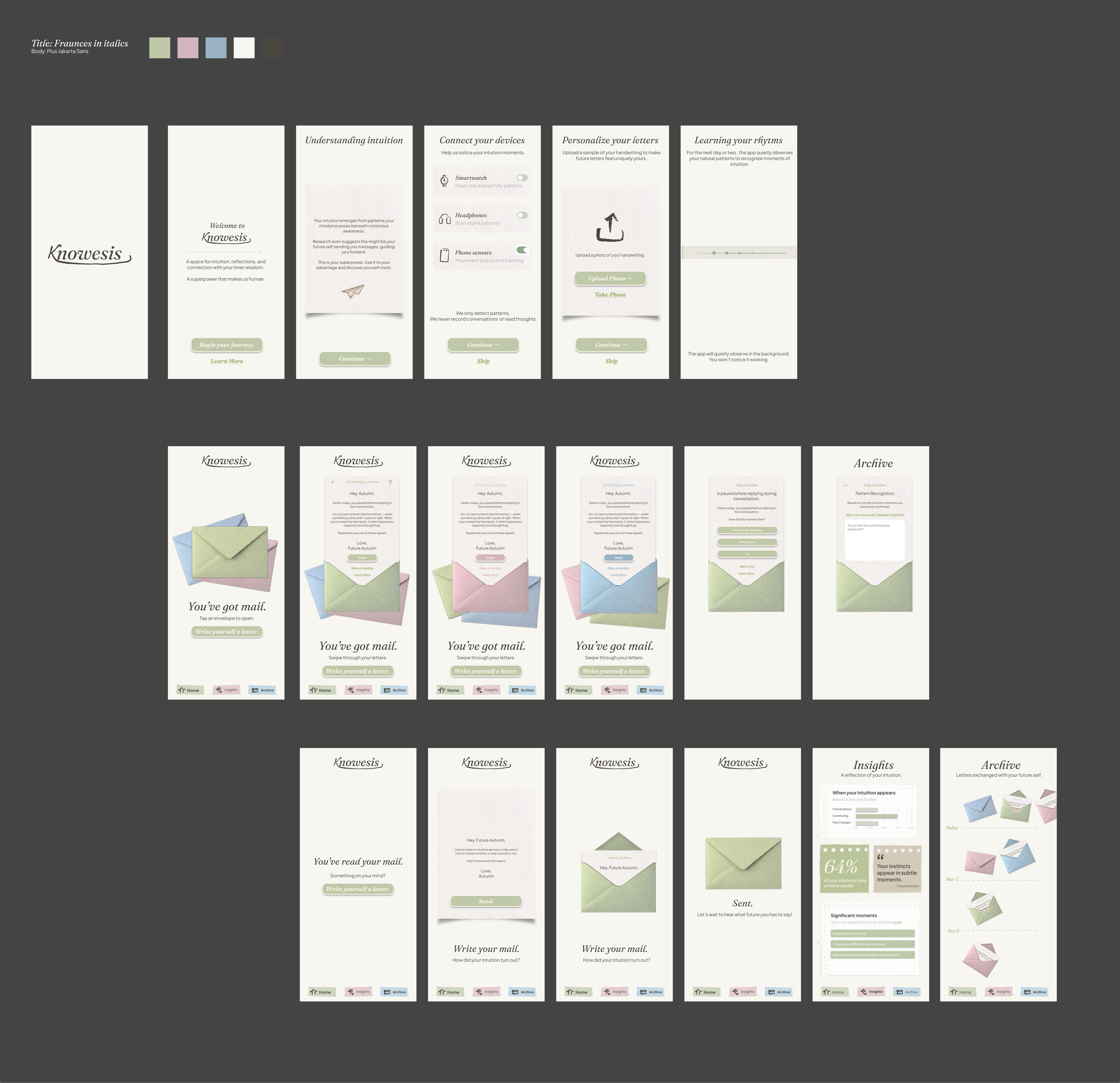
Knowesis: Home Page
-
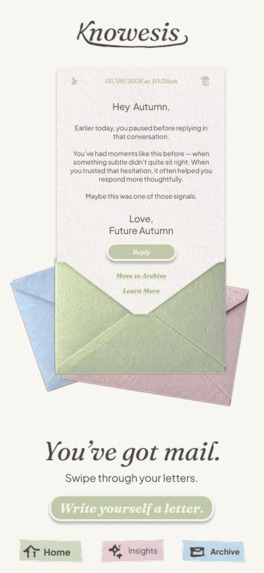
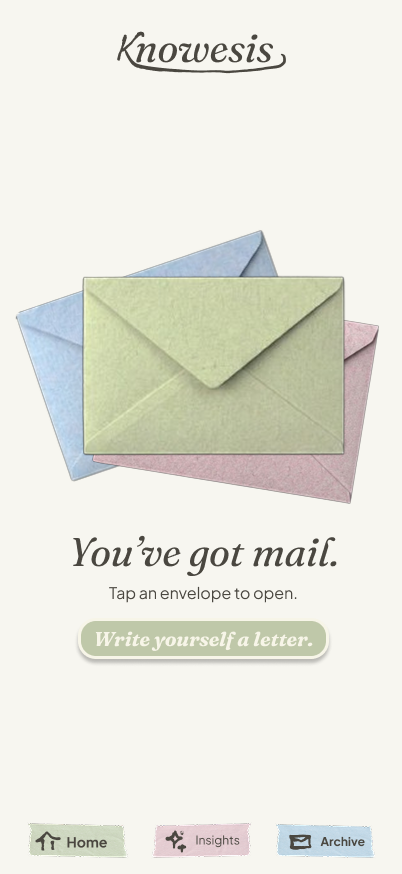
Knowesis: Letter
-
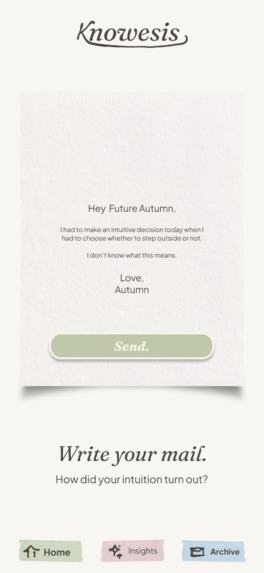
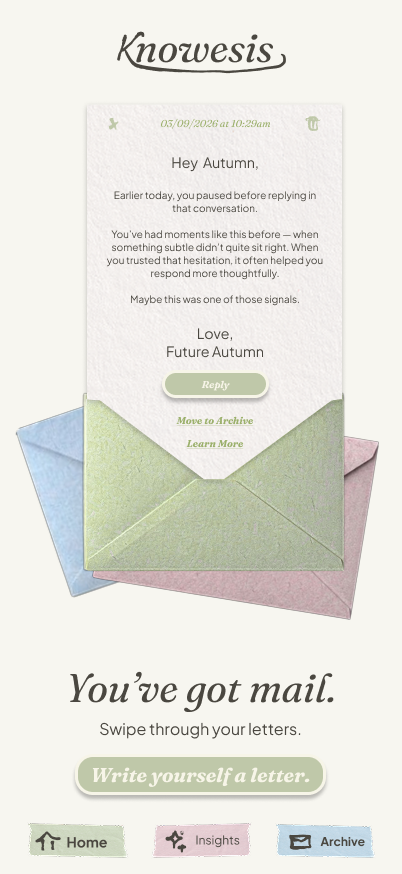
Knowesis: Write a letter
-
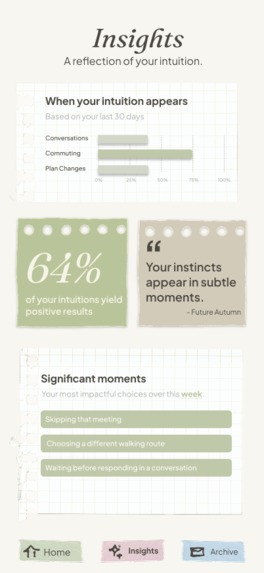
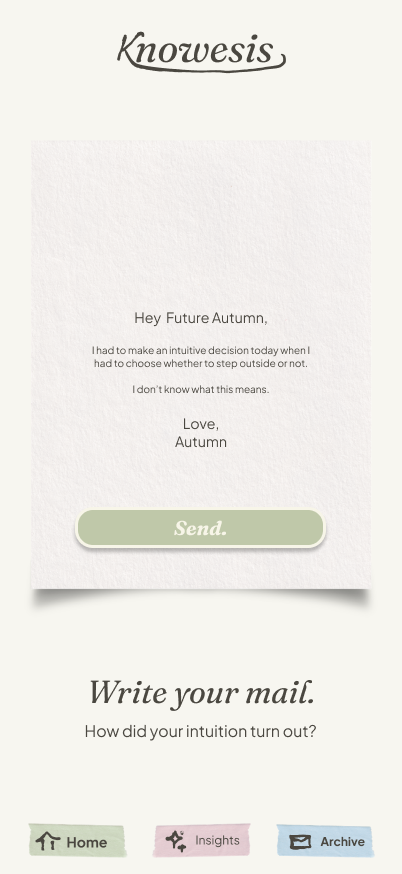
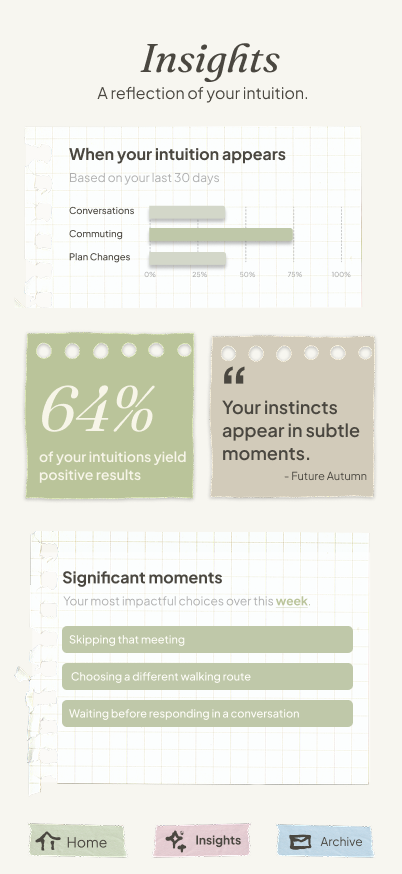
Knowesis: Insights
Inspiration
We started with a question most people have asked themselves at some point: "Was that feeling trying to tell me something?" We kept coming back to the gap between how much we track externally — sleep, steps, heart rate — and how little we track internally, specifically the quiet signals that shape our biggest decisions. The feeling before you take the wrong job. The hesitation before you say yes to something that doesn't feel right. These moments pass unrecorded, and we lose access to them the second they're gone. The inspiration was equal parts personal and research-driven. We discovered that intuition isn't mystical it's a measurable, body-based signal with real neuroscience behind it. Mossbridge et al. (2012) proved the body physically anticipates stimuli before conscious awareness. Kuo et al. (2009) identified distinct brain circuits for intuitive vs. deliberate decision-making. UT Austin's 2025 brain decoder showed neural signals can be translated into language from a person's own brain patterns in under an hour. The science was already there. Nobody had designed the experience around it. Knowesis started as an answer to that gap.
What it does
Knowesis is a speculative wellness app that detects intuitive moments through wearable sensors, ones that we anticipate will be made in the near future. This includes EEG headphones, smartwatches, phone biometrics — and sends them back to the user as AI-generated letters from their future self. When the app detects a physiological signal consistent with an intuitive moment (elevated heart rate variability, specific neural patterns), it silently gathers environmental context — time, location, calendar — and drafts a reflective letter. The letter doesn't give advice. It holds up a mirror, reminding the user what their body was processing before their mind caught up. Users can reply to letters, building a two-way correspondence with themselves over time. The Archive stores every exchange, grouped by date and context. The Insights screen surfaces patterns — when intuition tends to appear, what contexts trigger it, and how often the user followed or ignored it. A monthly Wrapped gives a high-level summary of intuitive trends. The goal is not to make decisions for the user. It's to give their gut a voice, and over time, help them learn to trust it
How we built it
Knowesis was designed entirely in Figma as a speculative design prototype for the Figma Build-a-thon. We began with the research foundation — grounding every design decision in the neuroscience of intuition before touching a single frame. From there we mapped the full user journey across 14 screens: onboarding, inbox, letter view, compose, send confirmation, insights, and archive. The visual identity was built around the metaphor of a personal postal system — cream backgrounds, envelope motifs, handwriting-style typography, and a soft palette of sage, dusty pink, and sky blue. The aesthetic was deliberately analog and intimate, contrasting with the speculative technology underneath it. We used Figma's component system to build reusable envelope cards, phone mockups, and interactive states. Animations were prototyped for the envelope unfold, card swipe stack, and send confirmation seal. The onboarding flow, bottom navigation, and letter interaction states were all built as connected prototype flows. The speculative technology layer — wearable detection, neural decoding, AI letter generation — was designed as near-future infrastructure grounded in real, existing research rather than pure fiction.
Challenges we ran into
Designing for a sense that has no visual form. Intuition is invisible and internal. Every design decision had to translate something felt into something seen — without making it feel clinical, cold, or reductive. The envelope metaphor solved a lot of this, but getting the tone right across the letter copy took many iterations. Balancing speculative and grounded. We needed the concept to feel believable without overpromising. Too far into science fiction and it loses credibility. Too conservative and it loses the imagination that makes speculative design interesting. The line we landed on was: real science, near-future hardware, present-day experience design. Distinguishing intuition from impulse in the UX. This is a core conceptual challenge that also had to live in the design. How does the app communicate that it detected an intuitive signal — not anxiety, not excitement, not stress? The letter format was our answer: it doesn't label the signal, it reflects it back in language that invites the user to interpret it themselves. Keeping the presentation tight. With this much research, concept depth, and feature scope, the hardest design challenge wasn't the app — it was the story. Distilling everything into a clear, emotionally resonant 4-minute narrative took more iterations than any single screen.
Accomplishments that we're proud of
The research integration. Every core feature — wearable detection, AI letter drafting, the archive, the reflection loop — is directly traceable to a specific peer-reviewed finding. This isn't a concept floating in abstraction. It has a scientific backbone. The letter format itself. It's the most human part of the design, and it's doing a lot of work. It creates intimacy without surveillance, reflection without prescription, and continuity without overwhelming the user. We're proud that it doesn't feel like an AI output — it feels like a conversation with yourself. The impulse vs. intuition framework running throughout the entire user experience. It gives the app a clear point of view. Knowesis isn't just tracking a feeling — it's helping users develop discernment. That's a harder and more meaningful goal than most wellness apps attempt. And the three personas — Maya, Jordan, Priya — each live in a different life stage, face a different kind of decision, and surface a different feature of the app. Together they make the concept feel universally relevant without being generic.
What we learned
Speculative design works best when it's humble about what it doesn't know yet. The strongest version of Knowesis isn't the one that promises everything — it's the one that says "the science is real, the technology is coming, and here's the experience we think people deserve when it arrives." We also learned that the hardest design problem isn't visual. It's tonal. How do you build a tool that touches someone's most private inner life without feeling invasive, patronizing, or addictive? The answer lives in every word of the letter copy, every privacy decision in the safeguards, and the deliberate choice to make the tool's long-term goal its own obsolescence. And perhaps most practically — research makes everything better. Every time we hit a design decision we weren't sure about, going back to the science gave us a clear answer. The wearable detects physiological signals because Mossbridge proved they exist. The letter is personal because UT Austin proved neural patterns are unique. The archive strengthens the intuitive circuit because Kuo proved repeated engagement builds it. The research wasn't decoration. It was the design.
What's next for Knowesis - Intuition Tracker
Near term — design refinement. The onboarding calibration flow needs more depth. Teaching users to distinguish their intuitive signal from anxiety or excitement is a design problem we've only begun to solve. A guided "signal literacy" onboarding experience is the next design challenge. Hardware partnership. Knowesis needs a wearable ecosystem to become real. The next step would be partnering with consumer EEG developers — companies like Neurosity or Muse — to define what signal detection could look like at consumer scale within the next 3 to 5 years. Letter personalization. Currently the AI drafts letters based on detected patterns. The next evolution is handwriting upload and voice tone matching — so the letter doesn't just reflect what you felt, it sounds like you wrote it to yourself. Clinical validation. We want to work with researchers in interoceptive awareness and affective neuroscience to test whether Knowesis-style reflection actually improves intuition-impulse discernment over time. The design hypothesis needs a research partner to test it properly. Community and cohort features. Intuition is personal, but learning to trust it is often social. A future version could allow users to share anonymized patterns — not letters, never letters — to surface collective insight about when and how people tend to override their own signals. The long-term vision: a world where self-trust is a skill people actively develop, not a trait they either have or they don't. Knowesis is the first tool designed specifically to build it.
Built With
- claude
- figma


Log in or sign up for Devpost to join the conversation.